We don’t know for certain who composed The Odyssey, which is generally and perhaps inaccurately ascribed to a single bard, Homer in the 8th century BCE. Most modern experts, including Emily Wilson in her otherwise excellent introduction to her recent translation, routinely comment that one person could not possibly have memorized the entire epic poem. Most assume one person could not have written those two book-length epic poems much less remember them. They suggest that both The Iliad and The Odyssey were composed over a period of time with adjustment and additions by several or many people.
Not necessarily so. The human capacity for memorization is astounding.
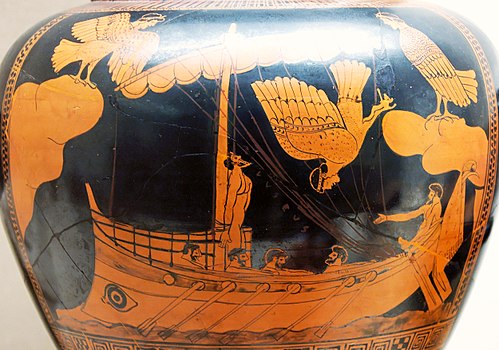
This vase from the British Museum (c. 480–470 BCE) was decorated during Athen’s classic age three centuries after the story of Odysseus was known and eight centuries after at least some of the events described may have occurred in ancient times.
.
There’s no actual evidence of multiple authors creating these epics that I’ve ever heard. However, coming from a primarily oral culture of 700-800BCE, it’s not an unreasonable guess that more than one talent gave us the poems in the form we know them. The events described were already oral history by then, having taken place about 400 years prior. The story contains religious characters, magical events, spirits, the dead, an underworld, and gods that few believe in any more. The entire story of the Trojan War was considered fiction, a “myth” for a couple of millennia—”myth” here used as a pejorative. Myth = someone else’s scripture that “we” don’t believe. It was regarded as pure fantasy. That changed when the site of Troy was identified by Frank Calvert and Heinrich Schliemann in 1871. They followed The Iliad to where the “mythical” Troy was supposed to be and there were the remains of a city in Turkey that had been repeatedly built and destroyed beginning 4,000 years before. It was right where the poem said it would be.
That city of the Trojan War, Troy, known as both Troia (Τροία) and Ilion (Ἴλιον), provides only the beginning of the second and shorter of Homer’s epic poems. The epics would originally have been sung or recited by a professional performer and perhaps with instrumental accompaniment. The predictable rhythms of both the poetry and music would have aided memory. hint: the epics were not written in ten-beat lines.
“The name dactylic is derived from Greek δάκτυλος (dáktulos), “finger”, referring to the basic rhythm of one long and two short syllables (resembling the long and two short bones of a finger). Hexameter comes from Greek ἕξ (héx), “six”, because the line consists of six feet. The first five feet contain either a dactyl (a long and two short syllables, written – ᴗ ᴗ) or a spondee(two long syllables, written – –). The last foot contains either a spondee or a long syllable followed by one short syllable, a trochee (– ᴗ).[1]: 120 [2]: 19 The six feet and their variation is symbolically represented below:
1 | 2 | 3 | 4 | 5 | 6 – ᴗ ᴗ | – ᴗ ᴗ | – ᴗ ᴗ | – ᴗ ᴗ | – ᴗ ᴗ | – x
Emily Wilson translated from the original language line by line, which is difficult since syllable count/word is not consistent between languages. That is, Wilson seems to have created a modernized version of the epic by reducing 12-17-syllable lines in Greek to 10-syllable lines in English. That is what I might call “challenging.”
Nolan’s recent film adaptation cut and altered the story, including, I’m told, the ending. He focuses on Odysseus’s sense of guilt and responsibility for others, which is not particularly characteristic of the man in the poem. Returning home from a war with the loss of every single one of your men and then slaughtering everyone you find at home doesn’t look particularly heroic to me. Perhaps standards were different then? Perhaps not that much. At least people are reading The Odyssey again.
By the time I began teaching high school juniors English in 1990, my 16-17 years old students had not learned poetry as I had beginning in elementary school. They struggled to memorize the Preamble to the Constitution, just 52 words. I required every word, every capital, every punctuation mark perfect in however many tries it took. Even singing along to the jingle from Sesame Street (which leaves out 4 words), most needed multiple tries to get there. They had not exercised that muscle in school, yet could sing along to dozens of popular songs.
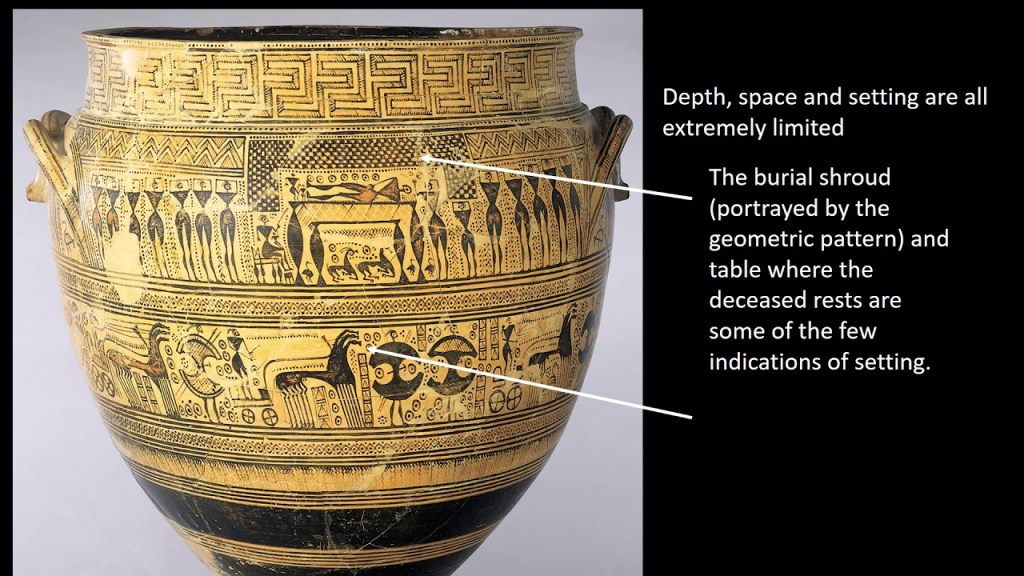
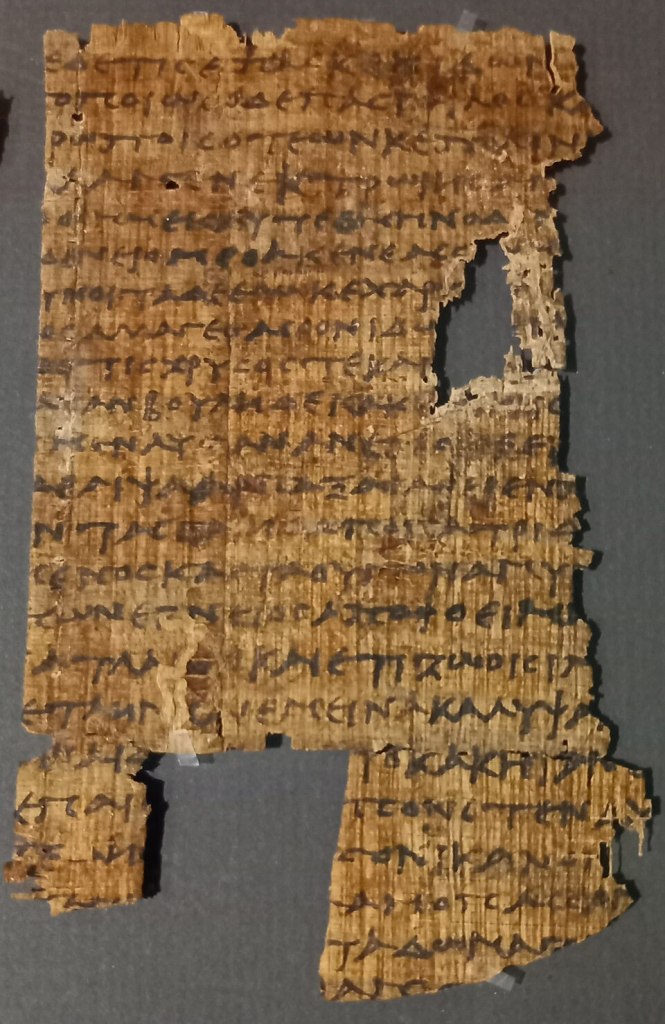
This is the oldest known fragment of The Odyssey, from 100-200 years after it was assumed to have first been performed. This image and others from Wikipedia and elsewhere. Fair use.
.
Of course, key to any discussion of The Odyssey is that whoever composed or performed the poem likely never wrote it at all because he or she could not write. There is a widespread assumption that the ability to write and read is essential and always has been. However, this epic was a performance art, and the fabled author Homer was blind. If he was an invention, consider that he didn’t need to be able to see to create a sung or recited epic poem, and others would listen and learn.
Literate people of today routinely underestimate what a single person can retain in their mind, especially in an oral society where this is no alternative. Reading is essential for most people in modern society; we rely on text for most of what we know. We look things up—even my husband does this on his cell—and alarm bells are ringing that we are becoming so dependent on our devices that we “know” less and less.
The underlying assumption is that people are less intelligent, or even stupid, if they can’t or don’t read. If they couldn’t read in the past, they must not have been very bright. Oh, dear.
Consider: When our son Ian was performing multiple and rotating roles in She Stoops to Conquer, he pretty much had the entire script memorized within weeks. That play has about 20,000 words. By the time the play closed, he was memorizing another. He was also working and a student with other obligations, not a full-time performer. He was particularly good at memorizing scripts and sang with an heart-melting tenor voice. In other circumstances might he have held longer works in his memory?
In Shakespeare’s day, actors would mostly have been illiterate and learned their lines by hearing someone say them aloud. The playwright’s much denigrated grammar school education was a rare privilege, including study of works in English, Latin, and Greek. He could write, but performers in Hamlet, with over 30,000 words and an actor in repertory theater might have learned nearly every word in a play (a minor role and another understudy role + prompts) while also still remembering lines in the play that had just closed, the two being performed at the same time, and the one that opens next week. In an interview at Ashland’s Shakespeare Theater, a repertory actor commented to me on how much more difficult it was to memorize modern plays. There’s a compelling advantage to much of Shakespeare’s plays being written in iambic pentameter, which acts as an aid to memory.
Ask Dame Judi Dench* to quote from most any of Shakespeare’s plays, plays she hasn’t performed in decades!
Wait! you say. The Odyssey has over 160,000 words. That’s the word count of a couple modest-length novels! In verse. With music.
A University of Washington Humanities class, taught entirely by PhD candidates from African nations in a variety of disciplines, revealed that an illiterate Ashanti local Historian of the eighteenth century could recite 20 generations of a family. Do the math on that one. It’s 1,048,576 names. That person’s job was to hold the entire community’s genealogy in memory, and they did. Over a million names back and sideways and forward again.
All this to say: a single person could certainly have composed The Odyssey and people who made their living as performers in ancient times could most certainly have memorized and performed the entire epic, even though that is nearly impossible for us to imagine today.
Imagine it.
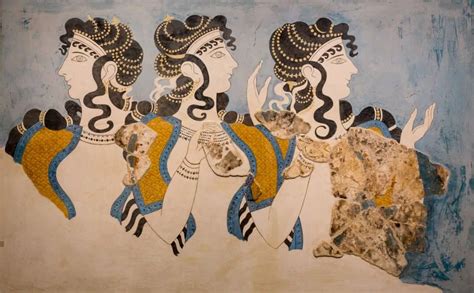
The Minoan fresco, familiar from Wilson’s cover, is much repaired but more or less what existed 3,000-5,000 years ago—long before Homer’s epic. There is evidence that the society was peaceful, trading, and both matriarchal and worshiping of a goddess.
It’s odd that I read [literary] murder mysteries and watch a lot of them too, but a movie starts with war, and I just turn it off. Gary has mostly walked out of the room in response to violent films. I haven’t seen the newest film version. [I had my doubts about it, and learning that Circe’s story was reduced to turning the crew into pigs put me off. Yes, I’d guessed Nolan’s Penelope is marginalized since I’d read a half dozen reviews before I found out who played her. Which seems odd to me.]
Wilson discusses the 19th century proposition that a woman wrote The Odyssey—widely discounted by men reviewers. She suggests that a woman could not have known so much detail about battles and sailing. Being contrary, I immediately considered men bragging through drunken evenings and wondered how any man could possibly know so much detail about women’s occupations in Penelope’s day. It’s there in The Odyssey. Since I went through several translations side-by-side, I was struck by the details on spinning, etc. Other than that quibble and her underestimation of the human capacity for memorization, Wilson’s intro was a game-changer for me. I love it! Time-consuming tasks that were purely within the domain of women are something Barker fails to provide in her novel The Silence of the Girls which is ostensibly about the women of The Iliad, but isn’t—a pity because I loved her WWI trilogy. Nicola Griffith, on the other hand has 7th century Saint Hilda continually spinning with a drop spindle, which is spot on. That’s in Hild,(2013), a novel I did love.
Translation has long been an interest. I read a wonderful essay about the difference between “modernized” translations and those that maintain the culture and time of the original even when that requires more work from the reader to fully understand. I realized I prefer the latter.
As one example of that struggle to maintain authenticity in translation, I never knew the Bible included what I would call jokes until I read the first page of Robert Alter’s translation of the first book of Genesis: The Hebrew Bible: A Translation with Commentary, 2018. The footnotes on that first page are longer than the text. Some might not care; I was delighted. Puns, Alter explains, are impossible to translate and then he explains how they work in the original Hebrew and that he will not try to make them work in English, but include an easier literary device, alliteration, to indicate wordplay. Can we agree that whether we laugh or groan, a pun is a humorous literary device? Right there with the birth of the universe, a stab at literary humor.
- Gary insisted I add “Dame.”
 IMPERFECT PATIENCE
Fascinating!
LikeLike
homer ‘s partner Jethro was partially responsible for constructing some of the odd-dishee, but left before the final crescendo to open a dance studio and dry cleaning business just out off town in a place called malice, so well never know what kind of impact the oddessey could have had on the world as we think we know it–the original oddessey was a travel book designed to inspire a local Sandle cobbler into creating a whole new line of foot ware not only for men but women as well–it could have been a popup book but because homer was blind as well as deaf, there was no need for an audio version until much later–the whole thing is pretty much greek to me, but I do find some comfort in old sons of Hercules reruns–toga anyone?
LikeLike