[from main page, CLICK TITLE above TO READ THE ENTIRE POST]
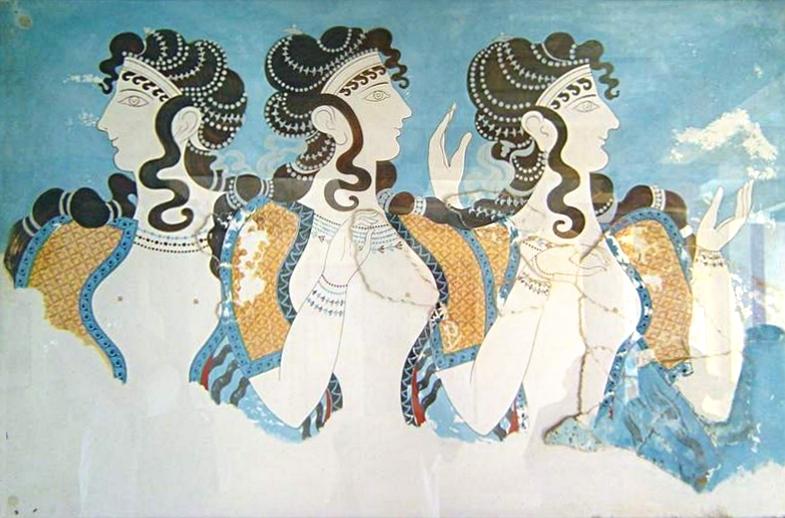
This is the “Minoan Queens,” one of my favorite frescoes from Knossos on the island of Crete, a mural from a civilization flourishing between the 27th and the 15th centuries B.C.E. The image appears, quite inappropriately, on the cover of the Wilson translation of The Odyssey. It is beautiful but in no way reflects the time or the culture of Homer’s Greece. Most scholars believe the epic works attributed to Homer were created late in the 8th century B.C.E., several centuries after the fall of the Minoan Empire, which was, in fact, not quite Greek. (Wilson makes a case for The Odyssey a few centuries earlier, but it’s still a clear miss.) The peaceful seafaring and trading society was long gone by Homer’s day. Some guess that this wide-reaching Mediterranean society was egalitarian in terms of gender. They worshipped a goddess. They kept no weapons of war. Very different from Homer.
The canon is the essential literature that we assume everyone ought to read. In the twentieth century the Western Canon came under attack for being too determinedly dead, white, and male. Mostly dead. It has broadened somewhat since the days I was in school and read dozens of stories and novels by white men. There was not one novel or story written by a woman or person of color. I read The Diary of Anne Frank, but even Shirley Jackson’s story, “The Lottery,” was not in the curriculum of my school.
I found A Raisin in the Sun as a teen and was blown away by this story of racial injustice and poverty. I determined to provide a broader view of the world to my own students and for twenty-five years I assigned texts by men and women of color, from Africa and the rez, and yes, from white men.
I was also writing my own stories and was assured again and again that if I continued to do good work, it would find recognition. Maybe so, but I have not found that to be true for other writers, and I question whether the canon is or has ever been representative of the best.
A great many dreadful books remain in print, and Zora Neale Hurston was out of print for decades. She did, of course, find her way back into print, but almost accidentally. The resurgence of appreciation of her work was the result, partially at least, of a single fan who found a copy of one of her books in a library, went searching, and wrote up her discovery for a new magazine called Ms. The fan was Alice Walker, author of the Pulitzer-winning The Color Purple, which is also a block-buster film. Walker championed the out of print novel of Hurston, and now that novel is widely read. I taught it for years.
It would be optimistic to assume that every novel as fine at Their Eyes Were Watching God would gain publication and remain in print, but I suspect in this case this is not the result of some magical efficiency in our system of evaluating and choosing great works.
What we most treasure is what we are told is good, what we are forced to read, and what others helps us to appreciate. That does not diminish the book we’ve never heard of, the one aging and unread in the school library, or the book we do not have the background to immediately understand. What we love in books can never exceed our experience, and our experience is limited.
Somewhere in someone’s attic is a novel written out in longhand, typed, or word processed—just the one copy—that you and I will never know but which might have changed our lives.
I was reminded of this truth recently as I began reading through a third complete translation of The Odyssey, the prize-winner by Robert Fagles (1996). I have already read one version that makes no pretense at replicating the poetry of the original, but places line numbers in the margin so that I know where I am in the original (Rieu, 1991). The other translation did its best to manage the original line-for-line in iambic pentameter, so that it offers precisely the number of lines as found in Homer’s Greek (Wilson, 2017). Fagles offers line breaks and stanzas in the appearance of poetry, and he numbers his lines, but his line numbering is of his own lines, not Homer’s.
Unfortunately, I am not interested in Fagles’ line numbers; I want to compare his translation directly to the other two. In some of the twenty-four “Books”, his line 190 is a line or two off of the original shown in the other two translations, other times it is off by a dozen or more. I must scan for Homers 7:107 to find the weavers’ oily cloth on line 123. I am still not certain if the oil used is from olives or some less precious source. One translation offers olive oil, but Walker, gaming determined to keep 10-syllable lines (which she often fails to achieve) and the other poetic version, do not offer a type of oil:
…their hands fluttering like the leaves of a tall poplar, while soft olive-oil drips from the close-woven fabrics they have finished. [7:106-7 translated by Rieu as prose]
with fingers quick as rustling poplar leaves,
and oil was dripping from the woven fabric. [7:106-7 translated by Wilson as “iambic pentameter”]
fingers flickering quick as aspen leaves in the wind
and densely woven woolens dropping oil droplets. [7:122-3 translated by Fagles as poetry]
[I think, ironically, the prose is the most musical. Wilson’s poetic translation is awkward and not iambic pentameter. Homer sometimes dropped a syllable in his 12-beat line for emphasis, Wilson adds a syllable, but I cannot say why. The word “fabric spoils the rhythm and might have as easily been translated as “cloth.” And Fagles, oh dear, the alliteration nearly becomes a tongue-twister. Where is the poet-translator when most needed?]
Was it olive oil that dropped from the cloth and not some common oil? This matters, because The Odyssey includes many such details of wealth to emphasize the elite position of the principle characters. Class and position are continuously emphasized in details of food and clothing, gifts and weaponry. Odysseus is expected to be treated well as a stranger, but the fictional birthright Odysseus invents is immediately used in support of this treatment. We are not dealing with ordinary people, we are dealing with favorites of the gods.
One introduction dismissed the possibility of a woman composing these epics because a woman would not have been adequately familiar with warfare to tell about it in The Iliad. I wonder how a blind man would have known any of it? How would he have known so many details about housekeeping and weaving and the dyeing and spinning of wool, all of which are covered in great detail in The Odyssey. Never mind, I will accept that it is unlikely that a woman of this period could have composed these epics. I have other quarrels.
Each introduction I have read, has focused on the challenge of understanding Penelope’s purposes and feelings. On the basis of only two translations and several introduction, no Greek, and my own experience and research, do not find Penelope’s actions the least bit opaque. She was commanded by her husband when he went to war: raise my son to manhood and remarry. She has stalled the suitors until Telemachus is grown and then, much as she would prefer not to, she will marry. How is this inscrutable? No action by Penelope contradicts these goals. When another characters swears faith but privately conceals deceit, Homer’s words reveal the lie. Penelope follows the promise to her husband. She will do whatever she must to safely raise her husband’s son and then she will remarry. She is not happy about remarriage and she misses her husband, cries over his absence. These are an absolute constants. Homer is not cagey about the secret feelings of anyone, not even Penelope.
Today, we might find such loyalty rather bizarre, but Penelope is not mistress of her own fate, she is a loyal member of her husband’s household. She does her level best to abide by his wishes.
This is a story of blind obedience, of absolute rank and privilege. We might want to believe Greece is the birthplace of democracy, but it was a brutally stratified society in the days The Odyssey was told, and a few centuries in the golden age of Athens, it was little improved. Only land-owning men had rights, and there was punishment for overstepping position or dressing beyond what was defined by law. Slaves had no rights. Servants were beaten. Failing to follow instructions lead invariably to death.
The Odyssey is not a nice story.
There are other details of form that are addressed in introductions, but rarely translated—the names of main characters, for example, are routinely prefaced with an epigram that denotes their essential character. Certain passages such as the oft-translated “rosy fingered dawn” are repeated each time in the original Greek, but most translators insist on varying the language, and lose the original oral patterns in the process.
When a translator abandons or adds detail in order to create a palatable text in another language, ignore characteristic repetition, or utilizes contemporary idiom, are we reading Homer or some other version, like a “based on” Hollywood movie?
Never mind. The Odyssey concerns a culture mostly dead—and it would be unreasonable to expect every student to learn Greek in order to read the epic in the original. People did, though, as late as a hundred years ago. The story is not completely beyond our understanding. You might recognize the bombastic egotism of Odysseus—and then you might wonder why anyone considers this braggart a hero. The motivations and values of its characters are worthy of study for how they are different from the motives and values of most of us.
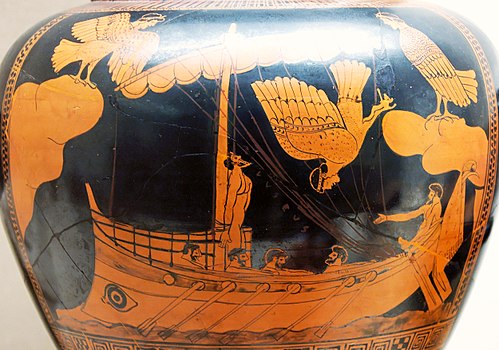
This rather far-fetched and nasty story rarely taught in public schools, and then usually only in excerpt. The Cyclops story Odysseus tells in Book 9 is a favorite and most familiar. And there are other monsters and magicians and dangerous sea voyages and butchery that go on for twenty years. Odysseus’ journey is appropriately nasty, brutish, and long. Only Odysseus survives, and he survives, according to his own account, by superior wits and the aid of the gray-eyed goddess Athena.
I am not done with The Odyssey. It is a different world and it carries the reader to a different place. There is still the rest of Fagles for me to read and then Chapman’s Homer (1616), which ignores any attempt to follow or mark Homer’s lines. But it is beautiful.
But all had motion apt, as Aspen leaves.
And from the weeds they wove, so fast they laid,
And so thicke thrust together thred by thred,
That th’oile (of which the wall had drunk his fill)
Did with his moisture in light dewes distill. [7:141-45 translated by Chapman as poetry]
Translation, as I have said before, is a bitch.
But despite my devotion to understanding Homer, without learning the necessary Greek, I cannot help wondering what other great works I am missing. What has the canon left out?
Might there have been equally adventurous and more egalitarian tales of Homer’s age? Perhaps. No high school teacher I know has ever assigned The Monkey, for example. I have read only bits and pieces myself. In translation, neither is a favorite, but each is has been enormously influential. I found Sappho n my own and read her work when I was 15. I found many authors who were not in the canon.
What texts did we miss? What else was written that might more closely reflect our values?
It is widely assumed the The Odyssey is a vital and necessary and supreme piece of our literary canon. And so it is true. But how do we know what else might have held its place? As one example, in it’s day Romola by George Eliot was regarded as her greatest work. I have never met anyone who even pretended to have read it, though many are familiar with Middlemarch. Who decided that Middlemarch was Eliot’s greatest work?
I return to the question about the canon: Do we base greatness on what has been recognized throughout time, what was most treasured in its own day, or from what we have to choose from? And do we accept the texts that reflect our values or merely attempt to squeeze our current values into old stories?
Are we reading the right texts?
If I had another life, I would study Greek and produce a strange, rhythmic story meant to be spoken in all its brutish glory.
SaveSave
SaveSave
SaveSave
SaveSave
SaveSave

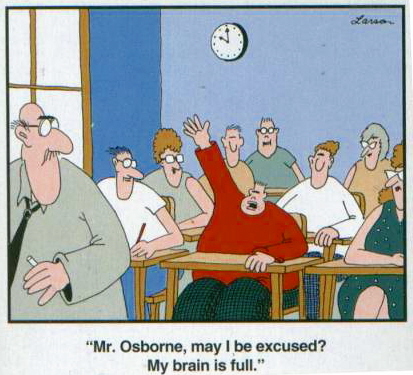 One of the assignments I used to give my juniors was to memorize the Preamble to the Constitution of the United States.
 IMPERFECT PATIENCE