Yeti, our last dog’s favorite treat was a Greenie, a green starchy chewable bone-shaped object she could chew into bits and swallow in a minute of two. Green meanies are something else and they hurt my hand to hold, as I am in this photo. I wish people would pick them up so I didn’t have to.
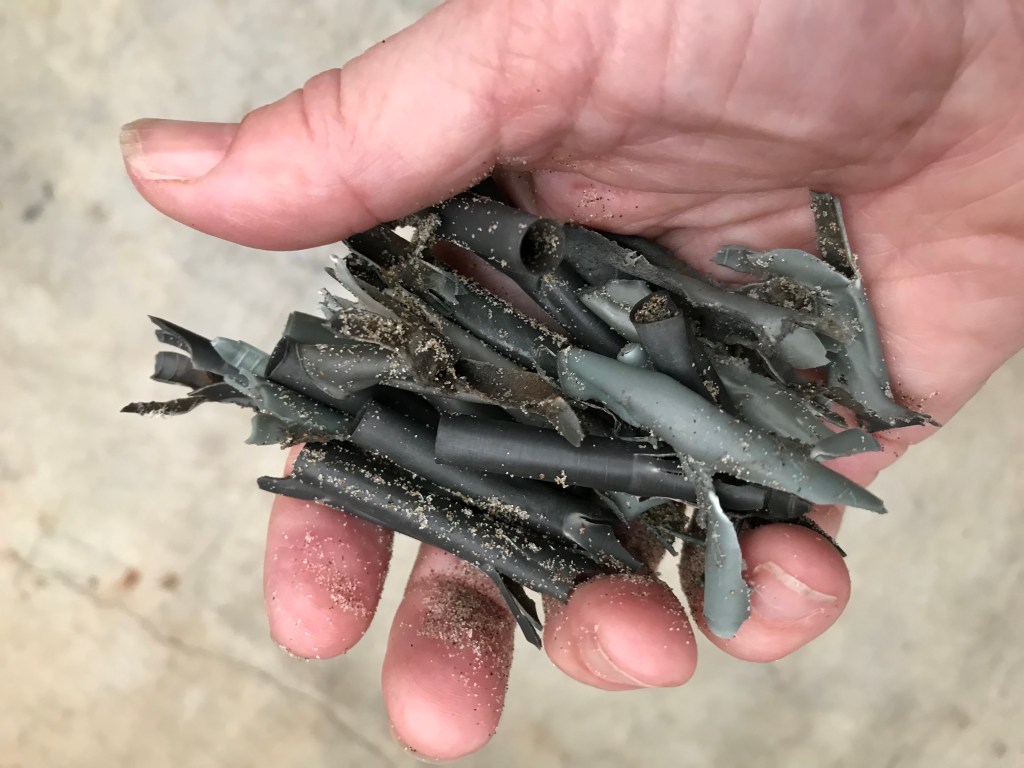
Collecting litter, including potentially dangerous litter from the shore feels like a duty to me. I’ve found two pieces of green sea glass this week, and picking up trash is my payback. It’s not a heroic act or a difficult or dangerous one. Even the lightbulbs and syringes we dispose of have never harmed us. After the 4th of July I dislike picking up the charred insides of illegal explosives, but I wouldn’t do it if I figured the risk was more than tiny.
I got eight hours of sleep last night and I’m feeling reflective. My novel coming out next month has begun appearing on lists, and nearly half the few copies printing now are promised. Yesterday, a science fiction magazine I admire emailed back within an hour to thank me and say they like a review I sent them based on a quick look. Could I wait four weeks for a final response? I laughed and responded, Sure. I loved the novel I’d reviewed and have the next submission already lined up. Can I wait 4 weeks? I waited well over a year to hear back about my novel! I think I won’t be doing that again.
The cover for a collection of short stories is already saved. Eleven stories, and I want two more. Just now I’m not writing fiction. I am not blocked, just busy.
Currently, I’m reading P.D. James last Adam Dalgliesh mystery and not loving it. Yesterday, I looked over a list of “classic” murder mysteries and while I’d read almost all of them, I was disappointed to find only one Dorothy Sayers, and not the one I’d suggest reading first. After my mother died a few days after graduation, friends from my MFA program urged me to start a blog and to post on Goodreads. I did both. My Goodreads stay show 1807 ratings (3.95 average) and 918 reviews.
Since childhood I have I read a lot of books and seen a lot of movies. When I was 17, I began reading science fiction deliberately and specifically to find a world where it was no longer a struggle for people to recognize that women are people. That wasn’t easy in the middle of 1970. I had also been watching films all the way through the credits, hoping to find a woman who wasn’t a make-up artist or a “script girl”. Again, rare.
Today, I am not much interested books or films about fighting, rape scenes, only white characters, only male characters, or women added for the sake of sex and romance. Oddly, I have loved several Korean RomComs.
Because I write them, I am offered books to review every few days. Publishers seem to know I’m looking for women characters, but too often I get as far as a military rank and battles in the introduction, and let it pass. I’m not interested in women doing the same horrible stuff we think men do. I’m interested in men and women finding their way through life with compassion and honor. There are conventions you would recognize if I wrote it out, stories you know will end with a wedding or kissing or the evil person paying for their crime. Or not.
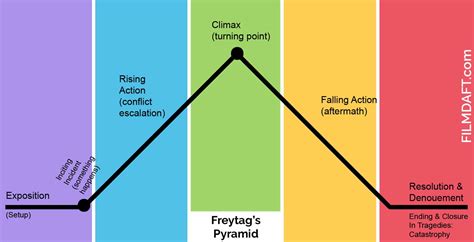
I taught diagrams for everything, including this one for plot. I also asked my students if the story we’d just read fit this diagram. [It never did.]
.
Stories usually begin where and when they were written—that is, unless the American author’s current story tips you off otherwise, it’s usually safe to assume the story is set now and the U.S. A character faces a conflict… which gets worse, until it reaches a crisis that is resolved, and everyone live happily ever after. Or not.
I used to begin my Junior English classes with a fable by an Indian woman that defied expectation and a short story set somewhere and at some other time with characters who are eventually revealed to be not at all what the reader expects. We talked about assumptions. Even so, both those stories followed the pattern of rising action with conflict, crisis, and falling action with closure, though not quite evenly spaced as we might expect from Freytag.
Short stories today usually begin just before of at crisis and sometimes end there. Exposition, establishing setting and situation might be done in a single line, but almost never in the paragraphs typical a hundred years ago. Denouement is rarely given space. There will be an ending, but the closure mostly happens off the page. Some stories begin near the end and back up. There are circular plot diagrams and zigzags, and a host of others. Freytag was describing the five acts of a play. Even plays aren’t written this way anymore,
None of this should be difficult, but just now I feel the particular need for humane literature and drama. It doesn’t seem like too much to ask, but most readers and viewers want drama, adventure, conflict. I was taught that all story centers on conflict. Interior conflict, personal conflict, physical and philosophical conflict, social and political conflict… Conflict drives plot. “Someone wants… but… so…”
I want the beach to be a peaceful and safe place but people blow things up, so I gather up what’s left behind. Not really a plot, is it?
I would like to safely walk barefoot on the beach but people cover beach fires with sand thinking that will smother them, and when I was nine I was scooting though dry sand and my right foot found a buried and invisible fire that should have been put out with water days before. So now I gather litter.
Better, but still no.
Maria was lost in thought as she walked the shore. She hoped to decide whether to quit her waitressing job and go back to school, but she wasn’t paying attention when she shuffled into a buried fire and burned her toe, [so] The very next day she drove into the city, limped from the parking lot to the registrar’s office and wrote a check for fall term. …okay, still not interesting, but you see the desire, the conflict, the action.
That’s not a real story either, not even the beginning of a real story. The real story I’m working on in my head involves a a young woman visiting a porcelain chocolate pot in an antique store. Why? I still don’t know what she’s obsessed or where that will go, but I can see the character, the antique shop, and the cabinet with the Nippon pot. I’m trusting it will go somewhere.

 IMPERFECT PATIENCE
great photo of ravens!
LikeLiked by 1 person
I don’t know if it’s clear there are four ravens—parents and their two youngsters. Gary says the two on the right are the mother grooming her youngster. We watched for a few minutes.
LikeLike
Thank you for cleaning up the beaches!
LikeLiked by 1 person
You’re welcome. Gary says it feels weird not to have a trash bag when we go out. The last year we weighed the litter was 2019 (over a half ton) and we stopped with Covid, but then started collecting trash again but never went back to weighing it for SOLV.
LikeLike
this time the weight
is not what’s in the bag
but that what was once on the beach
rests no more upon our hearts
LikeLiked by 1 person
business is picking up
said the raven to the bishop
as she handed out the spoons
LikeLiked by 1 person
Pingback: Rework, revision, relearn, refresh – kodecy
Thank you, and I loved your post! Someday, someone will explain pingbacks to me.
LikeLiked by 1 person
Oh, thanks! It’s nice to get a wider perspective on things, from outside of classes within institutions, but still within the community.
Thank you in specific, for mentioning that bit about Freytag’s Pyramid and the fact that it doesn’t match very many stories.
I am just beginning to get an idea of different schools of thought within writing. Incidentally, I was just barely able to save a book from donation today which I disagreed with and had set my mind to get rid of (it had highlights and so would have sold for $2 or less, if it wasn’t discarded).
I’ve also started to look into the book it appears to reference, which I’ve found on another required reading list. (I do not intend to take the class, if the book does not pass muster.) I’ve found a red flag in it, already.
At least I looked over a sample before buying it.
The major task seems to be to disattach the subjective (future) hope that the book will help, from the book itself (which is uninvolved with anyone’s hopes).
But so far as things go, I’ve got to say that I am coming to be glad that I went to college when and where I did. Of course, going to University doesn’t always help one’s career prospects; but at least I have some life skills now (where it comes to straightening out my thoughts through writing) that I didn’t have, before.
I majored in Creative Writing in Undergrad, not knowing that it wasn’t a great way to make a living (until after I had declared the major). But I also went to the University I did, because of their Creative Writing program.
It seems that people who come out of these, have a lot to say about them!
LikeLiked by 1 person