Thanksgiving, holiday memories, oystercatchers, Pilgrims, and my Thankful story about a small child. Sea lions, and giving thanks.
Among my earliest memories are holiday visits to my grandparents’ home on the western edge of Portland, Oregon. The house where my mother grew up was a huge Dutch colonial fronted by a quarter (half?) acre of grass and overgrown garden and surrounded by woods. I spent most of my time outside, but the house itself was worth exploring. There was a sunroom and breakfast room as well as a formal dining room, a refrigerator on the back porch, four bedrooms upstairs, and huge closets. The stairs themselves were special, the treads made of ironwood, and back stairs that led from breakfast room to landing. Like my mother as a child, I was afraid of the basement, but closets and the attic… The attic was forbidden, but I recall turning that key and creeping up those dark stairs many times. Stacks of National Geographics and steamer trunks. Eventually I was caught exploring and warned never to do it again. I did it again. The key was removed from the lock.
My uncle Harry Aron (who, along with his brother, a cousin, and his mother were the only members of his family to escape Germany in the 1930s) ate ham at Christmas dinner, joking about it as some other not-forbidden meat. His wife, my aunt Marcie did not get along with her mother because she blamed her for the divorce of her parents. (She and Uncle Harry would later divorce. My father’s parents also had divorced, and my father was divorced by his first wife before he met and married my mother. My brother has been married three times. Mom and I are the only members of our family to marry and not divorce.) I was yelled at one Thanksgiving for putting a raw carrot through the meat grinder. (Was someone making sausage?) My grandmother “Gaga” was forbidden to eat raw vegetables on account of her angina—medical advice precisely the reverse of what we would call “good” today. My step-grandfather “Papa” was always kind to me and brought his wife coffee in bed. Eventually, when she could no longer climb the stairs, he carried her up and down. When that became difficult in his 70s, she had her bed in the living room where the Christmas tree would live for a while nearer the fireplace. Papa would split a bottle of Coke between my brother and me, the old returnable pale green glass bottles that held just 8 ounces. The kitchen cupboards contained foods we never had in our home: marshmallows and jam. Sometimes potato chips.
I climbed trees and ran in the woods, befriended a local girl, and played horses, climbed more trees, watched the man fill squirrel feeders, sometimes pick flowers, and return to the house only when I was hungry. Meals mattered.
Thanksgiving was always turkey, Christmas was ham, rib roast for New Year’s Eve, Easter was leg of lamb. Pies in November and December. Potato salad for the 4th of July. Memorial day in my mother’s childhood was when she moved to the beach for the summer and Labor Day marked the move back to Portland. In my childhood, we did not spend summers at the beach or say grace at meals. Sometimes we listed things we were grateful for at Thanksgiving.
Holidays were not the only time we drove from Seattle to Portland, but they are more memorable than ordinary weekend visits. Driving no more than 50mph, travel required over four hours each way. We would leave on Friday evening and watch for Tacoma’s massive display of multi-colored lights shaped in a cone at Christmas. The Alaska Way Viaduct passed an old building that once housed a stable and carriage house with a horse’s head in stone or cast concrete in the peak. It was my favorite landmark because I was a horsy girl.
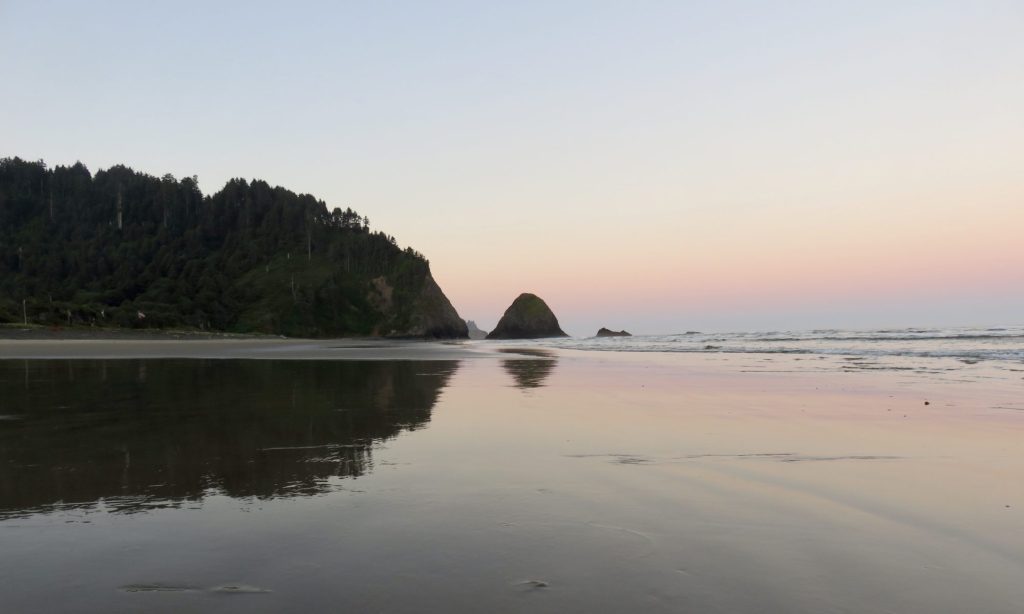
The other day as I was running, I saw what looked like a sea lion a wave back from the shore. No, I thought, it’s a drifted stump like the one buried in sand in front of our house. That’s a chopped off root at the top. Then the root moved and became the head of a sea lion after all. I was still fifty yards off when she went west into the bigger surf. Somewhere, I have photos of sea lions swimming inside waves. I watched this mammal and she bobbed her head out of the water to watch me, until each of us had gone our way. I am thankful to have seen her.
Thanksgiving is coming up and many people are concerned about this holiday, its origins and the false narrative associated with it mostly because of the way history is taught in schools. The Pilgrims were not “nice” people. They believed that success in life was a sign of God’s favor and thereby excused unforgivable brutality. (The real life man in Arthur Miller play about witchcraft, had already divorced two wives before the current ones, who suffered numerous miscarriages, and before Miller divorced his own wife of 20-plus years.) Few European invaders were respectful of anyone in their path. (I struggle to think of one. All faiths were abusive and the U.S.—not to mention other European governments—was set upon exploitation, butchery, and extermination of other nations.)
In respect of this, should Thanksgiving become a national day of mourning? Certainly there should be such a day. Our nation is built on the bones of hundreds of cultures, on genocide. (It is the heritage of most all European nations, if you think about it. I do think about it.) We have failed to properly address this in our history classes, and recent events suggest we will resist doing so in future. (I was certified to teach Art, Social Studies, and English but never had the opportunity to teach SS, though I always provided historical context for readings.) I would agree that we need a day of compassion and atonement for the cultures born and banished in North American and those still struggling to survive. Forgive me if I hope Thanksgiving is not chosen to be that day.
Giving thanks to God at the end of a long growing season in a harsh climate is part of our history. That would have been the point of a late autumn feast, thanking God it’s over: harvest complete, food stored, outdoor weather too extreme for anything but splitting cordwood, work mostly indoors for the next months until planting time in spring started it all up again. Historical records suggest that prayer and fasting were essential elements of the Thanksgiving celebrations in the seventeenth and eighteenth centuries.
Our Thanksgiving has other work to do.
To most Americans today, Thanksgiving is a secular holiday, not a religious one. Few of us are Pilgrims or even aligned with any of the historical faiths and lifestyle of that period. We do not celebrate having planted or gathered into barns. Winter does not impact our daily activities overmuch. We turn up the heat, work inside, and dress in coat and hat when we go out. At least that last if we do not live in states such as Alabama or Florida, where the seasons are… different? We roast a turkey or other fowl not because we have reached the end of a season’s grueling outdoor labor, but because the holiday provides an excuse to gather and eat too much.
Next week when celebrating (or mourning) Thanksgiving, we might feel thankful, we might say a blessing, or we might list our gratitudes out loud to one another. We might enjoy a four-day weekend and shop the sales, or, if we work in a service job in retail or medical care or utilities, the “holiday” might not even mean time off. We might think ahead to the next holidays, to Hanukah or Christmas or New Year’s or all three and others too. Famously, we eat and complain and quarrel with family at Thanksgiving because family generally forgives our boorish behavior in time to do it all again for the next holiday.
I am in favor of this as a valuable reminder of trust and humility and gratitude.
So before I begin baking cranberry bread and Gary’s pumpkin pie, here is my thank-you story for the most beautiful image I recall from running in Portland:
The little girl, perhaps two years old, sits on her small tricycle beside a young woman, who is crossed legged on the bare pavement. There is an eight foot chain link fence before them, and on the other side an old depot is being torn down—concrete buildings and paved parking—to make room for massive underground garage parking and five stories of shopping and housing. The little girl leans forward far over the handlebars of her tricycle, her fingers grip each handlebar, feet on the pedals but not moving because she is focused on the heavy equipment, the noise and activity, men and machines. The woman sits patiently looking to the little girl and then back to the activity. Both will still be there, watching, when I turn and run past again some time later.
Though I do not have a photograph, I can see this scene clearly. I should have stopped and said something that morning. I think that now: thank you to the young woman for making such a sweet image of parent or caregiver and child. When I last passed the site a few days ago, construction continues, has dug out a basement parking garage, poured walls, built with wood too, and risen to the fourth story. Every time I run past I think of the two of them watching. The adult explaining what is being done and why; the little girl absorbed by… everything.
Thank you.
I promised oystercatchers and then forgot. Yes, the breeding pair just north is around. (Perhaps siblings? I do not know that black oystercatchers retain their mates, though that is my impression.) An eagle failed to get an injured seabird the other day. We have not had rabbits in our yard all year. There used to be rarely-seen wild rabbits, then a local family released hutch rabbits that interbred with them and we saw spotted rabbits often for a while (mostly dead), and then the wild-domestic crosses back to wild survived with a few white hairs on their forehead. These last often came into our front yard to nibble the montbrecia down to the ground, which was fine with us. But none this year at all. Gary thinks he might have seen another weasel, but no salamanders either.
Ukraine president Volodymyr Zelensky delivered a televised message for people in the United States this day:
“On behalf of all Ukrainians, Happy Veterans Day and thank you for your service.
“For almost 250 years the men and women of the United States armed forces have prevailed against tyranny, often against great odds. Your example inspires Ukrainians today to fight back against Russian tyranny. Special thanks to the many American veterans who have volunteered to fight in Ukraine, and to the American people for the amazing support you have given Ukraine. With your help, we have stunned the world and are pushing Russian forces back. Victory will be ours. God bless America and Slava Ukraini.”
 IMPERFECT PATIENCE
Is your grandparent’s house still in existence?
LikeLiked by 1 person
My step-grandfather sold it after Gaga died. The property was much subdivided with houses built in the “front yard” and the garage and orchard gone. It might still be there, but I have hesitated to look.
LikeLike
thank you white buffalo robe woman
thank you white roots of peace
thank you all the grandmothers
thank you vi Hilbert
thank you greta thunberg
thank you moon woman
thank you nancy narrowback
thank you Buffy st Marie
thank you sand runner
thank you and never stop
thanking you
LikeLiked by 1 person
Pingback: THE MEAL | IMPERFECT PATIENCE