An imperturbable demeanor comes from perfect patience. Quiet minds cannot be perplexed or frightened, but go on in fortune and misfortune at their own private pace like a clock during a thunderstorm.—Robert Louis Stevenson
Civilizations rise and fall. A goal of the current administration is to eliminate support for most individuals, particularly those who require food and other support, to lean in to the rich, and deny rights to anyone unable to pay for them. The rationale seems to be that if a person cannot be rich, they don’t deserve assistance.
Yesterday, well before dawn because Gary has trained me to rise early, we stood at the front window and admired the moon. It was blood-red. My camera could not capture that light so my photo only shows a bit of the red reflected path and turned the moon pale gold. What we saw in life was far more glorious. That’s usually true.Continue reading →
Since childhood I have read editorials and op-ed pieces on both sides of the political spectrum. Like conservative David Brooks of The New York Times once did, I also read William F. Buckley. As a result, I read newspaper pieces that make me a little crazy sometimes.
This morning David Brooks posted “How Trump Will Fail”. I’m glad to read his admission that Trump’s “ego, which interestingly makes up 87 percent of his neural tissue; we burrow beneath the nucleus accumbens, the region of the brain responsible for cheating at golf; and then, deep down at the core of the limbic system, we find something strange — my 11th grade history textbook.”
Denali, the highest mountain peak in north America at 20,310 feet (6,190 m). It was named Denali for centuries before a gold prospector named it after a politician in 1896. Alaska fought for decades to return the U.S. name back to what it had been (and remained in Alaska). Image in the Public Domain from Wikipedia: “The Koyukon Athabaskans who inhabit the area around the mountain have for centuries referred to the peak as Dinale or Denali. The name is based on a Koyukon word for ‘high’ or ‘tall’. During the Russian ownership of Alaska, the common name for the mountain was Bolshaya Gora (Russian: Большая Гора; bolshaya ‘big’; gora ‘mountain’), which is the Russian translation of Denali. It was briefly called Densmore’s Mountain in the late 1880s and early 1890s after Frank Densmore, [another] gold prospector who was the first non-native Alaskan to reach the base of the mountain.
I laughed. Well, of course I did! But then all too soon, Brooks couldn’t help but unwittingly slip into fiction. I appreciate cowboy mythology as much as the next person, but let’s not mistake it for history.
I’m glad Brooks once had a Junior year history text*, but he might want to have another read. He makes this claim: “It was a time when the national character was being forged not among the establishment circles in Boston, Philadelphia and Virginia but out on the frontier, by the wild ones, the uncouth ones.”
David Brooks, as is typical, almost gets the point: “Poverty has been the norm through most of human history,” he wrote in The New York Times a few days ago. “
The question is not ‘Why is there poverty?’ but ‘Why is there wealth?’”
Edward Curtis photo of a Kwakwaka’wakw potlatch with dancers and singers. Kwakwaka’wakw people in a wedding ceremony, bride in centre. Photo taken by Edward Curtis, 1914. Film footage of this same event was used in Curtis’ feature film In the Land of the Head Hunters [also called In the Land of War Canoes]. This image is in the public domain. Note: The film itself is infamous for inaccuracies. “Some aspects of the film do have documentary accuracy: the artwork, the ceremonial dances, the clothing, the architecture of the buildings, and the construction of the dugout, or a war canoe reflected Kwakwaka’wakw culture. Other aspects of the film were based on the Kwakwaka’wakw’s orally transmitted traditions or on aspects of other neighboring cultures. The film also accurately portrays Kwakwaka’wakw rituals that were, at the time, prohibited by Canada’s potlatch prohibition, enacted in 1884 and not rescinded until 1951.”Continue reading →
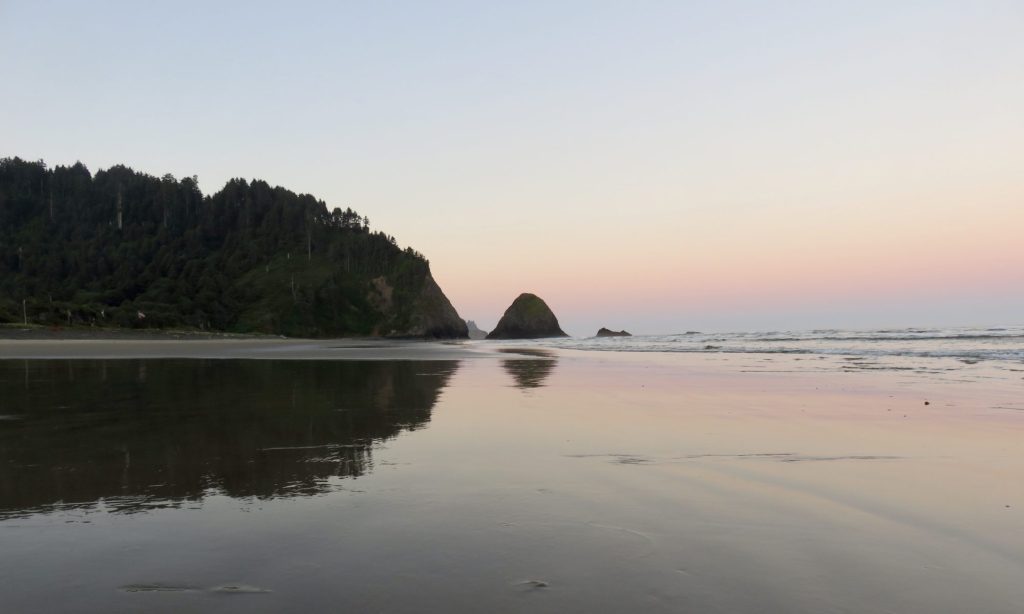
Temperatures rose well over 100° in Portland yesterday (105-107°) but we are at the coast, and I am reminded of why my mother’s childhood was spent at the beach in her great aunts’ home. Portland is hotter in summer and colder in winter, and now the heat is higher. Temperatures here are stabilized by proximity to ocean. During the past forty-four years we have gone entire winters without frost, enjoyed summers with temperatures that never rose over 70° (that has changed). There was no electricity or running water during my mother’s childhood at the shore in the 1920s and 1930s, and the house was surrounded by mature spruce. Now we are surrounded by rental home.
Last night we were fussing about a daytime high in the eighties and the internet being slow.
Times change.
Other weather has changed, but ordinary standards of behavior are changed. Bragging to someone about violation, bragging that we could commit an act of violence without altering voter loyalty, threatening violence—these are the acts of schoolyard bullies writ large. In my mother’s lifetime, such behavior on the part of a public person in America was unthinkable. In my own youth, even accusations of such behavior was enough to force resignation and shame.
Times change.
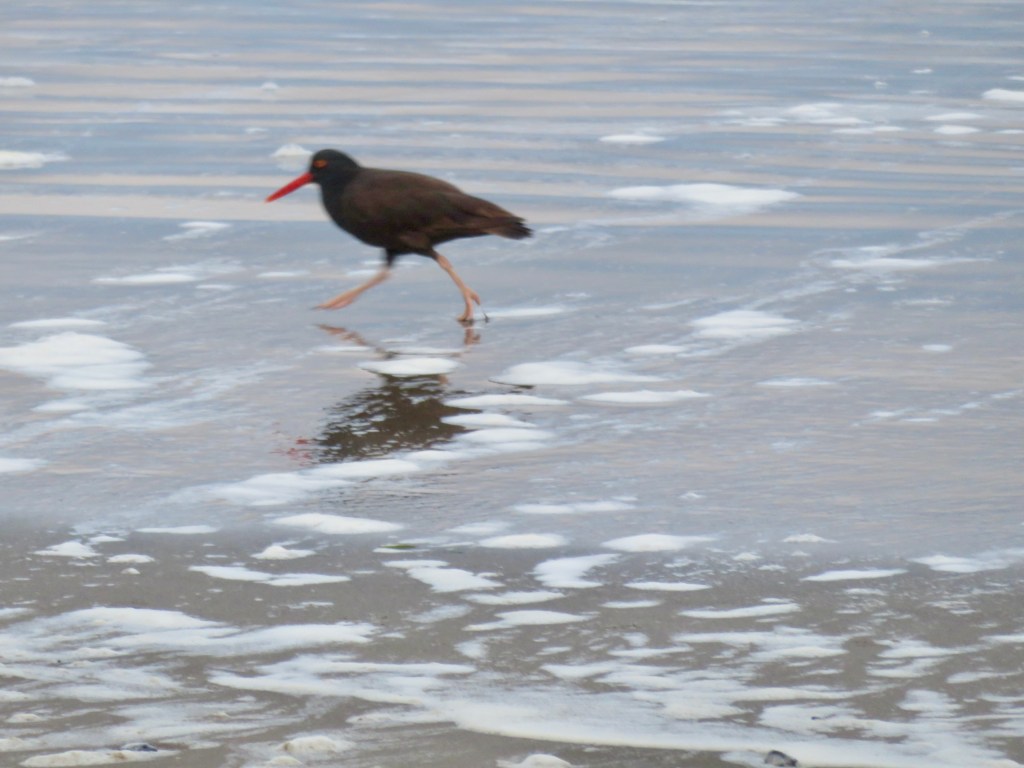
I always feel obligated to offer some beauty. Because it’s here, all the time, if we remember to look. It’s easier to point to the bad stuff, what isn’t working, what makes us angry or bereaved. But the black oystercatchers raised at least one baby this year, and that is a good thing.Continue reading →
Today is the 70th anniversary of the end of the 1950-1953 Korean War, one of the first international conflicts of the Cold War era.
—CNN’s 5 Things
On my walk the other day.
Right there: “Korean War.” It was studiously called a “police action” when I was a girl. No war was declared and we were corrected if we slipped and referred to it as a war.
Gary and I are working on our future. Eventually the upkeep and isolation of the Arch Cape house will be too much. Our sons do not seem attached to the coast—oh, they say they miss it, but they seldom come out to visit. Once a year, or twice. They lead busy lives. That means we’ll be on our own for day to day assistance with what we’ll need if we try to stay there forever. Shopping, repairs… No simple workaround in our unincorporated community and no fewer local political issues. In our 70s and in good health, we manage fine now. We did, after all get the new roof on and Gary spread compost. We drive to Costco once a month. I’d like to think we might become ninety-something-year-olds who manage on their own till death takes us. But as a compulsive planner, I’m not counting on that.
I know, I know, some of us love that movie and some hate it. I’m not going to write about the film. The 20-year anniversary documentary is playing, but either way, you are safe to read on.
Truth, fact, history. Lies, fiction, invention. Racism. Yes, I went down a rabbit hole of investigation and research.




 IMPERFECT PATIENCE