When our firstborn boys were tiny, a friend in a community just fifteen miles or so north of us used to call me every morning to ask if we had fog. I would look west to the roll of clouds lying on the horizon over the water and admit we didn’t. have fog Then, between puffs on her cigarette, she would complain about the fog. She lives in the high desert now where it gets hot in summers and icy and snowy in winter but is sunny nearly every day. If I lived there I would surely complain about the heat and cold, but that’s why I chose a climate I enjoy.

When Portland is due for 100° days, we get fog, and grateful to have it. Even though it will burn off today and the air become hotter than we like, at least our morning is cool.

I like knowing things. I am a reasonable person, which is not to say I am without bias, but I like reasoning things through. When I introduced the persuasive essay in MLA form to my high school juniors, I told them there were two ways to approach the assignment: find something you care about and find evidence to support your views, or find something you are unsure about and discover what is true. The latter is the better course, but students almost never chose to go that route.
But the rarest of all is the student who is quite certain of what is true who find evidence that their opinion is wrong . . . and is able to change their minds. Few people of any age can accomplish that. But it does happen.
The five paragraph essay—that cliché of persuasive writing—was introduced to me when I was twelve years old in Junior High English where we wrote short 2-3 page papers almost weekly. We wrote these papers, always about something we had read in class, longhand on lined paper. In those days researched persuasive essays were part of the curriculum in high school Social Studies classes. I wrote 20- and 30-page papers in high school History classes, as well as position papers of 5 to six pages. We had to type them, and footnotes were a particular challenge since we had to leave space at the bottom of the page and if I forgot a footnote or failed to leave enough room, I had to retype the page. (And sometimes several pages if I didn’t notice my mistake right away.) Today footnotes are the easiest thing on a computer.
By the time I began teaching English and in the small, rural, poor school where I spent most of my career, Social Studies teachers were all coaches. Those men were hired because they could coach. (This is not just my opinion; I was told as much by the District Superintendent.) These men did not teach any sort of writing. Only one required paragraphs. That was how I became a writing teacher when I was not hired to teach Social Studies (because I “could not say [I] could coach”) but to teach English.
I was a high school and college English teacher for most of my life. I taught MLA and APA forms, and creative nonfiction, memoir, fiction, fable, poetry, and persuasive writing. Except in the years I was pursuing my MFA in writing (when I wrote much, much more) I always wrote with my students. Over the years I published creative nonfiction, memoir, fiction, fable, poetry, and persuasive writing that began as classroom assignments for my students.
Early on, a peer told me in was “ridiculous” to think I had to do the assignments my students were given. “We teach lots of things we do not do ourselves.” I disagreed. Twenty or so years later, that teacher was an administrator and during an inservice she insisted that we had to take the tests and complete the essays we assigned to students. Yeah, that.

My morning gatherings include sea glass (ten pieces this morning) and all sorts of stones and shells. This is a “good” agate.
The other morning Paul Butler argued in The Washington Post that an eighteen-year sentence rather than thirty years for George Floyd’s murderer was optimal. In a comment I wrote:
There are many reasons to imprison a person for committing a crime: to provide closure for loved ones, to remove that person from the public so that the crime will not be repeated, to rehabilitate, to punish, to exact retribution, and to deter both that person and especially others from committing the same crime. Deterrence works when the crime is the result of power, ambition, or greed. Murder is more often motivated by passion which does not mesh well with any sort of reason or logic, and Floyd was murdered. On the other hand, unlike the many thousands of women who are killed each year by their romantic partners, Floyd was murdered by a man who committed a crime because he could. He leaned for at least two minutes beyond the point where Floyd’s pulse had stopped. That is, he killed him and then kept killing him after he was already dead. His motivation was power—he killed Floyd to show he could murder with impunity—and thus punishment would act as a deterrent to others.
Yeah, I want the killer gone for a long, long time.
[Police officers are sworn to “protect and serve,” but too often are taught to battle and confront. I am not unaware that there are bad people in the world. There are thieves and extortionists. There are also bullies and people with anger issues, people so afraid in any threatening situation that they lash out at the least provocation. There are people willing to take a life if they might be threatened, even if the threat comes from some whose back is turned and running away. I don’t want those “bad” people policing. I want officers who are inclined to deescalate a situation rather than turning it into a battle they feel they have to win.]
Responding to the article was easy because I had read many student essays about capital crimes and punishment. I had checked my students’ references, reviewed their sources, and done my own reading on this and many other subjects. One student argued that anyone convicted of a serious crime from simple robbery to murder should be tortured to death over a period of several days. When I pointed out that research suggests at least 5% of executions are of innocent people, he responded: “That’s the price you pay for living in America.”
That boy was ambitious and intelligent and I have felt sorry ever since for whomever he worked with in his future. I often disagreed with the thesis of a student essay, but though I insisted that students research opposing views and include them in their papers, it was my job only to help them write well, not to change their minds.
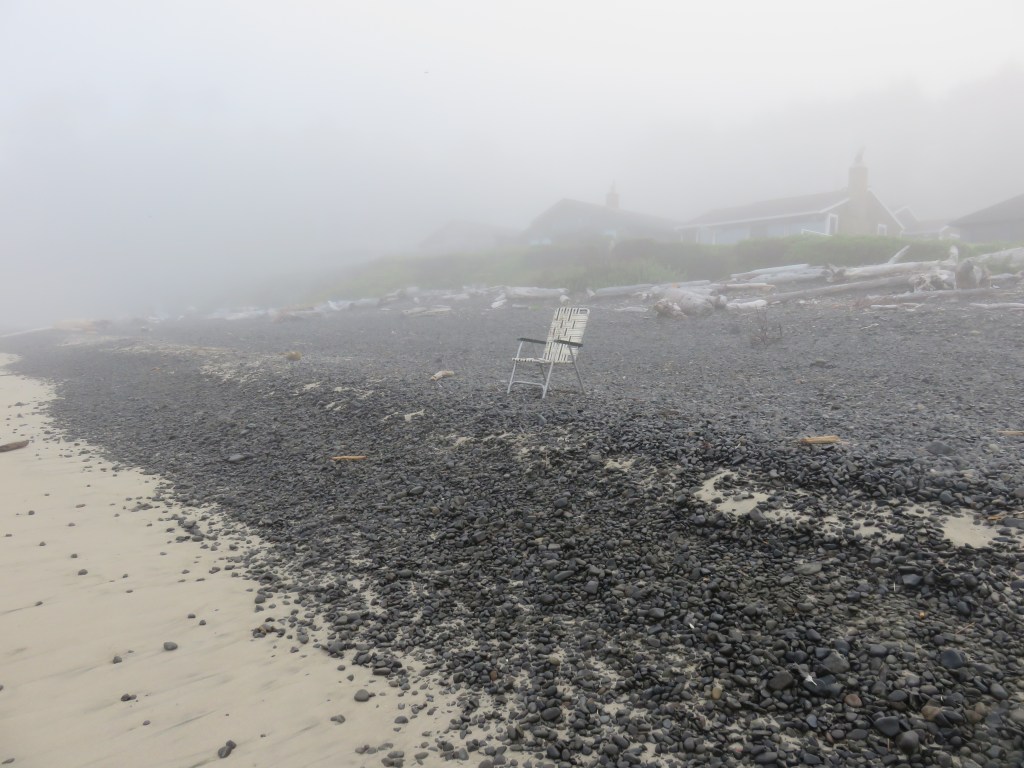
Sometimes you have to see something twice to understand what you are seeing. This is true as we beachcomb. Both Gary and I have gone over ground the other covered and found treasure—treasure to us; mere rocks to others.
Sometimes the treasure life hands us teaches us about others, sometimes about ourselves, and on very rare occasions it changes our minds.
Gary would want me to remind you it’s only six months till Christmas.

 IMPERFECT PATIENCE
Jan, thank you, yet again! And please tell Gary that the goose is getting fat. Love, Bette
>
LikeLiked by 1 person
Thank you, Bette. Good thing about that goose!
LikeLike
who is the old man with a tail or tale on the beach
I came to two chairs on the beach and sat down in neither of them
if there are only 6 months until Christmas then let the shopping begin
Jeremiah was a big fog could not sing to save his mind
it will be hard to find any ice in the next few days to keep your stick on
and in the distance I can see the bus
LikeLiked by 1 person
Or we just missed it.
LikeLike
I find your blog a great historical record of what lives and what is going on at the beach!
LikeLiked by 1 person
Thank you so much, Mary Jo!
LikeLike
We saw the chair up on the rocks on Wednesday. I thought it couldn’t be the same chair that Gary put in the surf. You would know better.
Triple digits tomorrow and Sunday in Seattle! Edmonds is always cooler it high of 99 predicted for Monday! Good week to do some ice dyeing!
George Floyd’s murderer should get life as far as I am concerned!
LikeLiked by 1 person
Yes, Gary originally found the chair after you arrived but weren’t up early enough to join our walk on Tuesday. It had been moved by the next morning. Seems my chronology (“today” etc.) needs correcting because I began this post a couple of days ago.
I cannot ever recall Seattle reaching 100° when we were young, can you? Eighty was crazy high in my memory. I don’t even remember 90° except in Portland.
Without parole. The video should convince anyone. The killer just enjoyed flaunting his power.
LikeLike