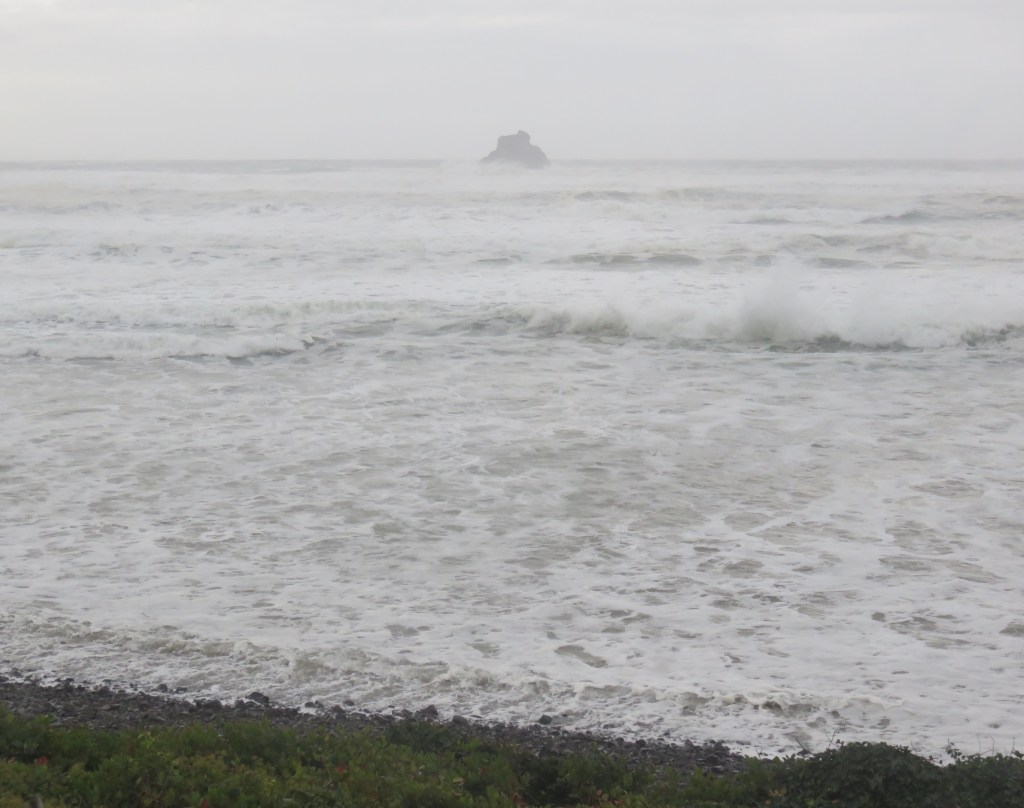
The cloud-occluded sky was dove gray and Oregon chalcedony blue. A fragmented break to open sky over the ocean glimmered platinum that swept a reflection across wet sand. I did not have my camera with me, so perhaps you will take my word. It was beautiful.
November, the middle of autumn, is like this. We are just home from a walk in a dry gale wind. It was easy walking out north, hard work coming back, our heads bowed into the blow. We had missed our morning walk because of the fierce winds and drenching rain. There was no sand at all, though it was only an hour past low tide. When the weather cleared this afternoon we took our chance. It is the great advantage to retirement, I think. We can go out whenever we like.
Yesterday, we were out early to see what the ten foot tide had left us. We have walked the shore daily for so many years, we recognize rocks, the places where sand shows through, where there is a flat stone, where the rocks are rounded and fine like river gravel.
All is changed. The path Gary built in March is entirely swept away, even the heaviest stones set as steps through the hedge were tossed. They have survived a dozen winters. Water flowed right into our neighbor’s yard, a reminder that house is built over a swamp and creek. The ocean remembers and takes back.
In the spring we pull aside basalt stones lining our shore to create a meandering path to the sand, a task requiring gloves and sometimes metal garden tools. This path is a depressed passage two feet wide through the margin between sand and land. It makes our morning walk down onto the beach easier. Walking over the stones is unsteady and bumptious on the bottoms of our feet. It takes hours or a few days to dig away stones. Sometimes the sand is a few inches under the stones. Sometimes we must dig deep and have to carry sand up to fill the resulting trench. The work is satisfying, traditional. Sometimes a high wave in April will sweep the rocks back into place and we must build the path again. Sometimes it happens again and again and we threaten not to bother rebuilding.
By summer, the sand has begun moving inshore from sandbars beyond the breakers. Most oceanfront homes have built paths through the stones to save their feet. The dry sand is untouched by most high tides, and low tide reveals a hundred yards of clean, hard wet sand. For three decades I ran on that smooth sand surface every other morning if the tide was out far enough to permit me. Now we walk our miles regardless. When I was a girl, sand swept all the way into the green by midsummer. That doesn’t happen any more.
Some of the sand is simply gone.
There has been less sand onshore for so many years, local newspapers don’t even mention it. Twenty years ago they offered several explanations. Most involve happenings far away up or down the coast. Barriers intended to protect harbors shifted the seasonal flow of sand, causing it to pile up. There are condominiums built on shore that did not exist so very long ago. A powerful wave in January of 1999 picked up not only sand, but the rocks themselves. Massive sandstones rolled amid the wet-blackened basalt. Strong waves push the basalt high. Some years there has been a ridge of rock five or even ten feet in the rocks up shore from us. We’d like to trust the seasonal shifts to level things out in summer. There is no counting. The tide is not dependable.
In autumn, sand begins to slide back into the sea. Tide and wind swipe the basalt clean, drive sand into the ocean. Waves seem to rise higher. Low tide gives a narrower strip of wet sand than we saw in August.
It is different all the time. Asbury turns hard right and flows a quarter mile south one day, and a week later it spreads straight west. Gulls rest there.
Everything changes, shifts from one tide to another, one month to the next, and year to year. It is a moveable feast. The people who bought the house north of us to use as a commercial rental asked us: “Where has our sand gone?” the first time they visited in the autumn. We could not help laughing.
Yesterday on our walk, a wave swept in across a hundred yards. We had climbed into the rocks. When an outgoing wave flows back into an oncoming wave there can be a great crash—the sound is starling and water sometimes flies straight up into the air. The so-called “sneaker” waves are silent, and it is the sudden quiet that causes us to run. An incoming wave overtakes a wave also moving in, picking up energy and speed from the one below. Then a third wave over the top of that one. There is no predicting, no pattern. It is a random event.
No telling when the sea will swing her skirts.
 IMPERFECT PATIENCE
That was wonderfully evocative, thank you!
LikeLiked by 1 person
Thank you!
LikeLike
Beautiful! I love hearing about the tides and waves over there on the other coast! We had an unusually high tide yesterday here in Maine, with the water coming in over the marsh, turning our path into a stream, leaving huge tidepools.
LikeLiked by 1 person
Thank you, Karen, for sharing your own tide.
LikeLike
The beach we like is Donovan sand and foam mellow yellow and as Hendrix said in this case my yellow is not so mellow his daddy is proud—lately it aint been so mellow—may there be peace in the valley when we get to the promise land. Until then, happy Christmas everyone—kiitos
LikeLiked by 1 person