An imperturbable demeanor comes from perfect patience. Quiet minds cannot be perplexed or frightened, but go on in fortune and misfortune at their own private pace like a clock during a thunderstorm.—Robert Louis Stevenson
June is ridiculously busy, which is not something I can say about most months. Most months my busy is entirely self-inflicted. I read, sew, knit, run, post online. Scrub floors. Gary and I drive to Portland and home from Portland, we walk across the city or walk five miles north on the beach. [We did this recently. Once. Ten miles round trip. Probably not again.]
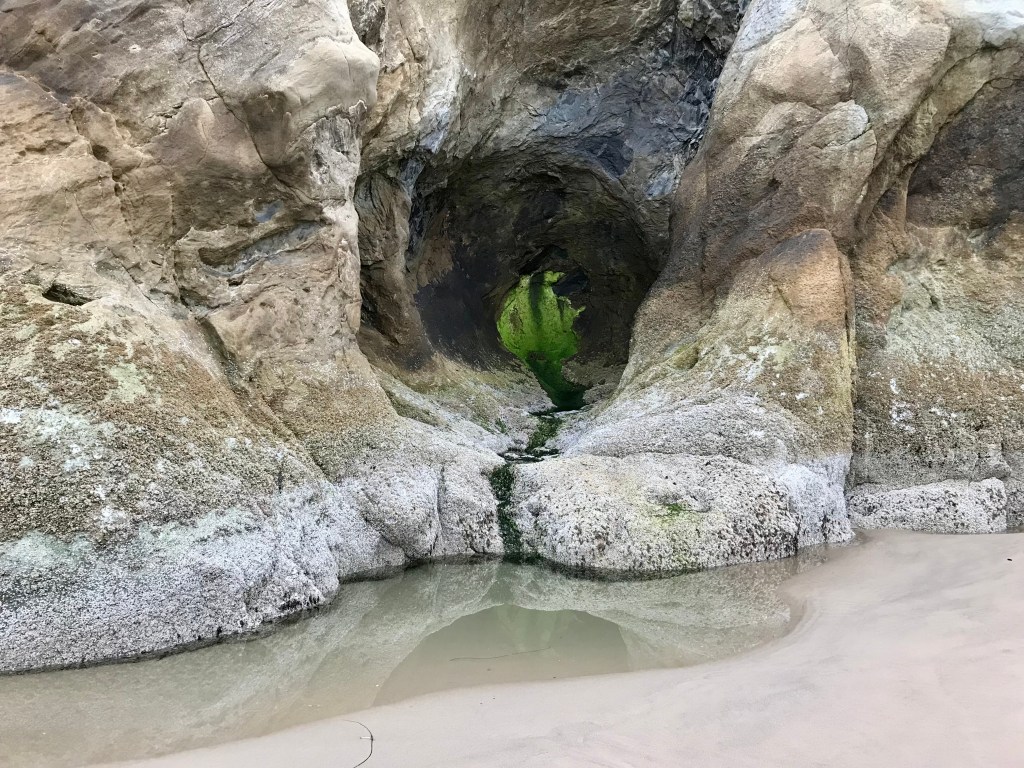
This is the hollow in sandstone facing the ocean that I call “The Little Altar.” Usually by this time of year there is a circle of green algae on the back. This year, there are three green penguins. Can you see them? Two looking south, a youngster flapping and pointed north? (And yes, there is a Big Altar a few feet north. No penguins.)Continue reading →
The cloud-occluded sky was dove gray and Oregon chalcedony blue. A fragmented break to open sky over the ocean glimmered platinum that swept a reflection across wet sand. I did not have my camera with me, so perhaps you will take my word. It was beautiful.
November, the middle of autumn, is like this. We are just home from a walk in a dry gale wind. It was easy walking out north, hard work coming back, our heads bowed into the blow. We had missed our morning walk because of the fierce winds and drenching rain. There was no sand at all, though it was only an hour past low tide. When the weather cleared this afternoon we took our chance. It is the great advantage to retirement, I think. We can go out whenever we like.
Yesterday, we were out early to see what the ten foot tide had left us. We have walked the shore daily for so many years, we recognize rocks, the places where sand shows through, where there is a flat stone, where the rocks are rounded and fine like river gravel.
All is changed. The path Gary built in March is entirely swept away, even the heaviest stones set as steps through the hedge were tossed. They have survived a dozen winters. Water flowed right into our neighbor’s yard, a reminder that house is built over a swamp and creek. The ocean remembers and takes back.
In the spring we pull aside basalt stones lining our shore to create a meandering path to the sand, a task requiring gloves and sometimes metal garden tools. This path is a depressed passage two feet wide through the margin between sand and land. It makes our morning walk down onto the beach easier. Walking over the stones is unsteady and bumptious on the bottoms of our feet. It takes hours or a few days to dig away stones. Sometimes the sand is a few inches under the stones. Sometimes we must dig deep and have to carry sand up to fill the resulting trench. The work is satisfying, traditional. Sometimes a high wave in April will sweep the rocks back into place and we must build the path again. Sometimes it happens again and again and we threaten not to bother rebuilding.
By summer, the sand has begun moving inshore from sandbars beyond the breakers. Most oceanfront homes have built paths through the stones to save their feet. The dry sand is untouched by most high tides, and low tide reveals a hundred yards of clean, hard wet sand. For three decades I ran on that smooth sand surface every other morning if the tide was out far enough to permit me. Now we walk our miles regardless. When I was a girl, sand swept all the way into the green by midsummer. That doesn’t happen any more.
Some of the sand is simply gone.
There has been less sand onshore for so many years, local newspapers don’t even mention it. Twenty years ago they offered several explanations. Most involve happenings far away up or down the coast. Barriers intended to protect harbors shifted the seasonal flow of sand, causing it to pile up. There are condominiums built on shore that did not exist so very long ago. A powerful wave in January of 1999 picked up not only sand, but the rocks themselves. Massive sandstones rolled amid the wet-blackened basalt. Strong waves push the basalt high. Some years there has been a ridge of rock five or even ten feet in the rocks up shore from us. We’d like to trust the seasonal shifts to level things out in summer. There is no counting. The tide is not dependable.
In autumn, sand begins to slide back into the sea. Tide and wind swipe the basalt clean, drive sand into the ocean. Waves seem to rise higher. Low tide gives a narrower strip of wet sand than we saw in August.
It is different all the time. Asbury turns hard right and flows a quarter mile south one day, and a week later it spreads straight west. Gulls rest there.
Everything changes, shifts from one tide to another, one month to the next, and year to year. It is a moveable feast. The people who bought the house north of us to use as a commercial rental asked us: “Where has our sand gone?” the first time they visited in the autumn. We could not help laughing.
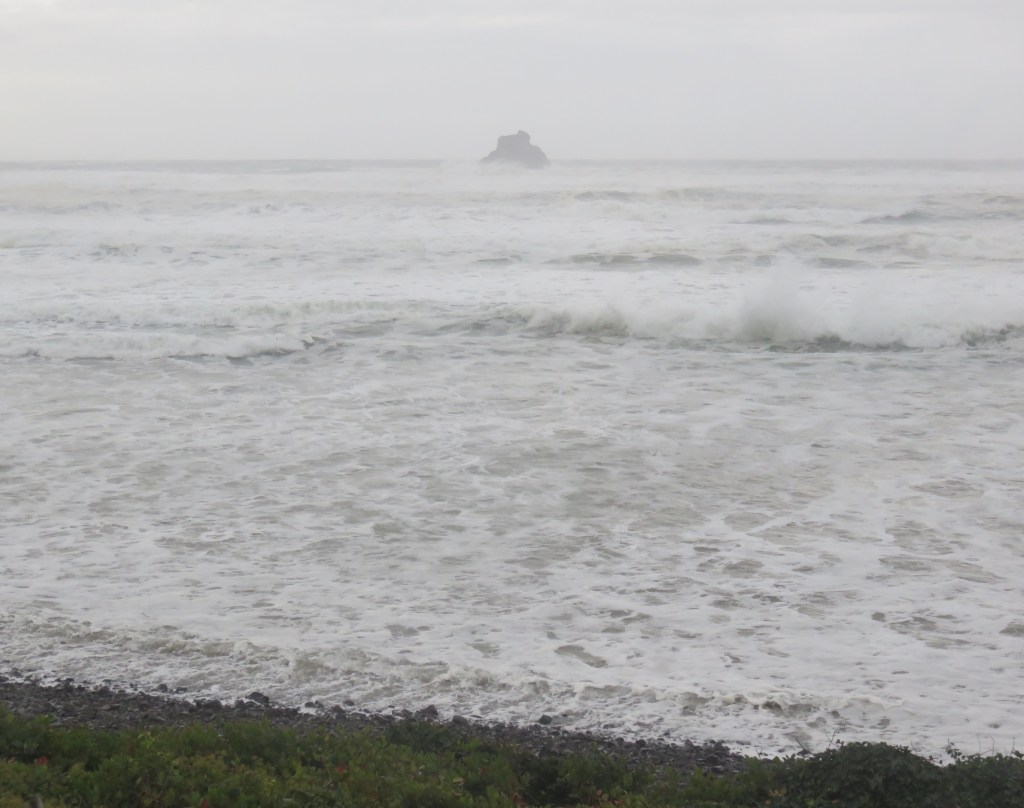
Yesterday on our walk, a wave swept in across a hundred yards. We had climbed into the rocks. When an outgoing wave flows back into an oncoming wave there can be a great crash—the sound is starling and water sometimes flies straight up into the air. The so-called “sneaker” waves are silent, and it is the sudden quiet that causes us to run. An incoming wave overtakes a wave also moving in, picking up energy and speed from the one below. Then a third wave over the top of that one. There is no predicting, no pattern. It is a random event.
We found this shrew on the beach the other day. A sad little creature. We find fish sometimes, but also this tiny rodent which had no business a hundred feet out on the sand.
Every morning as we head out on our walk, I write essays in my head. They are usually the same essay about what treasures we find, about petting Roxxie, and about the trash we pick up. Sometimes write in my head about our nicer neighbors and sometimes I plan bitter exposés concerning the selfish, mean so-and-so who likes to lie to tourists.
Mostly, I do something else when I get home. This month, I go back to work on my computer. I was awake buy 5am and writing for National Novel Writing Month, thirty days of November to write 50,000 words of fiction.
I thought this month that I would write a science fiction novel. I had done the research, I had the characters and some of the action. In April I whizzed right through 15k words during NaNo Camp. I planned to restart this story from scratch. I thought it would be my novel for the year. I had questions I would answer as I wrote. I even had a list of chapters, an outline of plot. I would work on a five-thousand word section at a time. I had it figured out.
Theoretically, I was in good shape at the start, but my confidence almost immediately went to ground. My story about all animals—birds, reptiles, amphibians, and mammals—dying and only a handful of human survivors scattered across the planet did not need the 70k words I’d planned to write in November. I read a news story about loss of insects on isolated tropical islands and my story about seven women alone on a planet with only insects collapsed. Could I kill off the insects too? I abandoned hope oh me who entered here! This was not going to fly. I was unprepared to make the necessary changes. This was obvious by the third or fourth day of NaNo. What I felt prepared to write did not need even the 50k words that NaNo demanded. The story today is 37 pages and 11k words and has ended. True, I have a couple of places still marked “place scene here”, but these will add a couple of thousand words, no more and possibly only a page. There is no novel here. No possibility for a novel. There is not even a novella. My eventual 12 or 14 thousand words will make a novelette, and that’s before I go back to butchering. It’s an 8k story pretending to be something longer. Maybe it’s only a 6k story. Maybe, in the end, it will not be anything at all.
In the mean time, I have dug into my files and found fragments and even stories I thought were complete (they aren’t) to work on. I have a file with 49k already, but the last seven thousand words are a very old story that will have to be torn apart and rewritten from scratch. I pasted it into my NaNo packet because I hope that a single line will get me going. A woman thinks she sees a dead kangaroo in the grass beside the freeway, and her daughter thinks she imagining things. There are 141 words of dialogue and a good title. That’s what I hope will lead to a story of about five thousand words.
It’s like that poor little shrew on the sand. I don’t know how he got there. Or she. She probably thought she was on her way somewhere else. Sure this was not where she planned to end.
I called this post “cat and shrew” because when I was a little girl, my cat Mica was an enthusiastic hunter of shrews. I thought I might tell that story, but instead, as with NaNo, I went somewhere else/
Anyone recognize this bird?
There was this hawk the other day perched in a snag on top of the cliff north of our home. Sometimes there are crows there or one of the ravens. Most often we see an eagle. We have seen a Cooper’s hawk because our tenant means to feed birds, but also feeds chipmunks and rats, which then feed the hawk. The doves too.
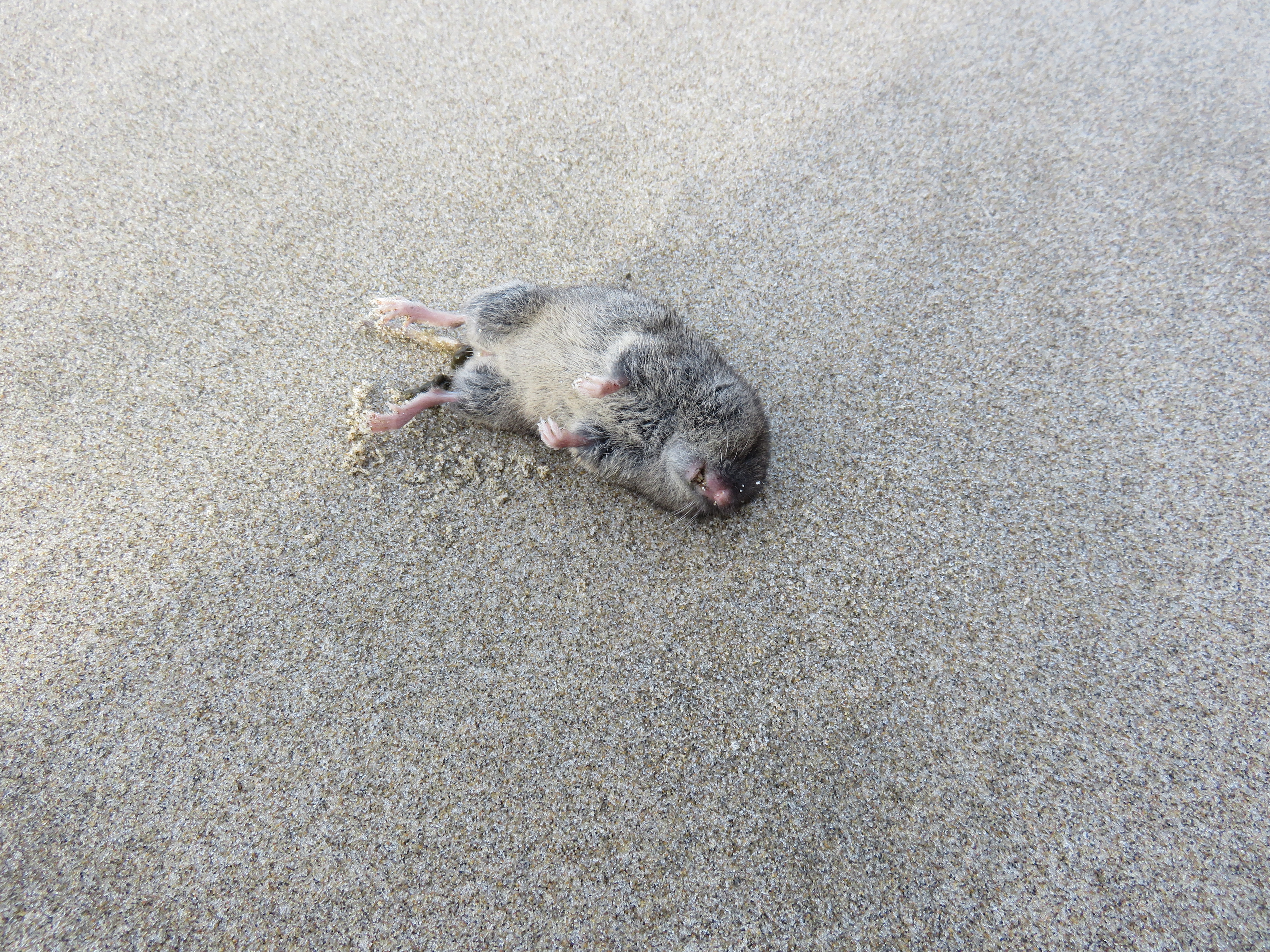 We found this shrew on the beach the other day. A sad little creature. We find fish sometimes, but also this tiny rodent which had no business a hundred feet out on the sand.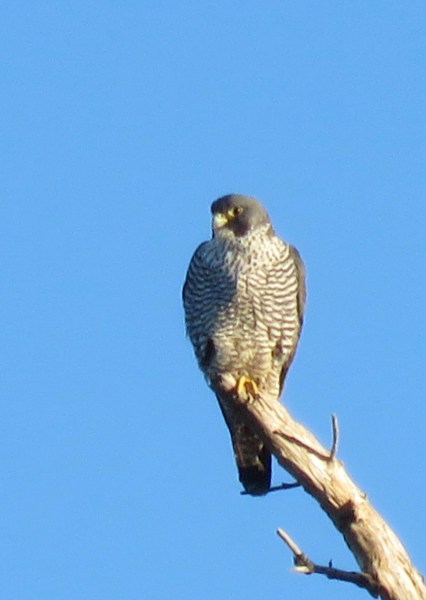
 IMPERFECT PATIENCE