“Butterfly Fontanelle” was the title of a short story I began writing more than three years ago. The fontanelle is the soft spot in the top on a baby’s skull where the bone has not yet quite closed over the brain. A “butterfly fontanelle” is the shape of such a soft spot, like two paired wings. Human babies, like most all mammals, are born before they are mature. A newborn cobra can already bite and kill you. Mammals may be able to stand but most are still becoming. For example, most people know a puppy’s eyes remain closed for a couple of weeks after birth, but her ears are sealed shut too. A puppy cannot learn until she is about three weeks old. Human babies . . . must gain sight and depth perception. Infants are becoming human.
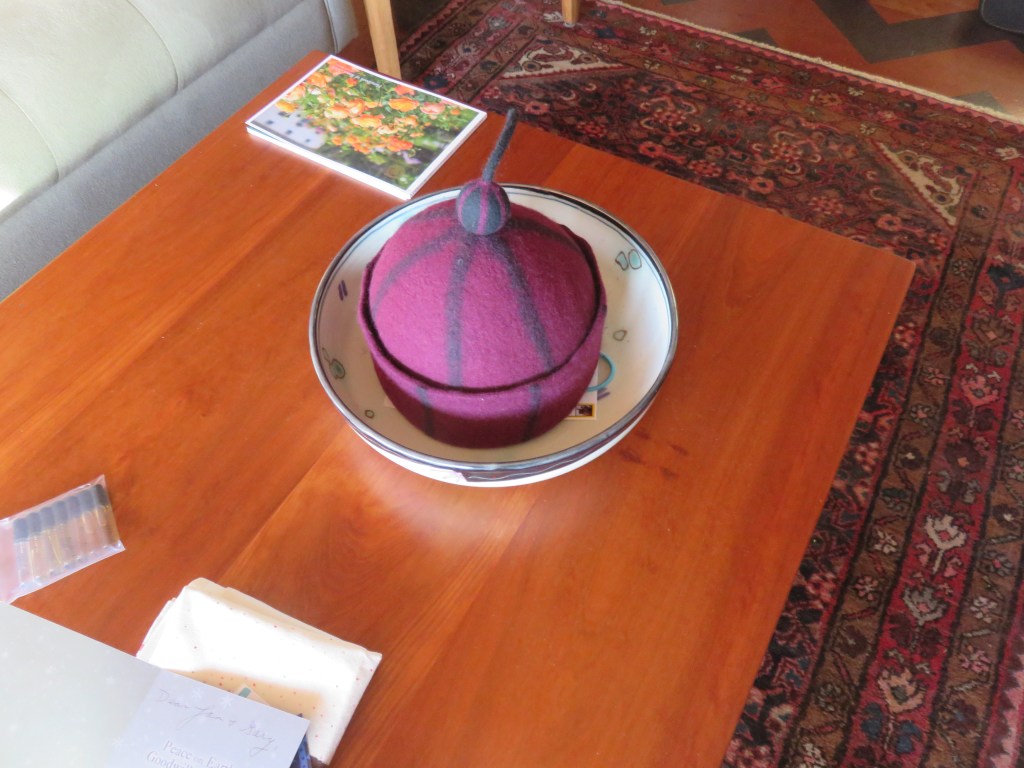
But first, because this has been a hard week, I want to share a publication on the Brevity blog: “Art Saves Lives” I am wearing my felted Acme hat, handmade on the east slope of the Olympic Mountains.
I began my novella with catastrophic death, but the truth is that the story was birthed in hope—it was my attempt to find a way forward, to start over, to find a future, to clarify what was necessary to a definition of humanity, and what could be set aside.
Where in development is inevitability?
I have been trying to write a novella or a novel or maybe a short story about extinction. I have written about twenty thousand words, cut it back, blown it up, shared my progress with another writer. And then I shared the novella “Butterfly Fontanelle.” No one has asked me where it came from, but I want to write about that.
It began with imagining the loss of birds because I always have birds in my stories. This is not deliberate, but a habit noted by my writing partner Rebecca Olson decades ago now. Though she is a former student, I have never filed her emails in my “former students” folder, but always in my “friends” folder. (Yes, I keep everything.) More than twenty years ago—I should look it up, but we’ll say it was about twenty years ago—we began trading writing assignments each Thursday. I would send her a prompt; she would send me one. At some point in the day I would open the prompt, set a timer and write like crazy. We did this for nearly four years. I am sorry we stopped. It was my idea to stop and I am sorry for that.
All those stories written on Thursdays were part of the reason I knew I could complete an MFA in fiction. I had written also three novels by then.
My computer must contain a thousand fictions and essays and poems. Maybe a few thousands. Several novel-length narratives by now. A lot of writing here. Some of it has been published. Some has won awards. Some of the documents are written using software I can no longer open. I have the titles, and that is all. None of it is actually important; all of it important to me.
A couple of years ago I wrote a fantasy story about children dreaming they are owls, owls which then dream themselves back into children. “If It Were True Owls Dream” was not my first speculative fiction, not even the first I published, but it was the first I wrote deliberately. It made me think I might be capable of writing science fiction, a genre I admire but had never attempted. The story “Butterfly Fontanelle” is science fiction.
When I used to teach science fiction to high school students, I explained that in the years of fears of atomic world destruction, SF was most often pre-apocalypse, apocalyptic, or post-apocalypse. The story concerned what led up to humanity blowing itself to smithereens, the actual destruction, or recovery. Other SF stories concern wars or space travel or alien landscapes or species. Not all SF concerns apocalypse, but my story does.
Mass extinction is possible. It is, in fact, happening among most species on our planet. Most. Vertebrates and invertebrates both. Insects.
I thought about what triggered the writing of Silent Spring. So I imagined all the birds gone and researched what impact that would have on ecosystems, the loss of pollination, proliferation of insect prey. There are places where this has actually happened. But once I began world-building without birds in the world, I realized that reptiles would likely go too. There is a distant connection. And if reptiles died, how could amphibians survive—frogs are far more vulnerable and have been in trouble for decades. I was still a young woman the last time I heard that overwhelming chorus of frogs croaking. We both heard one the other day on our walk and were unaccountably thrilled.
And then with several branches of the animal kingdom killed off in my imagination, the mammals had to go too. All the vertebrates gone. I worried for a time that the insects would be gone as well. (They are in trouble just now.) That was a struggle. I already notice how few there are compared to my childhood when a summer drive meant a windshield splattered with bugs. In conversation, Karen Joy Fowler laughed and said I could keep my bugs. I kept spiders too.
There would be plenty of beetle species still living. Spiders, ants, some flies, worms, nematodes. Some wild bees?
One young woman takes to her bed at the start of all this dying. She thinks she has a cold, or the flu, or something much, much worse. Maybe she has something like covid-19, a disease that is highly infectious but doesn’t not provoke immunity, that results in endless complications. Death.
My character lies too weak to do more than sip water from a bottle and is afraid she will lose her job from all the work she is missing. And then she is afraid she will die. And then she just doesn’t care anymore. She only wants to sleep.
When she wakes up, maybe days or a couple of weeks later, she is shaken and weak and dehydrated and what is that god-awful smell?
Then more research: What is she eating, how does she find water, shelter, cooking utensils, clothing? Everything rots and collapses. Fabric and even her hair can be nibbled overnight, her body hair and skin grow thicker. Pests like mosquitoes and lice and intestinal parasites die out for want of adequate human hosts. Her shoes collapse and she walks barefoot and naked most of the time. The world is much warmer, after all. Stores provide bottled water and tinned food. She does not mark a line on the wall for the passing of each day. She does not keep track of time at all.
Years pass.
When she decides local water system is likely toxic, she moves inland to former farmland. She harvests hazelnuts and berries and wild roots. She finds a few recognizable vegetables gone wild and presses their seeds into the soil. She remembers sometimes where she planted them and eats whatever she finds as seasons pass. She walks into the city to raid stores. She wears a silver ring and carries a knife and flint and steel from the REI.
Years pass.
One day she realizes she is pregnant. There hasn’t been another human around, much less a man, much less any sort of sex—when was the last time she even masturbated?—so she could not possibly be pregnant.
She gives birth in an explosion of pain and pleasurable orgasm to a tiny infant. She is certain the tiny thing will die. It hardly seems human. Yet it is human and it does live.
[This was a genuine issue throughout my writing—how human? In what way human? What is necessary to humanity?]
It is the first Daughter. She gives birth each spring for a long time. The Daughters grow and mature quickly, but they are different. Smaller. Darker. More musical.
This happens in three places in the western hemisphere. Gena, the woman whose story I mean to tell, was born in Seattle. She learns about the others from Tula who has been walking all this time from the Carolinas south all the way to South America to find Rosetha in Chile or Peru? There are rumors of four other women in Asia, but how could there be rumors? Who could tell such stories? Rosetha is rebuilding the world. Her Daughters indulge her, devoting time to sailing on the ocean and constructing houses. Perhaps a Daughter has crossed the vast Pacific and carried the rumors of other women from Before. Tula’s goal is to discover what happened to change the world. Gena does not care about the causes or rebuilding. She was an engineer in the Before time but solar cells and batteries seem irrelevant.
An issue not explained in the story itself. The mothers cycle and are capable of giving birth for the remainder of their eggs. These survivors cycle once a year, and thus fewer births for Rosetha or even Tula who are both older than for Gena.
Times passes. Tula has come and gone several times, their Daughters stay and leave, their music becomes more complex. The Daughters wear a band around their waist and carry small tools. When they find rings, they wear them on their thumbs and forefingers. They click the rings together. click click click. They blow through reeds and shake rattles made of dried gourds and pebbles. [This isn’t in the novella either.]
I have been trying to write a story about the end of our world. No stringed instruments, but wooden flutes and drums. No books but laughter. No quarreling but collaboration. No sex but sex.
After I had completed an early draft of the story, I read an article by a British evolutionary biologist. He insisted that two sexes are not necessary. Is it possible to have a viable species without two sexes introducing random and necessary variation. Yes, it is. [Parthenogenesis, the rare asexual reproduction of normally sexual reproductive animals is well established, though never in humans.] I did not know this when I began writing. What is the biological function of sex after all but to perpetuate life. What would be the use of orgasm, I wondered, if not to encourage sexual reproduction? To take the edge off giving birth. Orgasm exists today to reward the initiation of pregnancy, so in Gina’s after-world it exists as a reward for birthing and caring. I have to keep reminding myself that nothing exists to cause harm. Perhaps a few poisonous spiders? But it seemed to me already that Gina’s skin is thicker, that she suffers less from cold, that she is very thin and hungry but then figures out how to eat and she thrives.
She is no longer quite recognizably human herself. She lives a very, very long time. Her children do not. They wrap their dead and regather what is left seasons later and bury them. They sing over the dying and dead body and later sing while rewrapping the remains and then they walk away singing.
I think if I put my mind to it, my novella could expand to become a novel. I would like to think it might. There are aspects to the story that I have not yet explored, details mentioned here that do not exist in the manuscript I have saved. I was eager to complete the arc as I knew it. Somewhere I have much more written from the perspective of the Daughters. I tried to find that sequence but ended up rewriting it as a brief passage. Maybe I will return to the story and fill in the scenes I know must exist, but that I did not include in the novella. Maybe I will, but so far: no. I changed the title since after three years as a short story and many, many draft it might have needed that. I carved out some scenes. Filled in some details. Cut a bit. I’m not so sure all my recent changes were useful. It’s out there in submission, not accepted yet and a tricky sell because of its length—either too short or too long. I have probably made mistakes, but still.
I like how my story ends on the page.
I do not know how it will all end.
I can still hope it will not.
•
•
•
 IMPERFECT PATIENCE
the mystery is not knowing the ending, but could we start again please?
LikeLiked by 1 person