TREATING DEPRESSION

IMG_4933

“Better to be on meds than dead.” The psychiatrist was talking about a mutual friend she believed was being improperly medicated. He was depressed and not feeling “right” on his medication, but the alternative was not to be considered. Without medication he was suicidal.

The Lancet has published a review of research concerning antidepressants, a meta-analysis, that indicates they are effective. The Royal College of Psychiatrists claims the study “finally puts to bed the controversy on anti-depressants. . . .  the study found they ranged from being a third more effective than a placebo to more than twice as effective.” Better than the sugar pill is better than nothing. Anything is better than dead.

Here’s what troubles me. Depression is about more than feeling bad. Until the creation of modern antidepressants, human beings experiencing sadness or even clinical depression, mostly recovered with or without treatment. From 1999 to 2014, use of antidepressants have increased by at least 65%. According the a report from the CDC referenced by Harvard Health Publishinguse of antidepressants has increased by 400% since 1988. At best, antidepressants have been found to be effective for 20% more patients than sugar pills, at worst, they are in a dead heat. Some are associated with greater risk of suicide.

During the same 1999 to 2014 period, suicide rates in the United States increased by 24%. If antidepressants were really effective, shouldn’t that rate of suicides go down instead of up?

There seems little doubt that medication is helpful for some mental illness, that medication allows people to function, and that people believe it has kept them alive. Likely it has. But physician Marcia Angell is not the only professional who asks the obvious questions about how we treat depression.

If antidepressant medication were effective in “curing” depression, why are 1 in 6 Americans on these drugs today? (One in four women my age and race.) Why have more than 2/3rds of them been on the medication for years? Is lifelong addiction to antidepressants the best answer for almost 17% of the US population? If antidepressants were entirely or even mostly effective, why is suicidal ideation one of the risk factors associated with taking them? (You’ve seen the commercial: “Speak to your doctor immediately if you experience suicidal thoughts . . .”)

“Americans are awash in pills. The use of antidepressants has increased 400 percent between 1988 and 2008. They’re now one of the three most-prescribed categories of drugs, coming in right after painkillers and cholesterol medications.” The Atlantic 

Are antidepressants another opioid-epidemic crisis in the making? Have we evolved as a species incapable of emotional stability without drugs?

Perhaps medication would be more effective if we also made lifestyle changes and were actively taught how to manage our psychic pain?

No one gets through life without suffering. The old lie about “every happy family is alike” conceals a bald truth: So-called “happy families” are either better at hiding their suffering or have learned to deal with it more effectively than you have.

They do more than take pills. They commit to all the more challenging behaviors known to help us feel better emotionally. They drink moderate amounts or no alcohol and avoid other drugs, limit or give up caffeine, take regular daily exercise, sleep 7-8 hours a night, stay off screen time as much as possible, they read positive novels, they stay in contact with other people, and they contribute to their communities.

Family members and many of my teenaged students are on antidepressants. They do not seem “fine” to me. Most consume a lot of caffeine or alcohol or marijuana, sleep badly, never exercise, focus primarily on themselves, and spend up to eight hours a day online. They are teenagers or unemployed—two life situations most people find “depressing.” The are lonely and sad and isolated and confused. They read dystopian novels and play violent video games. They believe they need their medication, but without addressing the health of their whole lives, they are not getting healthy. They are barely hanging on as if they were taking opioids for the pain but go right on walking on a broken leg without cast or crutches.

At the end, feeling good, doing well, and being healthy requires more than popping pills. It requires living. Part of therapy for depression should be helping us do what we resist—changing our behavior for the better.


a little sweet

Well, here’s my problem: A prominent author a editor declared that photo at top “depressing.” I find it beautiful—maybe that’s because I am chronically depressed?

“WELL REGULATED”

From yesterday’s The New York Times “11 of the Most Dramatic Moments in a Day of Confrontation Over Guns”:

‘What is your definition of a well-regulated militia?’

At an intense town hall-style meeting Wednesday night, Diane Wolk Rogers, a history teacher at Marjory Stoneman Douglas High School in Parkland, Fla., confronted a spokeswoman for the National Rifle Association over the Second Amendment. How did allowing the 19-year-old shooter in last week’s massacre to own an assault rifle represent “a well-regulated militia” as is written in the amendment, she asked.

“Using supporting detail,” Ms. Wolk Rogers said to thunderous applause at CNN’s “Stand Up” town hall, “explain to me how an 18-year-old with a military rifle is well regulated.”

The “using supporting detail” is a teacher-basic direction for making a convincing case, whether your goal is a speech or persuasive essay.

And from The Washington Post, the revelation that Trump needs notes to remind him to say “I hear you.” My husband thought I was reading the satirical Borowitz Report.

Trump’s notes captures his empathy deficit better than anything?

By Justice & Drew

February 22, 2018

Analysis This photo of Trump’s notes captures his empathy deficit better than anything

President Trump held a worthwhile listening session Wednesday featuring a range of views on how to combat gun violence in schools. And while Trump’s at-times-meandering comments about arming teachers will certainly raise eyebrows, for the most part he did listen.

Thanks in part, it seems, to a helpful little reminder.

Washington Post photographer Ricky Carioti captured this image of Trump’s notes:

President Trump holds a card with talking points during a listening session with high school students and teachers on gun violence on Wednesday, Feb. 21, 2018. (Ricky Carioti/The Washington Post)

Yep, right there at No. 5 is a talking point about telling those present that he was actually listening to them. After what appear to be four questions he planned to ask those assembled, No. 5 is an apparent reminder for Trump to tell people, “I hear you.”

Even No. 1 is basically a reminder that Trump should empathize. “What would you most want me to know about your experience?” the card reads. So two-fifths of this card is dedicated to making sure the president of the United States assured those assembled that he was interested in what they had to say and their vantage points.

That’s at once pretty striking for a president and not at all striking for Trump. Through tragedy after tragedy, empathy has been the quality clearly missing from Trump’s reactions. He has focused on first-responders rather than victims. He has joked around when he probably should have been somber. He has attacked a political leader who wasn’t appreciative enough. Through it all, it’s been clear that expressing that he feels others’ pain just isn’t his strength.

Which is apparently why he needed a couple little reminders Wednesday.

Update: We now have a view of more of the card, for those interested (via AP’s Carolyn Kaster):

(Carolyn Kaster/AP)

https://www.washingtonpost.com/video/politics/trumps-meeting-with-fla-school-shooting-survivors-in-three-minutes/2018/02/21/39b86812-176f-11e8-930c-45838ad0d77a_video.html


A little sweet.

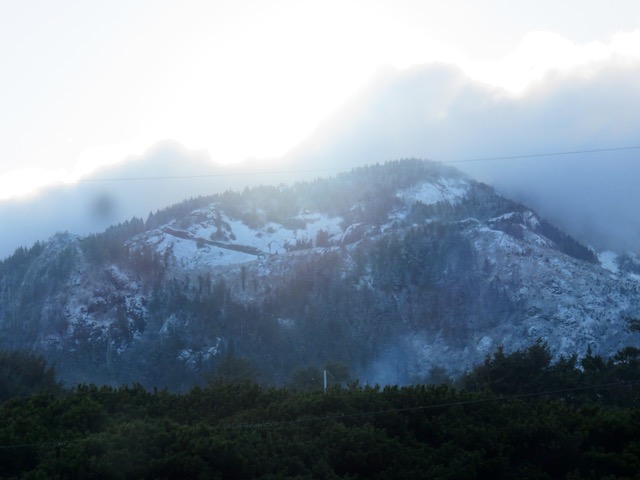
We often see snow on the peaks of the Coast Range in winter, but this is more than we have seen in over a year. This is Angora Peak, just a little over 2600 feet and about 2 miles back from the shore. It is what I can see from my bedroom window, over the tops of my neighbors’ homes.

IMG_2824

BELOW: We rarely see snow on Tillamook Head, about seven miles north of us. In fact, I cannot recall the last time snow dusted trees all the way to the headland. I slipped on the deck but did not fall when I went back out, wearing Gary’s shoes, to take this photo over our neighbor’s hedge. It’s probably hard to see in the photo, but the pale stretches are not bare soil or brush or leafless branches. That is snow and frost on hemlock, spruce, and Douglas fir.

IMG_2822

The slopes of Angora were clearcut around the time we moved to the coast in 1979. I recall saying that the good news was it would not be cut again for 30 years. I was off by almost a decade. Our surrounding forests are being logged off. I look forward, in a decade, to these barren slopes showing baby forests again. I will be gone before it is next cut.

Seaside_pid652.jpg

SaveSaveSaveSave

THE BEES’ DANCE

I know there will be trouble as soon as they begin handing out three-ring binders. I was a public school teacher for twenty-five years and as every new wave of pedagogy sweeps down from above, there is always a white three-ring binder. If I had not released them back into the wild, I would have a wide shelf of them by now. The binders always include text, dividers, colorful charts, and worksheets and handouts; they are never organized in the order they are used; and every single time, they announce new vocabulary. Not new ideas, just new words for old ideas.

When I attended high school, going on fifty years ago, we called them position papers. Today, The New York Times calls them Op-Eds or Opinion. In college they were analysis or persuasive essays. Recently, papers concerning a controversial issue with a thesis and supporting evidence are no longer called persuasive but argumentative papers. That term feels unnecessarily . . . argumentative. Monday, I learn that I am supposed to label such writing as “proposal and support texts”. Not essays at all. “Tasks” rather than text.  The presenters admit they still sometimes get the meaning of these terms confused.

I merely want my students in Writing 121 to construct logical and compelling essays that respectfully and effectively review a range of credible viewpoints, and convince readers of their own. It is more easily said than done, my educational task, and I still do it imperfectly. I keep trying things to improve. On Monday, I was accidentally reminded about parallelism.

Aristotle’s appeals? Evaluating information? Outlining as an organizational process? Let’s not get ahead of ourselves.

Pish-posh! The very teacher who said to me twenty years ago that I was “ridiculous” to insist on personally writing each assignment I give my students, was part of the team on Monday insisting I should personally write each assignment I give my students.

Presumedly, this person has learned something about teaching, something beyond trusting a strategy merely because it arrives in a large binder with dividers and new vocabulary. Doing the work is essential to teaching others how to do it.

Another teacher, binder open, asked about making bullet points of key features desirable in the assigned writing sample. Would this be a way of clarifying what they wanted from students? They were promptly told, No-no! 

I have always done both. I write the assignment and then identify what students must, should, or might include in their writing. I am always particularly pleased when students include some perspective or connection I had not discovered in advance myself. Bonus for that in student writing. Needless to say, this possibility of students out-thinking their teachers’ giant white binders did not come up. Despite a program that ostensibly insists on a “gradual release” of agency to students, we are already shutting it down.

In the mean time, we are asked to learn a new vocabulary that is not what is used in popular media or academia. This program asserts itself by renaming existing pedagogy.

This new system or approach is not worse than others I have seen in the past. But it is not any better. It is relabeling and renaming what has been known for decades. I figured it out years ago and I am not a genius. The program is packaged and involves training “leaders” and selling products. Despite having a nonprofit website, this is about sales. People are being paid and boxes are being checked off. There is money changing hands, public funds.

I do not say there is no need for teachers to better understand how to design curriculum and teach analysis and writing. Certainly, teacher training does not cover everything a teacher needs to be effective in the classroom. I am also not so foolish as to think I have nothing to learn. I am merely weary of being offered the same old meat in a new wrapper.

I am not sold.

Unlike some systems, this one is careful to cite research supporting their claims about how we learn and develop as communicators. What is missing? Respect for people as more than employees, genuinely innovative working structures, and the newest research on how we think and learn and develop as people.

Just one example: Human beings learn through stories. The presenters of this “new” system know this. Or they should. They used personal stories themselves in making their points about the need for this program. It is odd, then, that the words “story” and “narrative” were not listed in that binder. They seem not to exist as terms. Recent research makes clear how the human mind gravitates to story. It is as old as speech, this desire to convey ideas and values through narrative. Yet all the recent “innovations” from Common Core to this misguided program I attended, deliberately ignore how narrative informs our lives.

As bees dance to share the pathway to nectar, human beings share stories to explain their pathway through existence.


And some sweet.

IMG_1523

The eagle pair have been here for years. Three flew yesterday—the pair and last year’s youngster all grown now and white-headed. This photo is from another year.

BULLET PROOF BACKPACKS

This morning on the news was a story about bullet proof backpacks. What children will be wearing this next fall?

Publisher’s Lunch is an industry publication that sends out a daily condensed report for free. Right at the top is an overview of recent sales of manuscripts, categorized by genre and target audience.

This morning, under “Children’s: Fantasy”

“NYT bestselling author Kristin Cast’s THE KEY, a story about a ‘massive pandemic spread by touch that becomes the catalyst for a drastic societal change’ led by a dynamic force of young adult heroes and heroines . . . “

Young adult novels are written for a market aged 12- or 14-18, though increasingly this is what actual adults are reading. Middle grade readers are aimed at children aged 8-12. This fantasy about a pandemic is aimed at younger children no more than 10 and as young as 7. Years younger than the boy who just shot himself in school in Ohio. I wonder what twisted, cruel imagination thought that a story about a world pandemic would be appropriate reading for a second grader?  Even one with heroic young adults?

What we teach young children about the workings of the world impacts them for life. The narrative we live as children sticks. Neglectful and abusive parents do damage, but so do authoritarian parents. Children raised in households with strict power hierarchies—the sort of family where the father’s every whim is absolute law, for example—most often learn that government is tyrannical and dangerous. They may grow to be adults who are anxious and afraid of tyrannical rule. 

Experience becomes a narrative, which the child comes to see as “real life.” But reading itself is experience, as recent research makes clear. Reading makes us smarter, more empathetic; it literally rewires our brain in ways that allow us to absorb experiences beyond those lived as if we had lived them. All of this is good, researchers hasten to explain. The narratives in novels particularly become as instructive as lived experiences. 

And that is where I stop and recall the only novel my parents ever considered censoring. I wanted to read I Never Promised You a Rose Garden when I was eleven. My father was worried—I don’t know his specific concerns—but my mother, who had handed me a book on sex (an awful book in my memory) when I was ten, argued I should be allowed to buy it. What I now know was a semi-autobiographical novel by Joanne Greenwood, was published under the pen name Hannah Green. I had an early fascination about insanity, and Joanne Greenwood was schizophrenic. She also claimed a cure, which no one believed in at that time.

I read Greenwood’s controversial novel and found comfort in Ward Four. When I was confronted with a young woman in full psychosis, I recognized her symptoms immediately. I called the police and she was committed to the hospital. Her father drove from California and he seemed a kindly man, horribly distressed. Was that woman’s drug use the trigger of her illness or a reaction to it? I don’t know. I do know her parents were not the cause.

I know that somewhere between authoritarian and neglect, there is a sweet spot where children are allowed to grow and become their own person. Somewhere between unreasonable expectations and locking them in closets is giving children opportunity to find their way meaningfully in the world.

There is room for superheroes and fantasy and dystopia on our shelves, but perhaps a secret garden, all creatures great and small, the story of real people from George Washington Carver to Sue Barton, Sojourner Truth and Maxine Hong Kingston, Sandra Cisneros and Josephine Hull. Maybe even Shackleton or Frederick Douglas. A little balance, please. A heavy dose of common sense along the way.

What does it tell children when we provide them with a bulletproof backpack and hand them only books about the end of the world as they know it, where only superheroes can solve our problems?


A little sweet:

IMG_1663

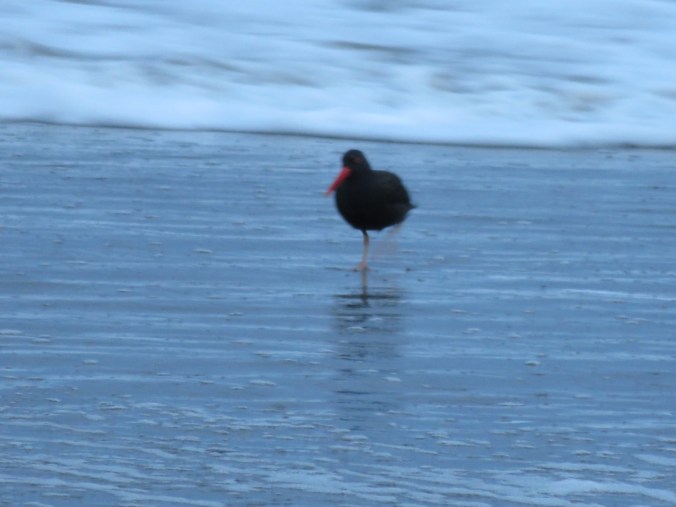
Oystercatchers are about.

SaveSave

E-MARE-GENCY: Everybody to get from street!

The Russian Are Coming, the Russian Are Coming. And these are not the nice ones from that movie who only wanted to return home safely. These Russians had an agenda, false identities, and they saw success.

The Russians were here, not only on Facebook and posting lunatic comments almost like Americans, but in person, on the phone, via Twitter, from Russia and more locally, calling people to rallies and reminding us again and again that Trump was the answer to everything that ails our nation.

From the NYT: “In written answers to questions from the Senate Intelligence Committee, Facebook said some 338,300 people saw the announcements of rallies promoted by the bogus pages — and 62,500 said they planned to attend one. Those numbers are modest against the background of the entire presidential campaign, but they show that the Russians were able not just to attract Americans to their ersatz groups but actually manipulate their actions.   . . .

“A glance at the Russian posts supports the idea that they focus on candidates. Heart of Texas ran an unflattering portrait of Mrs. Clinton with the tag ‘Pure Evil’; posted a fake photo of her shaking hands with Osama bin Laden; and paired her with Adolf Hitler as a supporter of gun control. Mr. Trump was shown surrounded by police officers wearing Trump hats and grinning outside a fake cage with Mrs. Clinton inside.

“While most of the Americans duped by the Russian trolls were not public figures, some higher-profile people were fooled. The indictment mentions the Russian Twitter feed @TEN_GOP, which posed as a Tennessee Republican account and attracted more than 100,000 followers. It was retweeted by Donald Trump Jr.; Kellyanne Conway, the president’s counselor; Michael T. Flynn, the former national security adviser; and his son, Michael Flynn Jr.

“They have expressed no regret that they were apparently taken in by the Russian operatives. Instead, since Friday’s indictment, Donald Trump Jr., like his father, has pointed mainly to the fact that it did not accuse the president or his associates of assisting the Russian operation.”

Of course, retweeting Russian propaganda does assist the Russian operation.

People do not like to believe they are influenced by commercials and slogans, but we are. Billions are spent annually to promote products we didn’t know we wanted. These companies have done the market research. They are not in business to waste money.


BETTER NEWS*

To change the subject entirely: Rice was brought by slaves to the New World, and it was likely a slave woman who taught Americans how to grow it. I cook brown Jasmine rice grown organically in California, but there are other entirely different strains.

Rice traditionally grown in West Africa and once promoted by Thomas Jefferson because it can be grown in fields with flooding (and malaria), grown by slaves in America, and presumed lost, has been found in Trinidad. Francis Morean, a Trinidadian ethnobotanist, identified the grain.

14rice5-master675.jpg

“The fat, nutty grain, with its West African lineage and tender red hull, was a favored staple for Southern home cooks during much of the 19th century.”

Recently tried by the chef at Junebaby, a Seattle restaurant, and perhaps on the menu in future. What once was thought lost, is found.

*A little sweet at the end.

SaveSave

SaveSave

DELETED

IMG_0212

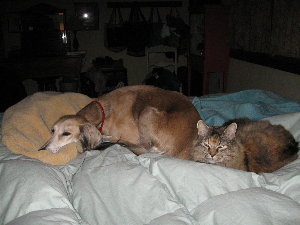
Yeti and Leakey are no longer with us. It was harder to see them go than it is to let go of Facebook. But you know this.

First, I turned off email alerts a few years ago. Then I limited my visits to once a day, then to only a couple times in a week. I tried deactivating my account and found that it spontaneously reactivated because of my use of other websites.

It is time to bite the bullet. With some misgivings, I have deleted my Facebook account. FB gives me two weeks to “change my mind”, and I fear it will reactivate accidentally through my use of Goodreads or some other account linked to FB. If that happens, I will likely delete my Goodreads account too. I am abandoning social media as best I can.

Here’s why: I have better things to do than become upset by FB posts. It causes me stress and fuss and worry. Gary insists: “That’s my job—no, I’m kidding. It’s my job to protect you from the jungle beasts. For you, it [Facebook] seems mostly to be disturbing.” There is already more than enough to disturb me in the world.

I am sorry to lose over 1600 “friends”. You were not all genuine friends, but people I knew or know and value. Even if we never met in life, I am sorry to lose these connections nevertheless. I hope family and friends will send me photos and videos of themselves and our grandchildren—Ruby stomping puddles, Logan trouncing about, EV turning pages of a book. I will miss that. I will miss links to projects and writings. I will miss hearing news of former students and friends from as far back as high school. I will miss the artistic community I joined as admirer and comrade. I will miss the photos of Saluki puppies I wish were mine and the children of former students and the stories on new jobs and campaigns and humor and triumph, the opportunities to commiserate at times of trouble and loss. I am so very sorry to lose all of that.

People, you know where to find me if you need me. I have not moved since 1979. My phone number, a land line, has remained the same and listed throughout all the years since. I have had the same Gmail account for at least ten or fifteen years. My Post Office Box has been 1442 in Cannon Beach since past owners of the deli destroyed the Arch Cape Post Office. My old Blogger blog is linked to this new one with the same name. My information is readily available to a Google search. I am easy to find if you look.

I hope you will.

SHE WAS THERE

merlin_134075493_127ddf2c-eada-4871-a472-57bc6f168d0e-superJumbo.jpg

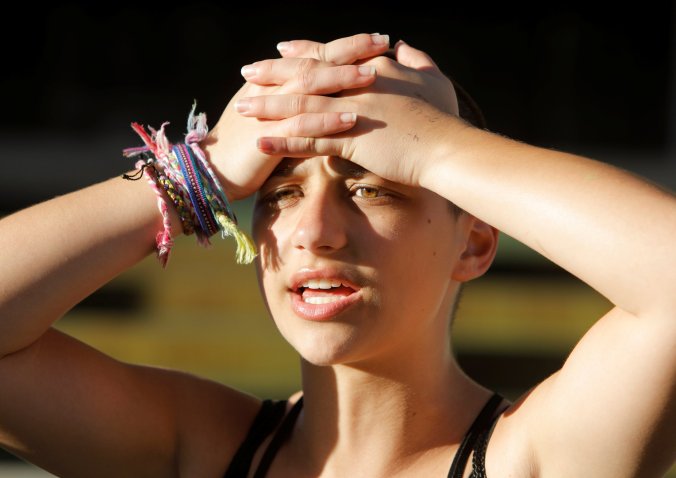
Florida student Emma Gonzalez to lawmakers and gun advocates: ‘We call BS’

SaveSave

HEROIC MACHO MAGIC

If 17 children hadn’t been shot and killed three days ago, I might not have disliked Black Panther so much that I had to stand and walk to the back of the theater. Explosions, chase scenes, and brutal battles with black men killing other black men with the underlying thesis of absolute honor and inherited rule.  It is based on a comic book, after all. There is no reality here, but black and white. Simple good and evil. Here the black people are mostly good. Mostly. I tried to reason with myself throughout the showing. It’s a comic book. It’s not meant to be realistic.

It is also reflects the real life fantasy of those men who insist on open carry and who stash too much ammo for dozens of weapons in fear of “tyrannical government.” They never outgrew the simplistic ordering of a world into bad guys and good guys. They want to be the main character. They see themselves as the hero in a struggle between good and evil. They live in a comic book world. They believe their violence solves all.

The Tomatometer certified the film fresh. Gary was suspicious, but neither of us could not find a bad review. It was playing 20 minutes away, which is our local theater. It was supposed to be a great film. We were hopeful.

The film has a lot going for it: strong gorgeous men and women with intelligence and honor. And while most reviewers avoid saying so, it is refreshing to see so many black performers in one film. The acting was fine. I am always grateful to see Forest Whitaker, though he wasn’t given much to work with here, and his purple costumes were embarrassing. Angela Bassett’s white gown and headdress* in her first scene were questionable. She deserves better. Dana Gurira, Lupita Amondi Wyong’o, and Letitia Wright were wonderful. Except, most of the time, the movie was not about them or any of the performers. It was mostly about blowing things up, killing, noise, and death. (There are only two white characters with speaking roles—one good, one bad. Martin Freeman’s voice with an American accent is so odd, I wondered if his lines had been dubbed.) The ultimate story is well-intentioned, but there are too few funny lines. By the time the cute rhino showed up, I had lost my sense of humor.

Superheroes. This is a wildly popular film, but . . . two observations.

The first will likely seem petty, but it’s serious to me because I have a lifelong love of architecture. The interiors are pretty standard comic book dark swooping expanses of plastic and pseudo-technology. But the city in Wakanda is a westernized hodgepodge. No architects, anthropologists, or anyone with even minimal understanding of traditional architecture anywhere, much less sub-Saharan Africa, were consulted. Someone did a google search. Maybe. Supposedly the production team wanted to honor the rich diversity of the continent, but they also included images from the comic. The home city, isolated and culturally rich for generations, is a hodgepodge: a Disney fun ride here, a UAE fantasy hotel there, ugly buildings lifted willy-nilly from downtown developers all over the world, as if no one considered there might be a regional unifying aesthetic. There is an “outdoor” set, a hundred feet of marketplace selling baskets I can find at Whole Foods. The two dominant towers owe something to structures such as those below. Perhaps that google search found a picture of Mali. Alas, the designers did not bother to explore the engineering of these buildings or to understand how such a city might grow organically. They threw in everything as if the way a western modern city is developed were realistic for a traditional culture. A “love letter to Africa”? No, a mess.

EPA_Djenne1_ml_160714_16x9_992.jpgOn the other hand, the hair and shaved heads were stunning. A shawl knitted from Noro yarn worn in one scene was also beautiful.


It’s probably fair to mention that the original comic was written by two white men, Stan Lee and illustrator Jack Kirby in 1966. Some of the more childish visuals and plot devices can probably be traced back to them. They seem to have done most of their research, pre-Google, by looking at racist cartoons. A Ubangi labrette and a green suit and tie.

178084-004-A7B85647.jpg

But that’s not what most upset me. It was kingship and royalty, and the non-stop violence where good always triumphs that rubbed me the wrong way. This too is from the original comic book. News flash: Most sub-Saharan African cultures did not have inherited kings, and winning the fight doesn’t prove anyone is the better man. There is no magic in inheritance that delivers to the best man the right to rule or guarantees he will win his throne in a fair fight. Virtue does not result in possessing the bigger gun. We see this again and again, these fairy tale assumptions that ultimately the “just ruler” will be born and that the best man will win. Virtue will triumph because in a fair fight the good guy, born to his position, will prevail. It is a peculiar ethos in the fiction of a nation founded on egalitarian ideals: all human beings are equal under the law and deserve to have their rights to life, liberty, and pursuit of happiness protected without regard to position or power. Puritans aside, we were not founded to believe that might = right. The real world does not work that way.

In the real world, powerful weapons inflicted on other nations are not shot down by a self-sacrificing white man, they are sold for billions of US dollars. In the real world, good guys do not always win the fight, but are shot in the hallway of their school. In the real world, a 16 year old with access to technology does not invent magical cure, but hacks into world banks. In the real world inheriting privilege rarely results in sharing with the needy, but in bullying and profit held close.

But this is America and we like our violence and our fairy tales writ large and loud. Nudity offends us, but apparently a scene where relatives attack one another with machetes is okay. All will magically be forgiven when the ruler lays down his weapon?

My husband laughed at a lot of things that were not meant to be funny. I was bored sometimes waiting for the action to end the the story to recommence. But then, I am not the intended audience eager for bashing and kabooms. I do not read comic books. I had to remind myself that was what I was watching. I was bothered by the visuals. Gary was bothered by the music. Both of us were horrified by the violence. It was a disappointing film for us.

Gary commented that it might have been better had Wesley Snipes made it in the early 1990s, or someone had made it at a time when CGI and pyrotechnics were less available. There might then have been more character development. More story. Maybe.

It’s a comic book. I am grateful to see so many fine actors in one film. I am sorry it was this one.

______________________________________________

*Nearly everywhere in the world, and throughout history, white is a color of grief and mourning. Is she wearing white in mourning? I might have appreciated that, though no one else wears white, and the shapes of headdress and dress are princess-film standard, what the Good Witch wore in The Wizard of Oz.

In the West, the bride and groom wearing white at weddings is originally a Jewish custom probably dating back at least 700 years. The colorless, undyed fabric may be symbolic that the bride and groom are the treasure, and earthly garments are nothing. The practice was never widespread, but then Queen Victoria wore white at her wedding. Perhaps she hoped it would make her small body stand out, which it did. Unlike every other bride at that period, she need wear her wedding gown only once and could put it away. White shows the dirt, as mothers used to say, and cleaning all those yard of silk would have been a challenge. Most brides in the nineteenth century wore colored cotton and continued to wear their wedding dress for special occasions until it was unwearable. In isolated regions of the American west, she might wear it to church each week for a year to insure that every member of the widespread congregation could see it. [I can’t help this. I know this stuff and it just wants to be let out.]

SaveSave

SaveSave

PREDICTABLE

As a teacher in public and private schools for over 40 years, I have never been injured by a student, but among other incidents, students have

yelled and sworn at me

thrown a chair at the wall

thrown a heavy metal padlock at me (it missed)

drawn a penis on a classroom poster

written about how they threatened suicide in order to get what they wanted (a gun) and how successful that threat was with terrified parents

wanting to “kill an animal in every country in the world”

emailed about holding a knife against their own throat

claimed to possess a concealed weapon permit (and to be “carrying”)

This all from white, male teenagers. Girls have been angry at me on occasion too, but never threatened me or anyone else. Such lashing out is not unusual. It has always been hard to be a teenager. And as a teacher, telling them what to do, I look like the bad guy. Sometimes I am the bad guy, though I try to be fair. It is predictable that I am blamed for more than I could possibly be at fault for. It is the job, the position of authority. Almost always this lashing out came from students who had, one way or another, been subject to brutality: abusive parents, dictatorial households, overwhelming loss and fear. I worked with Child Protective Services and my administration when the threats were to safety (suicide or abuse or a danger to another person) but I never turned over someone for a threat against myself. Frankly, it did not occur to me.

They were troubled, angry, lonely, depressed, resentful, disappointed. They were looking for an answer. They were looking for someone to blame. A way out. They were not mentally ill. Neither are most shooters. Their actions are not predictable, but an AR15 is. It has no use but murder.

I will say it again: We have an obscene faith in the United States in the power of violence to solve our problems.

We are wrong.

THE NEW YEAR

IMG_2821

Sea glass found during February 2018 walks . . . so far.

Every morning, my husband and I walk the shore. We usually head north toward Asbury Creek, or what even-now-I-am-not-certain might be Shark Creek. I have a map from decades ago and those creeks flow in other places.

So we walk north. We almost never go out in rain, but we can see the rain shadow coming. Some days we when know we will get wet, we walk anyway.

We recognize people on our walks, Tammy, “two-dog-man”, Larry, “the owners” (Gary’s name for the people who think this is their world and we merely live in it). There is the man who fishes the surf. Two friends from the north end we only meet when we cross that creek. Other people we know slightly or whose dogs we know.

Mostly, it is in the summer that we talk to visiting walkers. We wait for the tide to reveal sand or a shower to pass by, and then out we go. We pick things up and strangers ask us what we are picking up. If that is the question—What are you finding?—the answer is easy. We gather trash. Plastic bottle caps, spent fireworks, candy wrappers, shovels, abandoned beach toys, bits of nylon cord and plastic rope in blue and green and yellow and red, some thin and others thick as a baby’s wrist. We find toothbrushes and insulating foam, plastic cups, cigarette butts, and broken white spoons. Golf balls and grocery bags, crushed clear bottles and broken take-out containers. We find other people’s trash and we gather it. Too often these days we find a film of diesel on the sand, seasonally we find purple sailors or plankton.

If they ask us: What are you looking for? The answer might be different. We find limpets and scallop shells, pumice from Mount St. Helens’s explosion in 1980 still floating, smooth flat agates and quartz crystals in milky clear and gold and orange, and—best of all—what we are looking for: bits of glass from cobalt to pale green and clear. We find beauty.

After Yeti died last summer, we visit the Oregon Country Fair and drive the coast and make quilts and weave and garden and paint our bedroom ceiling to floor and then the rest of the upstairs floor, we write and listen to music and make our own, and we sort file cabinets and books and thin our possessions since nobody wants any of it. We have over twenty people visit in August, and that is a little crazy but important too. Jan does NaNo again. Gary is loving Estonian choirs, Jan cannot seem to stop teaching, and Gary takes care of the house.

We find life.


SaveSave