“Coming Out of the Kitchen—Coming Out of the Closet”*
In her young womanhood, my grandmother could not vote, sign a contract, serve on a jury, use birth control, or control her own earnings or even her children without her husband’s consent. All of this changed in her lifetime. There was no legal term for sexual harassment when she began working, and when it happened to her, no one listened to her complaints. That last seems to be changing in my lifetime. I have enjoyed many privileges and benefitted from considerable luck during my life—I am white and was raised Christian in a society that privileges white Christians. I am educated and come from a stable home. Despite mental illness and debilitating health issues, my family has been largely unimpeded by serious health issues and other marginalization. Nevertheless, I am aware that others experience their identity as a burden arbitrarily placed on their shoulders, that my fellow Americans suffer for their birth nationality, language, sexual orientation, socioeconomic situation, race, and gender. I have been fortunate but that does not make me blind to the hardships of others crippled by discrimination. Ultimately, privilege is the belief that something is not a problem because it is not a personal problem.
Recognizing how some benefit while others are punished opens awareness to wider issues of entitlement. The now-classic 1984 essay, “White Privilege: Unpacking the Invisible Knapsack,” resulted from Peggy McIntosh’s insights gained while seeking to understand the impact of sexism. It became clear to her that while women experience many disadvantages, she also benefitted from unearned privilege as a white person. She documents assumptions about events and opportunities in a list of “the daily effects of white privilege.” These include assuming that she may “choose blemish cover or bandages in ‘flesh’ color and have them more or less match my skin,” that she will be welcome in housing, travel, and cultural events geared to her as a white person, and security that her children will be safe from people who dislike them for their race. She is privileged. Building on experiences with sexism, McIntosh discovers a clearer understanding of how white privilege operates. Her willingness to explore her own marginalization makes her more alert to that of others others.
A key to countering white privilege is acknowledging that most white people are unaware of their privilege. They have done nothing to earn it, and likely have made no conscious effort to maintain it. McIntosh explains: “For me white privilege has turned out to be elusive and fugitive subject. The pressure to avoid [admitting it exists] is great, for in facing it I must give up the myth of meritocracy.” The myth people can achieve whatever they are willing to work for, condemns those who fail. It denies the impact of bigotry and simple luck. The truth is that many people work hard and never get what they deserve, often because they have disadvantages others do not. This is the point of Gina Crosley-Corcoran essay, “Explaining White Privilege to a Broke White Person,” which acknowledges the reality of white privilege but argues that poverty is another source of discrimination in America (Crosley-Corcoran). The difference: poverty can be overcome in a generation, but race and gender remain permanent and unmistakable markers of advantage or disadvantage.
Justice achieved by one group need not come at the expense of another. In his recent memoir, “Darling,” Richard Rodriguez makes the case that it is through the liberation of women from traditional roles while still valued in his church, that he, as a gay man, can overcome his marginalization. “It is because the Church needs women that I depend on women to protect the Church from its impulse to cleanse itself of me.” He draws an analogy not only between homosexual discrimination and racial miscegenation, but with the nineteenth century “condemnation [of women fighting for suffrage] that employed the adjectives of unnatural aspiration.” As victims of bigotry themselves, women defeat notions of feminine passivity, simultaneously freeing men from constricting assumptions about masculinity. Rodriguez predicts the church’s acknowledgement of women’s power will enable progress for him. Nigerian author and activist Chimamanda Ngozi Adichie supports this relationship between feminism and masculinity in We Should All Be Feminists: “We stifle the humanity of boys. . . . Masculinity is a small, hard cage, and we put boys inside this cage.” LBGTQ identities may be less observable but are still subject to societal prejudice. A gay man might choose to conceal his sexuality in order to make his way without suffering bigotry toward his sexual orientation, but this demands a denial of his identity, his essential being.
Jose Antonio Vargas experienced the secret humiliation of passing as something he is not. He completed his education, went to work as a journalist, and won the Pulitzer Prize before revealing himself as the undocumented son of undocumented parents in “My Life as an Undocumented Immigrant.” As a child Vargas was not aware that he was “illegal.” He kept his family’s undocumented status secret until coming out made sense as an act of principle. National original and first language may be disguised or denied, and in a generation they vanish, but just as Vargas came out as “illegal,” Rodriguez’s sexual orientation is personal and personally inescapable. Both these men want to be who they are, and each came out when he was in a position to set an example for others to follow. However, optimism that those who have suffered will offer a hand up to those next behind them is not always justified. Even Rodriguez concedes this. Americans whose own ancestors arrived as poor immigrants are notable among those condemning more recent arrivals. White women benefitting from white privilege may deny their racial advantage and even embrace the bigotry that limits their human potential. By refusing to acknowledge our “blessings” we are blind to the bald, unwarrantable usurpations they inflict upon others.
Some argue that acknowledging entitlements merely pits groups against one another: black against white, woman against man, gay against straight, poor against rich. An Op-Ed by Mark Lilla in The New York Times warns that “identity politics” neglects the valid concerns of white Americans, and he invokes FDR in a stirring appeal to focus on the “real foundations of modern American liberalism” that unite us as a nation. He claims Hillary Rodham Clinton chooses to speak only to some Americans and not all. Aside from misunderstanding Clinton’s message, it is clear that marginalized groups must be free to cross these divisions in the common effort for a more egalitarian nation. Lilla concedes the positive impact of Affirmative Action and Black Lives Matter but insists “the fixation on diversity in our schools and in the press has produced a generation of liberals and progressives narcissistically unaware of conditions outside their self-defined groups.” His pejorative use of the “identity politics” would have us believe that all would be well (or at least better) if we stopped talking about discrimination. It is an appealing notion to pretend something is not there in hope it will go away. Our path is not so simple. Despite our founding principles, there is ample evidence that our nation has not yet achieved equality for all. It must be earned through our shared conviction and activism. Both McIntosh and Rodriguez celebrate justice for others as essential markers on the pathway toward their own.
Guilt about advantage is not necessary for change; objectively is. It is only when we look beyond our personal and immediate concerns, embrace the concerns of others, and recognize our participation in an unjust system that we can support productive change. Justice and liberty are the birthright of every American. We trust our government of the people and by the people to protect us from unfair attacks on our ambitions and futures based on irrelevant biases—we wanted to be judged by who we are, not what we are. To accomplish this goal we must view society with clear eyes. When we acknowledge the entitlement that some enjoy at the expense of others, we must also admit how our country places many people at a disadvantage. Race, ethnicity, gender, able-ness and health are visible factors that may result in marginalization and disrespect; language can be heard but can b changed; sexual orientation and religion might be hidden but to do so is a violation of self; all of us lucky enough to get there will one day be aged; and yet poverty is too often judged as personal failure rather than an unhappy circumstance. We have grand ideals and far to go. Our country represents for much of the world a beacon light of freedom and opportunity. It requires defending. James Baldwin warned in 1963: “I’m terrified at the moral apathy, the death of the heart, which is happening in my country.” Our shared concerns as citizens must be greater than our self-interest.
My life has been defined and limited by my gender. I am white, English-speaking, and educated—what passes for lucky in this country. I have worked hard for my education, and while my family assumed I would go to college (an advantage), it would be decades before I understood that my mother only wanted me in college to find a nice man who would support me. My educational ambition was thus the result of misunderstanding the message I received. Others are far less lucky in how society responds to accidents of their birth and circumstances, receiving messages that demean their potential. McIntosh examines racial privilege through a lens of sexism; Rodriguez’s expects the shifting roles of women to result increased acceptance of the LGBTQ community. Seeing their problems upon a background of others’ misfortune was critical to their compassion and empathy. Like them, I began with personal concerns, but also like them I must stretch my understanding if I hope to see real justice in our society. To achieve the promises at our founding, we must look beyond self-interest to the greater good, and that view must include the specific as well as the general. Our government, both through tradition and statute, must ensure that entitlements do not interfere with the rights of any American. Respecting diversity need not be an impediment to celebrating unity—it may be the only pathway toward achieving justice for all.
Adichie, Chimamanda Ngozi. We Should All Be Feminists. Anchor Books, 2015.
Brown, Jeffrey. “Oscar-Nominated Film Brings the Prophecy of James Baldwin into Today’s World.” Review of I Am Not Your Negro. PBS News Hour, 3 Feb. 2017. http://www.pbs.org/newshour/bb/oscar-nominated-film-brings-prophecy-james-baldwin-todays-world. Accessed 3 Feb. 2017.
Crosley-Corcoran, Gina. “Explaining White Privilege to a Broke White Person.” Huffington Post, 8 May 2014, huffpost.com/us/entry/5269255. Accessed 30 Jan. 2017.
Lilla, Mark. “The End of Identity Liberalism.” The New York Times, 18 Nov. 2016, http://www.nytimes.com/2016/11/20/opinion/sunday/the-end-of-identity-liberalism.html?_r=0. Accessed 6 Feb. 2017.
McIntosh, Peggy. “White Privilege: Unpacking the Invisible Knapsack.” Peace and Freedom Magazine, July-Aug. 1989, pp. 10-12, nationalseedproject.org/white-privilege-unpacking-the-invisible-knapsack.html. Accessed 30 Jan. 2017.
Rodriguez, Richard. “Darling.” Harper’s Magazine, July 2013, harpers.org/archive/2013/07/darling. Accessed 30 Jan. 2017.
Vargas, Jose Antonio. “My Life As an Undocumented Immigrant.” New York Times News Magazine, 22 June 2011, mobile.nytimes.com/2011/06/26/magazine/my-life-as-an-undocumented-imigrant.html. Accessed 30 Jan. 2017.
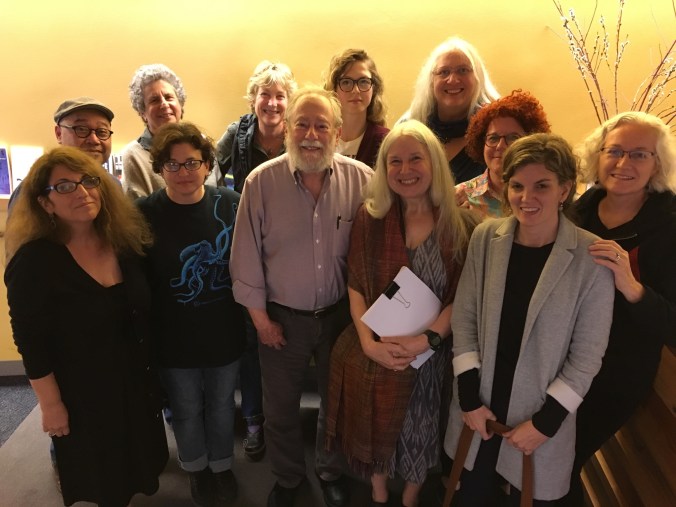
*My title is a quote from Richard Rodriguez’s essay. The photo is from a year and a half ago, starring some of my favorite poets.
 IMPERFECT PATIENCE
I slightly remember his name but not the boy. I don’t have much of a memory. Nicely written Jan.
LikeLike
Sorry, but what “boy”? Do you mean Jose Antonio Vargas? He is 37, not a bot, and was 30 when he broke his own story.
LikeLike