NO LIE

just for fun.


“On the Decay of the Art of Lying” is a short speech (or essay) written by Mark Twain in 1880 for a meeting of the Historical and Antiquarian Club of Hartford, Connecticut.

Observe, I do not mean to suggest that the custom of lying has suffered any decay or interruption–no, for the Lie, as a Virtue, A Principle, is eternal; the Lie, as a recreation, a solace, a refuge in time of need, the fourth Grace, the tenth Muse, man’s best and surest friend, is immortal, and cannot perish from the earth while this club remains. My complaint simply concerns the decay of the art of lying. No high-minded man, no man of right feeling, can contemplate the lumbering and slovenly lying of the present day without grieving to see a noble art so prostituted. In this veteran presence I naturally enter upon this theme with diffidence; it is like an old maid trying to teach nursery matters to the mothers in Israel. It would not become to me to criticize you, gentlemen—who are nearly all my elders–and my superiors, in this thing—if I should here and there seem to do it, I trust it will in most cases be more in a spirit of admiration than fault-finding; indeed if this finest of the fine arts had everywhere received the attention, the encouragement, and conscientious practice and development which this club has devoted to it, I should not need to utter this lament, or shred a single tear. I do not say this to flatter: I say it in a spirit of just and appreciative recognition. [It had been my intention, at this point, to mention names and to give illustrative specimens, but indications observable about me admonished me to beware of the particulars and confine myself to generalities.]

No fact is more firmly established than that lying is a necessity of our circumstances—the deduction that it is then a Virtue goes without saying. No virtue can reach its highest usefulness without careful and diligent cultivation—therefore, it goes without saying that this one ought to be taught in the public schools—even in the newspapers. What chance has the ignorant uncultivated liar against the educated expert? What chance have I against Mr. Per—against a lawyer? Judicious lying is what the world needs. I sometimes think it were even better and safer not to lie at all than to lie injudiciously. An awkward, unscientific lie is often as ineffectual as the truth.

Now let us see what the philosophers say. Note that venerable proverb: Children and fools always speak the truth. The deduction is plain—adults and wise persons never speak it. Parkman, the historian, says, “The principle of truth may itself be carried into an absurdity.” In another place in the same chapters he says, “The saying is old that truth should not be spoken at all times; and those whom a sick conscience worries into habitual violation of the maxim are imbeciles and nuisances.” It is strong language, but true. None of us could live with an habitual truth-teller; but thank goodness none of us has to. An habitual truth-teller is simply an impossible creature; he does not exist; he never has existed. Of course there are people who think they never lie, but it is not so—and this ignorance is one of the very things that shame our so-called civilization. Everybody lies—day; every hour; awake; asleep; in his dreams; in his joy; in his mourning; if he keeps his tongue still, his hands, his feet, his eyes, his attitude, will convey deception—and purposely. Even in sermons—but that is a platitude.

In a far country where I once lived the ladies used to go around paying calls, under the humane and kindly pretense of wanting to see each other; and when they returned home, they would cry out with a glad voice, saying, “We made sixteen calls and found fourteen of them out”—not meaning that they found out anything important against the fourteen—no, that was only a colloquial phrase to signify that they were not at home—and their manner of saying it expressed their lively satisfaction in that fact. Now their pretense of wanting to see the fourteen—and the other two whom they had been less lucky with—was that commonest and mildest form of lying which is sufficiently described as a deflection from the truth. Is it justifiable? Most certainly. It is beautiful, it is noble; for its object is, not to reap profit, but to convey a pleasure to the sixteen. The iron-souled truth-monger would plainly manifest, or even utter the fact that he didn’t want to see those people—and he would be an ass, and inflict totally unnecessary pain. And next, those ladies in that far country—but never mind, they had a thousand pleasant ways of lying, that grew out of gentle impulses, and were a credit to their intelligence and an honor to their hearts. Let the particulars go.

The men in that far country were liars, every one. Their mere howdy-do was a lie, because they didn’t care how you did, except they were undertakers. To the ordinary inquirer you lied in return; for you made no conscientious diagnostic of your case, but answered at random, and usually missed it considerably. You lied to the undertaker, and said your health was failing—a wholly commendable lie, since it cost you nothing and pleased the other man. If a stranger called and interrupted you, you said with your hearty tongue, “I’m glad to see you,” and said with your heartier soul, “I wish you were with the cannibals and it was dinner-time.” When he went, you said regretfully, “Must you go?” and followed it with a “Call again;” but you did no harm, for you did not deceive anybody nor inflict any hurt, whereas the truth would have made you both unhappy.

I think that all this courteous lying is a sweet and loving art, and should be cultivated. The highest perfection of politeness is only a beautiful edifice, built, from the base to the dome, of graceful and gilded forms of charitable and unselfish lying.

What I bemoan is the growing prevalence of the brutal truth. Let us do what we can to eradicate it. An injurious truth has no merit over an injurious lie. Neither should ever be uttered. The man who speaks an injurious truth lest his soul be not saved if he do otherwise, should reflect that that sort of a soul is not strictly worth saving. The man who tells a lie to help a poor devil out of trouble, is one of whom the angels doubtless say, “Lo, here is an heroic soul who casts his own welfare in jeopardy to succor his neighbor’s; let us exalt this magnanimous liar.”

An injurious lie is an uncommendable thing; and so, also, and in the same degree, is an injurious truth—a fact that is recognized by the law of libel.

Among other common lies, we have the silent lie—the deception which one conveys by simply keeping still and concealing the truth. Many obstinate truth-mongers indulge in this dissipation, imagining that if they speak no lie, they lie not at all. In that far country where I once lived, there was a lovely spirit, a lady whose impulses were always high and pure, and whose character answered to them. One day I was there at dinner, and remarked, in a general way, that we are all liars.

She was amazed, and said, “Not all?”

It was before “Pinafore’s” time. so I did not make the response which would naturally follow in our day, but frankly said, “Yes, all—we are all liars. There are no exceptions.”

She looked almost offended, “Why, do you include me?”

“Certainly,” I said. “I think you even rank as an expert.”

She said “Sh-‘sh! the children!”

So the subject was changed in deference to the children’s presence, and we went on talking about other things. But as soon as the young people were out of the way, the lady came warmly back to the matter and said, “I have made a rule of my life to never tell a lie; and I have never departed from it in a single instance.”

I said, “I don’t mean the least harm or disrespect, but really you have been lying like smoke ever since I’ve been sitting here. It has caused me a good deal of pain, because I’m not used to it.”

She required of me an instance—just a single instance. So I said—

“Well, here is the unfilled duplicate of the blank, which the Oakland hospital people sent to you by the hand of the sick-nurse when she came here to nurse your little nephew through his dangerous illness. This blank asks all manners of questions as to the conduct of that sick-nurse: ‘Did she ever sleep on her watch? Did she ever forget to give the medicine?’ and so forth and so on. You are warned to be very careful and explicit in your answers, for the welfare of the service requires that the nurses be promptly fined or otherwise punished for derelictions. You told me you were perfectly delighted with this nurse—that she had a thousand perfections and only one fault: you found you never could depend on her wrapping Johnny up half sufficiently while he waited in a chilly chair for her to rearrange the warm bed. You filled up the duplicate of this paper, and sent it back to the hospital by the hand of the nurse. How did you answer this question–‘Was the nurse at any time guilty of a negligence which was likely to result in the patient’s taking cold?’ Come–everything is decided by a bet here in California: ten dollars to ten cents you lied when you answered that question.”

She said, “I didn’t; I left it blank!

“Just so—you have told a silent lie; you have left it to be inferred that you had no fault to find in that matter.”

She said, “Oh, was that a lie? And how could I mention her one single fault, and she
is so good?—It would have been cruel.”

I said, “One ought always to lie, when one can do good by it; your impulse was right, but your judgment was crude; this comes of unintelligent practice. Now observe the results of this inexpert deflection of yours. You know Mr. Jones’s Willie is lying very low with scarlet-fever; well, your recommendation was so enthusiastic that that girl is there nursing him, and the worn-out family have all been trustingly sound asleep for the last fourteen hours, leaving their darling with full confidence in those fatal hands, because you, like young George Washington, have a reputa— However, if you are not going to have anything to do, I will come around to-morrow and we’ll attend the funeral together, for, of course, you’ll naturally feel a peculiar interest in Willie’s case—as personal a one, in fact, as the undertaker.”

But that was not all lost. Before I was half-way through she was in a carriage and making thirty miles an hour toward the Jones mansion to save what was left of Willie and tell all she knew about the deadly nurse. All of which was unnecessary, as Willie wasn’t sick; I had been lying myself. But that same day, all the same, she sent a line to the hospital which filled up the neglected blank, and stated the facts, too, in the squarest possible manner.

Now, you see, this lady’s fault was not in lying, but in lying injudiciously. She should have told the truth, there, and made it up to the nurse with a fraudulent compliment further along in the paper. She could have said, “In one respect this sick-nurse is perfection—when she is on the watch, she never snores.” Almost any little pleasant lie would have taken the sting out of that troublesome but necessary expression of the truth.

Lying is universal—we all do it. Therefore, the wise thing is for us diligently to train ourselves to lie thoughtfully, judiciously; to lie with a good object, and not an evil one; to lie for others’ advantage, and not our own; to lie healingly, charitably, humanely, not cruelly, hurtfully, maliciously; to lie gracefully and graciously, not awkwardly and clumsily; to lie firmly, frankly, squarely, with head erect, not haltingly, tortuously, with pusillanimous mien, as being ashamed of our high calling. Then shall we be rid of the rank and pestilent truth that is rotting the land; then shall we be great and good and beautiful, and worthy dwellers in a world where even benign Nature habitually lies, except when she promises execrable weather. Then—But am I but a new and feeble student in this gracious art; I cannot instruct this club.

Joking aside, I think there is much need of wise examination into what sorts of lies are best and wholesomest to be indulged, seeing we must all lie and we do all lie, and what sorts it may be best to avoid—and this is a thing which I feel I can confidently put into the hands of this experienced Club—a ripe body, who may be termed, in this regard, and without undue flattery, Old Masters.


NOTE: I have made “corrections” for the sake of modern grammar, punctuation, and spelling, and suspect Twain would laugh about that. I realized as I did so that my youthful fondness for Twain might help explain other fondnesses—for the em-dash, as an example.

This essay is not so sharp as some by Twain; his humorous observations are almost sweet compared to the liars we know now who might be the worst kind, worst than the poor well-intentioned lady described: Some think they have a magical gift whereby speaking the lie turns it true.—jp


STEP 8: Done, sort of

fullsizeoutput_1035

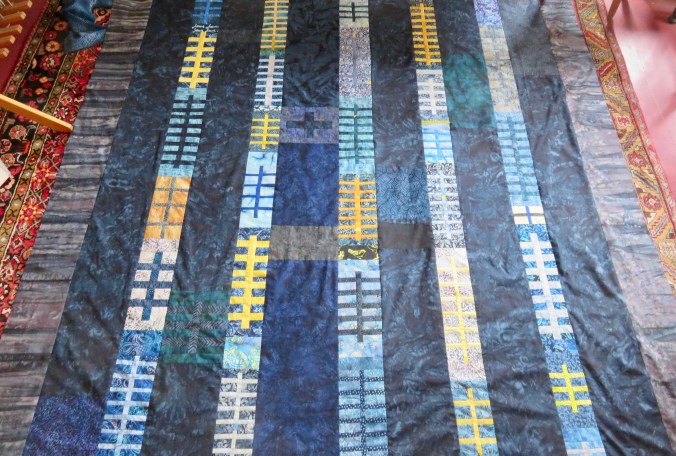
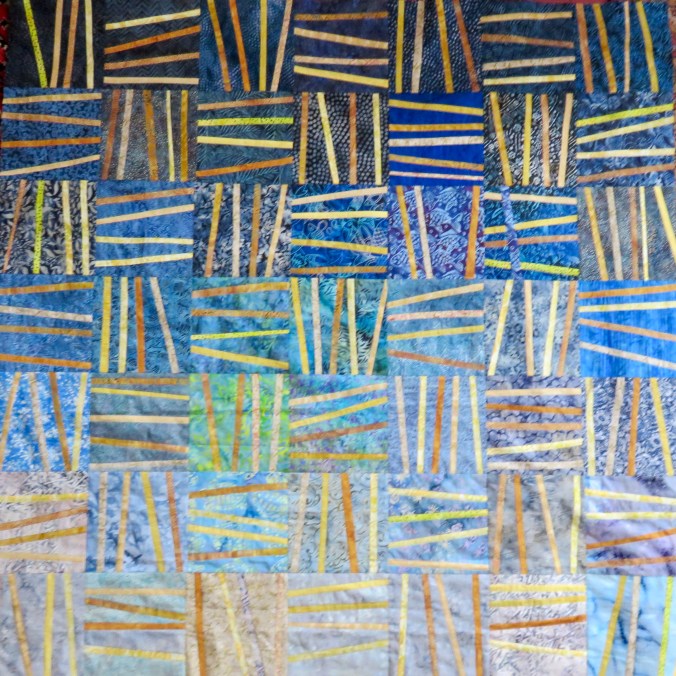
BlueToo, the second blue-and-yellow quilt top. In life, it is an 84″ square, not a trapezoid.

I completed two quilt tops this month, and pieced the back of one of them too. To be perfectly honest, I have completed two quilts at once before. But this was especially fun. I could, in the simplest form, sew two lengths of cloth together to make a front and do the same for the back, adding an additional strip because the backing must be larger than the front to accommodate the machine quilter. In real life, it’s not so simple.

The theoretical simplest quilt would require at least ten or eleven yards of 44″ fabric. And in the old days when quilts were created to use up scraps of fabric (a practice not actually as common as the mythology suggests), a quilter would gather bits of fabrics for years from making shirts and dresses, wool pants and skirts. In practice, many quilts were made with specially purchased fabric or fabric dyed for use in piecing a quilt. All quilts result in ever smaller scraps. I have a small mound of blue-and-yellow scraps and thread trimmings from my work this month.

I make quilts from ordinary fabric and still hand-quilt such quilts on occasion because I really do like the look and the control. Most of my quilts these days are made of Asian batik fabric which is hand-dyed and boiled making a tight, smooth cloth that is not easily pinned, much less hand quilted. I took a hand-quilted batik quilt in to show a friend who owns a quilt shop. (“You hand-quilted this?” she said. “Didn’t your fingers bleed?” Well, yes, as a matter of fact they did. I could only work for a short time each day until my fingers were too bloody to go one without staining the fabric.) She’s the one who urged me to find a machine quilter. “No one hand-quilts batik.”

I made a small quilt for my mother from Liberty cotton lawn. I made quilts for each on my sons when they turned two and when they went off to college and when they married. My grandchildren have each received three so far.

Each of these quilts incorporate dozens of fabrics, a few thousand yards of thread, and often have pieced backings. The two shown here, except for the backing on one and a third of the backing for the other, were made entirely from fabrics I have collected in what textile people would call my “stash.” I have, let us say, several large plastic bins (and several smaller ones) filled with fabrics to use in quilting. These cottons are mostly purchased in quarter-yard pieces (about 9″ x 44″) and some of them are over forty years old. The newest are a few months old.

I made my first pieced quilt when I was pregnant with Alan, my first-born son. That was thirty-nine years ago. I took the bus to Spokane to visit a friend and she took me to a quilt shop where I bought small pieces of red on white and white on red prints of conventional cotton. The quilt I made was a double nine-patch. I backed it with one of my grandmother’s pilfered hospital sheets. Over the years since, I made an Ocean Waves and a Snail quilt. I have made variations on log cabin several times. Mostly, though, I make them up. I think through not only the appearance, but the construction of the piece—what must be done first and how.

All this planning is not the result of an orderly and methodical personality. I am what is called an Abstract/Random. I am inclined to mess and disorder and risk.

I had to learn how to be linear and meticulous instead of lazy and meandering because the things I wanted to make demanded those processes that from me. I draw thumbnails. I make lists. I stare and stare and lie awake at night figuring things out.

There is a skinny line in the quilt above, the dark blue between the grayish outside border the bluer inside panel. That narrow piece is called a “frame.” I am fond of frames in my quilts, but this one was not supposed to have one. When I realized it needed that narrow dark blue frame, I felt a kind of despair, just for an instant. I was not sure the backing I had would be large enough to add two more inches both ways.  Otherwise I would have to dig through my stash to find enough fabric to enlarge the already-huge backing for my already outsize pieced top. I laid the backing out on the bare floor and measured. Fortunately it was plenty big, though out of square and longer on one side than the other from the way it was cut from the bolt (not my fault, that).

Most of my quilts run around 80″ square or a bit larger. I meant to make a pink quilt for a twin bed once and it turned into a 90″ square. Things just got out of hand. Making a special size is another whole struggle for me. I made one for a king-size bed that was a nightmare. The size (106″ square) was more than I could manage and I swore I would never do it again. I would do it differently now but smaller pieces would be nice for a change. Doll quilts are fun. A hanging would be fine but I do not have space to hang anything. But smaller, perhaps. I could try out ideas without committing eleven yards. Or I might be ready for the plastic bin with silks.

I have been collecting silks the way dress-makers did in the nineteenth century: an entire bolt of 14″ wide kimono silk, scraps salvaged from saris and other projects. I have a couple of yards of orange silk velvet, pink charmeuse, crepe with red apples on green. Bits and pieces. They would all be interesting to piece and quilt. Slippery and shedding but precious and variable in texture. It is the shifts in texture that attract me. I once pieced fabric for a jacket—all sorts of textures including corduroy—in long narrow strips. I wish I’d kept a piece of that. The textures are what I want, in addition to the play of color and value. Something quite different. Soon.

I cast on a knitting project last night and completed a couple of rows in a fancy pattern—unlike me in knitting. I like to think I can start something new because the quilts are done.

But first, these pieces go for machine quilting and when they return in a couple of months, I will still need to bind them. So . . . not really done. Close.

fullsizeoutput_1037

This is Blue Ladders, the quilt I originally set out to make this summer. I will negotiate with Linda Pinkstaff from Astoria Quilting about thread color tomorrow. Her advice is always good. I feel the need for a fancy quilting pattern here. We’ll see what Linda says.


REVISION

IMG_4653.jpg

I have a story under consideration just now at two literary journals. One of them has had it for well over a year. The other began considering it today. It is an important story to me for a variety of reasons and has received a good deal of praise from editors who “nearly” chose to publish it. Those personal rejections came from the more prominent journals. (It is some sort of irony that the journals who publish a larger percentage of submissions reject it quickly compared to the journals that accept only a fraction of one percent of submissions.)

The story matters to me, and that is why I keep sending it out. It is the reason I have restructured the story, changed the point of view, expanded it to over six thousand words and carved it back to barely three thousand. I have revised the story at least every six months for the past fourteen years. That is, I have dozens of drafts, some of them quite dramatically different..

I know when I wrote it because in 2005 I was admitted to an MFA program and this was the story I submitted with my application. It was the story that earned me a place in the program and that gave me my first response in an MFA workshop. I had experienced cruel feedback many times by then in various workshops and classes. I expected it. When the instructor objected to the twist at the end, I rewrote the story to reveal information early. The next editor found I’d tipped my hand too early. I moved things around again.

You get the idea.

A lot of life seems like that. You try to be polite and are accused of failing to address an issue head on. You’re more direct and someone’s feelings are hurt. Can’t you be more subtle? A little too small, too large, too fat, too thin, not beautiful enough, too clever by half. On and on. I get things wrong.

And then there are the people who stand by you and love you no matter what. You make mistakes and speak without thinking, you forget something that is important, or you insist on something that isn’t actually important at all. Or, at least I have done those things. What can I say?

My story is imperfect. My story is imperfect.

Back to work, honing my imperfect self, my imperfect story, the story of my life.

IMG_4792.jpg

‘Are we there yet?’

IMG_4718

We found this about a mile and a half north. It had survived a couple of high tides, but not the one last night. It was gone this morning.

It’s one of those phrases. “Poor kitties” is another. I should probably list more, but two will do. Today is our anniversary. Forty-fifth, unless you count our time together as a couple, which pushes it to fifty. We have a lot of lines and inside jokes that no one gets but the two of us. We were laughing about that this morning as we walked. We were out for about an hour.

Nothing last forever, certainly nothing human. But we have lasted a very long time as a couple. Fifty years is a long time in people-years. Three or more lifetimes for a dog or cat. Thirty-seven thousand high tides.

Numbers.

Human beings are devoted to numbers. it is our fundamental technology, like nest-building for some birds. Spiderwebs. I recall being told that a mother cat licks each kitten by way of counting them. Perhaps. Certainly a mother cat keeps track of her kits. But cats care nothing for mathematics.

My English students complained about doing math in my class. I thought they should understand how many words they read in a minute, what a score of 67/90 points worked out to as a grade (74%, a C). They thought they should not have to deal with such calculation unless they were at the other end of the school in a math class. Once, when I passed back an exam worth 50 points, an Honors English student started to haul out his calculator. He was taking Trigonometry that term and needed a tool to calculate his grade? I about had a fit. Double your score and that’s your percentage! How do you not know that?

I was never one of those girls who are “not good at math.” I loved math in school. I still do. I use it all the time, numbers running through my head as I bake or sew, the way they used to run through my head as a runner. (When I could not compute minutes/mile on a run I knew I needed a walking break. Thirty seconds. Maybe forty seconds of walking. I would return to a run and recompute how much time I would spend on the distance.)

Hood-to-Coast is this weekend, that Mt Hood to Seaside relay. I ran it five times, 1996-2000, first out of the second van, about 16 miles total. My pace on a very good day running the beach or even highway hills in those days was 8.5 minute miles, but usually I ran a steady nine minute mile. I never got close to that on the Hood to Coast. In 1996, the temperature on my first 6.2 mile leg was 96°F, already rated “very hard” for hills and distance. I had never run in heat before, but I maintained a steady pace. The night run was another sort of revelation. I had never run in the dark before, and it was lovely. I calculated my speed throughout my three runs. Another runner commented that my first mile and my sixth were almost exactly the same speed. Oh yes.

My last long run was from home to school on the first day of in-service in 2011. I underestimated the distance by a half mile and I forgot to wear my new shoes. By the time I was into my sixteenth mile I ran slow and would have taken a ride if Gary had not lost me along the way. My shoes were flat and I damaged my feet that morning. My minutes/mile do not bear thinking about. I would never run further than four miles again.

Numbers.

Fifty years married. During that time, my husband and I have traveled together and apart, completed five college degrees, worked in a dozen retail businesses and for five public agencies, saw through life ten dogs and five cats and a conure and a parrot, raised two sons, lived in three homes, bought seven vehicles, but I will not count the times we each lost our tempers and did incredibly stupid, bonehead things for which we have been forgiven. The love does not take to counting.

This morning we took our walk. We walked north and then south to home again, about three miles. Sometimes we walked side by side and sometimes fifty yards apart. I picked up seven shells, he gathered seven bits of beach trash. We’ve missed our walk only a couple of times this summer. A few times we walked twice. Sometimes we walked a couple of miles, and on an ambitious day we walked five. I will be 67 in a couple of months, he will be 70 in eight days.

Those numbers do not matter at all, of course. That’s just our technology—a foolish way of measuring progress.

It’s about glancing up shore to see where Gary is walking. It’s about knowing he is there. It’s about the walk. Not about how far or when we arrive. We arrived a long time ago.

Happy anniversary, sweetheart.

HIM

I have avoided saying his name or typing it, but it’s really getting out of hand now. I am sorry if you disagree. (Trump supporters had best avert their eyes. I am not likely to devote another post to this particular issue. It will be safe to return.)

Recent events and words are beyond offensive. They seem to me insane. And much of the medical community and even the more circumspect political analysts are speaking out. This is not my rant, but another’s. Follow the link and read the whole thing.


from James Fallows in The Atlantic, “If Trump Were an Airline Pilot”:

“But now we’ve had something we didn’t see so clearly during the campaign. These are episodes of what would be called outright lunacy, if they occurred in any other setting: An actually consequential rift with a small but important NATO ally, arising from the idea that the U.S. would “buy Greenland.” Trump’s self-description as “the Chosen One,” and his embrace of a supporter’s description of him as the “second coming of God” and “King of the Jews.” His logorrhea, drift, and fantastical claims in public rallies, and his flares of belligerence at the slightest challenge in question sessions on the White House lawn. His utter lack of affect or empathy when personally meeting the most recent shooting victims, in Dayton and El Paso. His reduction of any event, whatsoever, into what people are saying about him.

“Obviously I have no standing to say what medical pattern we are seeing, and where exactly it might lead. But just from life I know this:

  • If an airline learned that a pilot was talking publicly about being “the Chosen One” or “King of the Jews” (or Baptists or whatever), the airline would be looking carefully into whether this person should be in the cockpit.
  • If a hospital had a senior surgeon behaving as Trump now does, other doctors and nurses would be talking with administrators and lawyers before giving that surgeon the scalpel again.
  • If a public company knew that a CEO was making costly strategic decisions on personal impulse or from personal vanity or slight, and was doing so more and more frequently, the board would be starting to act. (See: Uber, management history of.)
  • If a university, museum, or other public institution had a leader who routinely insulted large parts of its constituency—racial or religious minorities, immigrants or international allies, women—the board would be starting to act.
  • If the U.S. Navy knew that one of its commanders was routinely lying about important operational details, plus flaring up under criticism, plus talking in “Chosen One” terms, the Navy would not want that person in charge of, say, a nuclear-missile submarine. (See: The Queeg saga in The Caine Mutiny, which would make ideal late-summer reading or viewing for members of the White House staff.)

“Yet now such a  person is in charge not of one nuclear-missile submarine but all of them—and the bombers and ICBMs, and diplomatic military agreements, and the countless other ramifications of executive power.

“If Donald Trump were in virtually any other position of responsibility, action would already be under way to remove him from that role. The board at a public company would have replaced him outright or arranged a discreet shift out of power. (Of course, he would never have gotten this far in a large public corporation.) The chain-of-command in the Navy or at an airline or in the hospital would at least call a time-out, and check his fitness, before putting him back on the bridge, or in the cockpit, or in the operating room. (Of course, he would never have gotten this far as a military officer, or a pilot, or a doctor.)

“There are two exceptions. One is a purely family-run business, like the firm in which Trump spent his entire previous career. And the other is the U.S. presidency, where he will remain, despite more and more-manifest Queeg-like  unfitness, as long as the GOP Senate stands with him.

“(Why the Senate? Because the two constitutional means for removing a president, impeachment and the 25th Amendment, both ultimately require two thirds support from the Senate. Under the 25th Amendment, a majority of the Cabinet can remove a president—but if the president disagrees, he can retain the office unless two thirds of both the House and Senate vote against him, an even tougher standard than with impeachment. Once again it all comes back to Senate Majority Leader Mitch McConnell.)

“Donald Trump is who we knew him to be. But now he’s worse. The GOP Senate continues to show us what it is.”

HERE WE ARE

IMG_4717

Rabbits ate my new roses. Bother [both] of them. Every leaf. But the stubborn plants refused to die. They pushed out new leaves. One of them blooms. Last year a visitor asked my husband why he’d hauled a twisty drift-root up from the beach. “What are you going to do with it?”

This.

REPRESENTATION?

b5a9770aa1ddb9cd7fd79830cebfa844.jpg

Yesterday there was a march and protest in Portland. Our younger son and his wife work in the theater, which means that they are nearly always downtown on Saturdays. Charlie and the Chocolate Factory is on stage at the Keller. The A.P. reported: “Flag-waving members of the Proud Boys and Three Percenters militia group began gathering late in the morning, some wearing body armor and helmets.” Proud Boys are designated as a hate group by the Southern Poverty Law Center. The white nationalist American Guard also said it would have members in Portland. Local news reported, “Steven Howard, a Vancouver resident who was the Imperial Wizard of the Ku Klux Klan in Mississippi, told KOIN 6 News he will attend the protest on Saturday.”

The tweeter-in-chief: “ ‘Major consideration is being given to naming ANTIFA an ‘ORGANIZATION OF TERROR’, the president wrote from his golf club in Bedminster, New Jersey on Saturday morning. ‘Portland is being watched very closely. Hopefully the Mayor will be able to properly do his job!’ ” The actual marchers—such as Proud Boys, self-described as the all-male western chauvinists—are bigots, but the president didn’t say a word against them.

Portland mayor Ted Wheeler said of Trump’s tweet: “Frankly, it’s not helpful. This is a potentially dangerous and volatile situation, and adding to that noise doesn’t do anything to support or help the efforts that are going on here in Portland.”

The president expressed concern only about those protesting the protesters, Antifa, but it is the Proud Boys who threaten to return to Portland streets every month: “Sooner or later, [Portland mayor Ted Wheeler] will run out of money and his counterparts in government will no longer take him seriously. The path forward for Mayor Wheeler is simple, free your city from the grip of Antifa, take direct and meaningful action.”

In the mean time, police seized weapons from and arrested thirteen participants. None of these people represent Portland’s community. Only four minor injuries were treated and reported by medics on the scene, but it was a tough day for police officers.

ECMOpGsUwAAEjZA

“We receive criticism no matter what. It’s either too much, not enough, you arrested this group and not this group,” Portland Police Bureau spokeswoman Tina Jones said. “It seems like some people are keeping score, and that’s not what it’s about on the law enforcement side. One hundred percent, it’s about public safety.”

My husband and I worried about the police presence and their safety, ordinary shoppers and shop-keepers, working people, and the safety of our family. We worry because Trump has taken sides and fanned the flames of violence. Again.

We don’t think any of these extreme groups are representative of our nation.

An Op-Ed in The Washington Post reveals how a fake article by a fake “real live worker” calling himself Archie Carter, not only outwitted (biased) fact checkers to find publication but “sheds light on the way right-leaning commentators depend on the voice of an imagined white working class to legitimize and advance their own viewpoints — viewpoints that are often opposed to those of the real working class.”

Before the gunman killed 22 people, authorities believe he wrote, “I am simply defending my country from cultural and ethnic replacement brought on by an invasion.”

This polity — white working class, racist, xenophobic, misogynist, homophobic — is just as imaginary as Archie Carter.

We are better than that. A lot better. Most all of us descend from or are immigrants in the United States. We get it. The right, especially the reactionary extreme right we are seeing in Congress and in the White House and all over certain media outlets, is wrong about who Americans are and what we believe.

Working class people overwhelmingly voted for Hillary Rodham Clinton by a 10 point spread. “Reagan actually lost union and low-income households to Jimmy Carter.” Working people, actual middle class and working class people are not so racist, xenophobic, misogynist, and homophobic as the Right likes to believe.

Most Americans do not share these vile views. Most Americans find the Proud Boys Western Chauvinists, Patriot Prayer, KKK, and Antifa, who protested in Portland to be despicable. (We might even call them “deplorable.”) Most Americans are opposed to the hate speech we hear coming from the White House. Most Americans did not vote for him and continue to oppose him.

Yet, he still lies: “I got it approved. Veterans Choice,” Trump has claimed more than eighty times, of the program signed into law by Obama in 2014. Thousands of lies, lies every day, every time he tweets or talks. Such bizarre things come from him that it’s hard to joke about what he might do. Nothing is too outrageous. He would like to buy Greenland. Yes, really.

Political satire begins to sound reasonable. The Borowitz Report suggests that Denmark might offer to purchase the United States. Perhaps we could benefit from national health care, education, and reasonable compromise in pursuit of common goals? Heck, let’s give ourselves away. Isn’t that what we are doing already?

Denmark, come and get us!


STEP 7: Choice

Making choices is exhausting. It is rewarding. It is power but also wearing. Like many things that matter, the creative process pays and pains.

Rebecca Solnit’s Men Explain Things to Me contains an essay about Virginia Woolf and uncertainty. The truth about wandering in the dark. In a journal entry of 1915 Woolf wrote: “The future is dark, which is the best thing the future can be, I think.” Certainty belongs to the past (and is not so very fixed there), but hope is what drives us toward the future. Solnit writes: “To me, the grounds for hope are simply that we don’t know what will happen next, and that the unlikely and unimaginable transpire quite regularly.”

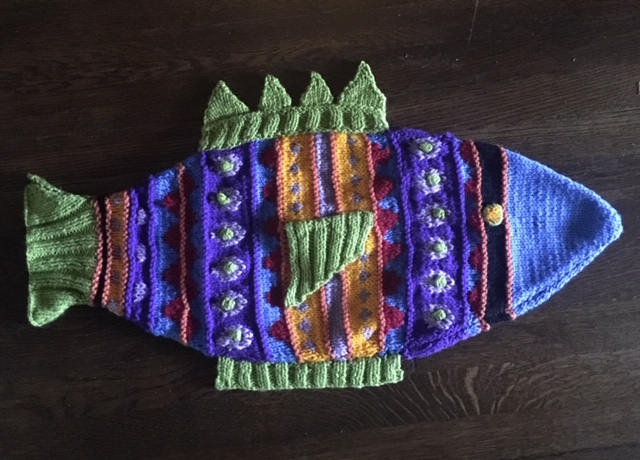
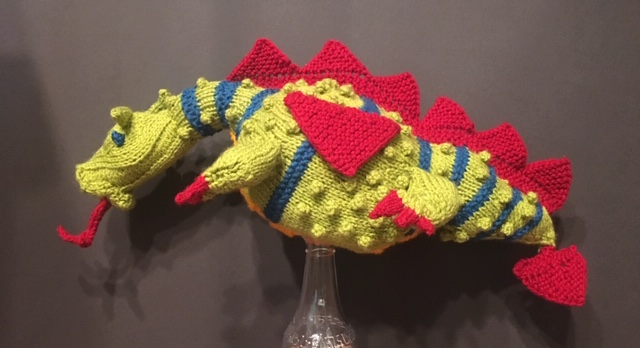
My friend Madora Lawson is a creative person, as are many of my friends. Madora is my friend who made a career of her creativity as an interior designer. She emailed to tell me that a post where I revealed that I rarely used a pattern prompted her to knit without a pattern. See what she made!

image2.jpeg

image3.jpeg

She cannot even remember how she made that dragon’s legs.

It works like that sometimes. We create something, make a series of choices in color and stitch and a dragon has toes!

The toes up top are from an aging walking group who took a weekend and learned to knit slippers from Madora. Each person had plenty of colors to choose from, stitches to try, closures. Being clever takes energy and courage. The reward is something fun lovely grand and strange.

Painting walls builder’s beige or gray is easy. Following decorator’s advice, copying a style. Even when it works, looks appealing and safe. Where’s the fun in that?

Creativity demands the courage to make another choice. The bright textile on the wall, the yellow button on a turquoise strap, the zig-zag dorsal fin, the peculiar combination of orange and electric blue mohair. It’s coming.

Who knows where one choice might lead? Solnit joined anti-nuclear activists in the late 1980s. They “did not exactly shut down the Nevada Test Site, our most overt goal, but inspired the people of Kazakhstan to shut down the Soviet Test Site in 1990. Totally unforeseen, totally unforeseeable.” It might argue for a certain recklessness, a measure of faith in accident and free choice.

In the mean time, I finished the central panel of BlueToo.

fullsizeoutput_101e

Fifty-some batik fabrics, five hundred pieces, and going-on two thousand yards of thread. So far.

LOLITA

Screen-Shot-2019-08-14-at-10.30.35-AM.png

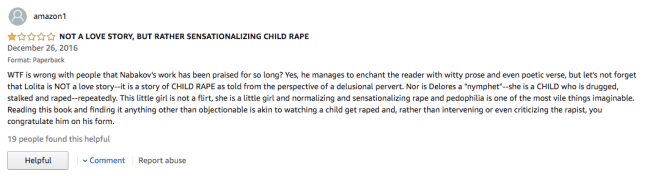
Literary Hub has an article up: “The 50 Best One-Star Reviews of Lolita.” The first time I tried to read Lolita, I did not get past in the first pages. I went to Amazon and read all 147 reviews, which gives you an idea of how long ago that was. I found they fell into three general camps: people who objected to the immorality of the story, people who loved the writing, and pedophiles. Reviews were not reviewed as they are now. Men wrote how much the novel reassured them that they were not alone in their sexual relationships with children. “Man-Child Love” advocates and rapists rationalized their behavior through literature. You can see it in responses to the one-star reviews.*

That name Hummer Humbert gave Delores, a 12-year-old raped child, has found it’s way into general usage as the name, Lolita, for sexually aggressive young women is perhaps ironic. It is also a horrible abuse of power.

Some argue that Nabokov wanted to see just how detestable he could make a character and still find readers, but ultimately, there are many things we can do but should not do. There is such a thing as judgement.

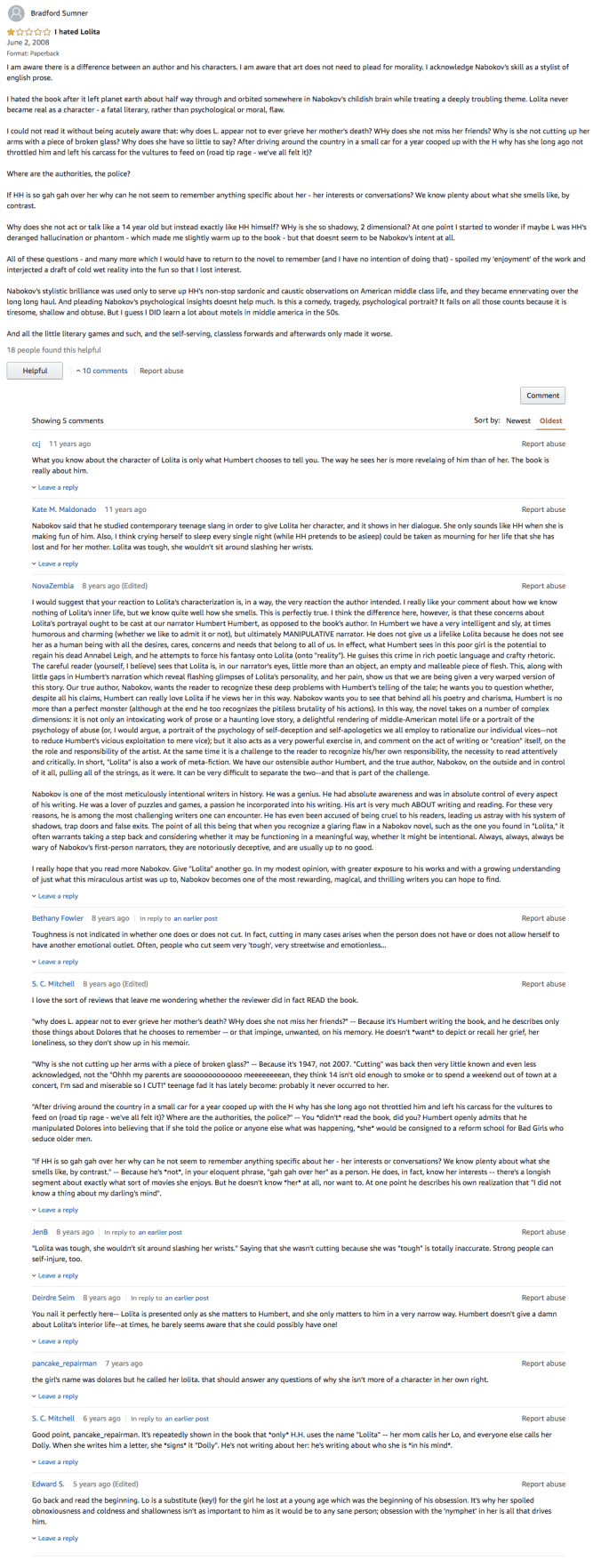
Here are a few of the reviews and comments on Amazon:

Screen-Shot-2019-08-14-at-10.49.37-AM.png

*Have a look at Edward S. just above. As a reader are you supposed to support HH’s obsession, or see past it as monstrous? I would like to think Nabakov was toying with his readers in much the same way that HH does with a child. It would be something if readers picked up on that, if they recognized how convincing evil can be. Well, friends, there are plenty of readers who fail to see beyond HH’s tale to feel shock that they have even temporarily sided with him.

Pedophiles inevitably find confirmation. They do not find HH monstrous, they find a kindred spirit. They can easily explain HH’s behavior. They are, after all, on his side.

STEP 6: Accident

fullsizeoutput_1019

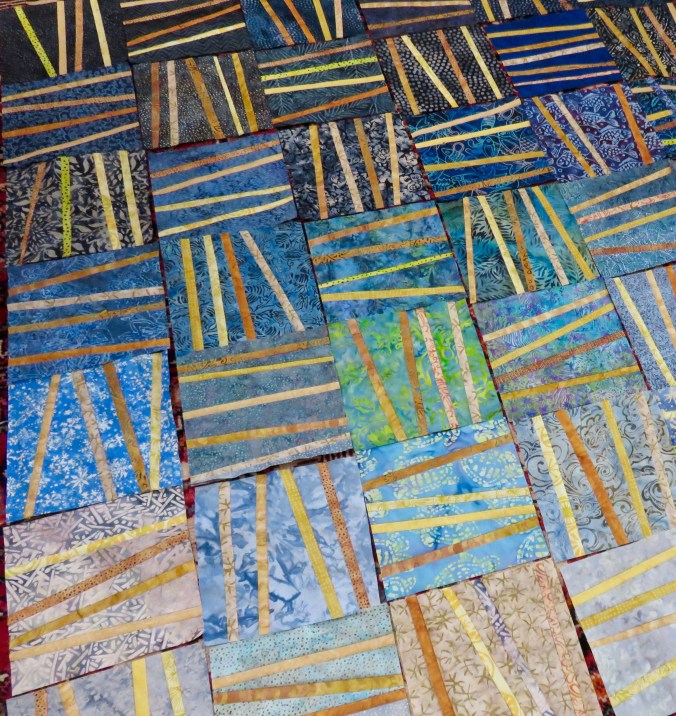
Above are a few of the forty-nine pieced square blocks laid out on the floor. The photo distorts them; they are each 8.5″ and carefully squared. So far I’ve used over sixty batik fabrics and cut over five hundred pieces of fabric. And this is only the center panel They will make a center panel 56″ x 56″ once they are stitched together, of an eighty-inch square quilt.

The second blue quilt was meant to be simple. I set specific, easy guidelines in order to piece it quickly and with a minimum of fuss. It’s that staring process, the decision-making at every cut and sewn seam. This color or that one, this way or that, rearrange and rethink the border? It was meant to be almost thoughtless but then the inevitable accidents. Most blocks were planned to be too large and I shave a quarter inch or as little as a sixteenth off the edges. A block might also too small or too dark or pushy or bland. I add another stripe or one going the wrong way, choose a different color or move the whole block to the other side of the quilt. Accident forces me to make decisions I might otherwise avoid, but accident has always served me as an artist. The writer Ron Carlson argues for something similar in writing fiction. Don’t allow serendipity to be cleaned out of writing. Let it flow. It is random chance that often hands us our finest work.

Decades ago, as a Metal Arts major, I was careless firing a base coat of enamel on square of copper sheet. The glass enamel color was called “Pigeon” a pale, perfectly transparent blue-gray. Fired over scrubbed copper it took on a lavender glow. Stenciled on copper, leaving some of the metal bare and then overfired to nearly 1700°F, the copper turned gunmetal-black, the enamel went palest blue-violet. The accidental firescale could be scrubbed off, leaving a line of black firescale on the edges of the enamel. I used that. Later, after deliberately overfiring sample tiles, I began using larger areas of firescale, enameling over the top and producing a unique metallic gleam. It was accident at first, and then a signature effect. It started by mistake.

Mistakes take time. Few are really useful. They are frustrating and not easily corrected. I have picked out stitches plenty of times making this quilt. Changed my mind in an instant. I could follow a quilt pattern or use a kit. There are plenty around that prescribe specific patterns and fabrics. I would not be constantly making choices, and choice is the hard work. But without choice, where’s the fun? I’m only barely interested in covering a bed. I am making art.

Mistakes push me, force me to reconsider, to change direction, to accept what happens sometimes and other times to fix it.

Mistake was at the first and will be at the last, so long as we don’t give up.

“The most important thing a writer can do after writing a sentence is to stay in the room. The great temptation is to leave the room to celebrate the completion of the sentence or to go out in the den where the television lies like a dormant monster and rest up for a few days for the next sentence or to go wander the seductive possibilities of the kitchen. But. It’s this simple. The writer is the person who stays in the room. The writer wants to read what she is in the process of creating with such passion and devotion that she will not leave the room. The writer understands that to stand up from the desk is to fail, and to leave the room is so radical and thorough a failure as to not be reversible. Who is not in the room writing? Everybody. Is it difficult to stay in the room, especially if you are not sure of what you’re doing, where you’re going? Yes. It’s impossible. Who can do it? The writer.”—Ron Carlson, from Ron Carlson Writes a Story