PANTS IN THE FAMILY

http---cdn.cnn.com-cnnnext-dam-assets-190716065029-hillary-clinton-official-portrait.jpg

In their official First Lady portraits “20th-century predecessors show a parade of cream-colored gowns, strings of pearls and periwinkle skirts. Clinton rocked a pantsuit in midnight black.”

As first lady, she chaired the Task Force on National Health Care Reform, pushing a proposed healthcare system some in the media dubbed “Hillarycare.” That failed, but she found more success with 1997’s State Children’s Health Insurance Program, and then the Adoption and Safe Families Act, and the Foster Care Independence Act.

She worked with the National Institutes of Health to ensure more funding for asthma and prostate cancer. She did not, in short, stay home and bake cookies. Evidence of her own career is visible within the official portrait itself: Her book, “It Takes a Village: And Other Lessons Children Teach Us,” lies on the table beside her.

I remember having scabbed knees almost continuously as a schoolgirl. I was not allowed to wear pants to school, and my dresses were usually torn open under their short sleeves. I played horses and ran around during recess. My mother liked to say I was hard on my clothes  I liked designing clothes for dolls but not actually playing with them.

It was my mother’s idea to get me a Barbie. I thought the doll’s tiny feet made to wear high heels, blue eye shadow, and bright red lips were stupid. Her hairstyle too. 

In the mean time, I had my Aunt Marcia, who lived in the Bay Area—Berkeley and later San Francisco. She was married to my Uncle Harry, but then lived alone. She was the model I wanted when I was a girl. Not Barbie, but an independent individual. Aunt Marcia made the single life an option, something possible and even elegant. She had affairs and a dog and she taught college Sociology. She empowered my daydreams of a single life as a person in my own right.

Hillary Rodham Clinton would have been a good model. Though I’m sorry for her philandering husband, I might like her better for forgiving her husband and supporting him than my aunt who was the one philandering. She was pilloried for saying: “I suppose I could have stayed home and baked cookies and had teas, but what I decided to do was to fulfill my profession.” She was a lawyer and she took her turn supporting her family. I did that too, taking turns with my husband as the primary breadwinner. I admire what HRC accomplished, both what she did and what she tried to do.

Who wears the pants in the family? Everyone. There are plenty of women  who still believe that men should rule their households. My parents did not subscribe to that division of power. My husband and I do not either.

A family should not be ruled. A family should work together toward shared goals. It should be loving and caring and productive, not a dictatorship.

STEP 5: doubt

fullsizeoutput_1017

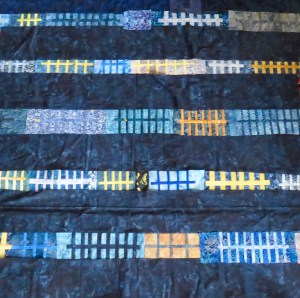
Here are the first two lines of seven. Maybe a little bland so far? Not quite what I had in mind? Once the squares are pieced and sewn, the effort in the first two rows is inevitably tame, inevitably distant from my vision. I began sewing the paler squares, the ones I like least. sigh

I fret and then will rush on to complete the more dramatic rows. I work vertically instead of horizontally, light into the dark. Maybe then I can find the stronger yellow-to-blue tension.

The inner wide border was to be two yellow or orange stripes on each pale blue bordering square (that’s the uncut band just in front of my feet). Now I think maybe dark blue stripes on the pale. Maybe three? Maybe even four? Maybe a narrow orange frame?

The narrower outer border? Four inches wide or thereabout. What do do about that? Color? Stripes? Once I have pieced all these squares, I might be stuck and will soon return to Blue Ladders, the other blue quilt.


More excitement from rentals. A neighbor filed a complaint about the people who pissed on our path, for the cars parked everywhere. This morning there are cars parked all over for another house, which would prevent a UPS truck passing. Not to mention a firetruck or Medic. Apparently there are rules about rentals and parked cars. Our neighbor will likely complain about this rental as well. People always assume it is me, but I have no idea where he is lodging his complaints.

Fireworks (illegal and all summer long) and people pissing in public . . . police and emergency vehicles will come if a life is endangered and that is reassuring. If only they can get here past the parking situation.


EMAIL

fullsizeoutput_100e

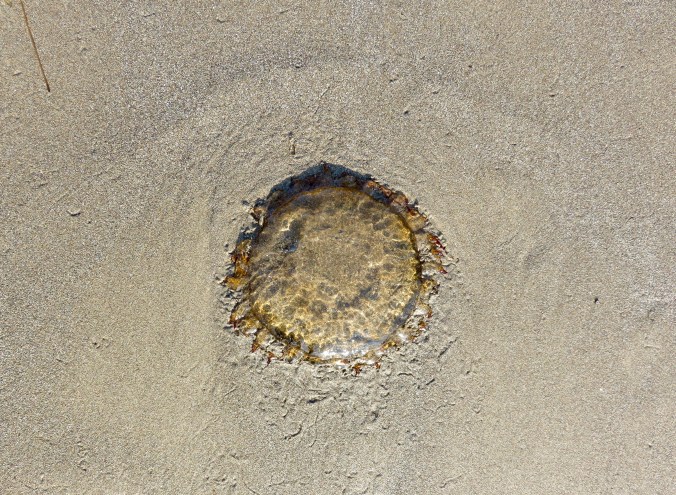
It’s a jellyfish, which is neither jelly nor fish, but common names are often like that. It’s actually a colony living together to make a shape. My dad warned against these orangey ones. They sting, even “dead” on the sand like this one.

I received a bulk email from a neighbor. He neglected to use the blind feature (Bcc) so better than three dozen people who apparently do not know one another except through him now have one another’s emails. (I should tell him my story about the Bonsai Kittens—a hoax my then-adolescent niece believed and sent out to well over a hundred people, outing their email addresses at a time people were particularly sensitive to junk email.) The original email promotes Biden as the best bet to defeat Trump. We do not all seem to be on board with that. I have disliked the man for decades and nothing he’s done recently restores any faith in his capacity for making wise choices or any vision.

A Canadian weighed in warning about the radical left. I wish he had been this Canadian:

My 91 year old father in law has been diagnosed as having a terminal illness.  He has lost the use of his legs and has a large cancerous mass in his lungs which cannot be treated due to his advanced age and fragile health.  We are having a lift installed to transfer him from bed to chair and back again.  He will receive 4 times a day care from nurses and aides and housekeeping services for him and my mother in law.  There are no charges for this, NOTHING, no deductibles, no co-pays, and no limit.  There will be no charges for his 3 weeks of hospitalisation either.  Sounds good?  Well, this is Canada, and this is how we treat people.  No one dies from lack of health care at any age, and no one ever goes bankrupt from medical expenses.  We all pay, and we all receive.

This person wrote in response to an article in The Washington Post about the murder-suicide of the elderly couple in Washington State. They explained they were overwhelmed by medical bills. Someone assured readers that they should have planned better in order to have better insurance.

It does not seem like a radical notion to provide health care for people in the richest nation on earth. I will also say that I had a medical emergency in Canada a long time ago. I was in terrible pain and a doctor came in to his office on his day off, took good care of me, and did not charge me a dime. Maybe he was just a nice guy. What a concept.

Before we go dismissing the “far left” for their crazy-impractical-radical notions, we might consider that most of, no, nearly all of the first world is already doing those things. Reducing greenhouse gases, cutting out unnecessary use of plastics, preserving parks and forests, healthcare for everyone, affordable public education right through college, better maternal and infant care, a rising life expectancy—we actually can afford it all and most of the world (well, not third world countries) does.

We are a rich country, but many poor countries take better care of their ill and elderly, care better for the environment, and have lower taxes. It’s amazing what a nation can afford when it does not spend more than the next ten wealthiest countries combined on military spending. Military bases in hundreds of foreign countries (would we pursue or even allow this in the United States?) cost enough to pay for the best medical care in the world for everyone, not merely the wealthy. New paint job for the President’s jets or healthcare? Do I have to choose?

Step 4: stalling

fullsizeoutput_100c

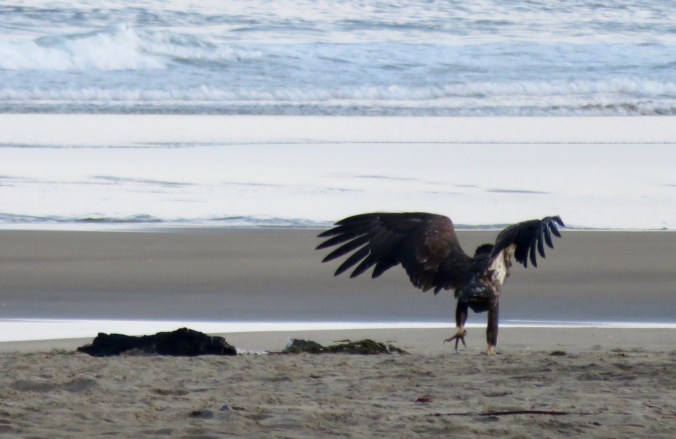
This is a new bald eagle, born this year and still in juvenile plumage. She was chased off by a tourist’s dog, but came back to feed soon enough.

This has been a bustling week. I am sipping ice water and Vera is playing on Acorn (my subscription runs out in a week or two). We are just back from an evening walk on the shore. Cool air blows in from the skylight and it’s hard to imagine knitting a sweater. Last weekend our younger son and his family were here and my grandson apparently thinks I am magic. He asked several times when his new sweater will be done. I think he expected me to answer: this evening or perhaps tomorrow. I told him perhaps by his sister’s birthday. That gives me until Guy Fawkes Day. I have four sweaters lined up. And just now the room is heated to over seventy degrees.

fullsizeoutput_1006I am stalling. Today I could have joined the blocks of the blue quilt at least into strips of dark dark blue and strips of lighter pieced strips. Instead, I have picked Blue Ladders up in stacks and laid out the beginning of the center panel of another blue quilt in squares. I won’t be casting on a sweater any time soon.

This has been a week. Monday was Scrabble. That was relaxing enough.

Tuesday, the neighbor’s dog Raven got lost. Gary went a little mad chasing around looking. He had seen the dog and recognized she was lost. The beach is overwhelming, sometimes even for local dogs and Raven is a rescue. But found again and safe at home.

Wednesday, we watched a paddle boarder thrashing about out past the surf line for an hour with increasing anxiety. He turned toward shore two or three times and paddled hard without making progress. He fell into the water over and over, a dozen times before I walked out onto the shore to get a closer look. Locals don’t usually surf this shore and maybe falling into the water every couple of minutes is normal? I called the Coast Guard thirty minutes after that, but then he seemed to change his mind and paddled south with the current. He’d been in the water a long time, but seemed to be wearing a wetsuit. Still, the danger was there, a current and an outgoing tide, night coming on soon. He came almost all the way in and then went out past the breakers again. I met others who were concerned. Cannon Beach Rescue showed up. He’d been out for over two hours by then and was a couple of miles south of where he’d first been spotted by a tourist staying well north of us. Eventually a member of the rescue team went into the water and swam to him towing her board. He finally paddled in on his knees and came ashore and I watched all that through binoculars. I called back to the Coast Guard, as I’d been asked to do. I apologized for wasting their time. The Chief Petty Officer thanked me for paying attention.

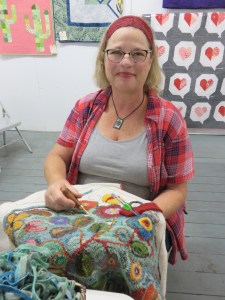
IMG_4672Thursday, we went to the Tillamook County Fair. I was a little disappointed in the quilts this year, but the rug tufters had lovely work, and as always I was tempted. (Just what I need, another project!)

The pony rides had all appaloosas. The veggies were delectable, the cows looked at me when I told them they were beautiful, but there are fewer cows brought into the fair barns than when we first attended decades ago now. This year there were no goats or sheep or pigeons, but a strong showing of pigs and chickens and rabbits. Lots of children were showing their calves and fully grown cows too. This girl (below) got several wet kissy-nudges from her pretty calf.

IMG_4679

The flowers are among my favorite exhibits. The Tillamook ice cream cone was great, but the onion rings came in a half-size paper dish. Those are my gavotte fair foods. Gary bought a new belt and Gary drove to Astoria to renew his driver’s license.

fullsizeoutput_1013

fullsizeoutput_1008

Friday, the sun set spectacularly and today we decided not to drive into Portland.

I have not touched my sewing machine since making a skirt for Ruby last weekend. Maybe tomorrow I will work on a quilt. Maybe I will even sew. Maybe I will only make tortillas and enchiladas. Maybe I will sit on the sofa and read. It’s been a week.

more . . .

What Toni Morrison wrote just after the 2016 election. She saw what was coming.

So scary are the consequences of a collapse of white privilege that many Americans have flocked to a political platform that supports and translates violence against the defenseless as strength. These people are not so much angry as terrified, with the kind of terror that makes knees tremble.

On Election Day, how eagerly so many white voters—both the poorly educated and the well educated—embraced the shame and fear sowed by Donald Trump. The candidate whose company has been sued by the Justice Department for not renting apartments to black people. The candidate who questioned whether Barack Obama was born in the United States, and who seemed to condone the beating of a Black Lives Matter protester at a campaign rally. The candidate who kept black workers off the floors of his casinos. The candidate who is beloved by David Duke and endorsed by the Ku Klux Klan.

I have to remind myself that Hillary Clinton won the popular vote.

The great tennis champion Arthur Ashe spoke long ago about being the first black tennis star. He warned that he was easy to accept—modest in appearance, “well-spoken,” and polite. He was acceptable as the token black man. There would be players in the future, he said, who would not fit so comfortably into the elite white world of professional talent. Yes, he saw the Williams sisters coming. It was not okay but accepted as inevitable that a few white players misbehaved. There was plenty of rudeness and poor sportsmanship among white (male) players long before Ashe’s gentle persona made an appearance and reminded people that tennis was a gentlemanly sport. But a few years later Serena raises her voice and suddenly the white world has hysterics.

Sometimes you need one foot outside the lines to see a bad call. Or to make a good one.

9 YEARS AGO

NINE YEARS AGO ON MY OLD BLOG I POSTED:

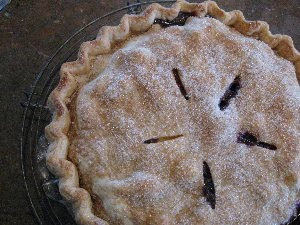
Today’s blueberry-peach pie. My family is of the opinion that a pie is done once it’s bubbled out of the crust. Yesterday I made pesto and apricot-gooseberry jam. Tomorrow… carrot-ginger jam.

8/8/2010: I woke this morning and realized that I didn’t have to run today [I was mostly running every other day until 2012], the weather is perfect, and I’ve spent my entire summer reading to prepare for the new school year and making jam. The jam is tasty, but I like making it more than eating it. The dog is not pregnant. The bathtub for the bathroom remodel is still in the garage. I haven’t written a story. I didn’t attend the Bellevue Arts Fair. I didn’t attend my 40-year high school reunion (that’s another thing, I’m getting old). We didn’t go to Lisbon. We didn’t go anywhere on vacation. I have two weeks before school starts up again.

I’m already tired just thinking about it, but I also look forward to getting back to work, to feeling useful and occupied. It feels good to be working a job I love.

A series of studies Dan Pink describes at RSA finds that once basic needs are met and people aren’t worried about money, money ceases to be a motivator for higher performance. It actually works in reverse—offer them more money and their job performance goes down. Yeah, weird. The study began at MIT but has been replicated all over the world such as rural India. Same thing. Extra monetary incentive for high performance doesn’t work when the work requires thinking. Assembly line tasks—more money, more work. Ask people to problem-solve, be creative, or think… and the whole scenario begins working in a way that seems counter to reason.

So pay people enough that money is not an issue anymore, and then if you want them to think harder and achieve really great things, you need a better motivator.

Instead of money, what motivates thinking people who aren’t worried about how to pay the babysitter or their overpriced medical care are three things: autonomy, mastery, and purpose.

  • Autonomy: Give us a challenge and just get out of our way—let us make our own choices about what to do. We want to be self-directed.
  • Mastery: It’s fun to do things well. That’s why we often work so hard at our leisure activities even though they do not “pay” us anything.
  • Purpose: Humans want to feel useful. We want to make a difference in the world.

What’s the lesson to be learned from this? Some of our traditional beliefs about leadership and motivation are turned on their head. Top down direction and money rewards work for the most simplistic tasks, but fail to address the need for creative and intelligent work in a modern society. To be fair, they aren’t working well for traditional cultures either, which include autonomy, mastery, and purpose in every job from cooking a meal to weeding a field. It’s the industrial system that has caused us to lose sight of the value of work because the end-game tasks are so divorced from the control and skill of the individual worker.

I have two weeks where I can wake up in the morning and decide what to do, practice doing it well, and look toward being useful. I guess that’s how I’ve spent my summer vacation.


Today I did not make a pie, but I took a walk. I made salal scones and eggplant Parmesan. Both turned out well, and we also attended the Tillamook County Fair this morning. I am fully retired, have still not been to Lisbon, and have heard no word about my 50th high school reunion that is coming up next year. I have made two kinds of pesto and six kinds of jam this summer. Nothing with carrots.

But yes, I still want independence, mastery, and meaning.

QUOTE

I know the world is bruised and bleeding, and though it is important not to ignore its pain, it is also critical to refuse to succumb to its malevolence. Like failure, chaos contains information that can lead to knowledge—even wisdom. Like art.—Toni Morrison, in a 2015 essay for The Nation

&

Word-work is sublime … because it is generative; it makes meaning that secures our difference, our human difference – the way in which we are like no other life. We die. That may be the meaning of life. But we do language. That may be the measure of our lives.—Toni Morrison, in her Nobel lecture in 1993

TONI MORRISON too

Toni-Morrison.jpg

Toni Morrison died yesterday at the age of 88. “Rest in power.”

When I began teaching English, I was already a great fan of Toni Morrison. I photocopied her entire first novel, The Bluest Eye, to use for one class and later was able to order classroom sets. A student came up to me after class and asked where he could find her poems. She doesn’t write poetry, I said. I mean that poem you read in class. He was talking about this:

Nuns go by as quiet as lust, and drunken men and sober eyes sing in the lobby of the Greek hotel. Rosemary Villanucci, our next-door friend who lives above her father’s cafe, sits in a 1939 Buick eating bread and butter. She rolls down the window to tell my sister Frieda and me that we can’t come in. We stare at her, wanting her bread, but more than that wanting to poke the arrogance out of her eyes and smash the pride of ownership that curls her chewing mouth.

The story is of Pecola Breedlove who will be raped by her father and utterly ruined. This is no spoiler. Morrison tells readers this on the very first page. Her concern is not what happens but how. She writes that why is difficult, but this is a novel about love and it is the how of love that she reveals in The Bluest Eye. Pecola’s brutal father destroys her. The narrator Claudia’s loving father protects her. Parents all seem harsh: “Adults do not talk to us—they give us directions. They issue orders without providing information. When we trip and fall down they glance at us; if we cut or bruise ourselves, they ask us are we crazy. When we catch colds, they shake their heads in disgust at our lack of consideration. How, they ask us, do you expect anybody to get anything done if you all are sick? We cannot answer them.”

The scene begins in iambic pentameter and ends a couple of pages later—

But was it really like that? As painful as I remember? Only mildly. Or rather, it was a productive and fructifying pain. Love, thick and dark as Alaga syrup, eased up into that cracked window. I could smell it—taste it—sweet, musty, with an edge of wintergreen in its base—everywhere in that house. It stuck, along with my tongue, to the frosted windowpanes. It coated my chest, along with the salve, and when the flannel came undone in my sleep, the clear, sharp curves of air outlined its presence on my throat. And in the night, when my coughing was dry and tough, feet padded into the room, hands repinned the flannel, readjusted the quilt, and rested a moment on my forehead. So when I think of autumn, I think of somebody with hands who does not want me to die.

There is enormous wisdom in these pages. It is not the most popular Morrison novel but one of the shortest. It shows up in standardized test questions and college courses. Many students have written essays about the novel in order to get into college. More have emailed me from college to thank me for introducing them to her work.

I taught Toni Morrison’s first novel for most of twenty-five years and assigned that opening passage every year I taught. It was one of the few disappointments of my MFA program that not a single person recommended her novels or referenced her work in a craft talk. Seriously. Not one.

Perhaps it was judged too high for graduate students to aspire to? In my own teaching, I always aimed above what my students thought they could do. Morrison always aimed high. The only path to excellence is to aim higher than our reach, to point the way to better than what we think we are capable of. Sometimes we surprise ourselves. I think many of my students were astonished at their own accomplishments. I hope they were.

Underestimating our capacity as a nation is equally problematic. When we assume that the United States deserves no better than a bully for a president, when we assume that it is too soon for a black or gay or woman president, we doom ourselves. We deserve better. It is the ideal upon which our country was founded. We deserve to strive and push beyond our comfortable complaisance into greatness. Isn’t greatness what the Founders had in mind?

Those eighteenth century wealthy white men aimed for a nation where people are judged by the content of their character rather than by their birth. Wasn’t that an amazing goal for such entitled folk who had all been raised to accept the divine right of kings? Of course they would not be comfortable in our society today, where a man dismissed as “white trash” can become president. (I am not talking about Trump who sits on a gilded toilet.) Their ideals far outstripped their capacity for justice.

Our ideals should always frighten us a little. I did my best as a teacher to break down complex tasks into clear and manageable steps. We must continue doing that as a nation. As Toni Morrison did in her novels: push the envelope, they say. Step out into our own idealistic world.

Step out.


“Toni Morrison, 88, winner of the 1993 Nobel Prize in Literature and the 1988 Pulitzer for fiction, died on Monday night at the Montefiore Medical Center in New York. Robert Gottlieb, Morrison’s longtime editor at Knopf, said in statement, ‘She was a great woman and a great writer, and I don’t know which I will miss more.’ Sonny Mehta, chairman of Knopf, said: ‘Toni Morrison’s working life was spent in the service of literature: writing books, reading books, editing books, teaching books. I can think of few writers in American letters who wrote with more humanity or with more love for language than Toni. Her narratives and mesmerizing prose have made an indelible mark on our culture. Her novels command and demand our attention. They are canonical works, and more importantly, they are books that remain beloved by readers.’ ”

“One of her most provocative public commentaries came during what she saw as the persecution of President Bill Clinton during the Monica Lewinsky scandal. In a polarizing New Yorker magazine essay, she observed that Clinton, his ‘white skin notwithstanding,’ was ‘our first black President.’

” ‘Blacker than any actual black person who could ever be elected in our children’s lifetime,’ Ms. Morrison wrote in that article, published in 1998, a decade before Barack Obama, the son of a Kenyan father and a white American mother, occupied the White House. ‘After all, Clinton displays almost every trope of blackness: single-parent household, born poor, working-class, saxophone-playing, McDonald’s-and-junk-food-loving boy from Arkansas.’ ”

She thought we would not be ready for an actual black president in her lifetime. Thank goodness she was wrong about that.

And I was wrong about Toni Morrison writing poetry. Here are five.

“In short, this is a full novel — rich, slow enough to impress itself upon us like a love affair or a sickness — not the two-hour penny dreadful which is again in vogue nor one of the airless cat’s cradles custom-woven for the delight and job-assistance of graduate students of all ages.”—from Reynolds Price’s review of Morrison’s Song of Solomon (1977)

WELL REGULATED?

Embedded video

Chant of “Do Something!” breaks out as OH Gov Mike DeWine speaks at a vigil in .

from a reader comment on The Washington Post:

Do something.
What do you want done.
I suggest
Ban assault type firearms like AK-47
Limit clip /magazine capacity.
Pass a federal Mulford Act type law that Reagan signed when governor of California which mandated  5 years in the clink for anyone carrying a loaded gun in public.
Close gun show loophole
Mandatory background checks.
Put assault type weapons under the 1934 National Firearms Act which required owners of machine guns and short barrelled long guns to  register with federal authorities and submit to fingerprinting.
Treat assault weapons the same way.

It will not be enough, but we need to do something.

What we have among the NRA gun advocates is a sickness. It is a perversion. It is a misunderstanding of history and a complete lack of common sense. Guns do not make us safer. Though a gun lobby Act prevents the government from compiling statics, we can be pretty sure that the number of guns in private hands contributes to unnecessary  death.

Until a few decades ago, only the gun lobby thought indiscriminate gun ownership was an absolute right, and they have spent fortunes getting their way. It’s time they were stopped. The second amendment did not come first in the Bill of Rights. It should not be the only right American citizens value. It should not be valued over human life. It does not reflect our current needs or the threats we face as a nation. The founders had something very different in mind when they wrote in a protection for the right to bear arms. Single shot, muzzle loader. A well-trained archer was more deadly in the early days of our nation. (No joke. Look it up. And then there is the “well-regulated militia” that we no longer rely on since we have a standing military larger than most of the rest of the world put together and hundreds of bases all over the world, including in countries with which we do not have diplomatic ties. How does any of this even make sense?)

Something must be done and now. However, if we simply ban the “bad weapons” we will continually be at the mercy of money-and-power-motivated people who will find a way to skirt the law.

It has always seemed to me that we are dealing with the very real threat of dangerous weapons backwards. Instead of saying people cannot have this or that, be positive. Approve guns. Don’t ban them. Allow the “well regulated” ownership of hunting rifles and occasional handguns. Allow ownership among people who meet a minimal standard of behavior and fitness, safety protocols and training. Make this need-based. Allow ownership among sports hunters, subsistence hunters (such as the local hunters I know who fill their freezers), people with occupations that put them at risk such as locksmiths, and collectors.

Do not approve sales to anyone of weapons that have no practical application. Several years ago on Facebook I made a similar statement and a former student responded that every hunter needed an assault-style weapon when going after deer. And then I just sat back and watched other former students who actually had hunted deer their entire life tell him he was wrong. (They might own them, just for fun, but useful for hunting? There wouldn’t be meat left to eat!)

I probably know people who will object to my proposal, but most of the actual hunters I know would be onboard, I think, even if they had to give up a couple of toys. The government should approve them, buy back the ones civilians should never have had in the first place, regulate them well.

“It’s really just scapegoating people with mental health issues,” says Dr. Seth Trueger, an assistant professor of emergency medicine at Northwestern University. And while rates of mental health conditions such as depression, anxiety and suicidal behavior are on the rise in the U.S., Trueger says other nations have similar problems and experience far fewer mass shootings. “Other countries have the same kind of mental health issues we have, the same kind of violent video games we have, the same religiosity that we have. All that stuff is just a distraction” from the need for better gun control, he says.

That position is hardly new. Studies show that a relatively small percentage of violent crimes are perpetuated by people with diagnosed mental health issues, and that gun access—not mental health symptoms—is the primary predictor of firearm violence. As a result, an increasingly large and vocal cadre of doctors has been arguing for years that gun violence is more an issue of access and regulation than it is mental health. Groups including the American Academy of Pediatrics and the American Medication Association are active in advocating for stronger gun laws and more widespread violence-prevention programs, and the American Psychological Association regularly cautions against blaming mass shootings on mental health.

“Routinely blaming mass shootings on mental illness is unfounded and stigmatizing,” read a statement the APA issued on Aug. 4, after the Dayton tragedy. “The rates of mental illness are roughly the same around the world, yet other countries are not experiencing these traumatic events as often as we face them. One critical factor is access to, and the lethality of, the weapons that are being used in these crimes. Adding racism, intolerance and bigotry to the mix is a recipe for disaster.”—Time