BIRTH RIGHT

IMG_4630

The beach is empty when we go out most days. On weekends there are crowds sometimes. Houses owned by people who do not live here sometimes have a dozen or more “guests.” The world is more crowded, but it doesn’t have to be.

I have always supported abortion rights because I believe all children should be born wanted. No child should be born because their mother made a mistake or a man did or because she had no choice. Despite statistics suggesting that many (or even most) pregnancies are unplanned, it has always seemed to me that a person should not ever be born into this world because of an accident.

In 1976 Adrienne Rich wrote, “We need to imagine a world in which every woman is the presiding genius of her own body. In such a world. . .sexuality, politics, intelligence, power, motherhood, work, community, intimacy, will develop new meanings; thinking itself will be transformed.”

An article posted today suggests another reason that birth control and abortion rights are critical:

I simply could not have existed, as I am, in any other preceding time or place. . . I could have been a professional writer at any period since the 17th century in Britain or in France. But I could not have combined this latter with a life as a sexually active woman until the introduction of contraception.—Angela Carter

The third excellent reason, perhaps the most critical reason, comes up in most articles discussing women’s health. When given the choice, women have smaller families because they can do better for two children than for six. For every kid who grew up in a large family, loving every minute there is an overworked parent. For every one of those happy-childhood kids there are a dozen with worse memories, with fewer opportunities, with hunger and necessary neglect. Often the boy of the family is spoiled—so common it is a cliché—because for some reason the parents know that child is the last. Hysterectomy, in past generation, was a common stopping point.

Paley had an abortion when she was married, pregnant for the third time, unwell, and “exhausted with these two tiny little kids; it was just about all I could do to take care of them. . . My whole idea in my heart had always been to have five, six children—I loved the idea of having children—but I knew I couldn’t have this kid.”

The planet could do with fewer humans in it. World population has quadrupled in my lifetime and is chairing ahead toward ten billion before the end of this century. The depletion of resources, global warming, starvation, disease . . . population is always controlled. Better women had the choosing and control.

Yet this morning I read in a national newspaper that Japan is alarmed that women are choosing not to marry and have children. The author puts blame this on a culture where women are expected to shoulder the burden of housework, childcare and elder care. It is possible that men are making the same choice, but the article did not explore that possibility. It is possible, too that overwork makes marriage and child raising a challenge for almost everyone in Japan. Yet, throughout this discussion, the fact remains that Japan is seriously overpopulated, that it is as highly vulnerable to global warming as any country. (Tokyo will not likely be under water in fifty years, but Shanghai and many European and American cities will be. New Orleans anyone?) It cannot produce all the food it needs to feed its population. People choosing to remain single and without children, despite inconvenience to the labor force, is probably good news.

Birth control, reproduction as a choice instead of as a burden is an inevitable result of opportunity. And not everyone wants that opportunity to be available, particularly not for women. Barefoot and pregnant was very much a strategy for keeping women down.

“What men frequently do when they want to manage and govern women,” Toni Morrison has commented, is to “focus on their babies—whether they’re having them or not having them. Reproductive organs become the focus.” Adrienne Rich wrote that “Women are controlled by lashing us to our bodies.”

My community is far more populous than it was when I was a little girl or when my mother was small or before that when only one person lived here alone in the nineteenth century. Of course, he is rarely counted because he was a Native person. None or one or two children. That is what we are entitled to. Having a large family in this world today is a sin against the planet and our future on this planet. I believe that, have believed it since I was a young girl and first understood the population bomb. I watched the woods and pastures where I had played be paved over, split level homes springing up like dragon’s teeth in a terrible mythology.

Give us emptiness. Give us land not relegated to “highest and best use” which translates as development and dollars. Give us wild place of beauty and possibility.

A little peace and quiet please.
VISIT the WC

IMG_4635

Each of our sons has brought his family for a visit this summer. For several summers we have hosted everyone at once, including cousins. After last year’s reunion, we acknowledged to one another that we were just too old (too tired, too house-proud?) to have thirteen people in our home. We are sorry to let that long weekend go but relieved too.

Friday, our younger son and daughter-in-law brought their two. Ruby has been in the ocean a dozen times, never wearing a bathing suit. She told me she only wears her suit in a pool or “a lake or something.” There has been one dress or another hanging on the line since Friday afternoon. Logan is content digging in sand and collecting crab claws. He is a preschooler and pissed at the cape, well below the high tide line. There is an excuse for little children the better part of half a mile from a toilet.

Last evening, before the sun set and well before darkness, fourteen people and three dogs staying in a local rental house partied on the beach. They were loud and drinking and put an entire log on their fire. One very drunk woman walked up our path and deliberately used our sitting log as a partial screen while she pissed. From my window I watched her reveal her pale butt and simply could not believe it. I walked out to tell them that I lived here and my grandchildren played where she pissed. She said she was sorry. Sorry? “What were you thinking?” I said. “What do you want us to do?”

In November this might not be such an issue. In late fall and winter, the tide washes up high into the rocks above where this woman squatted. But this is August. The tide mostly leaves fifty or a hundred yards of dry sand, with the occasional sneaker not coming anywhere near that spot. Which is to say: We should not be expected to live with her drunken blunder for months.

People on vacation. People out of the city. People to whom the rules of common decency do not apply. They were, perhaps unsurprisingly, a youngish, affluent, white group. Fourteen adults, one of whom could not be bothered to walk back to the rental house to take a leak. People who think it’s okay to piss in public if there is not so much of the public around.

In past summers children have built rock castles in our path, adults have accidentally kicked rocks into it. A man once built a fire in a wind-sheltered spot in our path through our hedge (which is not actually public property). People have come into our yard to take wood for their own beach fire and routinely dismantle laid fires we have set up on the beach.

Clearing our path and setting the log with stones to make it steady was the work of several days. That log has been used by many people this summer. Old couples have rested there. Young couples have sat and watched the sun go down. We have sat on the log ourselves, of course. Gary vows that this is the last year he will build a “fort” for our use. It’s too bad.


STEP 3: moving stuff around

fullsizeoutput_ff3

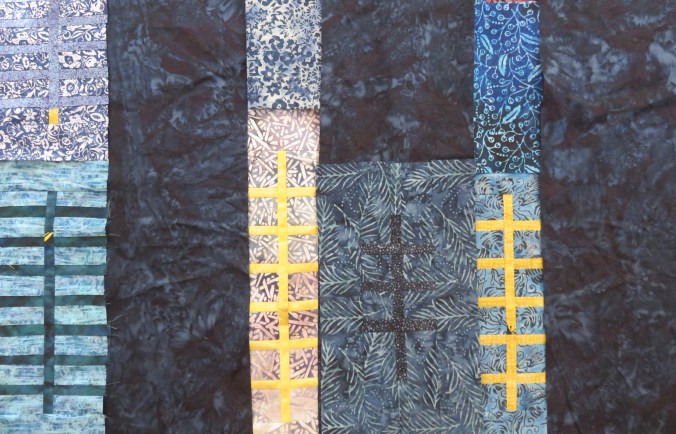
These batiks are entirely from my stash—some of the fabrics are decades old, off cuts from previous work, scraps smaller than a sheet of paper. So far, they are individual blocks that look messy because nothing is trimmed and sewn together. The wider dark bands will not be so wide once they are joined. The lines will be straighter. The colors are close.

This could go on for days or weeks.

About half of my blocks are done—the blue-and-yellows photo shows eighteen of twenty completed so far. I might piece thirty more blocks, but twenty would work for the front.

There are two more lines of narrow pieced blocks to make. And then the dark-on-dark wider strips. I might have all the blocked pieced by next week. Since the pieces are not attached to one another, I can move blocks around. The large wide one in the lower left quarter of the photo looks too light for the wide dark bands. I might cut it down narrower or find another place for it. Perhaps both. Deciding exactly what will go where is an ongoing consideration.

Usually, I end up with more blocks than places to put them in the project they were designed for. I have a strip of pieced squares from a cherry-blossom quilt. I used leftover squares from my grandson’s quilt to make a bank for his stuffed toy. Everything finds a place eventually.

The “Rain” quilt lay on the bedroom floor for weeks while I decided about the stripes, rearranging them, shifting colors. Below, on the left, the first iteration with strips of colors for the center panel laid in place. On the right, the final choices, stitched into blocks but the blocks not yet joined. There would be a double border too, also pieced.

And then there is piecing the backing. (I am already trying to find a way to avoid that task.)

fullsizeoutput_ff7

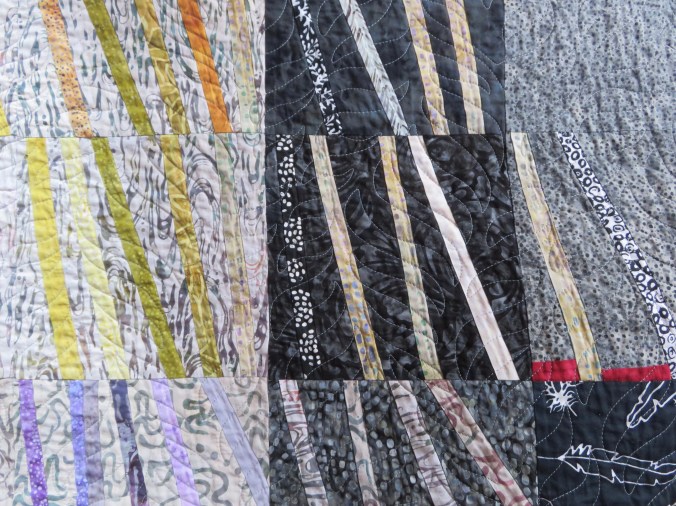
Close-up of “Rain.” Left is center panel, middle is first border, right is second border. I had to purchase only a half yard of dotted gray fabric to complete this quilt, the rest from my stash.

CLEARING THE DECKS

fullsizeoutput_ff1

I could have posted the photo of the crow parents showing their offspring a pair of running shoes on a log or the passage of pelicans. Instead, a pattern in the rock.

Yesterday Gary drove to Astoria and waited an hour to hand over our two cable boxes. I did not renew Acorn (which is why I watched all of Poirot last week). I stopped our subscriptions to Washington Post and The New York Times. I receive free regular information from Smithsonian and The Guardian and blogs and poetry journals, and we will continue to support several charities. From Smithsonian:

Keeping you current

Ethiopia Plants 350 Million Trees in 12 Hours—a New Record

The government claims that volunteers at 1,000 sites participated in the coordinated reforestation efforts

I tried watching the debates this evening but the first hour was taken up with arguing about whether Americans should be “forced to give up our chosen health insurance plans.” I wonder what America these people (the questioners and some of the candidates) live in? I do not know anyone who actually has much choice about their insurance plan. Maybe if I owned a large company I could chose. Five years ago when I had insurance through my employer, I could chose from three levels of one plan. I was allowed so many dollars to spend and I could bet I would get sick and spend my entire allowance or bet I would be healthy and take one of the cheaper plans and pocket the difference. It wasn’t much of a choice but it’s more than most Americans have.

Most of us, if we even have insurance through employment, are, A) stuck with whatever our employer offers. Or if we are buying insurance on the open market, B) our choice is between coverage that costs more than we can possibly afford and a plan that takes half our salary. Not much of a choice for anyone.

People work at jobs and in places they hate because they cannot afford to be without insurance. They work longer hours than they should because they need so-many hours to qualify. If they choose to cut hours to take care of family or are sick themselves or find a job they like better and lose coverage, they risk having to do without.

That’s not choice.

One candidate repeated that Medicare-for-all would close hospitals. This has been proven to be untrue. Hospitals would like us to believe it’s true, but it’s a lie. (Even my local hospital is the sleekest, most modern, well-appointed building in the area. Private rooms are nice and all, but medical care is supposed to be their goal, and I have had too many dealings with them, have witnessed too much in the ER.) Another claim was that Medicare-for-all would be easy and cheap, which is probably also untrue. Change is always hard.

What everyone agrees on is that the current system is better than it was in the past but not nearly good enough. We need to change the system to ensure that everyone receives the care they need and the insurance companies should have no say in how that is done. I would argue that sometimes the hard thing is exactly what we have to do.

Some years ago now, a single woman complained to me about how unfair it was that married people with children (me) had their entire family covered while she only had coverage for herself. She should receive a discount or be paid more. I pointed out that my entire family’s medical costs over the previous five years were less that hers had been in the last six months. (True, though not typical—but she had a raft of health issues, some of which were the result of her own unhealthy choices.)

She said: “Insurance companies don’t care how much my care costs.” Say what?

Insurance companies exist to profit. I buy insurance to ensure that I am not financially ruined by the costs of medical care. In case people didn’t know, medical expenses are the single most common reason people in the U.S. declare bankruptcy. It’s a gamble—break a leg, have a child with serious health issues, a mystery illness . . .

Insurance is a gamble where the house always wins. These companies do not exist to help anyone but themselves, they exist to make a profit. Long before our collective premiums add up to less than our health care costs, the premiums have been raised to ensure that the company can skim its percentage off the top. (Is their profit margin 23% as was claimed last night? I wish my savings earned such a return!) I do not smoke or drink to excess, I exercise daily, take no prescription drugs, and have no chronic health problems. This saves me a few dollars a month for my supplementary catastrophic Medicare policy. But if I were thirty years old and diabetic and looking for health insurance? Ouch.

Medicare has operating expenses of 2-3%, insurance companies take 23%. The math is simple here. Whatever system we come up with to replace private insurance will cost less per person while covering everyone. Will unions renegotiate pay once their employers no longer pay medical premiums? You better believe it. Will taxes go up? Probably, for many they will, but my employer paid well over ten thousand dollars for my insurance. It would have been nice to have yearly cost-of-living raises, and I might have had them if they had not used my medical insurance costs as an excuse to hold back. You think?

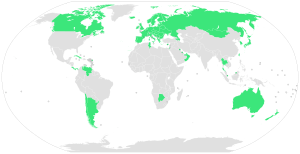
The average person in sixty-three countries receives care through some form of Universal Health Care and pays a fraction of what we do here in the United States. They live longer and healthier lives, their babies die less often, and they do not have to worry about a change of work costing their coverage. It is foolish to accept the argument that what works in dozens of other countries cannot work here.

Sure it can.

600px-Universal_health_care.svg

Nations with universal healthcare.

My husband and I have done our best to simplify our home and our lives. But terrible things do happen even when we have ever-so-carefully planned otherwise. Insurance is a way of playing safe against the risk of losing everything. The problem in the United States is that playing safe costs us more than it should—in dollars and peace of mind.

STEP 2: cutting

fullsizeoutput_fea

I particularly love this batik fabric, but I used a favorite speckled fabric for the bars, and a bit of yellow. There are not many yellows in my stash, but I mean for this to be a blue and yellow quilt.

An email this morning showed me a knitting pattern I liked. I never knit from patterns, but I often use patterns to push myself in a new direction. This one has a fancy design on both the body and sleeves. What I found interesting was the raglan sleeve shaping and that it is knit top-down. That is something I never do. I bought the pattern and discovered it has short rows, something else I have never done before. Two new skills!

I am up for that because I recently learned to do a twisted rib and I am eager to incorporate that into a sweater. I have the yarn and it’s green. But I also have yarn for a Koigu and kid mohair-and-silk sweater in smokey violets. The gauge for the purples is close enough to the gauge of the new pattern, so I watched a YouTube video about German Short Rows linked in the pattern. Very easy, very smooth, and the woman said, when it got a little counterintuitive, “Trust in the lord and keep knitting.” I am not religious, but the sentiment delights me.

Trust the process.

The quilt is coming along. I generally prefer to piece square blocks, but this time I am working in random-length rectangles. It may not sound like much of a challenge, but the shapes are pushing me outside my comfort zone. At least two blocks a day should see me done by the end of August, front and back too perhaps.

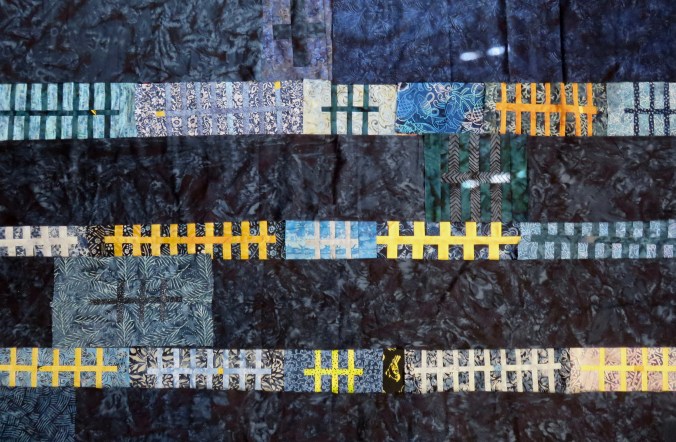
fullsizeoutput_feeHere are the first few blocks laid out in stripes. I have begun cutting and piecing, eight blocks so far. Laying out the pieced blocks on the floor tells me how far I have to go and how different combinations of hue and value work. These blocks are not sewn together and they will be moved around as I work. I mean to alternate wider and mostly solid dark stripes with narrower and mostly pieced stripes. Some fabrics are so charming in their pattern I will include them as whole blocks rather than piecing.
I should name the pattern I am piecing—in fact, it probably has a name, but I have never seen it before. It is an embellishment of Chinese Coin, a traditional quilting pattern of multi-colored horizontally-striped vertical bars alternating with solid vertical bars. But really it is a pieced version of a pattern I wove into the center of a weft-faced rug that was itself based on a Colonial American doubleweave coverlet pattern called Snowball and Pinetree. I enjoy reinterpreting traditional textile embellishment from other sources—weaver’s log cabin used in a quilt, knitting a quilting pattern of equilateral triangles, a common fabric piecing design. (I should have kept that sweater purely for the pattern. My family found it ridiculous, however, so off it went to a charity.)

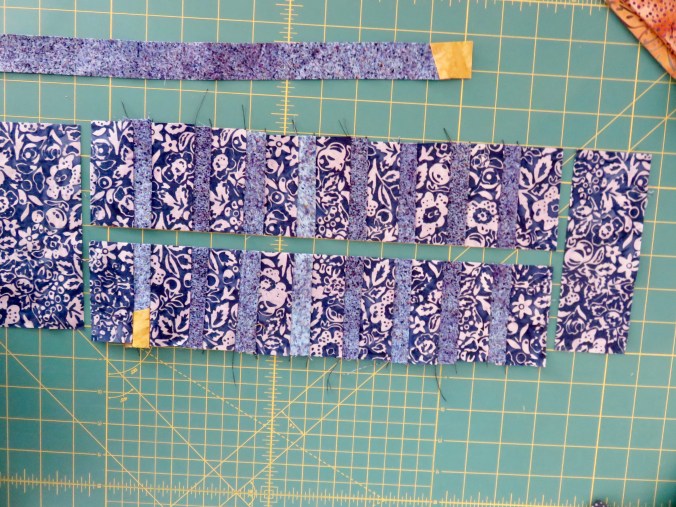
The pieced blocks will have skinny vertical lines crossed on the horizontal such as the yellow on blue in the photo. There is also a wide blue-on-blue block between the two yellow ones in the photo. Some of the center bars in the pieced blocks have a spot of another color—the yellow tip of a speckled blue bar upper right (part of the block shown half-finished in the photo above) and a bit of yellow in the dark blue bar of the block just south of that one. I will use about fifty fabrics in this quilt, all from my stash. The backing too, I hope to piece from my stash. Even the thread I am using is leftovers. Black so far, and on my second bobbin.


WHAT WE WANT

Amazon rainforest turned into farmland

Headlines in the United States concern politics, specifically disappointment that Mueller testified exactly as he said he would. It’s all in his report. The man in the Oval Office is a liar and cheat and does not care what happens to anyone so long as he’s at the top of the news. The news in the United Kingdom is about their new Prime Minister and the record-breaking heat. A few headlines down find concerns about logging in Brazil:

Deforestation of the Brazilian Amazon has surged above three football fields a minute, according to the latest government data, pushing the world’s biggest rainforest closer to a tipping point beyond which it cannot recover.

Amazon deforestation accelerating towards unrecoverable ‘tipping point’The Guardian

The photo above shows a vast area turned from forest to farmland. That forest feeds oxygen to the world, converts pollutants to pure cooler air. We need a stable climate, we need to preserve a livable world. The ocean of humanity needs the ocean’s temperature to stop rising. If humanity is to survive we need our appetites to cool. As Americans get fatter, farmland grows to feed our desires. This is not about need, it’s about what we want.

We know that plastic bags, meat production, air conditioning, driving, flying, use of fossil fuels in general contribute to global warming. Endangered tropical hardwood on the dining room floor. Some of these activities are more avoidable than others. Some of these activities are more damaging than others, but we don’t want to stop.

Assuming the plane is full, an individual’s share of a single one-way flight from coast to coast of the U.S. contributes greenhouse gases equivalent to driving a car for a year. We would still have to get home, so that’s another year. Airports and air travel have always been subsidized by our taxes. Like the tobacco industry, we aggressively protect the things we want, whether they are good for us or not.

Like our president, we want what we want and we do not want to hear the nay-sayers. We will contribute to the cause in some way that does not cost too much and make up for our use of endangered hardwoods or vacation to Europe or steak at dinner, the plastic bottles of fizzy water my husband is fond of. There are alternatives, there is sacrifice, but like most people, we don’t want to bother. We want what we want.

fullsizeoutput_fe9

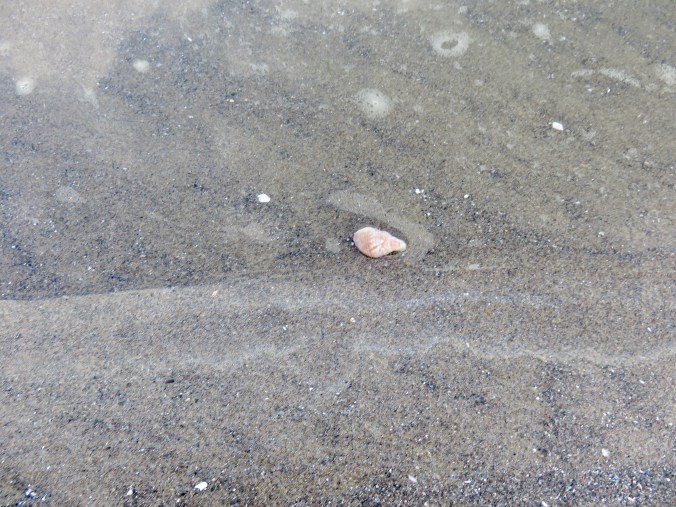
I wanted this little shell—delighted to find a whole snail shell. It is occupied by a hermit crab so I put it back into the water. You can just barely see its legs to the left of the shell. The little hermit crab just wants to live.

SENTENCE

1920.jpgThe current cover story of The Atlantic describes the crime most likely to escape prosecution. It’s rape. And not for any of the reasons we have assumed for so long. People are no more likely to lie about having been raped than any other crime, but police are far more likely to think a rape victim is lying. Think about it. If someone says their sister was murdered or robbed, is the initial reaction doubt that the death or loss of property occurred? If you saw someone you actually recognized running off with your television, would that mean the police would not bother to investigate the theft?
And if that same person stole someone else’s television, and another, and another . . . ? Except what is stolen during a rape is person and privacy and a sense of safety and well being. The crime is violation, and often by someone known to the victim, which results in police assuming it’s probably untrue or a one-off and not prosecutable. And the police would be wrong about all of that. Often the rapist knows his victim and the next ones too. Unless he is stopped, he does not stop.

Each year, 125,000 rapes are reported across the United States.

In 49 out of 50 cases, the assailant goes free.

These figures are a sobering reminder that, even in the era of DNA testing and #MeToo, rape is the easiest violent crime to get away with. In her cover story for The Atlantic’s August issue, Barbara Bradley Hagerty offers a sweeping, heartbreaking analysis of why so few rape cases are investigated by police, let alone brought to trial.

What she discovers—from her dozens of interviews with victims, police officers, prosecutors, and researchers—is law enforcement’s abiding skepticism of women who report sexual assault. And evidence shows that reported predators often go on to attack again. “How many rapes could have been prevented if police believed the first victim?” Hagerty writes. “How many women would have been spared a brutal assault?” Her piece is an unflinching assessment of the nation’s collective inaction and a guide to where we might go from here.

Jeffrey Goldberg
Editor in Chief, The Atlantic

Also in the news: a woman in Arizona is convicted of having sex with a thirteen year old child. I haven’t read the story, but she was sentenced to 20 years in prison. I would assume she will have to register as a sexual offender.

A woman Gary knew in Tillamook County was stabbed and killed in front of her two little children. Her ex-husband drove to town, bought beer, and drove then to his father’s house: “I killed Judy.” The man was sentenced to 5-7 years for murdering his former wife. He threatened to kill everyone associated with his case, but got out of prison early on good behavior and immediately sued for custody of his children.

It makes me wonder.

STEP 1: vision

IMG_4589

The first step is staring at colors. This might last for a few days or weeks or even years. I had the defining fabric for my “Rain” quilt waiting for at least twenty years before I figured it out.

The patterns of these collected blue fabrics are all over the place: sea shells, blueberries, stripes and sailing ships, speckles and dots and stars, flowers, leaves, swirls and zig-zags. The flying geese fabric might be thirty years old—batiks, as best I can recall, were still relatively new on the market. The fabric itself is somewhat heavier than what I find today. They are all batiks. The yellow birds on black are a color on black—a combination I rarely find these days—purchased for my youngest grandchild’s baby quilt several years ago. One bird for this quilt.

The process is slow, but much of my process is invisible. I have laid out fabrics for weeks at a time, once I figure out the pattern. I think about what to do until I can construct the quilt in my head, and then I build that vision relatively fast, usually in a few days. Years ago a non-artist friend complained that I had completed a gouache painting in a few hours—yes, but she did not count the staring and the thinking, or even the preliminary sketches. She didn’t see any of that.

I have to see the work entire before I begin the easy part, that making.

A compilation of squares and rectangles, each with an X in the middle? I’ve done that before. All squares with skinny bands? I’ve done that too. Alternate the bands horizontally and vertically? Grade from light to dark? Shift the size outside to inside or top to bottom? I never use patterns and I am not generally fond of blue, so this one is particularly tricky. I have reorganized these colors since I took this photo. There are a few turquoises and purples mixed in with the cobalts. There is also a stack of yellows and golds, by way of contrast. I would like to add hits of orange.

I’ve been messing with these colors for well over a year. Gathering them longer than that, without those fabrics admitting they want to be anything. The other day, while dozing half-awake before dawn, I envisioned a blue quilt based on the old “Chinese coin” pattern, narrow bands of stripes, skinny on fat and divide by bands of solid color. That idea makes me squirm, so it’s probably the one I should pursue. The temptation is always to choose the easier option, and I have to work hard to resist doing the fast and easy thing. I have considered making two blue quilts—the easy one in squares, the harder in stacks of coins.

I’ll let you know.

FAIR PLAY/FAIR PAY

Photo_51_x-ray_diffraction_image.jpg

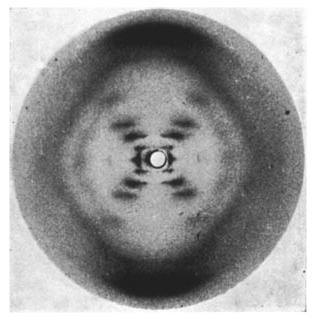
Photo 51, showing x-ray diffraction pattern of DNA. Photo 51 is the nickname given to an X-ray diffraction image of crystallized DNA taken under the supervision of chemist Dr. Rosalind Franklin. It was critical evidence in identifying the structure of DNA. Dr. Franklin was not credited for this work by two men who later won the Nobel.—Wikipedia

“Our science can only benefit the whole of society if it’s done by the whole of society. And that’s not currently the case.

—Dr. Jessica Wade, a British physicist who has added 670 profiles of women and people of color in the sciences to Wikipedia since 2017

Women and people of color are underrepresented throughout Wikipedia, which is an issue Wade and others hope to repair. Dr. Franklin is there, but for many years her pioneering work, and especially her contributions to the discovery the the double-helix in DNA, was not properly acknowledged.

As a girl in the 50s and 60s, I was fortunate to be aware that women had made scientific contributions.

My father cited a UK researcher who had published as a young woman, then later under her husbands’ names, and how he wished she’d stuck with a professional name so that her work was not scattered all over his library.


I learned two lessons from that brief story: women are scientists and a public name need not indicate a private identity. I used to tell that story when students asked me why my last name was not the same as my husband. (On a good day, I could cite eight or nine reasons I kept my name.)

GETTING ON WITH IT

IMG_4567

From Wallowa Lake Lodge looking north as the sunrise does what it does, taking over the sky.

We meant to wait until Monday, though originally we thought we would have most of the furniture back into the kitchen and dining room yesterday. I had to put a second coat of varnish on the new piece of baseboard, the parts of the room that waited for proper cabinets. That’s been a twenty-year, thirty-five-year project. The cabinets finally in, but the base boards only finished last week. Then, after varnishing the rooms’s floors and baseboards, I came back for a second coat and got a little ambitious. Monday I put another coat on most of the floors. A week to cure and we thought, well, Monday is not too late for company coming Tuesday . . .

That’s confusing, huh? Yes, for us too. The floors were all dry enough today to walk on with bare feet or socks. The furniture around the edges of the room—huge pantry bookcase, pie safe, fridge, could come in without waiting because the floor they sat on is fully cured. The dining table has to wait till Monday.

The real problem was the fridge, which was in the hall facing out of the kitchen, blocking the doorway. Putting it back in place meant crossing over second-coated floor. Gary was suddenly in favor of buying a new fridge. Maybe next year, I kept saying. I think he just wanted the fridge back in the kitchen and buying a new one meant someone else would move it.

We moved it all ourselves. I made salal muffins after an hour beach walk (not so exhausting as the two and a half hours a day before). Gary figured out how to move the fridge without damaging the floor, moved the coffee maker back downstairs, and then began cleaning. I restocked the pantry and made soup and roasted strawberries we are too exhausted to eat. Tomorrow.

Tomorrow morning I will put the first coat of varnish on the two-foot section of baseboard I could not get to because the fridge blocked access. And then we will drive north and I will play Scrabble with a friend. Two games, we cheat and do not keep score.

In the afternoon I will carry on. Maybe I will empty and clean kitchen drawers or begin cutting fabrics.

This morning I irritated someone I respect, and that has distressed me more than it should. I wish it were possible that after reaching a certain age and making a lifetime’s share of mistakes that we just didn’t need to care anymore. We fix it and then move on without self-flagellation.

A wonderful woman once told me that the great thing about turning 70 was “no one expects you to look young anymore.” I look forward to that.

We watched the end of Tales of the City and Olympia Dukakis plays ninety-year old Anna Madrigal. Dukakis is eighty-eight and looks great. We remember again that we are cleaning out our lives along with the house. There is a lot that is not going back where it was. Getting rid of things is never so easy as the magazines make it sound.

I have a new quilt forming in my head, sorted colors by value and hue on my cutting board, and the first “draft” spreading across the carpet. I stare and stare at colors till they form a pattern I can sew together in my head. That’s how I rest.