| Tomorrow marks 56 years since the murder of four young girls at the 16th Street Baptist Church in Birmingham, Alabama.
In an act of terror intended to intimidate civil rights activists who used the predominantly African-American church as a rallying point and organizing hub, Ku Klux Klan members planted a bomb under the building’s steps. It detonated at 10:22 a.m. on Youth Sunday, a day dedicated to the church’s young members, as the girls were getting ready for the service in a basement lounge. During his eulogy for Denise McNair, Carole Robertson, Cynthia Wesley and Addie Mae Collins, Dr. Martin Luther King Jr. called the attack “one of the most vicious and tragic crimes ever perpetuated against humanity.” He sent a telegram to then-Alabama Gov. George Wallace, telling the state’s top segregationist: “The blood of our little children is on your hands.” Ten days before the bombing, Wallace had railed against the civil rights movement to The New York Times, saying, “What this country needs is a few first-class funerals.” At that time, violent attacks on the civil rights movement were common in the city dubbed “Bombingham.” And in the decades since, researchers have laid bare the lack of political will to convict the perpetrators. Then-FBI Director J. Edgar Hoover blocked prosecution of the case, and the FBI failed to turn over thousands of files to prosecutors, including audio surveillance tapes. It wasn’t until 1977 that the first of four Klansmen behind the crime was brought to trial by the state attorney general and convicted. Two others were convicted in the mid-1990s by federal prosecutors. A fourth died before being charged. In 1987, the SPLC would win an unrelated, and unprecedented, civil lawsuit against the same Klan group behind the bombing – the United Klans of America – after its members murdered a black teenager in Alabama six years earlier. The $7 million verdict bankrupted the United Klans, finally putting an end to the group whose members had also killed civil rights activist Viola Liuzzoafter the Selma-to-Montgomery march. The church bombing did not slow the momentum of the civil rights movement. Instead, it became a seminal moment that galvanized the nation and propelled the movement forward. Ten months later, Congress passed the Civil Rights Act of 1964, outlawing segregation in public accommodations. Today, a memorial named “Four Spirits” stands across the street from the church with the inscription “A love that forgives” – the title of the pastor’s undelivered sermon on Sept. 15, 1963. During this moment of remembrance for these and all civil rights martyrs – those who fought and died for freedom – let us reflect on the words of Dr. King’s eulogy for the girls. And let us remember that deadly violence remains an all-to-common response to the ongoing struggle for civil rights in this country: “[T]his afternoon, in a real sense [the four girls] have something to say to each of us in their death. They have something to say to every minister of the gospel who has remained silent behind the safe security of stained-glass windows. “They have something to say to every politician who has fed his constituents with the stale bread of hatred and the spoiled meat of racism. … They say to each of us, black and white alike, that we must substitute courage for caution. They say to us that we must be concerned not merely about who murdered them, but about the system, the way of life, the philosophy which produced the murderers.” The Editors |
FINDING HOME

Pieced squares from a dark corner—they have not yet been joined and this is merely twelve of eighteen pieced, of the eventual forty-nine in the center panel. I kept finding more golds and oranges for the stripes, so there will be another quilt, “Blue Streak,” once this one is done, I think.
Though the sky is clear blue and I sweat as I sew (which involves pressing with a steamy-hot iron after each stitched seam), I know the weather is changing. We can feel the cooling and are grateful for it. Our contractor assures me the duplex roof will be on “asap.” Our tenant does did not have water dripping from the ceiling during the recent rainstorm. And yesterday I found glass. All good.
Kids are back in school, we have less than a week left of summer, and last night I had a teaching dream. Most of my dreams about teaching from while I was actually teaching, at least the ones I remember, were about teaching a subject I knew nothing about. The Boer War or Physics. I would be standing before a class of teenagers, who listened intently to every word and took neat notes in a way teenagers never do in real life. I was aware, in a kind of horror, that they would remember what I was telling them, that they would recall all the details I was concocting about a historical event I could not claim to know. I was making stuff up and they trusted it. Is that every teacher’s nightmare? It was always mine, that I would mislead my students.
Last night’s dream was quite different. The dreamt students attended an elite private school, both boys and girls. (I taught for from 1976-1979 at Forest Ridge, a girls’ prep school in Bellevue, Washington.) Some listened and some were inattentive and a couple were rude, and I was teaching them something I am familiar with: “Thirteen Ways of Looking at a Blackbird,” which I taught most every year. I used to be able to recite Stevens’s poem, and in my dream I certainly got through introducing it as haiku and reciting several stanzas as well as the parody I wrote, “Thirteen Ways of Looking at Computers.” It was not a nightmare, nor yet completely peaceful. There was some rushing about toward the end, some issue with wearing only a tunic and underpants and searching for my pants? (Why dreams about nakedness?)

From the bottom, a chipped but well-buffed piece of blue-green glass and a beautifully rounded piece of faintly green glass, a rough agate, an “ugly clam,” and several “butterflies,” which are really the back plates of chitons. Two of those are fan-shaped “tail” pieces.
I slept long this morning, till after six. We were late out onto the beach for our walk, the surf is a tame animal today, and I do not need ice in my morning iced coffee. The coffee has chilled since yesterday and the heat has relented. I plan to complete three more pieced squares of the purple-and-orange quilt this morning, finishing the third row of seven. This afternoon, I mean to piece the entire fourth row of this center panel. That row will more clearly reveal the shift in background hue and shade. I might put this one on a bed.
 Mom’s house, my parents’ house, the house I lived in from first grade until college, is owned by two delightful people who have remodeled and gardened. Marti showed me where she had transplanted the rhododendron and vine maple (acer), the way they used what we had called “the hut” as a workshop, the expanded master bedroom (just as I would have done) and second bath, the preserved paneling in the family room. They have lived in the house since buying it from Mom.
It was Gary’s idea to drive by last Saturday. When we slowed down, there she was working on the garden and Gary pulled the car over. Hello, I said as I approached her, forgive me but I used to live here. She smiled and said, Are you Mrs. Priddy’s daughter? and it was lovely. She and her husband Jay have lived here far longer than my family did. They have made it home.
Our home remains the Oregon coast. We have lived here now for over forty years. Gary was saying he had never lived anyplace for more than five or six years before we moved here. Often he lived in a place for a couple of years before moving on. There were the houses around Seattle, the three houses in seven Arizona years, more back in Shoreline and Seattle, the last two with me. I have only lived in six houses, counting the month with my grandparents in Portland before moving to Seattle in time for me to begin kindergarten. Most of my life has been in Oregon, more than forty-five years now. It is home.
I can see the ocean from here, and I should be knitting. I have thought of other ways to tell my butterfly SF story: as history or from the perspective of another character. I should be writing them. But there should be no shoulds. If it matters I will write it. If not, I won’t but do something else instead.
 But I really must begin knitting my grandson’s sweater. I knit half the back before ripping it out last week. It was going to be large enough for him to grow into . . . in about five years! He chose the colors and was excited when I showed him the gauge sample. I need to start knitting again. Do I try using a top-down pattern, or merely revise my own so that it will fit him? Once I find an answer, I can begin again.
OH DEAR

Another one.
Wasn’t I going to make something completely different? A story?
“Autumn Garden.” All batiks, about a hundred different fabrics so far here. All those skinny strips will be pieced into the squares.
SPEAKING OF THUNDER
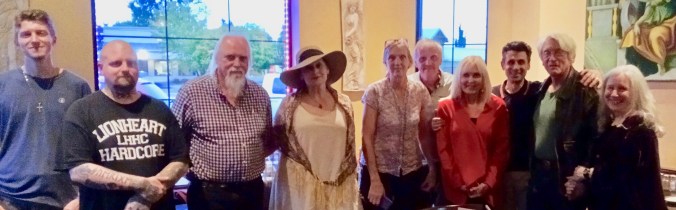
The extraordinary lightning strikes began while we were at dinner and continued for hours. Strange to be visiting in Puget Sound when such a storm began. The photo of the large group of ten is taken at a restaurant just a short distance from where Gary and I graduated from high school—that’s Gary and me on the right. Gary’s brother (gray beard) is moving to Tennessee and this was the goodbye party hosted by his youngest sister (right at top).
It was an interesting weekend, if by interesting you include skipping our morning walk to drive north, shopping for yarn and tea on Bainbridge, a flat tire, meeting the lovely couple who bought my childhood home from my mother (a highlight—they really were delightful and thanks to Gary for insisting we drive by), checking into a split-level house converted to an overpriced hostel (mold in the bathroom, but we stayed less than 12 hours), dinner with family, storm, early rising just after two in the morning, getting lost in Woodway (turn right, I said, but he always turns the wrong way), and driving south on I-5 (the first time for us on that particular route in well over a decade, and then I drove from Longview to Seaside—my longest drive in a long time) to arrive home by breakfast time. Excellent leftover tomato pie waited in the fridge.
Glad we went, glad to be home again. I think it will take a few days to recover.
VOLUNTEERS
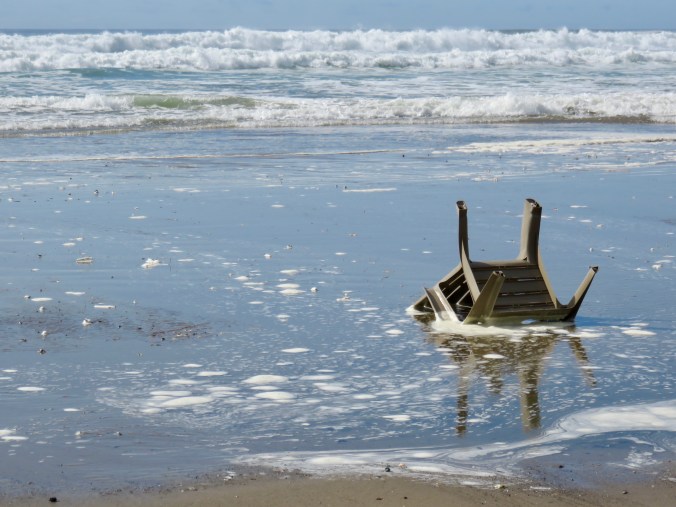
This is the chair that eventually traveled south all the way to the end of our beach, and then was tossed up on the basalt inner shore by the tide. Our Adirondack chairs are locally made of wood.
Looking west out over the ocean this afternoon, I can sometimes see Castle Rock, point-six nautical miles offshore. Then the fog folds it back into invisibility. We are both fond of this, I think, the cooling fogs, the way fog signals a very hot day someplace else but not here, at least not yet. Overhead, even when we first went out for our walk this morning, the sky shows blue, whisked by thin clouds, but north, south, east, and west over the ocean, the mist makes a pale mask on the landscape.
This morning we picked the plastic remains of (illegal) fireworks—some pieces are quite sharp—and four golf balls, our fourteenth Bic lighter of the season, plastic packaging and trimmings from cord and twine, candy wrapper, broken cutlery, unidentifiable objects lost off boats, broken beach toys. It’s what we usually find. I found glass melted and sharp from a beach fire. (Glass does not burn and neither does plastic.) Just as we turned for home, I found a sand-frosted disk of clear glass.
There are many dead birds. It is the season of juvenile gulls following after a parent, heads ducked in a vain effort to appear small when they are fully grown. Peep, peep, peep! they cry. Sometimes their parent leads them to food and walks away. Sometimes you can almost hear an adult gull sigh with exasperation. Get a life. The sea lion’s skeleton has finally come apart, and we saw a dead otter, which may have fallen victim to the unusual surf.
Yesterday, Gary went out and retrieved four beach chairs that had been caught up by high waves on the day before. The tide had not been especially high that day, but before the people picnicking on the sand south of us had to move, twice, he was already saying there was a danger of sneaker-waves. A true sneaker rages up fast and far beyond where you might expect. “Sneaker” because of that and because it is often silent.
The surf went from a single breaker in the morning to ten foot swells and many rows of breakers almost a half mile out on that day. It was a roaring sea with lots of plankton washing in from the recent heat and upturned colder water. The first sneaker swept up over the onshore sand bar that had been dry and untouched for weeks. A hundred-yard sweep of rushing saltwater. The next waves swept higher, all the way into the rocks bordering the green—the sort of massive sweep we expect in November not in summer. It was not yet even high tide.
This brings me to the chairs. A drunken party of tourists staying in one of the rentals a block east of the beach brought them down onto the sand early last month and then never bothered to return them. Four plastic chairs, two pistachio-green plastic Adirondack chairs with rounded backs and two tan plastic Adirondack chairs with fan backs. We hoped for a long time that someone would retrieve them or steal them, but no one did. Some visitors used the chairs and some pretended they were not there. The owners of the rental house closest to the chairs ignored them.
We certainly didn’t want them.
However, when we we discovered that one of the chairs had been swept a quarter mile south and then up onto the rocks, Gary went out again. He carried each of them into the front yard and hosed off the plankton. We have gathered up broken plastic chairs in the past. One way or another, he decided, we would be carrying these chairs up—either whole and still useful or broken into pieces.
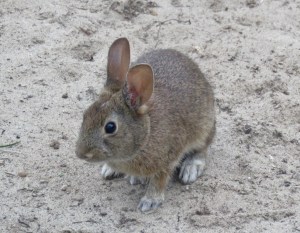 At top, violets we did not plant in our front garden. They are what gardeners call volunteers, like the little spruce growing in the center yard and the salal coming up everywhere. Nobody planted it, it just grew.
When we had our ocean-side deck removed earlier this year, most of what was revealed was bare, empty sand. The naturalized crocosmia (the orange montbrecia) came up immediately and the wild rabbits like to lift up on their hind legs, bite a montbrecia leaf halfway up, and then eat from there to the tip. They nibble dandelions down to the ground. Good bunnies.
Lately other plants have sprouted: lamb’s ears and wild roses and violets. The roses are prickly and I pluck them out with care, but the others are a lovely surprise. So far the rabbits have left the violets and lamb’s ears alone. We like to think they are gifts from the rabbits because we never shoo they out of our yard.
FREE ADMISSION
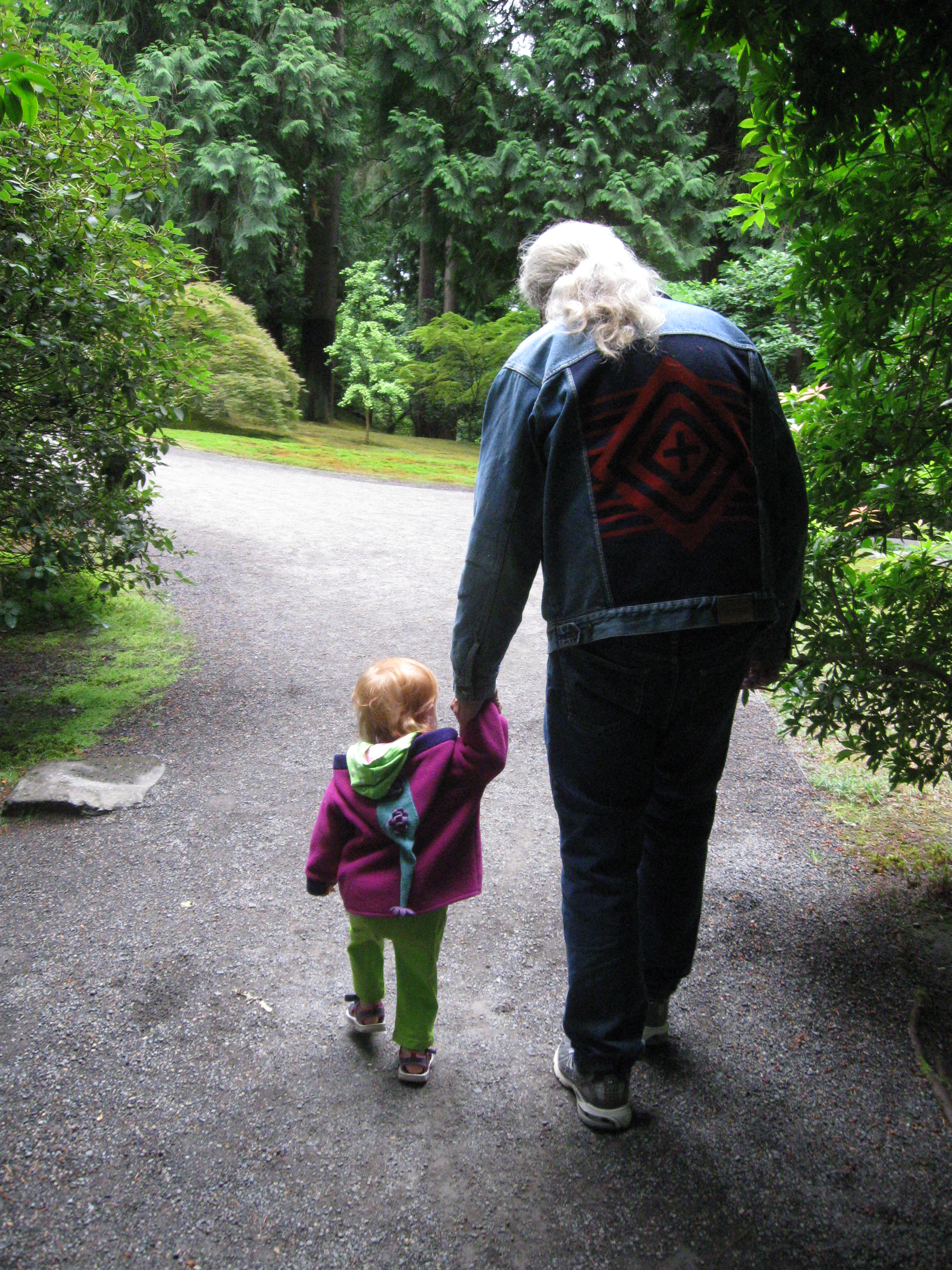
When we were children the zoo in Seattle was free. There were no tickets, no guarded gates. You could walk in the main gate or by the elephant exhibit or from Lower Woodland or over by the rose garden on the south side. The Seattle Art Museum (then at Volunteer Park on Capital Hill) was free. I have photos of my brother and me on the backs of stone camels. The Seattle Aquarium was privately owned, but for a time my family had free passes because my dad worked for the Bureau of Commercial Fisheries and he knew the owner.
Writer Sandra Cisneros spoke about visiting the museum on the free day in Chicago as a girl. Access to such cultural sites without paying admission was a critical aspect of her childhood. Mine too. These places were beautiful and free.
It was what her family and mine could afford.
The Asian exhibit on Capital Hill is still perfectly clear in my mind’s eyes though I have not been there in over forty years. The elephant walking across clouds carved into pale jade. That spectacular collection has been undergoing renovation and will reopen next year. It will not be cheap to visit. Nearby is the brick tower I climbed in my teens and a conservatory where I recall the overarching tropical foliage, volcanic rock just inside the door to the right of the entrance, the cactus and rows of potted flowers. That glass house costs money to enter, a relatively modest $8 for the two of us if we went today because we are seniors. By contrast, The Burke Museum on the University of Washington campus, a place we used to wander in and out of without a thought, would cost us $40. The Museum of History and Industry, which was a favorite haunt in my childhood would cost about $36. The Pacific Science Center would cost us $48 for entrance but another $70 if we wanted to see everything. There are free days, usually once a month, for many exhibits, though not that one.
If we drove to Seattle (which Gary absolutely resists doing), the museums (some of them free one day a month) and conservatory (except on the first and third Saturday) will cost admission. The zoo has been on lockdown since Gary worked there in the 1970s. It was free when he started as a volunteer in the aviary, but admission was added while he worked in the commissary. This was particularly controversial at the time since admission fees did not go to maintain the zoo but into the general funds for the City. It costs $42 for a pair of seniors to visit today. Cheaper than the Pacific Science Center, more than the Burke. I don’t know where the funds go for all these attractions. I use Seattle as my example only because we once knew the city so well.
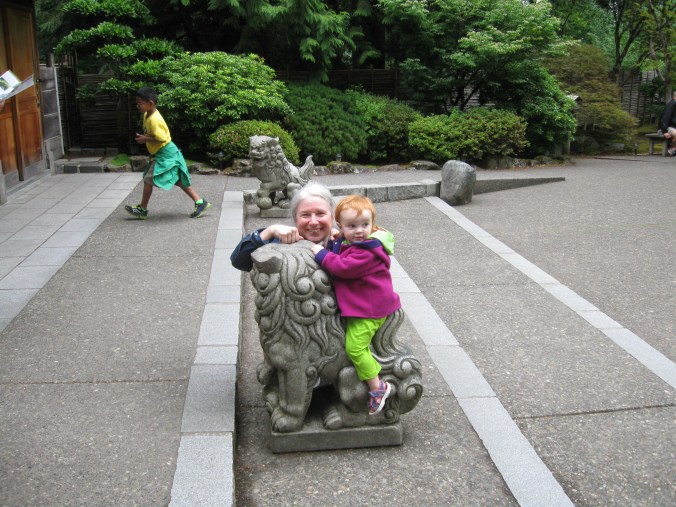 More recently, when passes were on sale, we bought a family pass to the Portland Japanese Garden. We took our oldest granddaughter to these gardens several times when she was little, and she loved the “big fish” though she says she doesn’t remember anymore.
 The gardens are crowded when we drive by, as we sometimes do on our way into town. For $110, we can purchase a senior family ticket to the Japanese Garden, and after concentrating on our house for the past couple of years, perhaps we will. Though it seems expensive, we can afford admission. Many families cannot.
I understand that people object to taxes and to paying for venues they never visit . . . and I think about the billions allocated for sports arenas, which are all about profits and competition and ritualized violence. And I think about the gilded screen with dozens of crows I saw as a child in Seattle, the science experiments, the wave machine, the Tiffany window—all those shared human cultural experiences I enjoyed as a child.
Public parks and museums should be free to the public, not restricted to those who can afford to pay. I wish everyone, every child, could experience what I did through public access. Very few can.
GARY’S PARTY
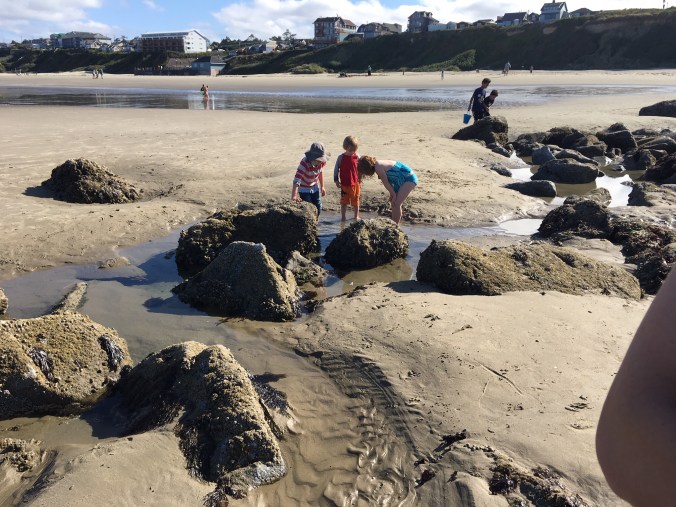
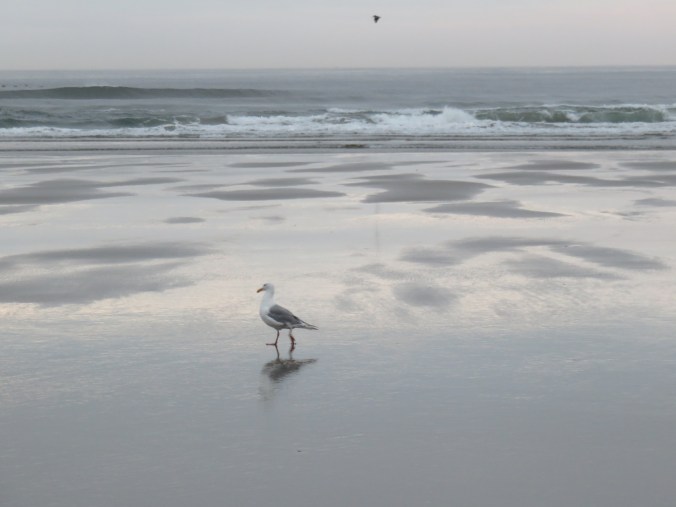
We almost always walk north. We went out before 7am for our walk this morning, before a quick breakfast and heading for home. But later in the morning two of our grandchildren and a friend’s son played in the tide pools, looking at hermit crabs. (Thank you, RO, for sending this.) Our three grandchildren enjoyed the party. The youngest stomped her feet and grinned. Such fun!
It was Gary’s 70th birthday Sunday, yesterday (it was also Lily Tomlin’s 80th and John at the Post Office had one and Barry Gibb became 72 and the guy at the market in Lincoln City turned 29). We drove down the coast in the morning, stopped at a farmers’ market, took our time. We didn’t have all that far to go.
We have been to the Sylvia Beach Hotel a half dozen times, staying in different rooms and enjoying the peace. We bring books or read what is lying about in this literary inn. I bring knitting. We walk on the beach and sit watching the ocean from the topfloor “Library.” Gary gets into the guests’ kitchenette before dawn and makes a pot of extra strong coffee. Not quite routine, relaxing.
We had made our reservation for the Emily Dickinson room and planned to have a meal across the street. No internet, no television, the Sylvia Beach is a peaceful Victorian on a bluff overlooking the ocean. Across the street is a great restaurant. Gary is particularly fond of the chef’s wife and had a photo of the car her dad drove in Australia. That was the surprise he planned. He had no idea people were coming until we came out of his favorite hotel to go toward his very favorite restaurant Ove Northwest. There was a friend in the doorway across the street. What is Rick doing in Newport?
We celebrated with our sons and their families and some friends. It is amazing that I managed to keep the secret for six months.
Gary’d never had a surprise party. He was stunned. He kept saying, 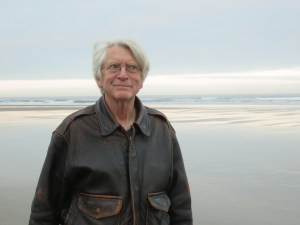 How did you do this? In fact, I’m not sure Gary had ever had a proper birthday party before this one. He never had a proper party as a child. He claims I threw him a party forty years or so ago when we were in college, but I don’t remember.
Gary is a self-effacing person, patient and kind under most all circumstances. He doesn’t ask for much or complain often. He loves cards and phone calls on his day. He smiles all the time but almost never for the camera. He was mugging for me this morning on our walk.
We’ll call this his first party. The very best. He could barely function when he began to understand what was happening. He just sat and looked stunned for at least an hour and Margaret kept his beer glass full. He was so surprised.
He says: Thank you. I love you.
[Gary has read this now and complains that I have failed to detail my craftiness. Okay, I was pretty crafty. I am so very grateful for the people who were able to attend or who called or sent cards. He deserved this.]
THE COLOR PURPLE

““I think it pisses God off when you walk by the color purple in a field and don’t notice it.”—The Color Purple by Alice Walker
My favorite pair of gloves are purple. They are not quite dark enough because I want the shade to conceal stains. That sounds practical, but I also prefer the shadows, which are not always practical. Just now I have fabrics spread out over the floor again. I am looking at a triad of deep purples and lime-sage greens and brilliant bittersweet, all batik. Waiting all over the floor because I have no wall space. Not practical.
My walls are painted pale tints of plummy gray, but what draws me to purple is the darkness. Purple has a royal association for many people, a sophisticated color. It might remind me of pain. As one example, I have been thrown from horses, kicked and bitten by them. People do die falling from a horse, but for pure suffering during recovery, I cannot recall anything more painful than that perfect purple-dark bruise risen on my shoulder that took a month to begin fading. That is what I think of first when I think of purple.
Violets have volunteered in our front garden. There is mostly only sand from where we removed the deck, the montbrecias coming up everywhere and mowed half down by the rabbits. (The rabbits have become large, and yesterday we watched one eat an entire dandelion—good bunny.) but just at the edge, between the expanse of sand and the hedge. a violet.
Many things that are called purple are not purple at all. Male purple finches have a reddish head. Purple prose is the overblown decorative fluff that gives English teachers a headache. On the other hand, blueberries are more purple than blue. The indigenous blue huckleberries make purple pies. Carrots were originally a purple root—the orange we know today is a sport that became so popular in Europe the original color is an oddity in modern markets. Few would consider purple carrots anything but fantasy.
The tall flower spikes of Digitalis purpurea, as its name suggests, is usually light purple. When we were young, my girlfriends and I plucked the hollow flowers from foxglove spires as tall as ourselves. They bloomed on the edge of the woods and we slipped a glove onto each finger. We knew the flowers (and the stems, leaves, and roots) are toxic. Digitalis is the medicine my grandfather took for his heart, and too much can kill, but we ran with our purple-gloved fingers fanned before us in games. I always assumed that the foxglove of childhood games and that I saw along my drive to work each June was native. But it is an invasive species, just another European, like most of my ancestors. Maybe this is the source of my complicated love affair with purple.
The Purple Heart is a military medal for physical injury in the field of battle—implying nothing about the actions of the wounded, other than to honor the wound. An award for suffering.
Pretty purple things: amethyst and iolite and tanzanite and the opaque sugilite. The thick petals of orchids can be many colors, but the color “orchid” is violet. I have dyed wool lavender with iris flowers. That iris tint fades in sunlight. It is fragrance as much as hue: violets and lavender, the tuberose, iris, lilac scents. Somehow I associate purple as much with folly as with bloom—the pain bruises.
Yet, as a textile artist, it is the color I reach for, covet, value and strand in weaving. I choose to spice yellows or orange in a composition, to spark pinks or green. It is a hue that wants to shove gray around. And that is probably appropriate since purple has a long association with power. The ancient Tyrian purple dye worn by popes and sovereigns for thousands of years was harvested from the mucous of three species of predatory sea snails, known collectively as Murex. The fluid protects the unhatched eggs of the shellfish and drives off predators. It can be harvested by killing the snail, but also through “milking” the mucous gland of the creature. Rare but stubborn, the color, a clear reddish-violet to my modern eye, withstands fading through wear, light, and washing. The dye was already ancient when Aristotle, who was so right about some principles and so very wrong about so many particulars, detailed its production.
In the mid-nineteenth century, a British chemist invented the first aniline dye, originally called Tyrian purple and then marketed as mauve, a delicate, slightly grayed, reddish-purple. (Mauve pronounced with a long O, not a soft ah sound.) The first chemically created color ever. It is on the edge of being a cool color, found on the color wheel opposite yellow-greens.
In youth I leaned to warmer colors—orange, vermillion, russet reds, dusty pinks, burgundy, and wine red. My preferences changed over the years and purple moved from a supporting role in accessories to center stage. This shift is reflected not only in what I wear, but in what I want to touch. I wore bellbottoms striped in black, lime, pink, and purple when I was fourteen. I dyed my hair purple when I was sixty, a joke on the old ladies of my childhood who used rinses to counter yellowing that turned their gray hair from murky yellowing gray to distinctly violet.
Purple is the foil that makes paler, more timid tints dance. Purple is the look-at-me color, associated with power, with royalty, nobility, Lent, Easter, and Mardi Gras, but very rarely named as favorite. Studies suggest that it is a color preferred by artistic folk, more often women than men, older adults rather than younger ones, and that was the character of the room when I took a class taught by Jungians on Art Therapy.
Sandra Cisneros had to fight conservative design review to paint her San Antonio, Texas Victorian home purple, a periwinkle blue, and pale blue-violet tint by my estimation, but the color proved to be historically accurate. There are painted ladies in San Francisco—not women, but the grand tall Victorian mansions of that city—painted in shades of violet. A favorite house in Seattle is a smokey violet shade I found on a paint chip called “Stetson” with a bright red door in the 70s before that became cliché. Hyacinth macaws are purple, and the queen of England is known to wear tints of that particular blue-violet. It is stitched into the border of a a sari or the facing of an Afghan dress.
It makes a pattern in concrete sidewalks, city sidewalks built with glass “prisms” faceted to direct light to anyone working in the spaces beneath. Clear glass pavers were made with manganese to clarify the glass, but eventually the iron that once clouded the glass swaps ions with manganese and over years of exposure to sunlight, the clear glass turns purple. There are such sidewalks across the country in Texas and British Columbia, Seattle and New York City. Nearby in Astoria, broken pavers have been replaced. Many have been damaged over the years, but the surviving glass in sidewalks is generally quite purple.
Violet is on the edge of wavelength in light that humans can see. Shorter X-rays and gamma rays and ultraviolet exist beyond the visible violet, just as microwaves and radio waves lie on the other side of the light spectrum beyond red. The rainbow shows purple inside the sweep to fairy gold. Some gifts seem the work of the supernatural. In The Color Purple, while discussing their view of God, Shug tells Celie she thinks God wants to be loved, “I think it pisses God off when you walk by the color purple in a field and don’t notice it.” We are supposed to appreciate the gift.
We are supposed to appreciate the gift of that richness and precarious pleasure, the flower that blooms for a day, the shellfish that guards its eggs with purple mucous, the semi-precious gemstone, the pebble in the water, and even the fresh bump on an elbow, the toxic flower that cups a fingertip, the fine line between the violet we can see and the next shade over that is invisible to our eyes. There is beauty, but concealment too, a warning both ways. My purple gloves are meant only to protect my hands from the cold. In sunny weather I require some other protection. It is ultraviolet that burns our skin.
AMAZING NAMES
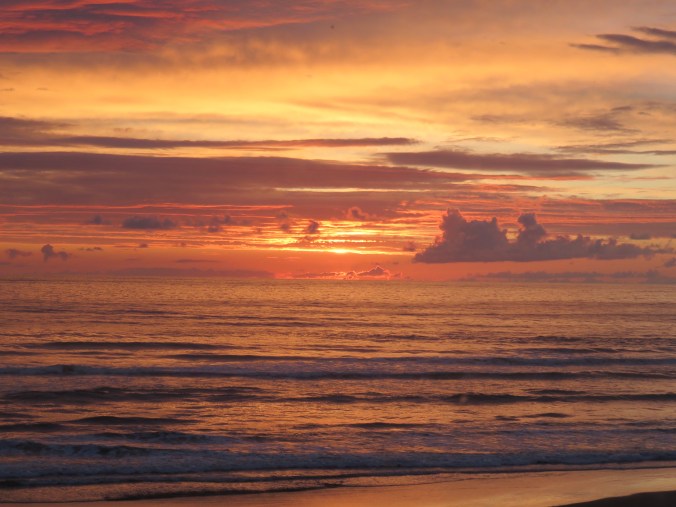
“Not many things are orange . . .” Really?
On 10 September 2015, I created a folder on my computer titled COLORbook. My intention was to complete a series of chapters about color, an entire book of nonfiction about my personal and cultural understanding of color. The idea had been stirring in my head for a long time. My earliest essay about color I can find was created 2006 about orange. “The word itself traces its lineage from fourteenth century English, back to Old French or perhaps Spanish through the Arabic nāranj, the Persian nārang, and eventually to the Sanskrit nāranga, meaning orange tree, a word that might derive from an even earlier term meaning fragrant. Our word for the color orange and the fruit have an ancient co-existence, but the citrus fruit came first.” The color name or the name of a citrus fruit or acknowledgment of the incredible scent of fruit and flower, orange blossom.
Anyway, I meant to write a book about color. I had completed several chapters and begun thinking about sending them out when, probably in 2017, I learned of the book On Color by David Scott Kastan with Stephen Farthing. It was released last year and I have just begun reading it. I will have to stop soon. It is making me cross. The obvious reason is that I wish I’d written it and I am annoyed that I didn’t.
It’s probably for that reason that I am arguing with the book. There are marvelous lines like “The sensation of color is physical; the perception of color is cultural.” The book does a very nice job of explaining color as wound into perception and culture. Homer’s “wine dark sea” seems to trouble a lot of people including these authors who desperately want Homer to have said the sea was blue. Water has no color, but reflects the sky. Maybe saying the sky or sea were indigo blue seemed entirely unnecessary. I look at the ocean every day, for hours at a time. The color I remark upon is a deep green, which is not typical but a personal preference. Perhaps the wine reference refers not to hue, but purely to darkness, richness. A dark sea. I have seen that—even seen it dark and the color of wine. Color is very much a matter of context, both physically and culturally. The Kastan and Farthing book does a good job of introducing that confusion.
But then another sort of confusion: “Not many things are orange” the book states by way of explaining why the color orange was there, of course, but the color name of “orange” did not exist in English until the fruit arrived in England. There was no word for that color until the fruit. It was unnecessary, they suggest. (Really?) Chaucer refers to a color “betwixe yelow and reed.” (He knew how to mix paint colors? The connection is not so obvious as the authors claim. I have taught enough small children and older ones how to combine primary colors to make secondary colors to know that most do not see this without aid.) But the authors make a gigantic leap in claiming there was no need for the color name because not many things are orange? How about sunsets, rust, and hair we call “red” to name just three? “Not many things are orange . . .” Only autumn leaves, chickens and foxes, fire and flower stamens. Apparently the word was necessary in India for millennia before it reached the British isles.
[Fewer things are purple, but that word is very old in English, from the Old English word purpul from Latin purpura, from the Greek πορφύρα (porphura), the name of the Tyrian purple dye made from a Mediterranean shellfish. Maybe I will post my essay on the color.]
 Anyway, this is probably a better book than I would have completed, had I completed mine. Twenty-two pages of endnotes, so the scholarship is solid. The stories I found in my research seem to be mostly covered here, and my copy purchased at a local bookstore is a squarer shape than what I see on Amazon. A pretty thing.
Despite Crayola crayons and poster paints, Hazel Koenig at the University of Washington introduced me to color theory. Pink is a tint of red, brown is a shade of orange. Pigment combines three primary colors and black and white in ways quite unlike color in light (which achieves all colors from red, blue, and green light). The four-color printing process (cyan, yellow, magenta, and black) has always amazed me—how do yellow and magenta combine to make pure red? Amazing.
Some of my essays are here on my blog if you searched for them. “Color Blind” and “Blue Sky” for example. I also wrote about orange and hot pink and little black dresses, ten chapters in all for my COLORbook folder.
I never got to yellow because I left off writing new chapters when I understood that someone else had written and published my book. It is not the first time.
In 1995, I completed the first draft of a terrible novel, and then I began better one. This was called Clean Away (working title was Bitch Trial) about four generations of women in family facing similar struggles over and over and perhaps doing better and better at coping. The central character, the daughter and granddaughter of older generations and the mother of a younger one, finds her grandmother’s diary behind a wall in a tiny family house in Astoria. This reveals a scandalous secret and places her own life in context. I worked on that book for a few years and then abandoned it when I learned of a new novel with a similar plot. I read all the way through that one. It was very good. My book was funny and the other was not, but mine was never published.
I used to write funny. That got lost for a while. I blame my poor mother. (Mothers so often get blamed for everything.) By 2002 my mother’s health was undeniably failing and my husband and I took care of her, someone told me I was the “most dysfunctional person” he knew and stopped communicating with me, and I lost my sense of humor.
Perhaps I only misplaced it, setting it aside for best. Perhaps it was unnecessary at that time. Not many things are funny? Or perhaps humor may be returning.
Most afternoons I watch the sky change color, the darkening sky blue overhead and shifting to orange on the horizon without passing either purple or green. Amazing. “How we are named and what we are called” is a phrase that runs around my head. It titled a story about Arizona that I wrote twenty years ago. It is the paradox of naming and valuing what we name. It explores that power of naming and of un-naming as Ursula K. Le Guin imagines in her story “She Unnames Them” where Woman lifts names off living creatures, removing the burden placed upon them. Some species insist their names are theirs and pets demand their personal names, but all are assured they are welcome to keep whatever names they believe suit them.
English is not the final word, nor the oldest in the world. Imagine a color book written from the other side of the world. China’s imperial yellow, red wedding dresses, white for funerals. I would read that.
Orange is one of the oldest words because so many things are orange.
WASTED

Yesterday on our predawn walk north, Gary stood on a rock that usually rises above my head from the sand. This summer it is nearly covered. This is the deepest sand we have had in twenty years. In January of 1999, a storm-driven high tide dug the basalt from under the sand into a high ridge and took out far more sand than usual. It’s taken all this time to see it return.
Wasted. Not drunk or high, I’m talking about money.
Our biggest waste was “The Maples,” a piece of land just over two acres that my husband and I purchased in the early 80s when our firstborn was a baby. I have photos someplace of me holding him in my arms. Above us are the enormous bigleaf maples that inspired our name for the property. It was on the other side of the coast range, up the Nehalem Valley on a road called Anderson, and a stream ran along the north side. No houses I designed had yet been built, but I had great hopes for that property, purchased on contract from a widow.
And then the sale of our Seattle house fell through. What year was that? We’d accepted a very long escrow in return for a very large earnest deposit of $5000. That was in the fall. It was the following spring, early June, a week before the sale was supposed to close that the buyers told us they’d changed their mind. “No hurry” returning the earnest money.
And the money was spent on The Maples. We didn’t have it. We could not pay back the deposit, which was paid to guarantee that the buyers would not do what they did. Change their minds. I was pregnant with our second son, and we had counted on the sale closing in order to pay off the land because we really could not afford the house payments as well as the land payments.
And suddenly we were in trouble financially with contract payments on the acreage and mortgage payments on the Seattle house. Remodeling on the house I had inherited from my grandfather’s third wife. Renters had been turned out of the Seattle house, as the buyers requested, and there was some damage from the buyers opening walls and from the house lying empty for all those months. We had lost the rent and now had repairs to make before the house could be sold. Less than month before our second child was born, I was not in a position to drive back to Seattle and do the work myself. My Visa bill already did not bear thinking about. We had hard decisions to make.
We gave the land to the people who had bought the property next door, just gave it away. They would take over our payments and Tootie Anderson, from whom we purchased it, would not miss payments she relied upon, and we would be out from under one of those monthly payments we could not afford.
The Maples were gone.
Gary has a hunk of quartz crystals found at the base of one of those spectacular trees. Gary calls it our “thirteen thousand dollar rock.” That was what we lost in down payment and monthly payments on the property we gave away.
There have been other wastes. When I opened this page, I’d intended to talk about my husband’s dismay when he found that a coat he purchased a few years ago, an expensive cold-weather coat, was on sale for a quarter of what he’d paid. There are plenty of examples of wastefulness, wasted spending. Bad meals in restaurants. A pair of shoes I could not return after they gave me blisters. Fabric. A braided rug. Gary has bought CDs he realized he already had, or once had and did not like. Three incomplete sweaters that I will never finish. I have bought yarn I never used.
In our downsizing process, I let go of many projects I no longer wanted to work on. I sold a few hundred dollars worth of yarn for $90 and gave away my enameling kiln to a former student. I never heard from her afterward. Perhaps she didn’t like the yarn. I unearthed additional tools related to the kiln that I would like to give her. Perhaps the kiln did not work. Perhaps this is her own story of waste. sigh
But most of our “wasted time” was not wasted at all. It was lived. Dozens of stories and several novels consumed half a lifetime and that was not wasted time even though they are unpublished. But money. Money is not something we are supposed to talk about. For almost the whole of my life I worried about money, a habit encouraged by my mother who actually prided herself on being a “worrier.” It is a waste of time, I think.
A friend referred to travel by train as a waste of time. But on the one train trip I took as a girl, watching the countryside pass by was not a waste. Biking across a landscape is not a waste of time, running the Hood to Coast was not a waste of my time. Walking the beach this morning—we plan to walk south around the Cape—is time spent, not wasted. Time lived.
There is rain today, cooler temperatures began yesterday and I slept right through the lightening and thunder last night. Slept a good eight hours. Not a waste. Life.
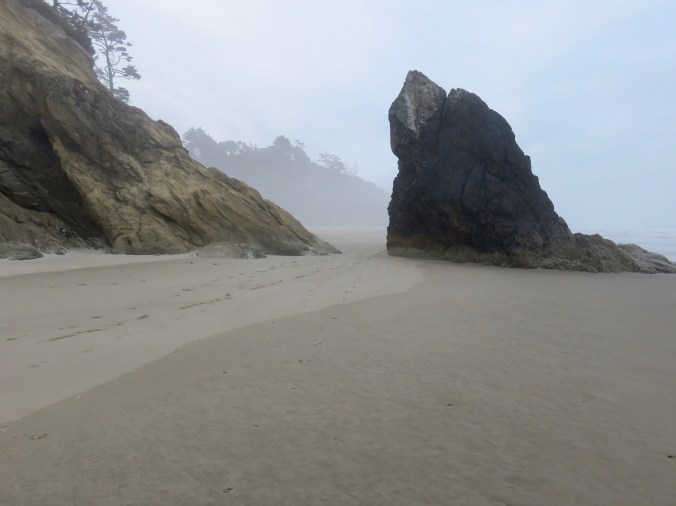
This is also from our four-mile walk, looking south. Last year we could not walk between the Seal Rock and the headland—the gap above that is filled with sand. Last year it never filled in even by August and there were pools of water and barnacled rocks. This year that is all under feet of sand.
 IMPERFECT PATIENCE