
BlueToo, the second blue-and-yellow quilt top. In life, it is an 84″ square, not a trapezoid.
I completed two quilt tops this month, and pieced the back of one of them too. To be perfectly honest, I have completed two quilts at once before. But this was especially fun. I could, in the simplest form, sew two lengths of cloth together to make a front and do the same for the back, adding an additional strip because the backing must be larger than the front to accommodate the machine quilter. In real life, it’s not so simple.
The theoretical simplest quilt would require at least ten or eleven yards of 44″ fabric. And in the old days when quilts were created to use up scraps of fabric (a practice not actually as common as the mythology suggests), a quilter would gather bits of fabrics for years from making shirts and dresses, wool pants and skirts. In practice, many quilts were made with specially purchased fabric or fabric dyed for use in piecing a quilt. All quilts result in ever smaller scraps. I have a small mound of blue-and-yellow scraps and thread trimmings from my work this month.
I make quilts from ordinary fabric and still hand-quilt such quilts on occasion because I really do like the look and the control. Most of my quilts these days are made of Asian batik fabric which is hand-dyed and boiled making a tight, smooth cloth that is not easily pinned, much less hand quilted. I took a hand-quilted batik quilt in to show a friend who owns a quilt shop. (“You hand-quilted this?” she said. “Didn’t your fingers bleed?” Well, yes, as a matter of fact they did. I could only work for a short time each day until my fingers were too bloody to go one without staining the fabric.) She’s the one who urged me to find a machine quilter. “No one hand-quilts batik.”
I made a small quilt for my mother from Liberty cotton lawn. I made quilts for each on my sons when they turned two and when they went off to college and when they married. My grandchildren have each received three so far.
Each of these quilts incorporate dozens of fabrics, a few thousand yards of thread, and often have pieced backings. The two shown here, except for the backing on one and a third of the backing for the other, were made entirely from fabrics I have collected in what textile people would call my “stash.” I have, let us say, several large plastic bins (and several smaller ones) filled with fabrics to use in quilting. These cottons are mostly purchased in quarter-yard pieces (about 9″ x 44″) and some of them are over forty years old. The newest are a few months old.
I made my first pieced quilt when I was pregnant with Alan, my first-born son. That was thirty-nine years ago. I took the bus to Spokane to visit a friend and she took me to a quilt shop where I bought small pieces of red on white and white on red prints of conventional cotton. The quilt I made was a double nine-patch. I backed it with one of my grandmother’s pilfered hospital sheets. Over the years since, I made an Ocean Waves and a Snail quilt. I have made variations on log cabin several times. Mostly, though, I make them up. I think through not only the appearance, but the construction of the piece—what must be done first and how.
All this planning is not the result of an orderly and methodical personality. I am what is called an Abstract/Random. I am inclined to mess and disorder and risk.
I had to learn how to be linear and meticulous instead of lazy and meandering because the things I wanted to make demanded those processes that from me. I draw thumbnails. I make lists. I stare and stare and lie awake at night figuring things out.
There is a skinny line in the quilt above, the dark blue between the grayish outside border the bluer inside panel. That narrow piece is called a “frame.” I am fond of frames in my quilts, but this one was not supposed to have one. When I realized it needed that narrow dark blue frame, I felt a kind of despair, just for an instant. I was not sure the backing I had would be large enough to add two more inches both ways. Otherwise I would have to dig through my stash to find enough fabric to enlarge the already-huge backing for my already outsize pieced top. I laid the backing out on the bare floor and measured. Fortunately it was plenty big, though out of square and longer on one side than the other from the way it was cut from the bolt (not my fault, that).
Most of my quilts run around 80″ square or a bit larger. I meant to make a pink quilt for a twin bed once and it turned into a 90″ square. Things just got out of hand. Making a special size is another whole struggle for me. I made one for a king-size bed that was a nightmare. The size (106″ square) was more than I could manage and I swore I would never do it again. I would do it differently now but smaller pieces would be nice for a change. Doll quilts are fun. A hanging would be fine but I do not have space to hang anything. But smaller, perhaps. I could try out ideas without committing eleven yards. Or I might be ready for the plastic bin with silks.
I have been collecting silks the way dress-makers did in the nineteenth century: an entire bolt of 14″ wide kimono silk, scraps salvaged from saris and other projects. I have a couple of yards of orange silk velvet, pink charmeuse, crepe with red apples on green. Bits and pieces. They would all be interesting to piece and quilt. Slippery and shedding but precious and variable in texture. It is the shifts in texture that attract me. I once pieced fabric for a jacket—all sorts of textures including corduroy—in long narrow strips. I wish I’d kept a piece of that. The textures are what I want, in addition to the play of color and value. Something quite different. Soon.
I cast on a knitting project last night and completed a couple of rows in a fancy pattern—unlike me in knitting. I like to think I can start something new because the quilts are done.
But first, these pieces go for machine quilting and when they return in a couple of months, I will still need to bind them. So . . . not really done. Close.
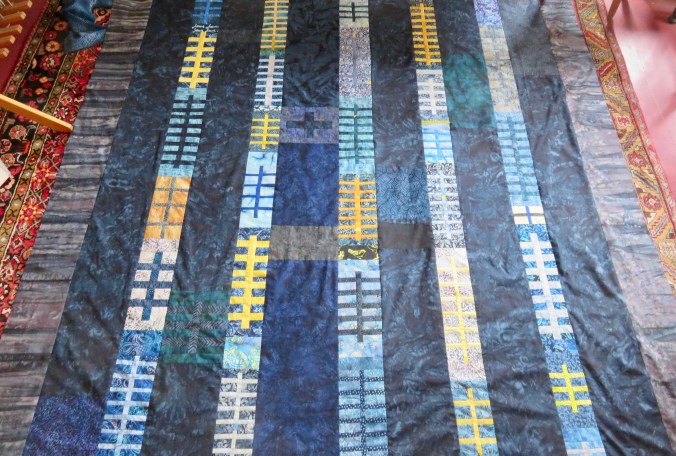
This is Blue Ladders, the quilt I originally set out to make this summer. I will negotiate with Linda Pinkstaff from Astoria Quilting about thread color tomorrow. Her advice is always good. I feel the need for a fancy quilting pattern here. We’ll see what Linda says.
 IMPERFECT PATIENCE
They are both beautiful. I especially like the energy of BlueToo. What fortunate grandchildren. You are a efficient quilter!
LikeLiked by 1 person
I made it work, as you predicted.
LikeLike
I love your quilts. Do you happen to know Teresa Paloma Acosta’s poem “My Mother Pieced Quilts”?
https://www.encyclopedia.com/arts/educational-magazines/my-mother-pieced-quilts#B
LikeLiked by 1 person
Thank you for telling me about it! What a loving and lovely piece!
LikeLiked by 1 person