WET

IMG_4967.jpg

Yesterday there were deer tracks at the base of our path to the beach. This morning a coyote had passed by. We went out a bit late, and I did not put up my hair or even put on a hat because it wasn’t cold or windy, just cooler and damp the way we like it. I unzipped my jacket on the way north because the rising breeze hit my back and I was warm. By the time I thought I should put up my hood, it was already wet inside. I figured that was okay. I hadn’t worn the jacket to keep warm but because it was wet.

As a rule, we do not mind the wet. If we minded we would live someplace else.

We walked for an hour, north and then back south. On our way north, Gary mostly followed the tracks of the coyote on the sand, and I mostly walked in the basalt rubble lining the shore. The tide came right up over the sand and several feet into the rocks last night. I found plastic bits and bobs and leftovers from fireworks, a piece of quartz, a crumb of sand-buffed green glass, and a shell. On the way home, we walked with Tammy. She was dressed for weather—hood, rubber boots—though she’d decided it wasn’t worth digging out her rainproof pants. Like my hair, her pants were drenched by then.

IMG_4966.jpgRecently, juvenile gulls have been following me. One trailed me up and down the sand and over the rocks for a quarter mile the other day. I told him that was not wise. Humans are not to be trusted, and I would not feed him even if I had anything in my pockets he could eat. Yesterday, one came quite close, stood no more than four feet away and waited for a long time for me to do something. What?

There are too many dead birds on the beach, it seems to me. We always see one or two when we walk a few miles. This time of year the new seabirds who have failed to learn their survival skills start showing up, juveniles who have starved or done something stupid. Fully grown juveniles hunker down and call weep-weep at their mothers, who are done feeding them. After the first big storm or a crazy tide, youngsters are swept off Castle Rock and wash up onshore. This morning we saw a dead bird every five to fifteen yards, and that is not typical for late September or really at any time. We haven’t had a storm and many of the dead are adults. Three banded birds in as many yards—a seagull and two cormorants. Gary says the banding may have been enough to stress them, and there is no typical, no normal anymore.

Climate change has killed billions of birds, and millions of species are already lost or threatened.

But this morning we came home dripping and I sat comfortably watching the pale sky dissolve into pale sea. The osprey was fishing, the tide rushed in, waves swept across the sand, which has not begun moving back out into offshore bars.

IMG_4969I have finished a third quilt earlier than I expected (the last four rows of stitching completed Tuesday evening instead of Friday). Late next week I will carry it to Linda, or whenever she’s finished the two I pieced in August.

Yesterday I cleared out my work space, sweeping my work table, sorting colors into warm and cool and black&white bins, and finding storage for miscellaneous sewing and knitting tools and notions. The floor seems oddly empty without fabric spread out in patterns. The scraps from stitching and trimming—trimmed threads and bits of fabric less than an inch wide—made a heap on my work table. I dug through the little pile once more and then tossed it into a waste basket. I hope Gary might pluck out bits and pieces to save for birds’ nest-building in the spring. If we composted, they could go in as “carbon” I think.

The season is changing, weather and focus. There was Open House at the high school last evening, but we were at a restaurant visiting with mostly-retired school employees. Are you enjoying retirement? Some confess to having a hard time, missing students and the work. Some are simply relieved to stop. A friend in the former group is in the hospital. After decades of deep involvement and commitment to teaching, the way we are let go can seem rather heartless. And the way those with social connections are privileged and allowed to continue on their own terms can seem unfair. Six months out, I am still uncertain where I stand.

My kitchen floor is cleaner than it’s been in almost thirty years.

Change is inevitable. Not all of it is good. Not all bad.


FREE ADMISSION

IMG_3616.jpg

When we were children the zoo in Seattle was free. There were no tickets, no guarded gates. You could walk in the main gate or by the elephant exhibit or from Lower Woodland or over by the rose garden on the south side. The Seattle Art Museum (then at Volunteer Park on Capital Hill) was free. I have photos of my brother and me on the backs of stone camels. The Seattle Aquarium was privately owned, but for a time my family had free passes because my dad worked for the Bureau of Commercial Fisheries and he knew the owner.

Writer Sandra Cisneros spoke about visiting the museum on the free day in Chicago as a girl. Access to such cultural sites without paying admission was a critical aspect of her childhood. Mine too. These places were beautiful and free.

It was what her family and mine could afford.

The Asian exhibit on Capital Hill is still perfectly clear in my mind’s eyes though I have not been there in over forty years. The elephant walking across clouds carved into pale jade. That spectacular collection has been undergoing renovation and will reopen next year. It will not be cheap to visit. Nearby is the brick tower I climbed in my teens and a conservatory where I recall the overarching tropical foliage, volcanic rock just inside the door to the right of the entrance, the cactus and rows of potted flowers. That glass house costs money to enter, a relatively modest $8 for the two of us if we went today because we are seniors. By contrast, The Burke Museum on the University of Washington campus, a place we used to wander in and out of without a thought, would cost us $40. The Museum of History and Industry, which was a favorite haunt in my childhood would cost about $36. The Pacific Science Center would cost us $48 for entrance but another $70 if we wanted to see everything. There are free days, usually once a month, for many exhibits, though not that one.

If we drove to Seattle (which Gary absolutely resists doing), the museums (some of them free one day a month) and conservatory (except on the first and third Saturday) will cost admission. The zoo has been on lockdown since Gary worked there in the 1970s. It was free when he started as a volunteer in the aviary, but admission was added while he worked in the commissary. This was particularly controversial at the time since admission fees did not go to maintain the zoo but into the general funds for the City. It costs $42 for a pair of seniors to visit today. Cheaper than the Pacific Science Center, more than the Burke. I don’t know where the funds go for all these attractions. I use Seattle as my example only because we once knew the city so well.

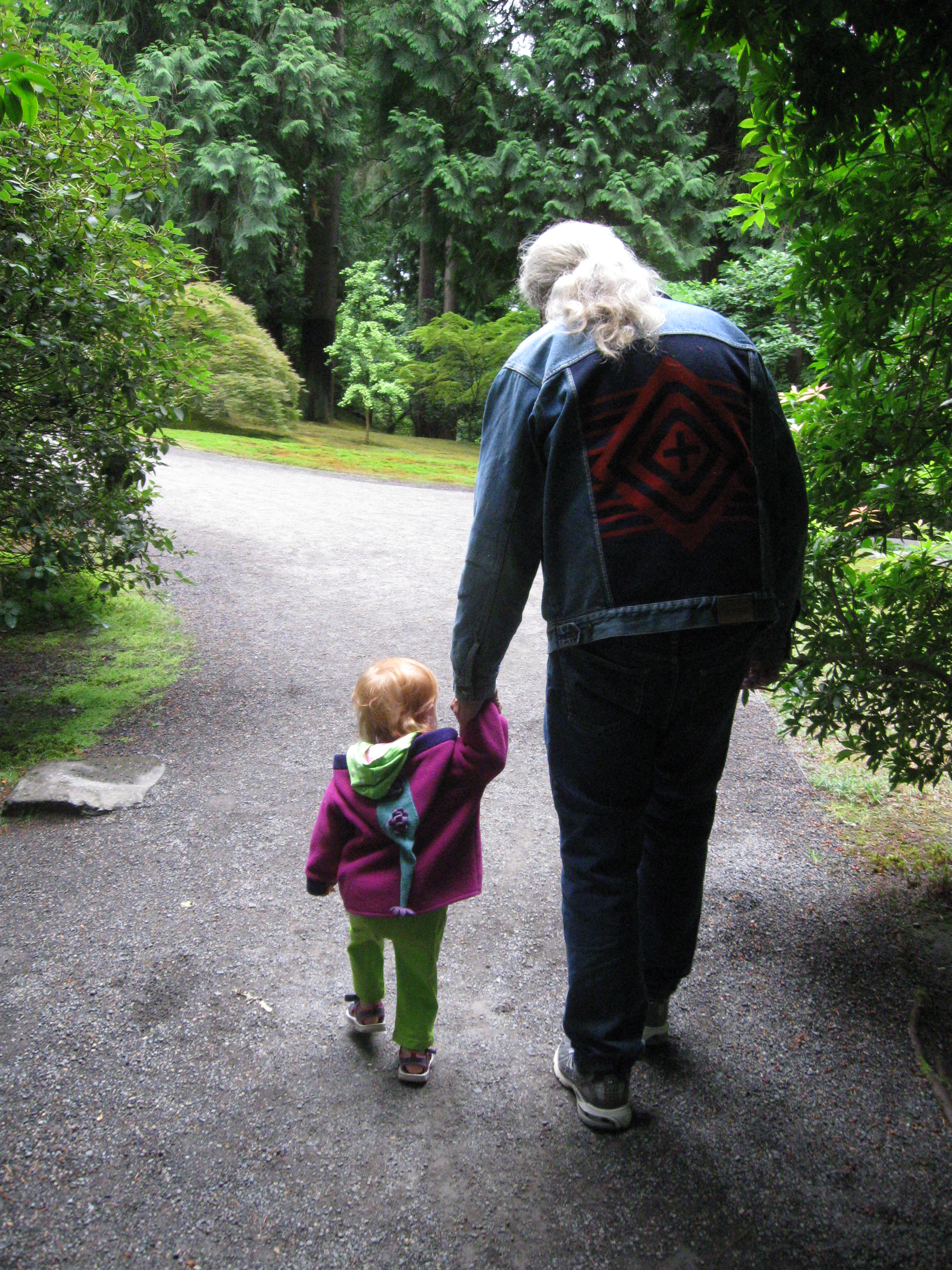
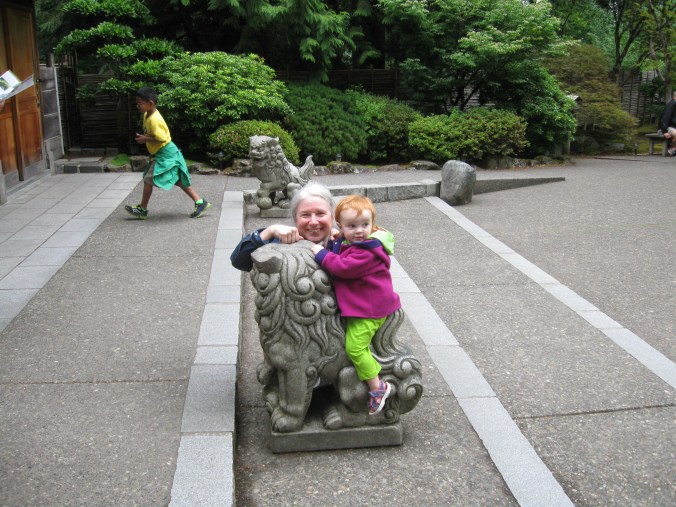
IMG_3624.jpgMore recently, when passes were on sale, we bought a family pass to the Portland Japanese Garden. We took our oldest granddaughter to these gardens several times when she was little, and she loved the “big fish” though she says she doesn’t remember anymore.

IMG_2021The gardens are crowded when we drive by, as we sometimes do on our way into town. For $110, we can purchase a senior family ticket to the Japanese Garden, and after concentrating on our house for the past couple of years, perhaps we will. Though it seems expensive, we can afford admission. Many families cannot.

I understand that people object to taxes and to paying for venues they never visit . . . and I think about the billions allocated for sports arenas, which are all about profits and competition and ritualized violence. And I think about the gilded screen with dozens of crows I saw as a child in Seattle, the science experiments, the wave machine, the Tiffany window—all those shared human cultural experiences I enjoyed as a child.

Public parks and museums should be free to the public, not restricted to those who can afford to pay. I wish everyone, every child, could experience what I did through public access. Very few can.


TONI MORRISON too

Toni-Morrison.jpg

Toni Morrison died yesterday at the age of 88. “Rest in power.”

When I began teaching English, I was already a great fan of Toni Morrison. I photocopied her entire first novel, The Bluest Eye, to use for one class and later was able to order classroom sets. A student came up to me after class and asked where he could find her poems. She doesn’t write poetry, I said. I mean that poem you read in class. He was talking about this:

Nuns go by as quiet as lust, and drunken men and sober eyes sing in the lobby of the Greek hotel. Rosemary Villanucci, our next-door friend who lives above her father’s cafe, sits in a 1939 Buick eating bread and butter. She rolls down the window to tell my sister Frieda and me that we can’t come in. We stare at her, wanting her bread, but more than that wanting to poke the arrogance out of her eyes and smash the pride of ownership that curls her chewing mouth.

The story is of Pecola Breedlove who will be raped by her father and utterly ruined. This is no spoiler. Morrison tells readers this on the very first page. Her concern is not what happens but how. She writes that why is difficult, but this is a novel about love and it is the how of love that she reveals in The Bluest Eye. Pecola’s brutal father destroys her. The narrator Claudia’s loving father protects her. Parents all seem harsh: “Adults do not talk to us—they give us directions. They issue orders without providing information. When we trip and fall down they glance at us; if we cut or bruise ourselves, they ask us are we crazy. When we catch colds, they shake their heads in disgust at our lack of consideration. How, they ask us, do you expect anybody to get anything done if you all are sick? We cannot answer them.”

The scene begins in iambic pentameter and ends a couple of pages later—

But was it really like that? As painful as I remember? Only mildly. Or rather, it was a productive and fructifying pain. Love, thick and dark as Alaga syrup, eased up into that cracked window. I could smell it—taste it—sweet, musty, with an edge of wintergreen in its base—everywhere in that house. It stuck, along with my tongue, to the frosted windowpanes. It coated my chest, along with the salve, and when the flannel came undone in my sleep, the clear, sharp curves of air outlined its presence on my throat. And in the night, when my coughing was dry and tough, feet padded into the room, hands repinned the flannel, readjusted the quilt, and rested a moment on my forehead. So when I think of autumn, I think of somebody with hands who does not want me to die.

There is enormous wisdom in these pages. It is not the most popular Morrison novel but one of the shortest. It shows up in standardized test questions and college courses. Many students have written essays about the novel in order to get into college. More have emailed me from college to thank me for introducing them to her work.

I taught Toni Morrison’s first novel for most of twenty-five years and assigned that opening passage every year I taught. It was one of the few disappointments of my MFA program that not a single person recommended her novels or referenced her work in a craft talk. Seriously. Not one.

Perhaps it was judged too high for graduate students to aspire to? In my own teaching, I always aimed above what my students thought they could do. Morrison always aimed high. The only path to excellence is to aim higher than our reach, to point the way to better than what we think we are capable of. Sometimes we surprise ourselves. I think many of my students were astonished at their own accomplishments. I hope they were.

Underestimating our capacity as a nation is equally problematic. When we assume that the United States deserves no better than a bully for a president, when we assume that it is too soon for a black or gay or woman president, we doom ourselves. We deserve better. It is the ideal upon which our country was founded. We deserve to strive and push beyond our comfortable complaisance into greatness. Isn’t greatness what the Founders had in mind?

Those eighteenth century wealthy white men aimed for a nation where people are judged by the content of their character rather than by their birth. Wasn’t that an amazing goal for such entitled folk who had all been raised to accept the divine right of kings? Of course they would not be comfortable in our society today, where a man dismissed as “white trash” can become president. (I am not talking about Trump who sits on a gilded toilet.) Their ideals far outstripped their capacity for justice.

Our ideals should always frighten us a little. I did my best as a teacher to break down complex tasks into clear and manageable steps. We must continue doing that as a nation. As Toni Morrison did in her novels: push the envelope, they say. Step out into our own idealistic world.

Step out.


“Toni Morrison, 88, winner of the 1993 Nobel Prize in Literature and the 1988 Pulitzer for fiction, died on Monday night at the Montefiore Medical Center in New York. Robert Gottlieb, Morrison’s longtime editor at Knopf, said in statement, ‘She was a great woman and a great writer, and I don’t know which I will miss more.’ Sonny Mehta, chairman of Knopf, said: ‘Toni Morrison’s working life was spent in the service of literature: writing books, reading books, editing books, teaching books. I can think of few writers in American letters who wrote with more humanity or with more love for language than Toni. Her narratives and mesmerizing prose have made an indelible mark on our culture. Her novels command and demand our attention. They are canonical works, and more importantly, they are books that remain beloved by readers.’ ”

“One of her most provocative public commentaries came during what she saw as the persecution of President Bill Clinton during the Monica Lewinsky scandal. In a polarizing New Yorker magazine essay, she observed that Clinton, his ‘white skin notwithstanding,’ was ‘our first black President.’

” ‘Blacker than any actual black person who could ever be elected in our children’s lifetime,’ Ms. Morrison wrote in that article, published in 1998, a decade before Barack Obama, the son of a Kenyan father and a white American mother, occupied the White House. ‘After all, Clinton displays almost every trope of blackness: single-parent household, born poor, working-class, saxophone-playing, McDonald’s-and-junk-food-loving boy from Arkansas.’ ”

She thought we would not be ready for an actual black president in her lifetime. Thank goodness she was wrong about that.

And I was wrong about Toni Morrison writing poetry. Here are five.

“In short, this is a full novel — rich, slow enough to impress itself upon us like a love affair or a sickness — not the two-hour penny dreadful which is again in vogue nor one of the airless cat’s cradles custom-woven for the delight and job-assistance of graduate students of all ages.”—from Reynolds Price’s review of Morrison’s Song of Solomon (1977)

FAIR PLAY/FAIR PAY

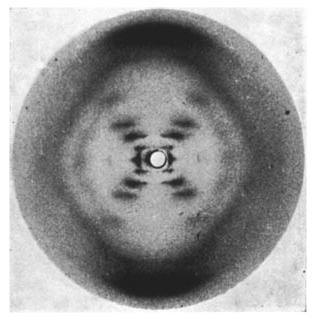
Photo_51_x-ray_diffraction_image.jpg

Photo 51, showing x-ray diffraction pattern of DNA. Photo 51 is the nickname given to an X-ray diffraction image of crystallized DNA taken under the supervision of chemist Dr. Rosalind Franklin. It was critical evidence in identifying the structure of DNA. Dr. Franklin was not credited for this work by two men who later won the Nobel.—Wikipedia

“Our science can only benefit the whole of society if it’s done by the whole of society. And that’s not currently the case.

—Dr. Jessica Wade, a British physicist who has added 670 profiles of women and people of color in the sciences to Wikipedia since 2017

Women and people of color are underrepresented throughout Wikipedia, which is an issue Wade and others hope to repair. Dr. Franklin is there, but for many years her pioneering work, and especially her contributions to the discovery the the double-helix in DNA, was not properly acknowledged.

As a girl in the 50s and 60s, I was fortunate to be aware that women had made scientific contributions.

My father cited a UK researcher who had published as a young woman, then later under her husbands’ names, and how he wished she’d stuck with a professional name so that her work was not scattered all over his library.


I learned two lessons from that brief story: women are scientists and a public name need not indicate a private identity. I used to tell that story when students asked me why my last name was not the same as my husband. (On a good day, I could cite eight or nine reasons I kept my name.)

TEAM SPORTS

kigoa football on green grass during daytime

Photo by Pixabay on Pexels.com

The young man was doing summer landscape maintenance at a local public playing field. That is, he was mowing a huge patch of grass. He shut off his machine before coming over and say hello. I was taking a summer course in a nearby building. I was charmed that he remembered his English teacher from a few years before.

He talked about how a fall sports injury kept him out of play most of his senior year, how hard that was to be sidelined, and how he had tried to talk to his coach about helping him with post-high school plans. And then abruptly, he looked down, was silent, and seemed almost to shiver. “Coach didn’t have time for me. He didn’t care about me except as a player.” He looked at me. “I just realized that . . . and it . . . it makes me so angry.”

A review of literature has led a physician to declare that playing team sports may protect players from future depression. She found: “Among those with ACEs [physical and sexual abuse, emotional neglect, parental alcohol misuse, parental incarceration, and living with a single parent], team sports participation during adolescence was significantly associated with lower odds of receiving a diagnosis of depression (unadjusted rate, 16.8% vs 22.0%).” Dr. Eaasterlin describes one barrier to participation as the monetary cost of playing, another not considered might be inconvenience. Easterlin assumes that playing team sports teaches teamwork and that this is the reason adults who have played sports are less depressed in their 20s. There are a few leaps in her reasoning, but perhaps she is right. She further argues that pay-to-play (the costs associated with school team sports) interferes with the potential positive outcomes of team sports. It is well to recall that team sports require more than money. They also require traveling and a great deal of time.

Is teamwork really the key and is that key derived only from sport? Her study didn’t find a benefit from other activities. Can we assume that money keeps kids out of sport or that money is not itself an key issue? Despite measures taken to ensure a balance, can we assume that these self-reported measures are representative or even accurate? What else is at play here: privilege, money, family support, time free from family obligations and work, social status in the school, coach and teacher bias? Time?

When I was teaching, I saw my students for no more than five or six hours a week. Coaches of some sports, such as football, worked with players for up to twenty. Students were always excused from academic subjects to attend sporting events, even as spectators. While students were required to be teaching at least most of their classes to play, teachers were routinely called upon to rearrange academic obligations to permit extracurricular involvement. Administrators will always say that academics come first, but in practice this is almost never the case. Involvement is emphasized even over studying from the time students enter high school. Teachers and classroom aides are hired because they can coach, and coaches were ferociously protective of their access to players.

As an example: Football players in my yearbook class were forbidden to miss practice in order to attend a mid-week day-long yearbook conference and workshop. One boy said, “Don’t worry, I’ll go.” But hadn’t his coach refused to play him on Friday if he missed a mid-week practice? The senior smiled. “Coach will play me, he has to play me.” That strong varsity player was right. What lesson did he learn?

Many studies on the impact of childhood participation in team sports suggest the impact of youth sports programs is not entirely positive. Participation in team sports do not lead to healthier adult behavior, according to a broad study by UC Berkeley. Only individual sports such as running, tennis, and swimming predict physically active adult behavior. For some players, team sports lead to disastrous experiences of bullying and and even physical injury—I well recall, in the small rural high school, the summer when four boys had broken bones from three weeks of pre-season play. Every year I had students who required surgery to repair sports injuries. There is also a well-documented pattern of abusive domestic behavior on the part of varsity high school and college athletes (especially football and basketball), and an unfortunate assumption of privilege on the part of some players.

As to team work. Maybe. But that notion of team sports building teamwork was used to marginalize women’s participation in many professions and careers in the days before Title IX. Imagine our surprise when objective studies found that woman overall tend to be better at teamwork regardless of sport experiences. Creating a mixed-gender engineering team, for example, led to stronger overall performance because women on the team advocated for collaboration and cooperation and, you might say, team work. This had nothing to do with sport.

Choir, drama, orchestra, gaming, and yearbook and newspaper classes—all these can teach teamwork, too. Over the years, many enthusiastic teen athletes have tried to prove that their sport was necessary to success in life in their research papers. It’s not true. Choir, drama, orchestra, gaming, and yearbook and newspaper classes are not necessary either, but like athletics, sometimes they help. Participants want very much to believe that their great experience is necessary and necessarily good.

Sports teach competition. They teach about winning and losing. For many young people, they provide much-needed incentive to be physically active and cooperative. They often provide access to coaches providing a stable and supportive adult influence. But they are not an unmixed blessing. For all the good they do, they also provide opportunities for distraction from education, injury, and both bullying and elitism.

This doctor found what she wanted to find. She may not be wrong about the impact of sports, but my own forty-year experience in education and a great many studies suggest she may not be entirely right.

How have we come to “trade the fiddle for the drum”?

xclouds.jpg

Fiddle and the Drum

And so once again,
My dear Johnny, my dear friend,
And so once again you are fighting us all,
And when I ask you why,

You raise your sticks and cry, and I fall,
Oh, my friend,
How did you come,
To trade the fiddle for the drum.

You say I have turned,
Like the enemies you’ve earned,
But I can remember,
All the good things you are,

And so I ask you please,
Can I help you find the peace and the star?
Oh, my friend,
What time is this,
To trade the handshake for the fist.

And so once again,
Oh, America my friend,
And so once again,
You are fighting us all,

And when we ask you why,
You raise your sticks and cry and we fall,
Oh, my friend,
How did you come,
To trade the fiddle for the drum.

You say we have turned,
Like the enemies you’ve earned,
But we can remember,
All the good things you are.

And so I ask you please,
Can I help you find the peace and the star?
Oh, my friend,
We have all come,
To fear the beating of your drum.

by Joni Mitchell

.

Years ago, I transcribed the lyric from this song (from her 1969 album Clouds) for use in my Honors Junior English class during the six weeks we spent on poetry in the spring. I had to play it several times because I am such a slow typist. My husband confessed he had never listened to the words before. He is a guitarist and had skipped this song since it is sung a cappella. New respect.

As poetry, it is one of her simpler pieces but timely.

IMPRINT EACH DAY

IMG_4160

Whimbrel imprints in the sand.

We walk nearly every morning and some days, when the wind drives onshore, we fill our bags with trash. Other days, like this morning, there was hardly a thing cast ashore. Most trash comes from the ocean.

All of Gary’s Mother’s Day wish is gone this morning. I thought the sand dollars had been swept away, but Gary points to the busy pattern of footprints even above the high tide line. Someone has gone out late yesterday evening and collected them. We do not mind. Take more, we say aloud. Take the other shells left as an offering on the edge of our path. Take the garden clippings Gary will not burn unless the weather turns damp and the wind blows off-shore.

We hope it was a neighbor’s child who took the sand dollars, a child not enrolled in school and not being home schooled, whatever might be the excuse. Her parents have told her that in the fall she will start at the local private school—a strong producer of entitled local youngsters, a few of them independent and charming people, but too many who think they are more important than the rest of the world. Nevermind. The little girl’s parents cannot afford to pay for trash pickup. Private school?

In the mean time I wonder: Is this something I must report? Since I am retired, am I still a mandatory reporter? Do I think this is neglect? I have known many mandatory reporters—teachers, doctors, counselors—who failed to report. My mother was still driving when she could barely walk. Where was the mandatory reporter then? No one ever thanks you for doing this duty. I have known both parents and students who never forgave me. That’s why it is mandatory, that is why I do not need to be sure. I need to have doubt.

Still.


Maggie Rue Hess

A HOUSEKEEPER’S VILLANELLE

I learned the beauty of futility, and now I know its sorrow
from cleaning rooms at the Holiday Inn;
what you tidy today will need you again tomorrow.
There’s a satisfaction in work whose effort you can show,
soothing to proper corners what is chaos when you begin.
I learned the beauty of futility, and now I know its sorrow,
because there is no end to the process. You must borrow
time, must accept that the struggle is the win:
what you tidy today will need you again tomorrow.
Is it never done? How do you live when you must go
through the same back-bending motions day out and day in?
I learned the beauty of futility, and now I know its sorrow.
Remember that it’s not just about hotel rooms, though;
it’s just as true for hate, failure, pain, or sin.
What you tidy today will need you again tomorrow.
The good work never sleeps: a housekeeper would know.
We clock in and clean up again and again.
And I—I’ve learned the beauty of futility as well as its sorrow—
what I tidy today will need me again tomorrow.


from Rattle #63, Spring 2019
Tribute to Persona Poem

NEXT?

IMG_2882

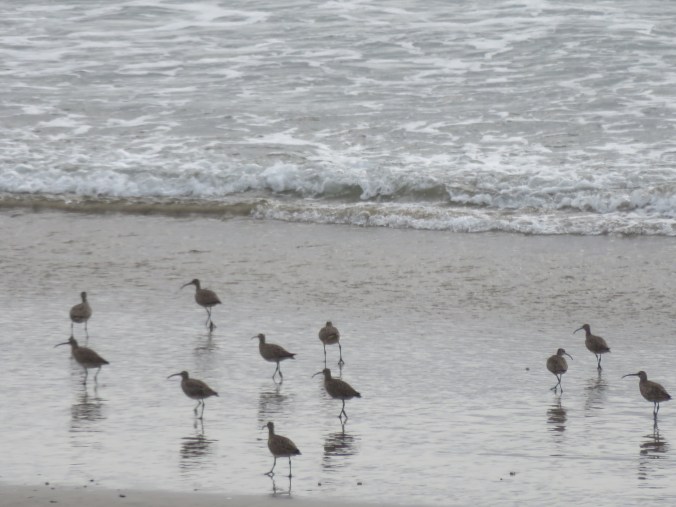
Yesterday morning ravens came to eat the stale bread we threw out. An eagle flew low over our heads, and we found the pile of abandoned “treasures” dumped from some child’s bucket. It must have looked like food. Only two gulls stood in the stream. The sky was bright blue all day.That afternoon I counted twenty-eight whimbrels.

There are even more this morning and we are walking out as this goes post goes live. I like thinking someone will read this while we are a couple of miles north on the sand.

To prepare for today’s post I checked back four years ago to the first time I (almost) retired.

I entered a classroom as a teacher-in-training in 1975, had my first job later that next year at a private girls’ prep school. After moving home to Oregon I worked as a substitute teacher for a long time in the English Department, but I quit teaching altogether this past March. I taught high school for over thirty years, and I substitute taught for another decade.

Each April morning between about four and about seven, I spent writing. I do this sitting up in bed. Some days I went right on writing for the rest of the day. It was a busy, reckless month. We went away for two nights. More recently, windows have been open sometimes this week. The ocean is always calling. Today we will get our longer morning walk.

Another retired teacher asked me recently what I would do now that I am retired? It is a good question for which I have no answer. Will I do something new, or merely divvy up my time in a slightly different way? I suspect the later.

What I miss is community. During the past month, various workshops, and my MFA program, I found that writing group I feel I needed. . . . At least for a month or couple of years or a few days at a time, but not regularly. What I have are a few people who will, if I ask not too often, read my work.

My original writing group was twenty years ago and it was only me and one student. B was the first sophomore we skipped over Sophomore English into the most rigorous junior class. This was pretty much necessary since she was, in skill and ability, far beyond her peers. She needed the challenge. She was the one junior in my senior class as well, and one day I walked out of the Faculty Room and there she was coming out of the Library. “Do you want to write together this summer?” I said. She agreed. We thought we would try writing a novella, just for the challenge because it is longer than a story and neither of us had written anything long. We weren’t even sure what a novella was, so while I was busy ending the year in yearbook, B researched.

After school ended in mid-June, we began writing and meeting weekly to share and respond to each others’ work. Neither of us wanted to look bad to the other. We worked hard. The manuscripts forged ahead, the stories growing beyond what we’d expected from ourselves, beyond our early goal of seventy pages or so of a novella. I discovered what a messy process I have, and B discovered she could do anything.

By August we each had a full length novel. Since I had a publishing connection, our books were read by HarperCollins. They liked B’s quite a lot. It was far the better of the two. (A senior editor wanted to see more, but HC was about to undergo a transformation and this went by unexplored by B.)

B has published since—poetry and academic writing, books, magazine and journal articles. She is a professor of English and much in demand. I have had publications too.

Later, I nominated a student for a writing award, which she didn’t win. But she went on to an MFA in fiction.

A third student was for a time a respected slam poet. And a fourth student completed an MFA in poetry from a program that rejected me twice.

Many of the students I had the pleasure of working with for a term or the better part of a year, have gone on to careers in education, the military, the government, and various professions and occupations in the private sector. Many of them earn more than I ever have. Many are smarter and more talented than I am. They are good in their various fields.

Someday they will retire too.

I receive emails about submission opportunities almost every day, but I rarely send out fiction anymore. I don’t know what I will do about writing. Duotrope shows many fiction submission in the past 12 months, but these were nearly all agent queries about the most recent novel, and now that is completely rewritten. I am not sure what to do about that. I have other work to submit, but that will take some organization. The poems too. I keep thinking I should print them all off and see what I have. There is a warp on the loom, waiting to be completed. Two quilts fight in my head. I have worked on a pattern for a grandchild’s cardigan.

Several times I have joined writing groups in the past twenty-odd years. More than one fizzled. Another decided fiction was too much trouble. Another turned out to be social, and I did not want to drink wine and smoke dope. (That word, “dope.”) I don’t know what  new thing will be that I pass on to.

That word “passing.” We pass tests, pass by, pass it on, pass Go, pass through, pass as something we’re not, pass out, pass under or around, pass over, pass away. Time Passes. So many ways to leave the building.

Camp NaNo day 9: REVIEW

Camp NaNoWriMo word count: 12,802 as of 7:30am on Tuesday, mostly journaling again though I wrote on another blog and also on The New York Times.

Revised novel EMD word count holding steady: 74,883

Local drama! It has come out that one of our neighbors whose house rents by the day has built two structures in his back yard with concrete footings, and a concrete walkway along the house without permits. Another neighbor who is trying to restore a wetland feels bad because his plans require inspections that may reveal the un-permitted work of that rental. It would be sad except that the neighbor who built without permits or inspections has done this before. The owner doesn’t believe in paying taxes or getting permits unless he’s caught. He pretty much yelled that at me a dozen years ago. It seems that attitude has not improved. 

He’s caught. 

More local Drama. It seems our bathroom window obscure glass is not so obscure. I have put up a curtain.

And I am writing a review of the nonfiction I finished.

A friend expressed her frustration as a student about reading assignments. “I’m a slow reader and rarely could I finish an assigned novel even once through, knowing that some analysis would be expected. It took a bit of the pleasure away from reading, even though I know that wasn’t the intent of the professor.”

Yours is a very common concern. I tried hard to address it. Over the two terms I offered students multiple strategies for both reading and note-taking. The goal was for them to discover a method that worked for them, a way to enjoy and recall the text so that they could talk about it. I am not a fast reader myself, much slower than is average for someone with my education, though I can skim. My “fast” readers were usually not reading at all, but skimming. They read only for content and missed the art, missing the music of the language because they often couldn’t (or wouldn’t) slow down to hear and enjoy it.  

Some books I read aloud in class, just the beginning or every other chapter.* When we read Cisneros’s The House on Mango Street, each student chose a short story (1-2 pages) to read aloud and I read all the rest. Sometimes hearing the novel, hearing the voice of the book is enough to catch interest. The reader becomes invested. We focused on the poetry of Mango Street, and of how our understanding of characters changed—the girl who seems so selfish and superficial rides with a dying young man to the hospital, a man she doesn’t even know but whom she grieves for. We find there is more to her than the careless ambition we first recognize. 

* I will always remember the girl who came to school excited about a book. I had read the first chapter of Dorris’s A Yellow Raft in Blue Water on Thursday and then she was home sick over Friday and the weekend. Her family went off without her and the cable was out so she picked up the book and read to the end. She said she couldn’t stop. She said she had never read a book all the way through. She was college bound and smart, but this was the first assigned book with a person of color and women narrators and women at the heart of the story. That book often turned students around (though I cannot talk about Dorris). It was the boys who wanted to come back and give it a testimonial. In anonymous reviews it was rare for a student to give it less than top marks. 

The sky is pouring rain and so we may not get our walk till later perhaps.

A BETTER WORLD

41l+4UobkRL._SX325_BO1,204,203,200_.jpgDystopias extrapolate the fears of the day while utopias project our dearest hopes and ideals.

Science fiction writers from the Golden Age of post-WW2, for example, often address the disastrous impact of the potential for nuclear powers to obliterate the planet. They were concerned about global and intergalactic peace and the trade-off in freedom resulting in a governing body with so much power. They recognized how population pressure and a shift toward manufacturing with machine rather than human power might dehumanize our future.

Huxley missed all that.

Brave New World was written at a time when the world economy was in the midst of a Great Depression and there was concern about finding the minimal 1000 calories necessary to maintain human life. Huxley addressed the need to stimulate the economy, reinforce social class and bigotry concerning gender, sexual orientation, race, and language. In a world rapidly opening to new ideas, Huxley maintains the status quo.   

Most languages are defunct, which is nice for the UK when English remains the lingua franca, but most languages from Polish to Spanish and French are so far extinct as to be gone from general consciousness. Women (always referred to as “girls”) exist as nothing more than inferior beings necessary for procreation. Sex. It is a white and male future. Casual lines about “negroes” within the first pages had my hackles up. There is ample evidence that he actually failed to notice that some of what he presents in his nightmare future, was already a nightmare. What Huxley knew was the rigid class system (which he then codifies here into biological law) and the need to regulate markets via absolute control of both production and consumption.

It is satire, with a lively and smug tone that reports in dizzying detail about a society that is irrational and repressive. Perhaps most societies are, but this is not a warning but arrogant. Not to mention how much he gets wrong.

What does he get wrong? Basics of biology, psychology, technology, communication, education, gender, race, nationalism, and the future importance of the British Empire. As one example, exhaustive detail about artificially breeding and rearing children is ridiculous. From specifics of harvesting eggs to programing children to be fearful of flowers, none of it is plausible. His story advances hundreds of years into the future, without considering how unimportant physical human labor is to society—a shifting paradigm evident in his day. He should have seen that coming.

What else does he miss? Dangers of post-WW2 pesticides and poisons, nuclear energy, wars, global warming, population pressure. These are the threats on which most science fiction of the 20th and 21st centuries focus. It is fair to note that Huxley could not have foreseen that the “War to End All Wars” was only the beginning, that military might would overtake social controls as a threat to world peace, that toxins such as DDT would create havoc on the natural environment, that global warming would alter climate and coastlines and food sources, that all these changes and the threat of nuclear war and a world population four times larger than the one he knew would threaten human existence.

Even Huxley recognized within a decade or so that his options of “Utopia or Savagery”/insanity or idiocy are inadequate, and he belatedly offers a third option, also inadequate.

Abuse of power is central to any dystopia, but Huxley’s book is hopelessly inaccurate in terms of science and fails to predict specific concerns nearly everyone in the world worries about today. His cheeky voice and sex-driven plot (in a future where the very word “father” is vulgar) may appeal to some. He can’t be faulted for most of his mistaken assumptions about the future, but the rampant nationalism, sexism, and racism in the novel do beg the question: Why is anyone still assigning this novel to high school students?

And I know the answer, surely I must. But still.

Utopias are harder. We do not accept them as a possibility. With a unique human determination to find fault, we grasp at the dystopia as representative of everything that might go wrong. But perfection? Oh, no, we cannot imagine that.

9636460.jpgAnd then most utopian novels I have read are no better at creating perfection than Huxley was at predicting disaster. Walden is utopia, but somewhat false as nonfiction since Thoreau did not actually live the life he writes about. The novel Walden Two, by behaviorist B.F. Skinner, on the other hand, does a a more honesty job by not pretending to be true.

“We are only just beginning to understand the power of love because we are just beginning to understand the weakness of force and aggression.”—Walden Two

B.F. Skinner asks if you knew how to manipulate people into living in an ideal society, wouldn’t you do it? We are all products of our experiences and responses to societal conditioning. Wouldn’t it be best if we deliberately created a society that conditioned us to live harmoniously and happily?

If readers are looking for a conventional novel, there is a plot here, a beginning and middle and end. But that story is mostly beside the point.

The story is a thought experiment first conceived immediately after WW2. Here an academic psychologist Burris visits another psychologist, Frazier, taking with him a pair of veterans, their “girls,” and a philosopher Castle, also an academic. The structure of visitors observing and interacting with members of a utopian community has been used many times. Herland by Charlotte Perkins Gilman (1907) is an earlier example. The visitors argue against the workability of a society that clearly is working just fine.

herland-14.jpgIn 1970, my first term at the University of Washington, I took a psychology class taught by a recent retiree from the US Navy. The man was a behaviorist, of course, and had spent 20 years training porpoise to commit acts of war. I worked hard in that class, harder than was typical for an intro class. I read the novel and wrote a paper about Walden Two. Mostly what I remembered was the clever way work was set up in this imagined utopia. Everyone had to do at least a little manual labor, but all work was chosen. Payment was in credits and each member of the community had to earn 4 credits per day. Some jobs such as cleaning out sewers earned more than a credit/hour. Some, such as working in a flower garden, earned less than one credit/hour. “Payment” was adjusted if more or fewer workers were needed than takers. I loved that system.

I also recall that the founder, Frazier, was not liked much but was tolerated in his utopia, and was actually not very good at following his own utopian guidelines.

There was a great deal I did not recall after all this time, and mostly that is because Skinner got so much wrong. Like Huxley, he even got the science wrong. He is wrong to remove children from one-on-one care by parents. He is wrong in the way he describes “teaching” young children to withstand frustration, and ironically he is wrong to underestimate the impact of “delayed gratification” as a necessary skill for adolescents and teenagers. I would have recognized some of this at the time since I was aware that group-raising infants in the USSR had proven unsuccessful. Promoting childbearing by age 15 or 16 is not “much better” than waiting to have children when the body is mature. Child-bearing is not something to be got out of the way while still a child. And since Skinner is squeamish about religion and extra-marital sex, he fails to address the issues that come with promoting marriage among very young teenagers.

“In a cooperative society there’s no jealousy because there’s no need for jealousy.”

He insists there are no laws in Walden Two, yet there is a Code and violating the Code has consequences. That is law. His Managers and other officials are not government because government is irrelevant unless it is local. Citizens of Walden Two are told how to vote in local elections.

“The majority of people don’t want to plan,” the novel’s protagonist insists. “They want to be free of the responsibility of planning. What they ask for is merely some assurance that they will be decently provided for. The rest is a day-to-day enjoyment of life. That’s the explanation for your Father Divines; people naturally flock to anyone they can trust for the necessities of life… They are the backbone of a community—solid, trust-worthy, essential.”

Skinner argues hard for his scientific approach and claims that his invented society is egalitarian about race and gender. What he refers to as “Girls” and women are supposed to be on an even footing, yet we have mostly all men everywhere in charge in this novel. There is a cheerful woman dentist. All the childcare givers are women, though he insists men help too. All the characters seem to be white, and all the girls are pretty—this is actually remarked upon early. Men are “caught” by women—an out-of-date notion about marriage. (“The man chases the woman until she catches him.”) The character Castle is said to be a strong debater, but he is a peevish straw man opponent here, often failing to make his point in arguing with Frazier. Frazier himself is set up as a failure to his own cause, which is probably the most compelling and realistic detail.

There is a great deal to argue with in the specifics of this imagined utopia. I might wish he knew more about biology and anthropology, especially the latter. I am sorry he demeans history repeatedly as mere “entertainment”, while freely referencing [Western European white] history to make his case. He is actively hostile to every other scientific field. That last is particularly unfortunate.

Yet I am still intrigued by his underlying question about a perfectible society, by his approach to labor, and his emphasis on cooperation rather than competition. He might have made a stronger case had he focused less on specifics such as his tea carrier and more on how humans have cooperated for millennia, for all time. He failed to see the population bomb coming and his setting this confrontation in an agrarian society during summer is a sort of naïve cheat that repeats in many discussions and debates between characters. Remove the favoritism of parents and their poor knowledge of scientific method, remove competition, use behavioral principles and there will be no envy or jealousy? Snap! Problem solved. (I can hear the whining from here.) I found myself repeatedly thinking that Skinner’s daughter was fortunate that it was her mother who was the primary caregiver.

I still contend that Skinner’s task was more difficult than Huxley’s, and neither accomplished it very well.

“In the summer of 1945, B. F. Skinner wrote The Sun Is But a Morning Star, a utopian novel he published in 1948 as Walden Two (Skinner, 1948). An impetus for the book arose over the course of a dinner conversation in the spring of 1945 with a friend whose son-in-law was stationed in the South Pacific as World War II was coming to an end. Skinner mused about what young people would do when the war was over. “What a shame,” he said, “that they would abandon their crusading spirit and come back only to fall into the old lockstep American life—getting a job, marrying, renting an apartment, making a down payment on a car, having a child or two” (Skinner, 1979, p. 292).
. . .
“Skinner’s utopian vision, then, was not about any of Walden Two’s practices, except one: experimentation. His vision was to search for and discover practices that maximized social justice and human well-being. This was Skinner’s unique contribution to the utopian genre; it distinguishes Walden Two from all the others. As he later exhorted, “Regard no practice as immutable. Change and be ready to change again. Accept no eternal verity. Experiment” (Skinner, 1979, p. 346).—B. F. “Skinner’s Utopian Vision: Behind and Beyond Walden Two” by Deborah E Altus and Edward K Morris

And then there is Ursula K. Le Guin’s classic short story, “The Ones Who Walk Away from Omelas.” She knows we find it hard to believe in perfection—how certain we are that someone else must pay for our pleasure.