My final offer for lower credit card interest rates came via a phone call just the other day. That’s not the last time I will receive it because despite the sincerity of the young woman’s tone and message and her assurance that they have been trying to contact me several times and this is my last chance, she’s lying. (And I really do not care about lowering my credit card interest rates because I have paid off my credit cards each month since my sons graduated from college.) My other credit card sent me a letter lowering our credit line because we’ve failed to use our card. The New Yorker keeps making their final offer—today it was $5 subscriptions—but then they will back in a couple of weeks offering me a tote bag to subscribe. The New York Times too. A few years ago I did not want information about aluminum siding because I have cedar shingle siding. I do not want a lot of things that telemarketers persist in offering—not replacement windows or senior housing or life insurance. Limited time offer. For a few weeks in March and April, we received no sales calls at all, and Gary and I looked at one another and said: Well, there’s something coming from the coronavirus. Continue reading
EDUCATION
GRADUATION
The Atlantic‘s advice for the class of 2020
This year’s college graduates are having a very different graduation season than they probably imagined. At The Atlantic, we’ve been trying to help the class of 2020 retain at least one ritual: the commencement speech.
Here are a few words of wisdom for the graduate in your life:
That whole career-track thing you’ve been worrying about? Fundamentally interrupted. Don’t see this as a void; see it as a permission slip.
— David Brooks, Atlantic contributing writer and New York Times columnist Continue reading
SPROUTS

At the base of Hug Point, above, there is a roadway cut into the stone. You can see it, the cliff drops straight down to a short level place and then a little hump just to the left. That is how my great grand aunts, my grandparents, and my mother and her sister got to the beach from 1911 until the mid-1930s. They drove over a rough roadway cut into stone.
My tomato seedlings are growing their second set of true leaves, a sprouted mango pit needs to be put into soil, and the other night I dreamt about a former student, the only student I’ve ever had who I would still have said I disliked. Continue reading
REVISE

Part of an early quilt top before going out for quilting. Watermelon Sliced.
written yesterday: I should be weaving just now, and I have fabric pulled for a quilt of ordinary cotton, other block-printed fabric waiting for my attention, and an impressive stash of batik cotton. If I put my mind to it, I could have a couple of quilt tops done before summer. I could do three. A month and a half of steady work.
The catch, of course, is actually completing the work.
The Mentalist: Reward and Routine

Getting through a national crisis might be a little crazy like a police consultant following instinct and impression or it might be orderly like completing a knitted pair of socks. Maybe it’s a little of both. I have one sock of a pair in the works, knit top down. The leg part is done, the heel flap, and the heel is turned. I also have five book-length projects I could be working on just now, at least 350k words that need work. I could be working on revising those books, or I could be painting the hallway even though there is snow on the hills behind my house. (Because the paint is zero-VOC and I have brushes and a roller ready to go.) I could scrub dust from the baseboards or the molding of the bathroom door. I could sort my books or bake sweet rolls. I still have plenty of flour, five eggs, and sis sticks of butter. I could bake something. My husband says I should be doing our taxes. And I have the time.
I am not going anywhere anytime soon.
Instead, I want to watch season 6 of The Mentalist. Continue reading
Over the Rainbow
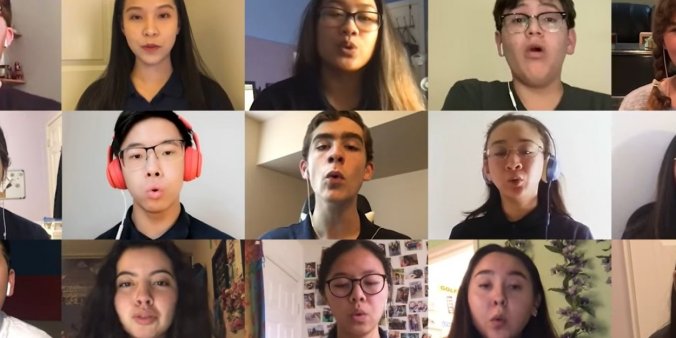
Our older son was in Band in high school (sax) and our younger (first tenor) began Choir in middle school. I attended State competitions for both Band and Choir, but one year the Seaside High School choir director, Michelle Starke, directed a song from the middle of an auditorium with students all around the sides of the vast space. That meant the choir had to pay absolute attention to their director because sound does not travel instantly. To keep their voices together required discipline.
A California high school choir sang a capella from home. If you haven’t already seen it, you need to listen and watch this.
“School closures throughout the nation have halted highly-anticipated campus events and activities with hundreds of thousands of students practicing social distancing at home. While the annual Chino Valley Unified School District (CVUSD) Choral Festival—originally scheduled for Wednesday, March 18—has been cancelled, our Chino Hills HS Chamber Singers demonstrated resilience by recording their individual a cappella portion of Over the Rainbow in their separate homes, and through technology were able to appear together as a family again. Their harmonious performance was shared online for the CVUSD community with the goal of spreading hope and cheer during this difficult time.”
And from novelist Nicola Griffith: “No one knows where we’re heading or what it’ll be like when we get there. So be kind. Be patient. Be cheerful. Don’t let yourself be ruled by fear. Choose love and compassion. Forgive yourself and others. Stay connected to others. Take your joy where you can. Try to assume good intent. If you feel bad, be kind to yourself. And remember that some people out there will be in a bad way, mentally, physically, emotionally, and financially. If you can spare anything extra—money, kindness, patience, a mask, the benefit of the doubt, a moment to listen—you might brighten one small corner of the world. Do your best to be a fine human being. And we might all get through this.”
DEFINE TERMS

Early in the school year, I used to do vocabulary activities in my junior English classes. They required the use of hardcover dictionaries and most often teamwork. In each case the terms and their definitions were written into classroom journals which could be accessed during quizzes and exams. No need to write any of this down, I’d say, but if you find you need the information during a test, you can look it up in your own journals. Sometimes I did this twice.
The short version had four words: “sympathy,” “pity,” “empathy,” and “compassion,” and illustrates the classic case of dictionary definitions that reference one another. Continue reading
TREE SKIRTS

Over the years three boys in my Junior English classes argued in their research papers that nuclear power was the cheap, non-polluting, and safe alternative to fossil fuels. They were blissfully unaware that radiation is deadly. They did not want to hear about it. When one boy asked an engineer via email whether there were any health dangers associated with nuclear power, he was oblivious to the sarcasm dripping from the nuclear expert’s response: None. I pointed out that a nuclear engineer was certainly an expert but not on health. No matter. He found an industry website that gave him the quote he needed to prove his thesis.
1 million years
That’s how long Germany has to keep the radioactive waste from all of its nuclear power plants buried for it to be safe. The country recently closed all of its nuclear power plants and is looking for a way — and a place — to make the million-year commitment.
Nuclear fuel is only cheap if you do not count the waste left behind. It is absolutely polluting in itself as well in the vast amount of water heated while cooling the reactors, and safe? Seriously? Why did I have to keep bringing this up. Radiation is dangerous. At least acknowledge that and work from there. But these young writers were determined to ignore any information that countered their thesis.
We want to believe what we want to believe sometimes. Climate change is not happening. The hearings are unfair. I do not have to testify. I am safe to drive. I do not have to tell you. My situation is different.
Yes, it is. They are fair. You do and you should. No, you’re not. Yes, you do. It’s the same for everyone else.
It is inconvenient to face facts.
There is no magic in pretending. What we believe is not the same as what we know. Faith in what we want does not have the permanence of truth in the real world.
Year after year, the majority of my students chose to write their persuasive essays about something they already believed and many of them left cavernous gaps in their argument because they could not be objective in their research. And year after year a few students chose to write about something they did not already believe and generally wrote better papers as a result. Once in a great while students changed their minds, and that was most impressive of all.
Yesterday I addressed holiday cards. They say “Happy New Year!” so there really is no hurry sending them out. It’s just one of those things on our list like ordering candles (done) and finding a tree (also done) and wrapping gifts (whoops). My approach to the holidays is to spread the labor throughout the year so that I can better enjoy the season. This must be a habit left over from having two toddlers and six dogs (with weekly grooming I did myself), and later a job that overwhelmed my time. I even held a holiday Open House for years when the kids were small. (Baking done each night after I got home from school for a month in advance.) Get it done early so that I am “not rushing about at the last minute,” as my mother used to warn me.
By the time the big Black Friday sales begin, my shopping is already done because I started a year ago. I am free to enjoy the season. Yes?
Does that really work for me anymore?
I’m not certain. The truth is that I enjoy making and buying presents. The truth is that I am one of those people who overdo the holidays. The truth is that my mother never entertained so I had no model for how to do that. The truth is my husband had a genuinely impoverished childhood and this was a dreaded season for him before we met, but now he loves it all. So that mission is accomplished.
Is that the goal? I check my list and mark off the tasks and something always remains undone.
There is a tree in our living room and NaNo is done and I still have to seal and stamp cards and one bed is crowded with gifts waiting to be wrapped. I am still knitting. This year I have several projects I hope to complete sooner rather than later. I thought I might actually sew patchwork tree skirts for family members. That project has been on my list literally for years. It generally haunts me till New Years. I plan each year to start on them earlier . . . and then I don’t.
I have already decided that to cross out tree skirts. It is good to let go of some obligations. It is best to face truth that everything cannot and need not be done. I am not sewing tree skirts.
There’s always something.
WORTHWHILE

“… it is utterly impossible for over-worked teachers to preserve an instinctive liking for children; they are bound to come to feel towards them as the proverbial confectioner’s apprentice does towards macaroons. I do not think that education ought to be anyone’s whole profession: it should be undertaken for at most two hours a day by people whose remaining hours are spent away from children.”—Bertrand Russell from Education and Discipline
I didn’t want to get there. I have explored options and considered alternatives.
It was the end of Winter Term and the beginning of my last spring as a full time teacher. A former student who wanted to write and perhaps also to teach, asked me if I would enter the teaching profession again? Did I have regrets? I suppose the easiest answer would be to suggest posts about teaching on my blog. Without denying the challenges, it was been a great career. I loved teaching and I am deeply grateful for the opportunities teaching has given me to develop writing skills, to work with students, and to contribute meaningfully to the world.
My former student acknowledged that “education is something that’s extremely important and I think that high school is the most crucial age to reach out to students.”
Yes, I feel that. I feel commitment and love for my students. I recall all too vividly what and who I was in high school, and the common lie about it being the “best time of life” when for me it was lonely and frightening, and I am fortunate to have survived. Unlike most of the teachers at my school, I did not love sport and I did not turn to teaching as a way of prolonging my own student experience. I came to teaching out of compassion for those terrible years of becoming.
I have no regrets. I have loved teaching. I enjoyed the challenges to my intelligence, innovation, and certainty. I made many mistakes on my way to wisdom.
But I did not begin wisely. I entered teaching with the same foolish notions shared by many others.
- I thought I was a natural at teaching. (not a chance)
- I thought it would be easy. (oh dear)
- I was a visual artist and thought teaching would leave me time to create. (ha!)
- Vacations and summers off! (ha!)
- The pay for my area is good. (not so much)
- Job security, good pension, sabbatical. (gone)
Fortunately, I outgrew these notions, accepted my mistakes, and loved my job before I became too discouraged to continue.
Would I enter teaching now? She asked me this as I struggled to carve out a week of space in the Spring Term for the new achievement test designed to rank students, teachers, and their schools. Fortunately, these tests would be phased in over the next three years—that is, there were alternative paths for students seeking to graduate other than passing that test. No administrator I knew fought this or even talked publicly against it. I suspect they all hoped, as did most teachers, that the test would go away. Perhaps its replacements will. But thus far, despite my skepticism about the accuracy of test score, I am sorry to discover my former school has lost ranking.
In the mean time, while I was there, required testing limited what I could do with juniors that spring. It stole time and energy and attention. It caused distress, and in the end it proved almost nothing. Even if students do well on the test, no matter if they failed, more than a hundred years of experience with high stakes testing via the SAT reveals what any sensible person knows: Teachers still do a better job of evaluating accomplishment and predicting future success than any test. What I recorded in my grade book was a more accurate evaluation.
Nevertheless, we have lost faith in teachers. The pension system is somewhat gutted, but then this is the trend across our nation as unions have been axed and the middle class attacked. There was a golden period, and had I been teaching while my sons were little I might have retired with a pension that more closely reflected my current earnings. Or I could have been a university football coach, the one The Oregonian likes to cite when attacking my pension. The newest pension system, the one teachers now have, is even weaker than mine was when I started. I could not begin to retire with twenty-five years with only the current pension system. I am not sure I could ever afford to retire. The pension was something I looked forward to during bad days when I was scaling by: At least I had my pension As a person inclined to worry about money, I do have fears about being alone and destitute at the age of eighty, when the funds from my more recent pension will run out.
Would I have entered teaching if the education landscape looked like what it does today? Perhaps. I would have been wiser to choose another career path. I was good at the job, I think, and I loved it. But about half of the people who enter teaching—even before the recent changes to pension, job security, and testing—leave within a few years. This doesn’t happen in other nations. In most nations teachers leave teaching about as often as plumbers leave plumbing or lawyers leave the law. Education here is tougher: American students are poorer, our school days are longer, the total student load (the number of students seen each day by a teacher) is higher. Job security and a strong pension are gone. Other perks of the profession disappeared early in my teaching career—tenure and sabbaticals are a memory in my state. All of that make education more challenging for students and teachers.
My term teaching as a student, my practicum, was completed under Field Advisor Hazel Koenig and Lynn Gray as my Field Teacher. Two extraordinary women helped me to grow and also to find my first job as an Art teacher. fifteen years later, I took a lot of classroom management workshops and graduate classes once I was hired as an English teacher and thus shifted subject areas.
It was lucky for me in terms of personal growth, not so fortunate in other ways.
The energy to create my own art—whether that was visual or written—and to work with students seems to come from a similar place. John Gardner warns beginning writers about this in On Becoming a Novelist. More recently, in the first chapter of her newest collection of essays, This Is the Story of a Happy Marriage, Ann Patchett writes about this too. By the time she’d spent a week working with students on their writing she had no energy left for her own so she tried to wait tables, also exhausting. Finally she chose journalism and in that profession she learned both to write to order and to let go of words.
Nevertheless, the way I came to think of myself as a writer came through teaching writing. I have written several novels and I have managed to publish fiction, poems, and nonfiction while also teaching full time. This is, shall we say, an unusual accomplishment. And it has likely been achieved at the expense of doing my best in any area.
Most summers—for all but three in the last years I spent in the classroom—I was in school and planning curriculum and often working part time as well during those ten weeks “off.” For the other three summers I was merely planning curriculum. I woke at five in the morning and was frequently still answering emails from students until I shut my laptop down at around nine in the evening. I regularly received requests from graduates to forward class materials on MLA form and résumés and to edit graduate school applications or all three inside a week). I am not complaining. On the contrary, I am pleased that former students still think of me at all.
It has never been easy and I wasn’t good at my job for the first years’ teaching. I had bad days and failures. There were many days when I think of myself and my life as a teacher and I am profoundly grateful. Sometimes I think of myself as a writer, but perhaps that will change. Most things have.
But I liked my students, and I liked them right through to the end of my career.
BEING SMART & HIDDEN

The student stopped me in the hall one Fall day to tell me another teacher thought she was stupid, had told her she was stupid. I did not entirely believe her.
And then a few days later, that teacher she’d complained of also stopped me in the hall, in almost the same spot, and told me that student was misplaced in Honors classes and not capable of doing the work I demanded in my college writing and lit classes. “There might be three in my Honors class who can do the work.” His upper lip fairly curled. He mentioned the girl by name and said she was stupid to think she could keep up.
I knew better. I had taught her the year before and found her highly capable, perhaps smarter than her transcript suggested. She had participated in discussion and demonstrated skill in reasoning and composition, and I had spoken to her outside of class. Her mother was a mess and this girl was protective of her family. I suspected she was heavily disguised because being known as smart had not served her well in school or life.
I’d seen it before, but it was hard for me to believe that a teacher would miss how smart she was, how insightful and kind, that he would be so unkind as to allow a student to see he disrespected her. He later apologized for being rude about students to me, though he had not altered his opinion about students. Perhaps there were “four students capable of the work.”
Soon after, test results came out, and though I have limited faith in State testing, this girl’s scores were right up there, top of her class. It was, despite his opinion, a highly capable class overall. I noticed the previous year.
But this one girl. She was not the first to hide her intelligence. I’ve had others—students smart enough not to want most people to know they are smart or even to fully appreciate it themselves.
Sometimes they set a bar so high for their work they cannot reach it. They are smart enough to see how high the bar can be set but not yet experienced enough to leap that high. One girl at sixteen had never passed an English class. She did the work but never believed it was good enough to hand in. Gradebooks showed strings of zeroes for her work beginning in Sixth or Seventh Grade. Her friend and I staged an intervention: “You have to hand in an essay that is really, really bad. It can not be a good essay or even okay,” we told her. “It has to be bad.” We cajoled and even, I confess, we bullied. We all three of us laughed and laughed. But she handed in her story. (It was not bad. We teased her about that: “You’ll have to write worse than that.”)
Gina became my model of the Sixty-Percenter, a student who will do precisely 60% of what is asked, just enough to pass. She might answer six of ten questions perfectly and leave the remaining questions blank. She might complete just enough of a writing assignment to squeak by. Her skill at pinpointing that passing level was astounding. My response was to ask more and more of her, because whether the work was “easy” or “hard” she would always perform at that 60% level—better to do passing level work in a harder class than an easy one, I figured. I could not fool her.
Kevin was another Sixty-Percenter, but he was too stoned most of the time to gauge his own progress. He was the only student I ever routinely lied to. He needed to pass and would check with me about his grade. If he knew he was passing my class he would disappear for a few days. I learned to tell him that he was almost passing at 58%, but “if you’re in class for activities during the next two days, by Friday you should be back to passing.” That got him to the weekend. Sometimes he actually had a B average, never less than a C. Like the first student I mentioned, he tested in the 99%tile but in nearly every subject.
In fact many of my troubled students were gifted. I say many, but I taught for thirty years. I can recall a dozen or so of the thousands of students I taught who were highly gifted to the degree that they were hiding extraordinary brilliance in plain sight.
There was the boy who doodled on the sides of his pages and liked to express opinions that he knew would wind me up. He was absolutely the smartest person in the building for the four years he attended the high school where I taught, but the only one among his circle of friends who refused to take the SATs and who never went on to college. He went to work in the woods and when he later realized that in order to survey forest he needed advanced math skills he had avoided in school, he found a textbook at the GoodWill and taught himself.
I have personal experiences as well.
I recall vividly when in Seventh Grade I was outed by my homeroom teacher as the top performing student in my class. I was surprised when the teacher made this announcement and so were my classmates. I was not so smart as the dozen or so of my most gifted students, but like them I did not come from an affluent home. I did not go on skiing vacations or take special classes or play piano or take dance or have braces. And like some of them, I was not deliberately hiding my intelligence, I was hardly aware of it. My peers barely noticed my existence. I only knew that I needed to keep a low profile.
My older son was identified as disabled by his Second Grade teacher. He was tested by hearing, speech, academic, and learning specialists and tested as perfectly normal, though highly gifted in math. The lasting result was his insecurity that something was wrong with him. And then, when his brother was of concern from another Second Grade teacher, the district psychologist urged me to allow testing to “get them off his back.” Yes, crazy-smart.
In her landmark essay, “Small Poppies: Highly Gifted Children in the Early Years” (1999), Miraca Gross describes how extraordinary intelligence can lead to dysfunctional children and tragically lost adults. Despite the popular and thoroughly debunked belief that intelligence leads to or is caused by insanity, gifted children often learn to hide because what they understand and care about is out of step with both peers and teachers. (See above & below.)
[Insanity has no connection to intelligence (though a slight connection to creativity. It is a very popular notion but many studies debunk it. People of average or even above average intelligence are determined that geniuses are bat-shit crazy. No. It’s only that we do not follow them. Pretend for a moment that IQ tests, all tests, have more reliability than they actually do. That’s what a psychologist did in order to explain why highly gifted children are at risk. A person with an IQ of 150 has no more in common with the capacity of an average person with and IQ or 100 than a person with an IQ of 50. (Look up what an IQ of 50 means for real world function.)]
Smart children are generally out of step with peers and teachers, but most smart children learn to navigate a world hostile to their capabilities just fine. I was smart in school and always felt out of step. I was smart enough to manage, to find my way without getting lost. But I was not so smart as the children Gross is worried about. These are not merely gifted children, who will muddle along as I did.
The exceptionally brilliant child is more at risk because the way they think is so far beyond the average person’s abilities that as children they cannot find a way to accommodate to expectations of teachers and peers. They offend their teachers who do not grasp ideas and processes this child takes for granted. Yes, these children are too smart for their own good. They are less knowledgable and less skilled than their teachers, but far more intelligent. I’ve seen it too often. Once is too often. Teachers can be offended by a student asking questions too advanced for the teacher to answer or too complex for the teacher to even understand. Some teachers pick on such students, ridicule and bully because they are frightened by superior intelligence. How sad is that?
When a student asked me a question I had to admit I could not answer, the most common response from the student was an apology. They were so very sorry to have asked a question the puzzled me. They had been taught to be sorry for their curiosity!
Every public school today provides protections and special support for students with learning disabilities. It is in federal law. All children must be guaranteed an “appropriate education” even if that means being given more detailed step=by-step instruction, more time or easier work, one-on-one support and coaching, and continued help in reaching graduation for years past age eighteen.
Support for gifted children, children with special needs because they are exceptionally intelligent or otherwise academically or creatively gifted, varies from state to state. My state says there should be support for gifted students (those in the top 3% in performance or capacity according to tests) but offers no funding to pay for it or to more effectively identify children who need, really need support. Indeed, my own experience is that administrators and teachers often resent any sort of support for gifted students. “It should be easy for them.”
Often, this is not at all the case. Smart children are teased by peers, resented by teachers, and often ignored. They are alone in a way that most of us never experience.
Some students are singled out for TAG (Talented and Gifted) programs based on early verbal skills which were too often derived from social advantage rather than innate skill. Wealthy or influential parents pushed their kids into TAG. In the mean time, genuinely brilliant children are sometimes told they are stupid or come to believe they are, or learn to perform at a minimal level or in other ways to hide their abilities.
We fail to give them an appropriate education.
Smart children are not meaner or “crazier” or necessarily more dysfunctional, but they do have potential to master great problems. The cliché I hear all the time that “children are our future” applies to all of them too. It is an absolute and cruel loss to society when we allow the brightest among us to languish in pain, when we exclude them from their own potential. Because we are scared? Because we are jealous? Or only because we fail to recognize our shared obligation to identify the issues and ease the way of each child according to their individual need.
*Miraca Una Murdoch Gross AM is an Australian author and scholar recognised as an authority on the academic, social and emotional needs of gifted children. Born and trained in Scotland but spending a large part of her life in Australia, Gross is currently Professor of Gifted Education at the University of New South Wales School of Education and the director of Gifted Education, Research, Resource and Information Centre.
 IMPERFECT PATIENCE