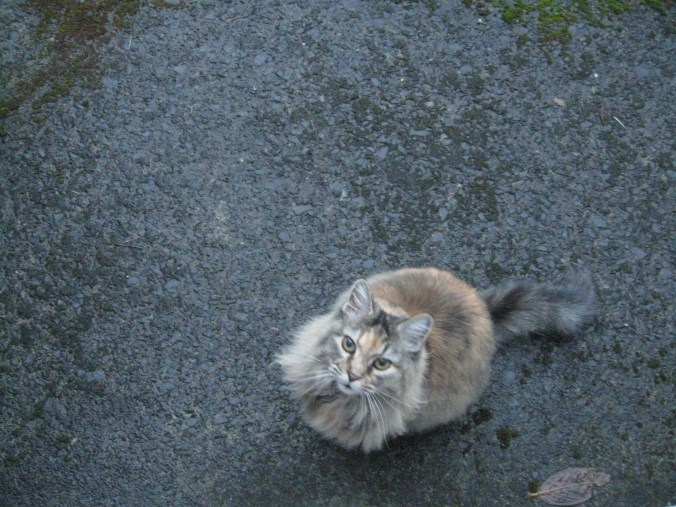
Our cat Leakey was named for the anthropologist. She arrived on our doorstep literally half-starved and Gary saw her first. When I got home, I picked her up and she purred like a motor boat. “Don’t touch it, don’t pick it up!” Gary said over and over, but who had fed her the can of tuna? I brought her into the house. She had fishhook claws and liked to tease the dog.
The other day when we came home from our morning walk, Gary did what he generally does and walked around the house. Just in case. That day he found a dead rat on the north side concrete walkway. No blood, no wound, an apparently sleek and healthy but certainly dead rat.
Had the rat tried leaping from the tree next door and missed our roof? Had it climbed the side of the house and fallen? Most likely, we decided, a neighbor has put out poison. There is no kind way to kill a rat, but poison is one of the uglier choices and also endangers other wild creatures. When a cat or hawk eats a poisoned rodent, that’s called “secondary kill.”
The dead rat reminded me of a story I used to tell my students about the different ways rats and human beings learn, starting with my introduction to rats as pets. A PhD psych student at the University of Washington told me long ago that if I ever wanted a rat as a pet I should find one that was not white. White rats are most often lab rats, rats bred for hundreds of generations deliberately to have no variability because they would be used for experiments in which individuality, including a unique personality could taint results. “Get a brown rat or a spotted one,” he insisted. “Any color but pure white with pink eyes.”
So what sort of behavioral experiments were done with white rats where a personality might affect the outcome? Plenty in the heyday of behavioral science. Rats in mazes, rats pressing buttons for food, rats raised in colonies. [They learn to run the maze faster and faster; they can be conditioned to press a button hundreds of times to receive a pellet of food; with limited space, rats exercise a kind of birth control.] One experiment had to do with two rats in a cage with a pair of buttons. Pressing one button dropped a food pellet into the cage; the other button produced a non-damaging but painful shock. The rats in the cage were hungry and curious and eventually each pressed both buttons, discovering that one hurt and the other fed.
But here’s the thing: One rat would get shocked, run around in pain and surprise but then eventually go back to try the other button and receive the pellet of food. The other rat, despite having seen this play out, was just as likely to press the wrong button and receive a shock. The second rat learned which was food and which was pain from personal experience, but seemed unable to learn by observing others.
I used to act this out in class, playing each of the rats, simulating their pain when shocked and their pleasure at finding food.
Human beings, by contrast, can learn not only from their own mistakes but by observing the experiences of others.
Don’t be a rat, I would tell them. You can be smarter than that. Be a human being.
[I recall seeing the experiment in the Seattle Science Center when I was a child. But perhaps that is not true about rats not learning from the experience of others. I have also been told that sharks cannot learn at all. They will bite whatever is in front of them, in case it’s edible. Don’t be a shark.]
Can we learn from observation and without direct experience? Yes, we are capable of that. I can see my friend burned on a hot stove and learn the lesson without the pain. Human beings are capable of setting down rules for behavior that keep everyone safe and our society just.
Human beings are not so simple, not always so reasonable. We cling to our preconceptions and prejudices. A look at the carelessness of some Americans concerning the pandemic suggests that many of us would prefer to ignore what we know in favor of what we want to believe. Most often there is no great harm in that. Belief is a powerful thing. My husband firmly believes that we met and fell in love as a result of fate. I cannot avoid feeling we were very lucky, but I do not believe in fate. I object to the concept of predestination on principle.
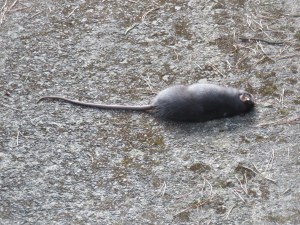
Poor rat, big rat, very dead rat.
Gary suggested that the dead rat was left by our cat Leakey as a ghostly gift. It is where she left her kills or the parts of her kills she did not eat. She was an industrious and generally responsible hunter. She never killed a bird or even a shrew. She mostly ate what she caught and didn’t play with her food. Rats were her preference, though mice and the occasional chipmunk were fair game. There was also a longstanding disagreement with a weasel . . .
Leakey has been dead for a few years, which is the only reason rats venture onto our property at all. There were many years when we had cats who were hunters, doing what domesticated cats have always done.
I think that rat was poisoned.
We agree to disagree.
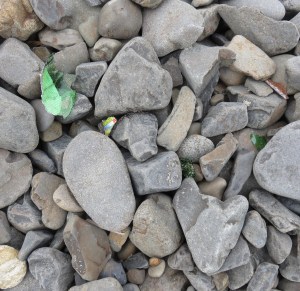
Glass moved off the path. Will it make “seaglass”? Maybe.
Then the next morning we found broken glass on our sand path to the beach. I saw what at first looked like a green leaf. Bending over it, I recognized it was broken glass. Gary still insists there must have been two bottles because there is glass all over the rocks. We agreed that the shards are from a Reed’s ginger ale bottle (we found part of the label) likely thrown on the rocks by someone staying at the rental next door. We agree that shards of glass in our path was accidental (we found where it first hit the rocks north of our path). And we both picked the pieces up (I got the bigger bits and Gary went out with a sieve to double check we’d found it all).
Then yesterday we found more glass, not new but just more we had not noticed. Gary might be right about two bottles. When we spotted a tourist sitting on the rocky shore I went our to warn her to be careful of glass. She was nice about that too.
A local rental owner has set up a large fire pit high on the beach in the rocks. A sign welcomes others to use it since “we know this is a public beach” and asks people to leave it as they found it. The problem remains that the fire pit is in the rocks, too close to greenery (there is a law about that), and the fire pit itself is ringed in basalt stones that will, if they get too hot, crack or even explode. I used to warn people about that last, but people do not believe me until they have actually seen a rock pop open. Sometimes an exploding rock will shoot fragment into the air. No one I know has lost an eye from that happening.
Maybe it’s fate?
 IMPERFECT PATIENCE
I think it was about 5 days ago, I saw a car with a Pest Control sign park at the same short term rental whose owner built the fire pit for their guests. Perhaps it was their poison that killed the rat. There used to be an abundance of chipmunks but not now.
LikeLiked by 1 person
We saw it too. Poison is an indiscriminate killer. (That fire pit, by the way, continues to be a problem. I looked up the regulations.)
LikeLike
Other than her two sisters she was the best cat in the world—at least thats what she used to tell me.
LikeLiked by 1 person
Okay, so Yeti (the dog) was one “sister.” Am I the other of those sisters?
LikeLike