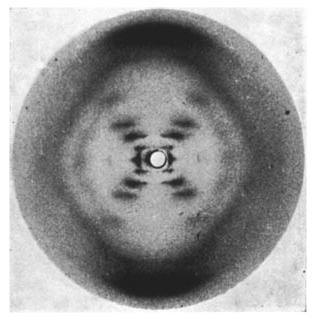
Photo 51, showing x-ray diffraction pattern of DNA. Photo 51 is the nickname given to an X-ray diffraction image of crystallized DNA taken under the supervision of chemist Dr. Rosalind Franklin. It was critical evidence in identifying the structure of DNA. Dr. Franklin was not credited for this work by two men who later won the Nobel.—Wikipedia
“Our science can only benefit the whole of society if it’s done by the whole of society. And that’s not currently the case.
—Dr. Jessica Wade, a British physicist who has added 670 profiles of women and people of color in the sciences to Wikipedia since 2017
Women and people of color are underrepresented throughout Wikipedia, which is an issue Wade and others hope to repair. Dr. Franklin is there, but for many years her pioneering work, and especially her contributions to the discovery the the double-helix in DNA, was not properly acknowledged.
As a girl in the 50s and 60s, I was fortunate to be aware that women had made scientific contributions.
My father cited a UK researcher who had published as a young woman, then later under her husbands’ names, and how he wished she’d stuck with a professional name so that her work was not scattered all over his library.
I learned two lessons from that brief story: women are scientists and a public name need not indicate a private identity. I used to tell that story when students asked me why my last name was not the same as my husband. (On a good day, I could cite eight or nine reasons I kept my name.)
 IMPERFECT PATIENCE