RISK

fullsizeoutput_1255

A friend traveled to her vacation house, another marched for justice, and our younger son and his children are here for the weekend.

Most of my yarn order arrived in the post office, but we will not visit before Monday or Tuesday. The website promoting my fifty-year high school reunion has not been updated for months. The painting I bought early in May is still lost by UPS. So is Gary’s CD from Estonia and the doll from Russia. I discovered that UPS does not acknowledge or search for lost packages until and unless you absolutely insist. Who knew? Continue reading

continued SHIPPING ADVENTURES

IMG_6070

The rabbit ate every single leaf off this rose last summer. Gary put her in a cage and she’s blooming. So is pretty much everything!

Some good news and some other news. Mostly funny stuff. Mail, stories, running, television.

The TV remote fell over the back of the couch last night and we could only turn the television on and off, but we could not use the up/down/side-to-side button that would allow us to access anything online. Continue reading

POLICE, a verb

fullsizeoutput_1248

It depends on what you mean by police. Officers of the peace uses “police” as a noun. Police as a verb is action. To police the grounds means to pick up what does not belong and put it where is does belong, to collect waste and protect order. Policing also means to serve and protect, to serve as a warning and a promise of justice, to provide oversight and balance against incursions by individuals and organizations threatening peace.

police, verb

1:  to control, regulate, or keep in order by use of police
2:  to perform the functions of a police force in or over
3a:  to supervise the operation, execution, or administration of to prevent or detect and prosecute violations of rules and regulations
b:  to exercise such supervision over the policies and activities of
4:  to make clean and put in order
5:  archaic, GOVERN

According to “Defund the police? Here’s what that really means,” an Op-Ed  in The Washington Post this morning:

“To fix policing, we must first recognize how much we have come to over-rely on law enforcement. We turn to the police in situations where years of experience and common sense tell us that their involvement is unnecessary, and can make things worse. We ask police to take accident reports, respond to people who have overdosed and arrest, rather than cite, people who might have intentionally or not passed a counterfeit $20 bill. We call police to roust homeless people from corners and doorsteps, resolve verbal squabbles between family members and strangers alike, and arrest children for behavior that once would have been handled as a school disciplinary issue.”

The author, Christy E. Lopez, is a professor at Georgetown Law School and a co-director of the school’s Innovative Policing Program. “For activists,” she writes, “this conversation is long overdue. But for casual observers, this new direction may seem a bit disorienting — or even alarming.” The goal is not to remove protections, but to shift strategies and redefine responsibilities for public safety.

I thought over my own interactions with police officers and others charged with protecting property  and people. There were great experiences and terrible ones.

There was the police officer who looked down my shirt and declared: “One more button and I could take you in for public indecency.” There was the line of armored National Guardsman several blocks from a peace march who shoved me off a sidewalk and into traffic, despite my noninvolvement. There was the time I waited for a bus in front of Andy Shiga’s import store in the University District and officers got out of their patrol car and accused me of prostitution. (Let it be noted that I was wearing sport shoes, jeans, and a blue workshirt from Penny’s during each of these incidents, and it was buttoned to the top after that first incident.)

But it was kind policemen who coaxed the young woman out of a shared bathroom in the apartment building Gary and I managed in the University District all those years ago. They were calming and gentle and took her to Harbor View where she was held and treated until her father arrived to take her home. The hospital diagnosed a complete psychotic break triggered by a drug overdose. Those officers came by to tell us what happened to her, and came by later to ask if we knew how she was doing. By then Debbie was in a California mental hospital. There have been a lot of times like that when I witnessed police officers taking care of the public.

When a series of local burglaries resulted in lost food and small items from several homes and a broken window, the community assumed it was the work of a local teenager. Nevertheless, neighbors held a meeting at “Sitty Hall” and invited the county sheriff to weigh in. “What should we do?” The sheriff suggested we all buy guns. “That’s a terrible idea,” I said. And seriously, that is a terrible suggestion. 

Everyone seems to know someone who knows someone else who had an uncle who protected their home against Violent Drug Addicts or Known Felons. That was not what we were looking at. We were looking at kids breaking into holiday homes and raiding the refrigerator. The truth is we needed to de-escalate, not turn petty crime into a gang war.

You start something, I get a gun to protect myself, you pull out a gun to protect yourself. Someone goes to the hospital for four ounces of cheese and a transistor radio that hasn’t worked for years.

I don’t think most officers enter policing so that they can bully or beat citizens.

But some are trained to do just that.

Police on television seem most often to be soldiers fighting a war against the public. Oh, yes, career criminals and gangs and so forth, but too often this orientation of police and policing as a sort of domestic warfare does our society more harm than good. Lopez goes on to explain: “Defunding the police means shrinking the scope of police responsibilities and shifting most of what government does to keep us safe to entities that are better equipped to meet that need. It means investing more in mental-health care and housing, and expanding the use of community mediation and violence interruption programs.

from today’s The New York Times:

“An encounter in Buffalo last Thursday — in which two police officers shoved a 75-year-old man to the ground and left lying him there while blood poured out of his ear — was troubling partly because of the original police account.

“The account claimed that the man ‘was injured when he tripped and fell.’ If a video hadn’t existed, the truth might never have come out.

“That’s a widespread problem:

“Philip Stinson, a criminologist at Bowling Green State University, who has analyzed thousands of police reports, told CNN that lies like these were fairly common.

“Activists in the current protest movement have begun to focus on how they can turn the rallies of the past 10 days into lasting change, to reduce both racism and police brutality. And reducing the frequency of false reports by the police is likely to be a key issue.”

Forget the cop shows and consider personal experience. Our faith that problems are best solved with the threat of violence or incarceration instead of reason and safer options might be at the heart of the problems they are supposed to address. Sometimes we do not need the knight in shining armor when a little old lady speaking slow and calm might have served to resolve the problem. Most policing situations are better served by an officer trained in de-escalation of an emotional situation than by an officer trained to fight a war. It sounds tough and purposeful to say a “war on drugs” or a “war on poverty” but there is no glamour in winning those fights and too often we abandon them even when we are winning.

I understand the appeal of a fight in an arena or on media, all that violence raising our blood pressure and exciting our lives. Action movies. Video Game. Football and ice hockey. So thrilling! At a safe distance.

In real life, we just want to go about . . . living. We want to do our jobs, get to the store, talk to the people we love. We want a hug. We don’t want a fight. In real life, most of us do not want war.

Ask someone who has been in one. Let officers of the peace do that.



STRANGE FISH

IMG_6022

I am more than a little bit obsessed with the sky.

Gary went to the Post Office yesterday and we received a “limited edition” 2021 calendar from a nonprofit. He considers this an act of optimism, not merely because they hope we will give them money, but because they think we will need and use a calendar next year. That seems almost naive. In the mean time, I now have three packages temporarily missing if not actually lost in shipment. The painting is still lost (for two weeks) and now also a small yarn shipment I wanted for my next warp seems to be misplaced, both carried by UPS and last seen in Hodgkins, IL; the third shipment is from an artist-friend in Russia, so that would be Russian mail or a ship sank or a plane went down, or it burned in New York. And Gary has a CD that will get here eventually from Estonia. I wish I could explain why all this is so funny because we both think it is hilarious.

My novella was shortlisted by a very good magazine and rejected three days later. They would like to see more of my work, and I wish I had more to offer. I have sent the novella off again to another magazine. Assuming it is also rejected there, I will submit it at least twice more. If no one chooses to publish it by then, I will stop. These are carefully chosen markets with smart editors and if they do not find it publishable, I will accept their judgement. I was telling a friend that I have submitted one story at least 58 times and received some quick rejections and some very kind ones. I revised that story after each rejection, and many other times besides, starting it different ways, altering chronology and point of view—hundreds of hours—so you see how I have over-invested in it. However, whatever is wrong with that story, I still love it though evidently I am the only one. Enough already.

The lost packages will be found, or money refunded, or some combination, or not, and my novella will find a home or not. I am entirely resigned about publication. Instead, I will create my own little book with a spectacular cover illustration, print off ten or twelve copies, stitch the binding, and give them away. Sometimes I just need to see the process completed. Maybe I will write more of the story as Tula sees it, or Rosetha, or the Daughters. Or maybe I will just be done. It is good to finish things.

fullsizeoutput_1252

Just a bit of the pieced top in progress—you’ll have to trust me that this photo does not do the fabrics justice.

Since I do not have the yarn I need, I turned in another direction for the sake of sanity. Mid-March I ordered vintage Indonesian cotton from Cargo Inc. in Portland, hand block-printed and batik fabrics. I wanted to visit the store, but we were already self-isolating “in an abundance of caution” as people were starting to say then. The fabric came quickly by mail with a lovely string of little bells. I wanted to piece the front and back of a quilt. They had sold out of one fabric, and another was too blue so I thought for a while, sorted and arranged, pre-washed and ironed twelve yards of fabric, fiddled and rearranged. I had what I had and could not get more. I dug through my grandmother’s cotton threads and decided to sew with red. That was a happy choice. Piecing the black-and-cream backing took only a day and I was satisfied. Then there was the long period of staring at the rest of the fabrics, of accepting that the original vision would not fly and seeking an alternative. Eventually, pieces began to settle in my mind’s eyes. Yesterday morning I started working on the front, cutting and sewing. It is a center diamond pattern, a simple and classic America design. Two frames in red, an inner and outer border. When I ran out of red thread, I used pink. Strangely, no major glitches along the way. I work fast once I figure out what I am doing. The top and backing are finished already, the top in one day, and are pressed, folded, and ready for quilting. I began this task before eight and kept at the task unsteadily for the next eight hours. This morning I ache all over from my efforts and am grateful showers and downpours will likely keep us from a long walk. It is currently pouring rain, a great dark cloud moving in from over the ocean.

[Gary has stripped the bed so that there will be no question of going right back to bed after we eat our oatmeal. Tempting.]


Emails have carried many messages of solidarity from museums and news agencies, social activists, and yarns stores—from virtually everyone I know virtually! It is heartening.

“As always, we hope you’re well, and we hope you’re safe. We took a break from knitting this week, to speak from our hearts about the deep-seated problem of systemic racism and anti-blackness. We just haven’t had the heart for our normal chatter about knitting.”

And perhaps heartening of all, the NFL has finally reversed their stance on players taking a knee. A white player has apologized for his wrong-headed condemnation of protests over racial injustice: “Through my ongoing conversations with friends, teammates, and leaders in the black community, I realize this is not an issue about the American flag,” New Orleans Saints quarterback Drew Brees wrote. “It has never been. We can no longer use the flag to turn people away or distract them from the real issues that face our black communities. We did this back in 2017, and regretfully I brought it back with my comments this week. We must stop talking about the flag and shift our attention to the real issues of systematic racial injustice, economic oppression, police brutality, and judicial [and] prison reform.”

One of the greatest accomplishments is to change our mind.


IMG_6024

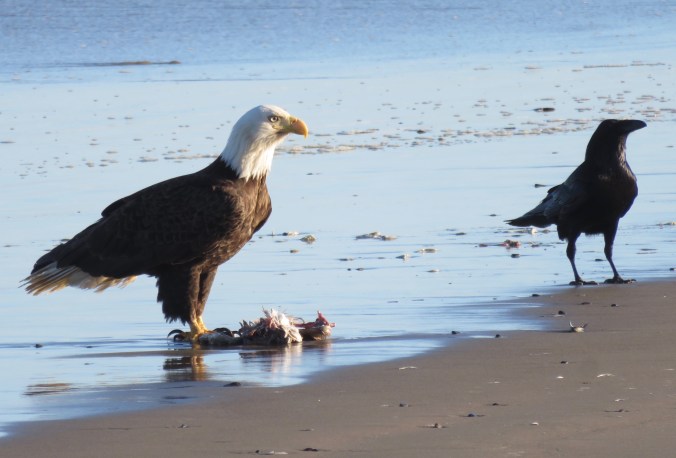
Eyes gone but the teeth . . .

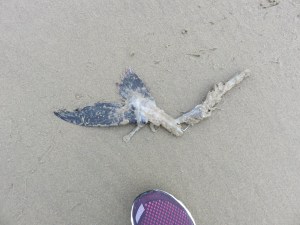
Seriously, anyone recognize that mostly-eaten fish up top? Teeth! What looked like a dorsal fin. The eagle got most of it. I think our resident pair have eaglets they are feeding. We have seen a great deal of them. Seagulls had dragged the tail off to a safe distance.

The osprey has been fishing in front of our house.

The ravens do a fly-by just to be sure they aren’t missing anything.

IMG_6025

Most of the tail with the toe of my shoe for scale.


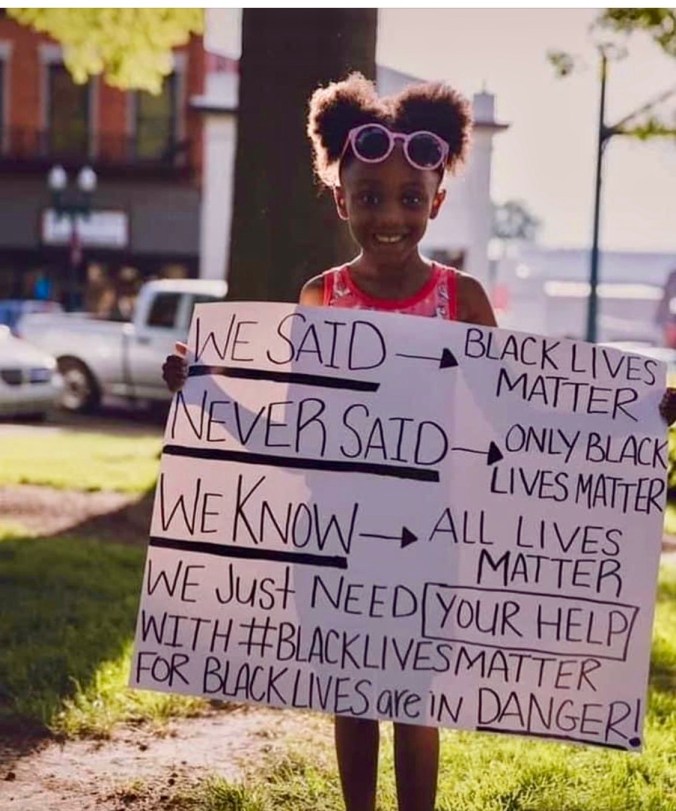
WE NEED HELP

IMG_5490

Just to be clear.

A story comes to mind from a friend who was struggling to understand Why Are All the Black Kids Sitting Together in the Cafeteria? It’s the title of a book by Beverly Daniel Tatum, Ph.D., useful to educators trying to understand how to help all their students.  Continue reading

“YOU DON’T FEEL MY PAIN?”

lincoln-memorial

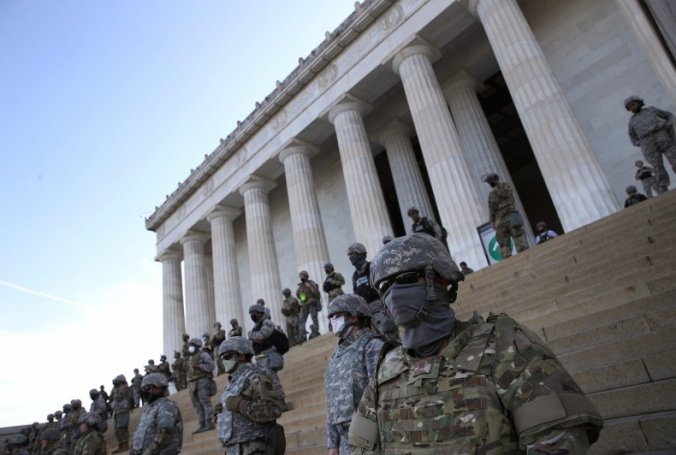
“Dozens of National Guard troops were positioned on the steps of the Lincoln Memorial on Wednesday night . . . The appearance of a band of troops at one of the nation’s most iconic monuments came as protests escalated throughout the nation in response to the police killing of Floyd, an African American man who died in police custody in Minneapolis.”


In the video I watched this morning, a man on his knees before armed and shielded guards asked for reform. “I just want reform. Reform. . . . Will you shoot me?”

In what world does a man have to get down on his knees to beg for simple respect, for fairness, for justice? For all.

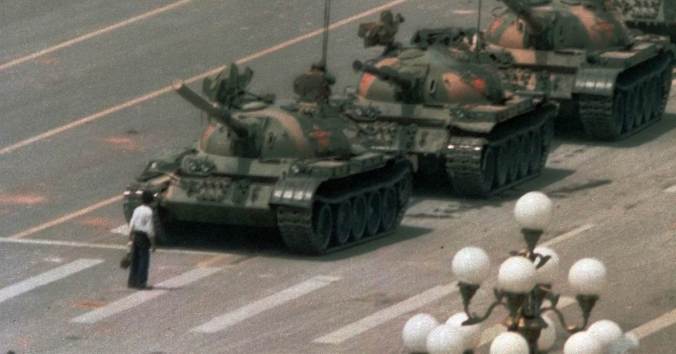
In what reality, other than a YA dystopian nightmare, does the Lincoln Memorial resemble Tiananmen Square?

Maybe some are too young to remember that such visions were once something white Americans thought only happened in Other Countries, dangerous autocratic countries ruled by bullying dictators and communist regimes gone vile.

Maybe, some actually think that man who defied Chinese tanks was asking for it?

190604-tiananmen-square-1989-mc-835_215f3009bb35c257a195a2f72af1c116.nbcnews-fp-1200-630

“Set off by the death of pro-reform Communist general secretary Hu Yaobang in April 1989, amid the backdrop of rapid economic development and social changes in post-Mao China, the protests reflected anxieties about the country’s future in the popular consciousness and among the political elite. . . . On June 5, the suppression of the protest was immortalized outside of China via video footage and photographs of a lone man standing in front of a column of tanks leaving Tiananmen Square via Chang’an Avenue. The ‘Tank Man’, as it became known, became one of the most iconic photographs in the 20th century. As the tank driver tried to go around him, the ‘Tank Man’ moved into the tank’s path. He continued to stand defiantly in front of the tanks for some time, then climbed up onto the turret of the lead tank to speak to the soldiers inside. After returning to his position in front of the tanks, the man was pulled aside by a group of people.
Although the [identity and] fate of ‘Tank Man’ following the demonstration is not known, then-paramount Chinese leader Jiang Zemin stated in 1990 that he did not think the man was killed. Time later named him one of the 100 most influential people of the 20th century.”—Wikipedia

I am going to try very hard not to look at the news today. The coastal parks are being reopened tomorrow and we are hoping for rain. We are alarmed by license plates from Texas and California and Georgia, and especially the many from Washington state which has a much higher rate of infection. We are trying to be safe. We would like a vacation from taking care. We would like to see our sons and daughters-in-law and grandchildren in person. We would like to attend a birthday party, even outdoors on a deck. We would like to observe the precautions that are convenient and ignore the ones that interfere with our lives. But my husband and I have tried to follow the rules exactly.

I could, and do blame a national failure to prepare and national irresponsible and careless and largely absent leadership. I acknowledge that those in the White House have interfered with progress rather than led the way, but surviving this pandemic is also about us all. It’s not enough to blame Trump for his failures if we fail to do what little we can to ensure we and our nation survive. It is not enough to assume a vaccine will solve the problem—it certainly is not a time to pretend the pandemic does not exist.

If everyone, absolutely everyone, did what they were supposed to have been doing during the past couple of months, the United States would be like New Zealand, which had zero new cases in the last ten days. Instead, most people cheat a little bit or a lot. Too many Americans think the rules do not apply to them personally. We like to brag about our “rugged individualism” and claim we have the best of everything. In truth, this is is our entitlement speaking. A month of rigor and we might be clean. Instead as a result of carelessness, we live in the United States, where despite a call for people to stay home and maintain social distancing for the past ten or twelve weeks, over two hundred thousand (200,000) Americans were diagnosed in the past ten days, and over nine thousand died. Many of them were health care workers, grocers, and meat plant workers because of lack of proper protective gear, unmasked customers, and unsafe working conditions. People of all ages, ethnicities and in every state have died in the United States at the rate of about five in one hundred cases. The relative death rate is much higher for people of my age, for poor people, for people of color, but no one is immune.

Armed men invaded state capitals to demand their right to move freely despite the pandemic, and they were encouraged to do so by man incapable of leadership. Contrast that with unarmed citizens using the First Amendment rights to assemble, demand redress, and report on these events are tear-gassed and clubbed. Both risk their lives. I know which group earns my sympathy and respect.

“Where’s the bottom?” cries Beneatha in A Raisin in the Sun. (She is the younger sister of Walter Lee Younger, hoping to defy her tenement upbringing and her sharecropper grandparents and become a doctor.) Where, indeed, if we fail in our civic duty? What can it mean to be patriotic if citizenship demands sacrifice we are unwilling to honor? Some have given their lives for our country, yet we are unwilling to stay safely at home? We choose to attack those who merely want justice, those who look like they might expect fairness?

It is more than our bodies that wander while seeking the promised land.

A former student, recently become a doctor, admits “there has been a lot of hostility towards Asian-Americans and I am lucky that this has not affected me as much, but I fear for my family members and other members of the community. I aspire to be a positive representative for Asian-Americans and to help break down that hostility.”

She was an excellent student, and insisted, since before she even began her medical training, that she wanted to help those who struggle to find good care. She since recommitted to working with under-served populations. May she be granted the freedom to fulfill her goals.

Put a knee to the ground instead of on anyone’s neck.

TAKE A KNEE

(CNN) “Americans have been protesting the death of George Floyd at the hands of Minneapolis police for days on end in dozens of cities throughout the United States.

“While tensions between police and demonstrators have heated up in many places, some officers have shown solidarity with the movement by hugging protesters, praying with them, mourning with them, and taking a knee to honor Floyd.” 

. . . and another: ” ‘In that moment, it wasn’t about kneeling to appease anybody,’ an officer said. ‘I was kneeling because I wanted to show my people I’m with them in solidarity. … It would have ate me up if those protesters were like, “Kneel with us, kneel with us,” and I said, “No.” It would have ate me up.’ ” They knelt in Santa Cruz, California and Portland, Oregon, in Des Moines, Iowa and Washington DC, in Flint, Michigan and Spokane, Washington, in Germantown, Maryland and Coral Gables, Florida. And protesters thanked them, blessed them because their mission is to protect and serve. “Walk with us!” the public said to police officers all over our nation. They bowed their heads in thanks and walked in pride.

Respect.


more . . .

The Washington Post Editorial: “Even amid the tear gas, the rubber bullets, the sirens, the fires, the standoffs, the looting, the “vicious dogs” and “ominous weapons,” the best of America has been visible. People who were angry and scared have acted with peace and compassion, defusing situations by protecting and embracing — sometimes literally — those whom others in their position might have feared.”

And a voice of justice and compassion “Biden, in speech to the nation, denounces President Trump’s actions against protesters and vows to heal racial wounds” He reminded me what national leadership sounds like.

“With malice toward none, with charity for all, with firmness in the right as God gives us to see the right, let us strive on to finish the work we are in, to bind up the nation’s wounds, to care for him who shall have borne the battle and for his widow and his orphan, to do all which may achieve and cherish a just and lasting peace among ourselves and with all nations.”—Abraham Lincoln

https://www.washingtonpost.com/video/opinions/opinion–this-is-propaganda/2020/06/02/aa178cd0-875f-4f1f-9ced-ba1dee619078_video.html


POLITICAL

IMG_5991

A few seconds after I took this photo yesterday, the eagle backed off from his kill.

from the news:

“I took six rubber bullets, but do you know what didn’t happen to me?” Elizabeth Ferris, a 36-year-old Georgetown University student, told The Washington Post. “No one kneeled on my neck.” Continue reading

BREAKING EGGS

fullsizeoutput_1182

Do you know where your food has been, who touched it, who breathed or sneezed on it, how it was prepared?

Annia Ciezadio insists in The Washington PostThe safety problem for restaurants isn’t the dining room. It’s the kitchen.” Restaurant employees work in close quarters and are too rushed to take proper safety precautions, most do not have health care coverage and cannot afford to remain home when they are sick. They work anyway.

And managers do not stop them. They want cheap labor.

Undocumented labor is in a particularly tough position when it comes to staying home while sick. In many restaurants they are the invisible workers doing the hardest and dirtiest tasks such as using high pressure sprayers to clean dishes (and blowing mist into the air all over the kitchen). In my county 84% of those diagnosed with coronavirus are Hispanic. As in many places in our country, the main outbreaks have been in animal processing plants, locally that is seafood. The work is hard and even dangerous, and proper precautions to ensure both food and worker safety are perhaps lacking?

[Years ago ICE came through my county, and all my Hispanic students, whether documented or not, stayed home from school. The vice principal, contrary to law, had called the federal agency to report them. The principal had a fit because the job of public schools is, by law, to educate the public not to question citizenship. It was a question that as a teacher I did not ask. In the mean time on that long ago day, every restaurant in the county temporarily closed. I used to tell my students, themselves often called upon to work hours well beyond the legal limit for their age, that the only way many businesses stayed open was because of their labor and the labor of undocumented individuals. We do not want to pay.]

Sensible precautions seem too difficult even for some home cooks and bakers. I was reading an article online about the best way to separate eggs—removing the yolk from the egg white. In the comment section people complained the preferred method of removing egg yolks by sifting through fingers was annoying because they would then have to wash their hands right after.

I thought: you mean you do not wash your hands every time you touch eggs?

I wash my hands before I begin cooking and any time I handle something raw, especially eggs and even the carton they come in since I was taught to be cautious of Salmonella. “The U.S. Food and Drug Administration (FDA) estimates that 79,000 cases of foodborne illness and 30 deaths each year are caused by eating eggs contaminated with Salmonella.”

We cannot even rely on health care to take proper health care. Decades ago when half my family was diagnosed with giardia, a parasite carried by mountain beavers, the local clinic did not report the infection to County Health. But I had looked up regulations and so I reported it. The county had not had a report, the nurse said, in a couple of years yet the pharmacy that filled my prescription said they filled that prescription several times a week.

When my husband managed a grocery store (and was still eating meat) he stopped buying meat from his own store because he’d witnessed how his butcher handled product. When he later worked in a deli he only ate sandwiches he had prepared himself because one of his co-workers picked his nose while making sandwiches. That popular deli was regularly cited for health violations, the produce guy failed to clean his cases for months at a time (Gary wound’s buys produce there either), and there were rats that came out at night. One Whole Foods in Portland stank so bad near the meat department that I spoke to the manager about the smell. Gary speculated that the “diaper” under their meat cases was not being properly changed out. It was bad the next time too, and we stopped shopping there. Before the pandemic we had a wonderful Thai meal, but Gary won’t return to the restaurant because tables and dishes were not clean. We have seen servers handle both food and money without washing hands, despite what we fear lingers on bills. Of course these days most businesses will not accept paper money for fear of passing illness.

A dollar bill probably isn’t the greatest danger we face while eating out.

Too many do not even understand the most basic truths about illness. A friend said she never got a flu shot because she never vomited. She did not know that influenza is a respiratory illness.

So-called “stomach flu” is not influenza, but what is more accurately labeled gastroenteritis, inflammation of the digestive system—food poisoning—usually caused by food contaminated with a virus or bacteria—pickers who do not have access to proper restrooms, packers who do not properly wash their hands, preparers who sneeze without a mask, food that is unwashed or improperly stored or handled. Our food is often unclean and many Americans do not know how to manage food properly, or do know and fail to do it consistently.


PHISH

My final offer for lower credit card interest rates came via a phone call just the other day. That’s not the last time I will receive it because despite the sincerity of the young woman’s tone and message and her assurance that they have been trying to contact me several times and this is my last chance, she’s lying. (And I really do not care about lowering my credit card interest rates because I have paid off my credit cards each month since my sons graduated from college.) My other credit card sent me a letter lowering our credit line because we’ve failed to use our card. The New Yorker keeps making their final offer—today it was $5 subscriptions—but then they will back in a couple of weeks offering me a tote bag to subscribe. The New York Times too. A few years ago I did not want information about aluminum siding because I have cedar shingle siding. I do not want a lot of things that telemarketers persist in offering—not replacement windows or senior housing or life insurance. Limited time offer. For a few weeks in March and April, we received no sales calls at all, and Gary and I looked at one another and said: Well, there’s something coming from the coronavirus. Continue reading