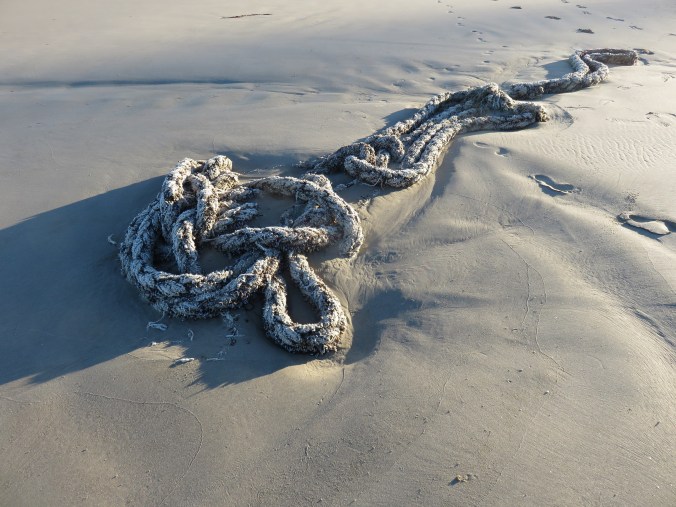
If it didn’t weigh hundreds of pounds, we’d have dragged this rope home. It has been in water a long time, is several inches across and perhaps ten or more meters in length, heavy with water, and loaded with tiny gooseneck barnacles.
Today is the 25th of June and I am struggling to keep track of time, especially because July Fourth is coming up fast. For most of my life payday was the 25th because I worked for a local public school district from 1979 to 2019 . . . or was that 2018? Everything, especially time, is becoming fluid and muddled. I seek markers for passage of time. Today is a Thursday and alternate Thursdays we have garbage pick-up. Today is Trash Day.
As a Thursday, today is also a Going-Out day where we head out for groceries in the nearest grocery store. Once a month we go further afield to Costco and Natural Grocers and Fred Meyer. We mask except on our beach walks where we try to keep fifty feet from others. Not all locals or businesses respect recommendations about distancing and masking, but we do. We planned to go to another food store today, but they do not mask their counter-help. A couple of days ago, I wrote a brief email expressing our hope to see the business again once they began masking or the pandemic ended. [NOTE: I said nothing about politics.] The response:
It is concerning to consider what choosing not to mask counter help suggests about inconvenient safety precautions in other parts of the business. Perhaps this is what their primary customer base demands? I wonder who those “health practitioners” were. A new local covid-19 case (50-year old male) was announced the same day.
NOTE: According to today’s Daily Astorian, “The [Clatsop] county Board of Commissioners voted unanimously Wednesday night to opt in to a mask requirement announced last week by Gov. Kate Brown for seven Oregon counties. . . . [requiring people] to wear masks in indoor public spaces like grocery stores, retail shops and restaurants and bars when not eating or drinking.” Gary went to get mail and shop alone today and said the lack of masks and overcrowding were “scary.”
It isn’t merely now that people fail to exercise a common sense and consideration.
We have our own protocols specific to this time of year. The blinds go down on sunny afternoons, we sit out in our yard when the air is mild, and Gary clears everything burnable from in front of our house to avoid attracting tourists looking to build beach fires.
The 4th of July is coming up soon and we have had people take over fire rings we laid in the sand, sit in our lawn chairs, and steal our firewood piled up and ready to be lit. Gary used to stabilize a log with rocks for us to sit on, but these get carried away and burned, or burned in place, so now he avoids temptation. There was the drunken partier who pissed on our path. Revelry generally ends by 10pm, but once in a while it just goes on and on, keeping us from sleep. One year bottle rockets landed on our roof when we still had a cedar shingle roof. (I had to climb out the skylight to ensure they did not catch our house on fire—no worries, just a scorched spot.)
I am proud that my home state ensures the public has access to all beaches. “In 1911, [Democratic] governor Oswald West was elected on the promise to reclaim Oregon’s beaches as public land.” My grandmother who left me the family home hated this plan for public beaches. She argued that “the public will make a mess of it,” and I suppose I can see her point. Nevertheless, I remain on Republican governor Tom McCall’s side. In 1967 he vigorously defended public access against a challenge in Cannon Beach. (Remember when Republicans were honorable people?) The Oregon Beach Bill ensured
“The Beach Bill declares that all ‘wet sand’ within sixteen vertical feet of the low tide line belongs to the state of Oregon. In addition, it recognizes public easements of all beach areas up to the line of vegetation, regardless of underlying property rights. The public has ‘free and uninterrupted use of the beaches,’ and property owners are required to seek state permits for building and other uses of the ocean shore. While some parts of the beach remain privately owned, state and federal courts have upheld Oregon’s right to regulate development of those lands and preserve public access.”—Wikipedia
One of my students’ pet peeves used to be visitors asking “How do I get to the beach?” To local kids it is a stupid question with an obvious answer: walk west. All east/west roads lead to water. Among ourselves we point east and joke: three thousand miles that way.
My students, many of whom surfed or walked the beach throughout the year, found it inconceivable that no other state allows people access to “private beaches.” Oregon is unique in granting this right, but having grown up here my students assumed that what they took for granted must be the norm. One student visited colleges on the east coast, came home, and described her frustrating search to find access to the shore of the Atlantic. “Ms. Priddy, I just could not go into a business and ask ‘How do I get to the beach?’ I just couldn’t say it. It took us forever to find public access.”
The public has access and use of shorelines in Oregon. However, “free and uninterrupted use of the beaches” does not mean people may do whatever they like. About beach fires, specifically, there are rules. The same Oregon that allows access also defines how that access may be legally used.
Visitors and out-of-state second-home owners invariably get this wrong. Even local Chambers of Commerce and local residents fail to abide by the law. (Gary is hanging his head about now for past violations.) Perhaps we all want to believe laws only apply to Other People or only when-convenient-to-me? Local businesses don’t want to irritate tourists and that might be one reason laws about beach restrictions are not actually easy to find.
I found the regulations about beach fires and here is the gist, followed by the actual statute:
- Build a fire in the SAND.
- NEVER CLOSER that 25 feet from public paths, greenery, piles of sticks or drift logs.
- NEVER burn beach drift logs, but only small pieces of drift.
- BURN wood you brought to the shore and other materials free from nails, staples, glass, and plastic.
- DO NOT use any petroleum-based starter.
- Build a small to medium fire NO BIGGER THAN A BEACH CHAIR.
- STAY with the fire as long as it is burning.
- PUT OUT the fire thoroughly with water, NOT SAND.
- NOTE: During a burn ban, all fires are prohibited, but may be allowed on private property ONLY if small and contained in a metal barbecue.
No giant bonfires. No two guys lifting a log big enough to sit on onto a fire. No leaving it burning overnight.
We see people who only want to sit near a fire for thirty minutes—without understanding that the fire they started will burn for hours. They “put out” fires with sand without understanding that the fire will smolder, sometimes for days, under the sand. Common sense and simple courtesy suggests no one should co-op another’s neatly stacked fuel (it happened just this week). And here is where I get to ask why people think burning plastic is a great idea? Plastic does not burn. It releases toxins and melts into a hard lump.
And don’t get me started about fireworks. Maybe another time.
State of Oregon rules regarding beach fires:
736-021-0120
Fires
(1) A person may have a recreational beach fire in the ocean shore state recreation area under the following conditions:
(a) Fires are no larger than three feet by three feet by three feet in dimension. A person may apply for a special use permit under division 16 for larger fires.
(b) Fires must be located as follows:
(A) In the open sand area;
(B) Downwind of any shoreline vegetation and small wood debris or log accumulations;
(C) Never in dunes, small wood debris or beach log accumulations; and
(D) A minimum of 25 feet away from beach access points, shoreline vegetation, log accumulations and seawalls constructed of wood or other combustible material.
(c) Fires must not be left unattended;
(d) Fires must not cause damage to facilities or natural resources;
(e) Fires may not be covered with sand; and
(f) Fires must be extinguished completely with water and be broken apart before its users leave the area.
(2) A person may only burn paper products and untreated natural wood free of attached metal, nails, glass or plastic objects. A person may not use gasoline, diesel or any other petroleum-based products to start a fire.
(3) Notwithstanding section (1), the department may restrict fires to individual beach areas, or temporarily prohibit fires due to high fire hazard conditions.
(4) Beach fires are prohibited in western snowy plover-management areas as provided in OAR 736-021-0090.
Statutory/Other Authority: ORS 390.660
Statutes/Other Implemented: ORS 390.124 & 390.660
History:
PRD 1-2013, f. 1-15-13, cert. ef. 2-1-13
PR 3-1997, f. 11-5-97, cert. ef. 11-10-97
PR 9-1994, f. 11-29-94, cert. ef. 12-1-94
And just now, fires should be spaced away from others’ fires because of the pandemic.
•
 IMPERFECT PATIENCE
25 June 1876: Greasy Grass. ahehee!
Officer Michael Lee R.I.P.
I will have a fire on the 4th and remember.
LikeLiked by 1 person
That is good information about the beach fires, the permanent setup by the 2nd homeowner is definitely illegal. And I had no idea that there were such antics in front of your house. Perhaps on the fourth sit in front of your house so those people know there are eyes watching and maybe they will camp elsewhere. On the day of the fourth we put a sign with our last name on it on a chair next to a temporary pit with firewood stacked next to it so that people know it is not abandoned and so far we have been lucky.
LikeLiked by 1 person
First, a quick walk reveals there are many fire pits set too high in the rocks, too close to the green line. I an others have put out fires left to smolder all night—though I won’t be doing that anymore, even during the burn ban!
On the other hand, we’re usually lucky too, but some years—a few—have been bad. There was the year we could not even breathe from the fireworks smoke drifting into our yard so we had to move inside. One year people staying in the rental next door were blowing up illegal fireworks practically overhead—another time we moved indoors. And the time a floating lantern landed in a spruce two house south and, thankfully, went out. The last time we set up a fire and placed beach chairs, people set fire to it before dinner time! Ha! They were nice enough and we sat with them and chatted throughout the evening’s “entertainment.”
When Dale did the fireworks it was wonderful, but I understood when he backed off because of the crazy crowds.
Our dogs were okay, but plenty have to be tranquilized from the noise. I know people who generally leave the country to avoid what happens on our beach on the 4th. I know people who survived a war zone one way or another and need medication to get through the holidays.
Most often the sun going down is enough. Beautiful country.
LikeLike