ADVENTURES IN SHIPPING

The most frightening shipping experience I’ve ever had was when I flew from Portland to Sacramento and the airline lost my dog. (Don’t fret, this story ends okay.)

I was delivering Cutter to his new home. He was entered in a dog show the next day, so he was impeccably washed and groomed and a very sweet boy besides. I had his information taped on the top and three sides of his kennel, and a placard wired to the door. (All of this would later be found to have been meticulously removed in transit.) Continue reading

WHAT NOW?

IMG_20200520_163802There are the things we are not doing just now, but more interesting are the things we may never do again, the things we might do less often, and what we might do instead. But first, confession.

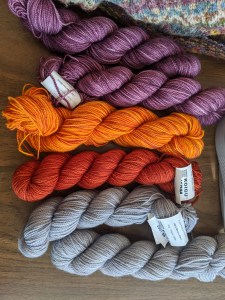
Yes, it’s true I ordered yarn. The colors at left are close to how they will look when they arrive tomorrow, except the color at the bottom is not gray (as it might appear); it’s a pale smokey violet, one of my favorite colors that I use often in warps of all colors. And the terrible thing is that none of these colors works into either of the warps I am considering next. “Strawberry” wants reds and pinks and a particular soft sage green. “Carnival” wants variegated super-bright primaries plus spectrum green all in the same yarn.

We have not attended a party or traveled more than we absolutely must to get food and mail and for my root canal. We venture out in masks and sanitize before touching anything. We strip down and wash all our clothing when we get home again. We have not seen any family members except online, and not often enough even there. We have, once each, been handed things on the beach—a shell, a scrap of paper—by people we know and who have been self-isolating. We held our breath while that exchange occurred. We washed carefully after. We did not touch our face.

I think we never need to enter Safeway again. When we were in college in Seattle, the local Safeway was a terrible place, Pike Place Market was perfect, but there were no local farmers markets as there are in Seattle now. Safeway was always being sued for unfair and illegal employment practices, losing those suits, and then going right on doing underpaying women employees or violating other laws. Gary went to the local Safeway the other day for the first time in over two months. As a former grocer he was genuinely distressed by both the running of the store and the carelessness of customers. Costco and Natural Foods and even Freddie’s have offered better shopping experiences. I miss the Portland Farmers Market very much, and we might go again someday. Someday soon, I hope. A day trip the way we used to two times a month to buy vegetables. The Market is set up with fewer, spaced-out stalls and with limits on the number of shoppers allowed in order to maintain distancing.

We do not need paper napkins ever again, and we’ve been using the same roll of paper towels for three months. It is only half gone and I think should last us through the summer. Gary uses a paper towel to wipe out my cast iron pans. I use a piece of a paper towel to wipe up egg white from cracking eggs on the counter. The sponges and cloths and napkins go into the washing machine.

Gary has not bought a lottery ticket since January, but he probably will again when it’s safe to touch a keypad. We rarely ate out—not at all now—but probably even more rarely in future. Hotels? Will we visit the Kennedy School and The Sylvia Beach Hotel? Drive to Victoria to stay at Elaine’s? Perhaps we will. Movies in theaters on the other hand? Good riddance. I have always thought that films people insist “must be seen on a big screen” must also be weak if that is the only way they are impressive. I can sit closer to the my TV in a dark room, turn the sound up too loud, and mimic the movie theater experience without people talking behind me or a man coughing on my neck. Live theater on the other hand will revive, at least I hope so. There is a critical connection between performers and audience, an experience impossible to replicate at home.

“A huge majority of respondents in The Post’s early May poll — 82 percent — said they opposed the reopening of movie theaters more than any other category of business (with gyms not far behind). Another mid-May survey found that even if the cost was the same, only 13 percent of respondents would prefer to watch a first-run movie in a theater as opposed to their living rooms.”—The Washington Post

We obviously have internet, though no cable or other regular television. That decision was made last summer. We paid to stream a movie the other day, the first time we’d done that. Though we watched at midday and the room with our television is bright with windows and two skylights, the experience was good. We will likely do that again. We also have Netflix and Acorn and BritBox at the moment, which collectively cost considerably less than our old cable bill. Amazon is a concern. We have Prime, but are trying to use only the videos and MarketPlace for Gary’s used CD orders. Eventually, despite a future without Mrs. Maisel, we will cut Prime. Putting entertainment where our voice says?

Going forward, I have been running. Saturday I managed eight minutes in two minute intervals. This morning I will pull out new shoes and try for ten minutes [I managed eleven and am now running every other day with very gradual increases in time]. I have running tights and my Ghost 12 shoes and will fake the rest. Though I kept gear, I discovered that I have no sport bras, not a single one saved. So I went online to Title Nine the other day and ordered a bra. It will be June before I have it. In the past, I always felt I had to earn the right to purchase gear, and I did myself harm by not starting out with the right shoes, bras, and running tights. Not this time. I will do better.


Today is Memorial Day, the day we are supposed to honor those who fought (and died) for the safety of our nation. Among my immediate relatives are my father who fought in the Army as far as Germany, and my aunt who was a Marine in San Francisco. My mother-in-law and father-in-law also served during WW2.

For all the flag-waving and whining about “freedom” I think the people protesting the lockdown mean for others to die for them, while they refuse to rise to this challenge. I know some people who are barely inconvenienced at all while others work in hospitals and grocery stores and delivery, dangerous occupations. I know people working from home and families with no income at all. I know people who ignore the rules about travel and distancing and also those with preexisting conditions that make them particularly vulnerable and cautious.

One hundred years ago communities struggled to cope with a disease that had no vaccine or reliable treatment. The communities and entire cities that practiced rigorous social distancing, isolated the sick, and those that took these unpopular precautions longest, faired best. Fewer people died and local economies bounced back faster where the isolation lasted longest. We have, in fact, a great deal of evidence to support a conservative approach to reopening. It isn’t merely computers modeling what the future is likely to bring, it is the lived experiences of great and great great grandparents.

Human beings have always existed in groups. We are not solo individuals but communal. We agree to rules in order to better support one another. One of our rules should be that we do what is best for everyone over just what is good for ourself, that the old and sick and frail should not suffer due to the heedlessness of the young and strong and selfish among us.

We should follow the rules established for everyone, even when we think we know better because most often we do not know any better.

fullsizeoutput_1239

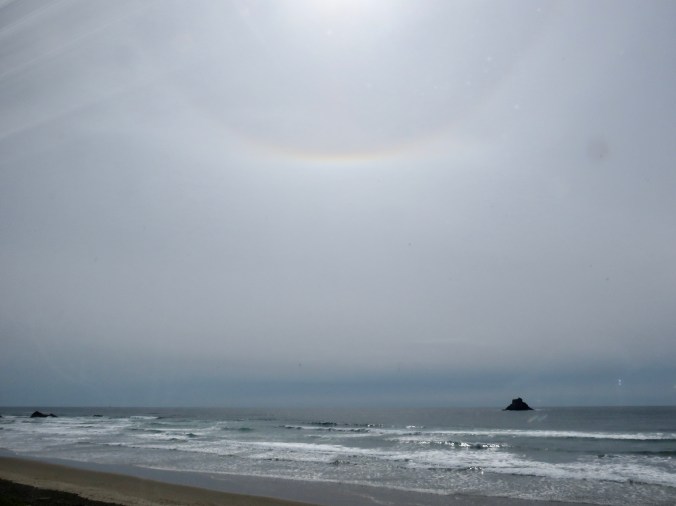
I was afraid to take a photo of the entire halo for fear of damaging my camera. But that half circle at the top of the image? That was a circle around the sun. “RIngs around the sun are caused by cirrus clouds — high altitude clouds that form above 30,000 feet. Cirrus clouds form when water droplets condense around tiny mineral particles in the air, then freeze. The clouds appear to form a ring around the sun — or the moon — when light reflects off the ice crystals and refracts by passing through them.”

SPROUTS

fullsizeoutput_1230

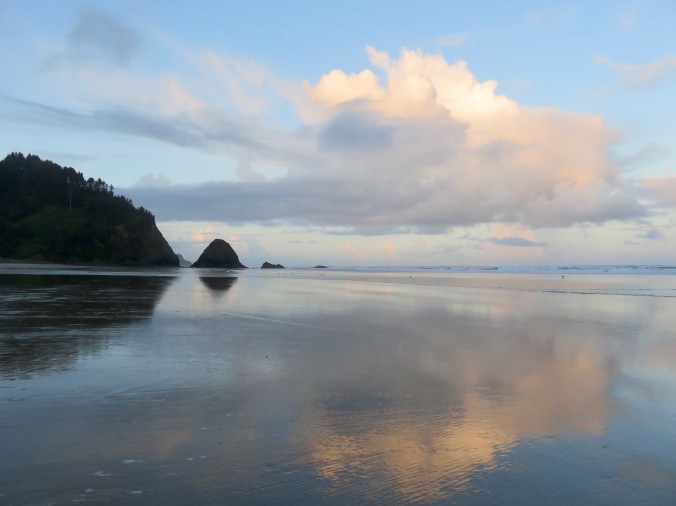
At the base of Hug Point, above, there is a roadway cut into the stone. You can see it, the cliff drops straight down to a short level place and then a little hump just to the left. That is how my great grand aunts, my grandparents, and my mother and her sister got to the beach from 1911 until the mid-1930s. They drove over a rough roadway cut into stone.

My tomato seedlings are growing their second set of true leaves, a sprouted mango pit needs to be put into soil, and the other night I dreamt about a former student, the only student I’ve ever had who I would still have said I disliked. Continue reading

VOTE BY MAIL

In Support of States Determining Their Own Marijuana and Hemp Policies Without Federal Interference:

“Five states currently conduct all elections entirely by mail: Colorado, Hawaii, Oregon, Washington and Utah. At least 21 other states have laws that allow certain smaller elections, such as school board contests, to be conducted by mail. For these elections, all registered voters receive a ballot in the mail. The voter marks the ballot, puts it in a secrecy envelope or sleeve and then into a separate mailing envelope, signs an affidavit on the exterior of the mailing envelope, and returns the package via mail or by dropping it off.

Vote by mail logo“Ballots are mailed out well ahead of Election Day, and thus voters have an ‘election period,’ not just a single day, to vote. All-mail elections can be thought of as absentee voting for everyone. This system is also referred to as ‘vote by mail.’ ”

Oregon has voted by mail since voters chose to make that change in 1998. Voting by mail has not led to voter fraud. I missed going to the precinct voting booths at first, but it’s easier and safer.

I make my choices on a paper ballot, put that ballot into an “privacy” envelope and seal that envelope in a larger envelope, sign the outside, and send it on its way.

All American adults are entitled to vote. It is our right and our responsibility. Now more than ever.

TWO EAGLES

fullsizeoutput_1219

There are eagles in the sky most days. All that beauty in the air.

I pulled out my weaving: merino baby blankets, shawls, and lap-robes out of the tansu chest and stacked them up in a chair. Twenty-three—I turned the photo sideways so they would fit my screen. More than half these soft things have been woven since we began our personal lockdown on 10 March. I have a new warp on the loom now and I began weaving the second shawl yesterday just before 8pm. I mean to stop at 4, and then I go back and work some more, and then I think 7pm is a long day when I’ve been awake since before dawn. But I wanted to see how the hands-spun I have been hoarding for a few years would work on this warp, and it’s lovely, subtle and tweedy. There will be twenty-six weavings by the end of next week. And then I will start winding skeins for another warp. Continue reading

FOR DEAR LIFE

IMG_5873

My neighbor always used to blame me whenever she caught a cold or flu—”You gave me this”—and now I know she should have washed her hands before touching her face. I do not think she will be able to blame me for this. “Worser and worser” was the ungrammatical line from my childhood. A new Brevity post about how to write during this pandemic is meant to be a list of humorous writing prompts. The author suggests subtly informing your younger self to learn to cut your own hair. I have cut my hair since I was fifteen. Continue reading

INVENTORY

IMG_5867.jpeg

It started with East wind, which was warm and dry on Friday and floated dry grains of sand across the shore. That called up the memory of walking Bowzer and how he stood so tall and alert, looking far off north until he noticed the sand accumulating on his feet. He would pick up each foot and shake it free of sand and then prance to avoid it gathering until his attention was caught and he would stand still again, the process repeating itself. I dreamt of the Afghan Hounds the other day.

And today we have been isolating for two months. So I thought about my clothing and my shoes and where we might have gone and what me might otherwise have done in the past two months. I am not among those working as a cashier, though I did that work for years. I do not take care of sick patients nor am I forced to work overtime because the job I do is essential. I have no job.

I have too many shoes. Nine pairs on the rack I assembled when I was Kondo-izing my closet, including slippers and pink flowered Crocs, four pairs of booties, two pairs of sandals, and the pair of flats I keep only because my mother ordered them for me. Tucked in the bottom of the closet there are three pairs of Eileen Fisher shoes found cheap, or relatively cheap, on sale, the black cowboy boots I bought at a garage sale ten or fifteen years ago, and my old Bean boots purchased when we first moved to the beach some forty years ago. And also two worn pairs of black boots too disreputable to wear to work. Except I no longer work.

What I actually put on each morning are my runners, even though I no longer run either. Mostly, I wear the same running gear I bought in the 1990s with grey t-shirts and good socks. I put on a bra the other day and it improved my profile, but I am out of the habit. I did not wear a bra in my senior year of high school because P.E. was no longer required, and I did not put one on again until I’d completed three degrees at the University of Washington and started my first teaching job at a Sacred Heart prep school.

These days I dress as if for a run and after our hour or two morning walk shift to clean cotton jersey pants and top, bare feet, sometimes a sweater or my bathrobe. We always go out early, always have. (Now we go out extra early to avoid the tourists and second-home owners we wish stayed sheltering in their own homes. License plates from Washington and California.) Soon we will be ordering our lives to avoid the heat of the sun. Already I am barefoot most of the day, with or without clean cotton socks. Gary reminds me this is an improvement from when I damaged my feet in 2011 and could not even stand for long without orthotics.

Most of my wardrobe is useless, unused for two months and likely to remain so even after the current emergency. There are dresses I have owned for twenty years that, barring moths, will be wearable when I die because I have no where to wear all that lovely silk and wool and that perfect silk-and-linen blend. I can see now that the garments are unnecessary. I took out all my earrings last month. Five empty holes. I wish I had not lost one of my little sterling Laurel Burch birds on the beach, but even if I had them both, it would only be to have and hold. The pair I pierced my ears for. Precious objects (object) of sentimental attachment sitting in a drawer.

Other than walks, I leave the house once a week these days. Without the pandemic, we would have daily driven to pick up our mail six miles away. Many more trips to purchase groceries. We probably would have gone to Portland at least five or six times, to the Farmers Market and Powell’s Book Store and out for lunch and to visit our sons and their families. Cargo to see Calli. I might have made strawberry jam by now (there are eight jars of mango chutney instead). We had planned a drive to Canada, the Black Ball to Victoria and two or three days at Elaine’s.  Now I daydream about San Francisco, maybe in October of 2021. I weave but I am not entirely hopeful that the show I am weaving to prepare for will take place in December. The work passes the time. Like spending an afternoon making more chutney than we will eat in two years. Even without the pandemic, it was a good use of my time.

Without the pandemic, there would probably still be at least six shawls from two warps finished, but maybe not three warps—nine shawls folded away—with a fourth going through heddles today. I likely would have visited the yarn store in Victoria and Churchmouse on the way up north.

Without the pandemic, we would have finished reading books eighteen and nineteen in Patrick O’Brian’s Jack Aubrey and Stephen Maturin series by now because I generally read aloud on a drive and now we are busy in separate rooms. Maybe we would have read the last one of the series and started something new by now.

Without the pandemic, Gary and I would still be gathering trash from the shore during our morning walks, another two hundred pounds or more in two months. I would still be coming home from those walks with a sore back. So there is one advantage.

Without the pandemic, I would have gone to see my dentist about the pain in my jaw by now. We would have had friends over for dinner. We might have gone to visit friends, sat in their living room, and told stories. I would have played at least eighteen games of Scrabble. We would have gone out for a meal. I would not be baking all our bread. I would not have perfected my recipe for sticky buns or made my very best brownies ever. I would not now be nurturing five kinds of vegetable seedlings. Losses and gains.

Without the pandemic, we would have been able to choose gifts for family in person, and I would have made cakes for two grandchildren’s birthdays. I would feel optimistic that my fifty-year high school reunion would take place in September. We would attend. Family members who need medical care would be receiving it. I would not worry less.

Without the pandemic, “Virtually Normal,” the Brevity blog post scheduled for next week would never have been written. Perhaps I would have written a poem for each day of the last month—I’ve done that for years past. My presentation for Willamette Writers would have taken place in Newport last month, so that would have been another trip. Instead of posting assignments online, I would have had the opportunity to share in person.

Without the pandemic, my novella might remain languishing in a computer file instead of being shared on line for a month, or maybe I would have revised it for NaNo and rediscovered how fond I am of that thought experiment. As it is, I have a page of revisions, additions, and possibilities for when I am next moved to write fiction.
IMG_5863How has life changed for someone like me? A person who is able to isolate with someone they love, but who still feels what is missing? The iris are in bloom. The little flowers volunteering in the front garden would open their faces to the sun. Maybe the middle garden would have less attention. I would have bought starts instead of planting seeds.

Regardless, the tides sweep in high and low. Weather moves through. People and places exist even if I do not get to see them in person. I hope it has not all been bad for fortunate people like me, that even as I miss many things life has changed for the good in some small ways. I hope the useful changes become permanent. I do not believe that what does not kill us always makes us stronger because sometimes what does not kill us leaves us crippled and unkind. Surely we all know that is true. Nevertheless, hardship might reveal to us our power, render us flexible and compassionate. We might find the legendary workaround.

I believe that any time we are forced to do something difficult, something that will not kill us, we should change, and that we should do our best to ensure that the changes we find in ourselves and in our world are for the better.

Happy Mothers’ Day!
IMG_5868.jpg

BLACK SWAN

There are literal black swans. But the expression “black swan” when not speaking about birds means something else.

A black swan is an anomaly. It is the thing that careful observations and experience tells us cannot happen… and then it does.

For example, living in 18th century England, I could have looked at literally hundreds of swans, maybe even have seen every swan in Europe. Every single one would have been white. And it would have been reasonable for me to conclude that “Swans are white. They are all white. Every single swan I’ve seen in my lifetime has been white and therefore swans are white and no other color.” I would have made a rational and reasonable assumption based on extensive experience. Then a British naturalist came back from Australia in 1790, a continent I hadn’t even cared existed, and announced: black swans!

Who knew that everything I assumed was proper and normal could flip over in an instant?

That’s a fairly simplistic example of what some scientists call a “black swan problem.” This is something else: a newer idea called “black swan theory”. We humans are too reliant on prediction, too trusting that the world unfolds in some reliable and predictable order, when in fact, our world is closer to random chaos (if I can use that term without evoking chaos theory, which is something else). Two black swans.

An entry in Wikipedia explains it like this: “The [black swan] theory was developed by Nassim Nicholas Taleb to explain:

    • The disproportionate role of high-impact, hard-to-predict, and rare events that are beyond the realm of normal expectations in history, science, finance and technology
    • The non-computability of the probability of the consequential rare events using scientific methods (owing to the very nature of small probabilities)
    • The psychological biases that make people individually and collectively blind to uncertainty and unaware of the massive role of the rare event in historical affairs

      “Unlike the earlier philosophical ‘black swan problem,’ the ‘black swan theory’ refers only to unexpected events of large magnitude and consequence and their dominant role in history. Such events, considered extreme outliers, collectively play vastly larger roles than regular occurrences.”—“Black Swan theory” Wikipedia

The older “black swan problem” was a simple matter of logical deduction. That’s what I did in my 18th century example: Every swan I have every seen is white, therefore all swans are white. Then I discover even a single black swan and my theory about all swans is destroyed. The revelation of black swans is not even dramatic enough to count as a black swan in black swan theory where black swans are game-changers.

Black swan theory concerns something more dramatic than an error in reasoning. Taleb describes an event that for good or ill shocks people experiencing it, could not reasonably have been predicted, and dramatically impacts lives. However, in hindsight people struggle to rationalize what has occurred as a predictable event (which is isn’t). Think 911, or perhaps the discovery of antibiotics. Taleb’s argument is that while we can not, by definition, predict black swans, we should understand that we can’t predict the most transformative events we will face. In the mean time, we should work hard to minimize the disasters and exploit the gifts they bring. These things will happen.

Most of this theory is over my head, I must admit. I have Taleb’s book, but have only paged through and not studied it.

[NOTE: There is limited assertion just now that covid-19 is a black swan. Since intelligent people in medicine and government the world over were predicting a pandemic in the near future, it really does not make the cut.]

The concept, however, of events that cannot be predicted and how we respond to them is interesting, even for this philosophical amateur.

Maybe that’s because I am a grandmother.

Most of a child’s day, when it’s an interesting day, is made up of black swans. (For literal black swans too.) Babies know their parents and their own room and bed and clothing. But consider: every time something new happens—mom has curry for lunch, someone sprays perfume, a new song plays on the radio, radio!—it’s a brand new thing that they’ve never experienced before and could not have predicted. Black swans everywhere from the baby’s perspective.

Although newborns should be protected from unnecessary exposure to germs and disease, children who lie in a crib all day in a quiet room with little hustle and bustle fail to develop normally. The newest theories of encouraging childhood development all emphasize exposing them to many colors, textures, and experiences. Further, there is ample evidence these days that an excessively clean environment actually leaves children susceptible to allergies.

By the time they are a few years old, most children have been exposed to a great variety of sights, sounds, tastes, smells, and environments. They have begun to understand “normal.” The normal clatter and roar of the city is no more disturbing to an urban child than the normal sounds of birds and wind-blown branches are to a child-raised in the country. Eventually they come to understand and anticipate patterns of behavior and speech that the adults around them have been demonstrating for their entire lives.

And then one day, out of the blue, parents announce they are divorcing—tragedy—or the child hears an opera—a gift. Black swan, black swan! This is the way the world changes fundamentally and forever for a child. This is not a black swan event for the world, but on an individual level, the world changes.

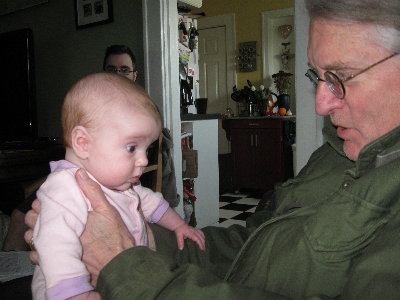
Taleb is concerned with international events, events that impact large numbers of people. Read the book and see what this is all about. In the mean time, my husband, who was certain that becoming a grandfather was not a good idea, took one look at Ruby as an newborn and—BLACK SWAN!—the world changed. He could not have predicted, could not have planned for how one little baby changed everything. Epiphany. Marvelous joy! Going on nine years . . . still amazing.

For the record: this wasn’t a surprise for me. I know who I married.


Black Swan IMAGE by Sérgio Valle Duarte Wikidata has entry Q16269994 with data related to this item. Own work “First mother swan swimming lesson for newborns 2006 Ibirapuera Park”


THREE WORDS

Works Progress Administration “(WPA; renamed in 1939 as the Work Projects Administration) was an American New Deal agency, employing millions of job-seekers (mostly unskilled men) to carry out public works projects, including the construction of public buildings and roads. It was established on May 6, 1935, by Executive Order 7034.”—Wikipedia Continue reading