TRYING FOR NORMAL

IMG_5789

This rock is larger than it might look, about a mile and a half from my home. The sand has been coming onshore earlier than usual, but it is still about twenty feet high. I used to walk here with my boys when they were little. They climbed the rock and often wanted to be carried home. They took turns. I could not carry them both together very far, but I recall when I was young enough to try.

I wake most often in the middle of the night these days. I know before I look at my watch what time it is, usually within a few minutes. I wish it were near dawn, but it’s not. It’s not even 4:30am, when I would not mind so much being awake. I turn and look for a more comfortable position in bed. I know it’s 2:15am or 1:30. Get up and go to the bathroom? Sometimes. Sometimes I will read a few pages and that settles me. Usually I lie looking up into darkness, then close my eyes and go back to sleep. It doesn’t always happen that way. I’ve noticed after our weekly trip to pick up our mail and groceries, I might lie awake until dawn. “Going out” is stressful.

Continue reading

REVISE

IMG_3707.jpg

Part of an early quilt top before going out for quilting. Watermelon Sliced.

written yesterday: I should be weaving just now, and I have fabric pulled for a quilt of ordinary cotton, other block-printed fabric waiting for my attention, and an impressive stash of batik cotton. If I put my mind to it, I could have a couple of quilt tops done before summer. I could do three. A month and a half of steady work.

The catch, of course, is actually completing the work.

Continue reading

ORAL HISTORY

image

Jackie Cochran(center) with WASP trainees.” The women in the publicity shots were always young and pretty. Is there any doubt this was meticulously orchestrated? [note: these black & white images are in the public domain.]

I was reading an article in Time magazine about oral histories, how we should all be keeping coronavirus journals because such personal stories add texture to historical accounts. Katherine Sharp Landdeck is the author of The Women with Silver Wings: The Inspiring True Story of the Women Airforce Service Pilots of World War II, and found in her research that the journals of those WASP pilots was essential to making meaning.
image

“Harlingen Army Air Field, Texas–Elizabeth L. Remba Gardner of Rockford, Illinois, WASP (Women’s Airforce Service Pilots), Class: 43-W-6, takes a look around before sending her plane streaking down the runway at the Harlingen Army Airfield, Texas, ca. 1930–1975. Note: Almost certainly this dates from 1942–1944, part of project of having women pilots move aircraft on the home front to free up more male pilots for combat duty.”


The personal journals that Landdeck researched revealed why women chose to serve and how that service altered their perspectives and life goals. How trivial events became essential and how early concerns faded away. These women risked their lives and 38 of them died, piloting planes to where they were needed.

Publicity shots like the one at left always show pretty faces.

Continue reading

ART STUDENT

fullsizeoutput_c7d

The Brahma Teapot with the lid off and tipped back to show the bull. I made an entire teaset (the goldsmith who commissioned it did not want anything representational) and dozens of mugs in this style back in the day. The clay looks like porcelain, but is only a low-fire white clay. The patterns are underglaze and protected by clear fired glaze.

Back when I was an art student, I thought I might earn money, if not actually a living, from my art. I envisioned a dramatic difference in my life compared to how I was raised.

I was first a Ceramic Art major at the University of Washington. In the clay side of the Fire Arts Building, we were divided into throwers and handbuilders. I was a handbuilder and our work was primarily sculptural art. It was gallery stuff and I did eventually exhibit in galleries and museums (Bellevue Art Museum and Tacoma Art Museum), but selling was what throwers did because they were in to “production.” That is, they made many of a single shape and sold bowls and mugs and so forth. The year of the first University Street Fair in 1970, I had still been in high school, but I sold handbuilt work. I did that again after I had studio space in the Fire Arts Building, in 1972 perhaps. I took over firing the Skutt kilns with everyone’s work, and completed dozens of handbuilt mugs for sale. A year or so later I juried in to the Bellevue Art Fair. I handbuilt entirely different mugs, dozens of mugs in the style above, and I was disappointment when a friend came along with her ceramic-handled flatware and sold more than I did. I mean: crushed with envy, destroyed. Of course, she is still making a living with her art, so she had the better instincts even then.

Long story short? Selling my work became a painful experience. I gave work away. I traded a teaset for a stunning 8″ gold stickpin. I completed two other pieces on commission and was shafted one of those times. I should focus on success, but I wanted then (and still today) to be the best or not at all. Selling, despite my day job in retail, remained a frustrating and unsuccessful experience, a reflection of failure, inadequacy, foolish hope.

But here I am, weaving shawls for sale. A stack of three quilts, unpriced but intended for sale. And my stories too.

I was still almost young when I began writing seriously. I had a fantasy of selling my first novel and making enough money to create that coveted dramatic change in my fortunes. I would quit teaching and write full time. I would pay off my mortgage. I had the same fantasy about the second (also unpublished) novel.

The first time I made actual money from a story was just a couple of years ago with “If It Were True Owls Dream” which was a fantasy story. My first fantasy and first cents-per-word payment. It made me laugh. I did not need the money as I felt I had and no longer had delusions about fame and fortune. By then I was beginning to wonder about how to construct a story where (nearly?) all sources of conflict were absent. And I thought that perhaps I could make some money selling SF/fantasy. Maybe. Or not. Did it matter?

But then Trump and covid19 and rejection from publishers. I send essays off to Dinty Moore and he is kind enough to publish them in the Brevity blog. Mostly recently I wrote an essay about the creativity we will find after much of what we assumed was true about the world, how things work, and ourselves is unraveled. That essay goes live next month. Does anyone think this will be over next month? Convince me.

And then I decided to serialize some of the story that has consumed my writerly imagination for a long time, years. That is why bits of “Butterfly Fontanelle” showed up here. A little at a time goes up as I work through the only draft I could find on this computer. There is a 37k word version someplace, I think. I am working from the fourteen thousand word version. It’s growing a bit. Each day I work on it, I am a little bit surprised at what is happening. I am trusting that by the time I put up the 15th or 18th installment, it will end properly, that it will have gone someplace. I honestly cannot recall how this one ends. Not for sure. Maybe. We’ll all find out together.

And I have retired from teaching. The mortgage is paid. And here is a dramatic change to my life.

SHUT DOWN

Gary and I were awake at three this morning. I am trying not to read the news, not to compulsively check statistics for an entire day. I deleted unread all the news in my mailbox right away this morning without even reading headlines. Instead, I worked on the story, revising what will go live today. Gary has brought me coffee, and then drank it himself. Coffee allows him to go back to sleep. (which we did.)

I think today I will finish the second shawl of this warp. I was still weaving yesterday past seven in the evening so there is not so much left of that dreamy ocean-colored shawl. (The photo shows just the start of that piece.) I usually take a risk with the third length of weaving, choosing unexpected colors for the weft. I am not decided how the last will go, will I use the odd multicolored skeins with violet that I have laid out or something entirely different?

Continue reading

DREAMING


IMG_5660.jpegLast night, just before sunset, a deer appeared on the shore. Not a good thing in daylight. She was wet and confused and kept to the surf line. We see deer tracks frequently in the sand on our morning walks, but never the two deer themselves. This one moved along just fine, though she did not look happy, and the tourists with their dogs had all gone home. Local dog-owners came out on the beach, saw the doe, and leashed their dogs. Perhaps she had been separated from her companion, which I assumed from its smaller tracks was a yearling fawn? She stood right in front of our house, trotted north and then back south. And then the sun went down.

This morning, I dreamt we were living in our first house in Seattle again. Our dog Volant Sequoyah (“Bowzer”) had jumped the fence into the neighbor’s fenced yard and I’d left him there for a day and a half to teach him a lesson. Ian and Kerris showed up with packages of ground beef and hamburger buns just as I brought Bowzer home, and we didn’t want it because we’re vegetarian, but I thought about feeding Bowzer the meat. He was hungry. There was also a sequence of visiting the local school, which had been temporarily housed in an upper floor of a fancy office complex.

Well. Dreams are like that sometimes, a mixture of what we know and wish and experience muddled with places we have been, people we care about. Alan commented on the phone that the house yesterday that the house he and his wife first bought was up for sale and that set me thinking about our old house in Seattle. Online it is valued at nearly a million dollars. We paid less than twenty thousand for it in 1975.

At the beginning of 1978, Gary had left the zoo job and was tutoring American Indian students in the Edmonds School District. He had just been accepted to a grad program at the University of Washington’s School of Education for the fall. He planned to teach elementary school. I think he would have been wonderful at that job, he enjoys goofy humor and his impulse toward soothing and calming others would have served his students well. I was teaching art classes at Forest Ridge, an elite girls’ prep school on the other side of Lake Washington. We had six Afghan Hounds then, including Bowzer and his sister, and were active in showing and lure trials. I was a licensed field trial judge and we traveled often across the PNW and to Canada for shows and field trials. Instead, Gary’s father was dying of cancer, his family was falling apart and he quit school to support them. My grandfather’s third wife died and Genevieve left me the family house at the urging of her second husband. We thought we might buy land outside the city.

Instead we decided to have a family. We moved to my grandfather’s beach house in Oregon, the state where I was born. Gary took a job in a farmers’ co-op because he had worked in the Woodland Park Zoo commissary before he started back to school. we had our children, and I became an English teacher.

All in all, the dream seems more likely than that doe in the waves.


IMG_5656I should note that I took the photo above with a zoom from our deck. We are careful to avoid approaching wild animals. It is distressing for the animal and can make a bad situation deadly. Locals understand it is best not to “help” a wild thing.

Oh! I should have put up Assignment #3, only because I said I would do five. No one seems to be writing them, but I will post “The Idyllic Place” tomorrow.


PEACEFUL DAY

fullsizeoutput_11dd

We each have our favorite colors of sea glass. Gary almost never finds the dark orange “brown” glass. Cobalt blue (the piece above is more than 50mm across and 6mm thick) is cause for celebration.

Today I will bake rolls and roast green beans. My mother would have made lamb, but we are vegetarian and I have a casserole of mac&cheese already made and ready to go in the oven. I found fresh blueberries on our weekly grocery run, so there will be a pie. No ice cream, but blueberry pie. We will sit at table and remind ourselves of our good fortune. Continue reading

TEACHERS & other essentials

Nurses, doctors, firefighters, the EMTs who answer calls, ambulance drivers, therapists, technicians, and pharmacists.

A local hospital administrator must leave her infant son to ensure medical care is available for the rest of us.

Like other essential services, children need education and local teachers are still at work, striving to accomplish what they can without actually having students in front of them. It is a challenge. One teacher, working from home in her basement, commented, “As you can imagine, it is not best practices just to put your assignments online and think they will be able to do them.” She has always done so very much more than that. And every day.

A local trucker friend who delivers fuel is also working, often with people who do not think any of this is a big deal. He worries about his mother, in her 90s.

The nearest grocery is five miles from us and having trouble keeping supplies in stock. Their employees are gloved and masked, but they are still open.

Our favorite bakery in Tolovana delivers bread at their door.

No one wants to take cash, but we are not spending much either. We stay close to home and do not sleep well the night before we must go out. But there are invisible people still plugging way and keeping things moving, people who still go to work each day, people who log on to their computers and do the job, people who are old themselves but still taking care of older relatives, people who fill my yarn and book and CD orders, people who gather to sing virtually.

Thank you. Thank you every one.

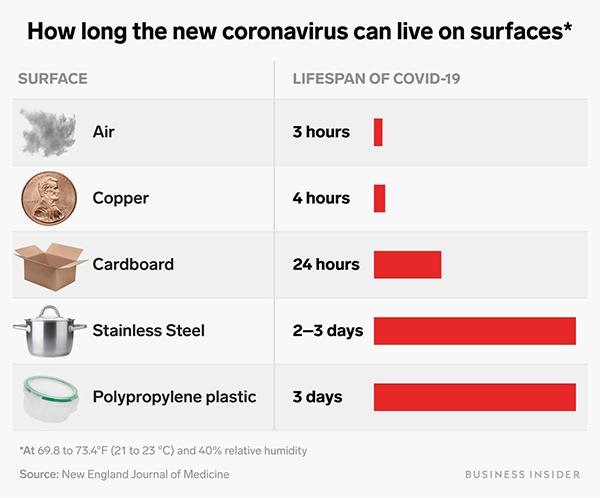
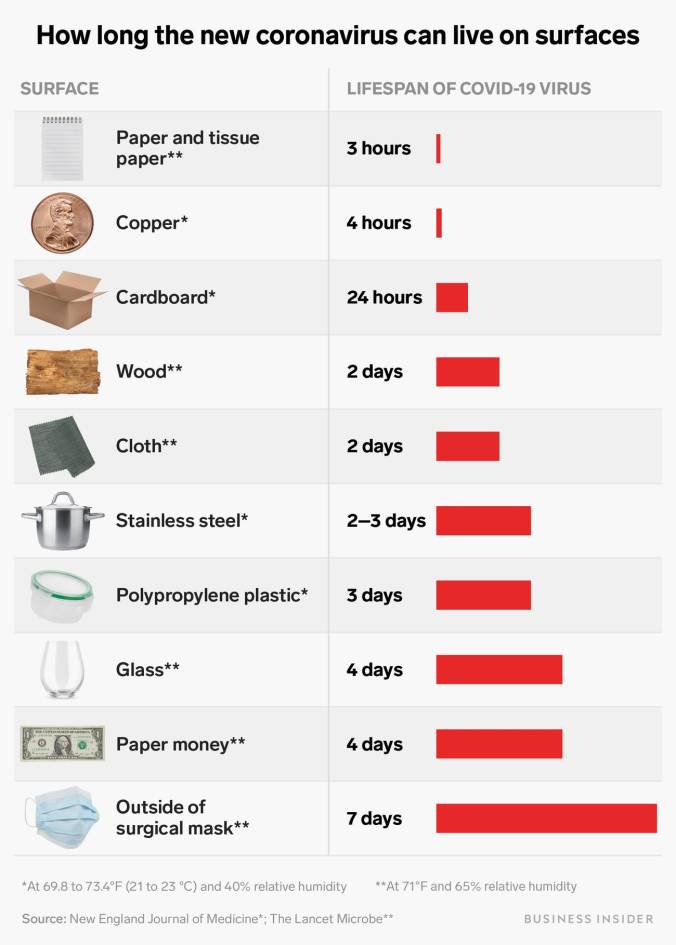
HOW LONG? 2 charts

5e7787ee1378e37a8a67d1925e8cdb448427e964fd756ce6.jpeg

“How long the coronavirus can survive on surfaces

“The researchers behind the new study tested the virus’ life span in a 71-degree-Fahrenheit room at 65% relative humidity. After three hours, the virus had disappeared from printing and tissue paper. It took two days for it to leave wood and cloth fabric. After four days, it was no longer detectable on glass or paper money. It lasted the longest, seven days, on stainless steel and plastic.*

“Strikingly, the authors wrote, the coronavirus was still present on the outward-facing side of a surgical mask on day seven of the investigation. That’s the longest duration of all the materials they tested.”

NOTE: It lasts longer on cooler rather than warm surfaces. Some research has also suggested that increases in relative humidity reduce how readily the virus can spread between people. Your mail is most likely safe on delivery according the the article.


Gary wiped down a wine bottle with alcohol wipes, but we’re mostly avoiding bleach. Mostly, we allow things to sit for days. We wish freezing or refrigeration made a difference (no). We wish vinegar killed it (acidic—wouldn’t that be nice? but no). We wish we didn’t have to think about this at all.


from Business Insider. https://www.businessinsider.com/coronavirus-lifespan-on-surfaces-graphic-2020-3?utm_source=DI20B8U3&utm_medium=email&utm_campaign=20_feb_corona&utm_term=04_06

STATS

Explain this, as of 4 6 April:

219,564 residents in Jackson County; 2133 2269 tests; 33 confirmed cases, still no dead

346,868 residents in Marion County; 1567 1716 tests; 188 198 confirmed cases, 5 dead

In Jackson county, as of 4 April, Oregon had managed to complete 1 test for each 102 residents.

In Marion county, Oregon had tested 1 in 221 people. Yet Marion has many more cases and five people have died.

In our most populous county, Multnomah, as of 6 April there have been 4209 4603 people tested with 209 233 confirmed cases and six seven dead. There are 811,880 people in Multnomah County, which means Oregon had tested only 1 on 193 176 people in our most densely populated county, but six seven have already died.

There are 3,831,074 people in Oregon, 18,925 19,556 have been tested (one person in 202 195), and 999 1068 are confirmed positive, 27 have died.

What’s the deal with Jackson County? And while I’m at it, what’s the deal with that person with Marin County, California plates shopping at the local grocery?

Yeah, I should be nicer, but Gary says my mother would be proud of me: “Going through everything, trying too make sense of the puzzle. That’s what your mother did.” It’s true, Mom cared about numbers and fairness.