An imperturbable demeanor comes from perfect patience. Quiet minds cannot be perplexed or frightened, but go on in fortune and misfortune at their own private pace like a clock during a thunderstorm.—Robert Louis Stevenson
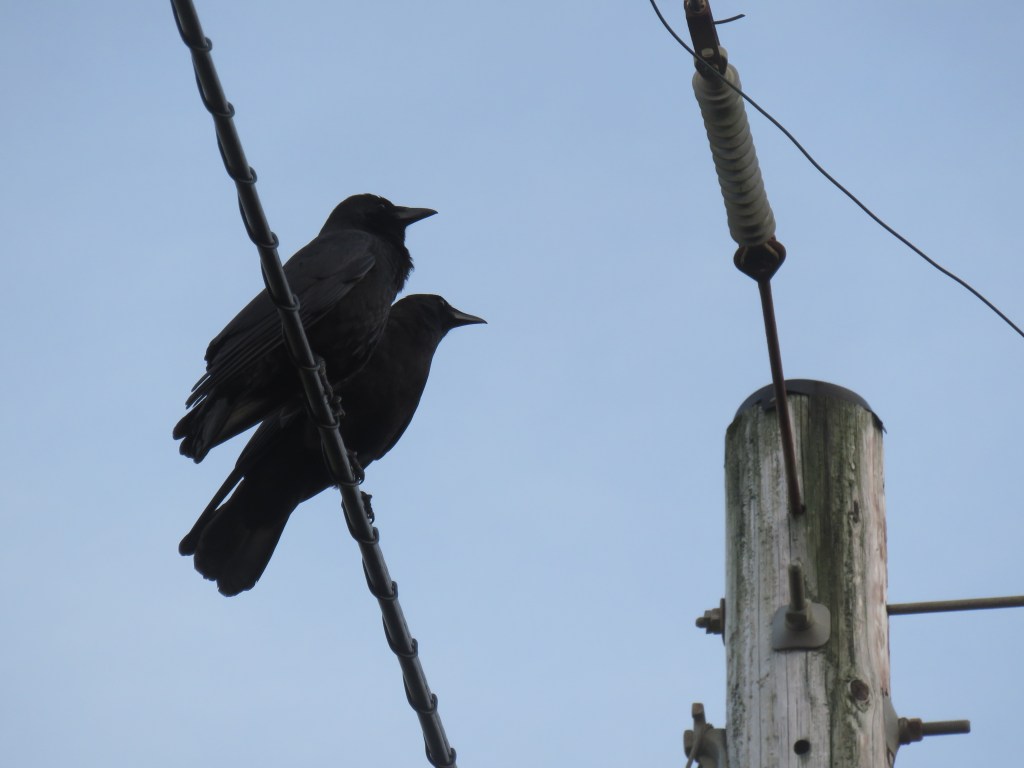
These two are nest-mates, we think, not pair-bonded. We see them every day in about this place on the power lines, near the Fentons’ home.
“I think deep down inside children are all the same,” she said. “They want two loving parents and they would prefer a house with a neighborhood they can play in. They want teachers that they can like. I don’t think children have changed that much. It’s the world that has changed.”
Gary was after me to post today. It’s π day, we missed our walk, but entertained ourselves watching the tarp peel off the remodel next door.
The pie is made from what I found in the freezer: organic mango chunks and wild blackberries with a generous amount of cinnamon and a couple tablespoons of brown sugar. The crust was beautiful. All butter and baked close to the bottom of the oven. Crispy and delicious.Continue reading →
A friend asked me the other day about our beach walks. How far, how long, how fast? We basically walk north on the shore and then home, sometimes south too. If we can get over or around enough creeks and headlands, we might manage to get two miles north, four miles round trip. But it’s not that simple; we also walk into the rocky edges of the shoreline, east-west, up and down, over and over. I told her that when tides force us to walk on the highway we manage better than 20-minute miles. That’s not fast, but good enough. When I log distance, I mostly count North-South distance because it’s impossible for me to accurately record what our zigzag path covers.
Life is like that, isn’t it?
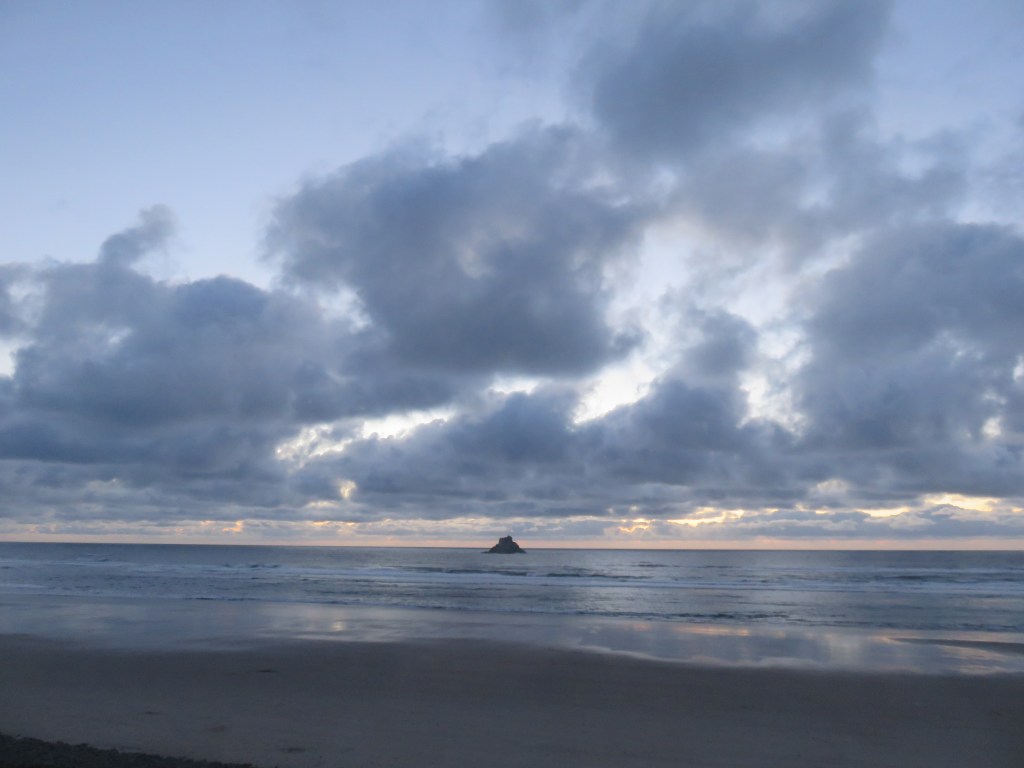
It is the sky I love. These cool colors ended a bright sunny day on 11 March. It marked more than a year in mostly-isolation. Most of our friends have been vaccinated, many have been ill.Continue reading →
Vicious, viscous, victorious, vitreous. That last word has been humming around in my head for a week. Vitreous describes a material such as ceramic which has melted into itself, creating a glass-like and waterproof material. Clay molecules “stick” to one another as they are heated to liquid and taken to a high enough temperature the molecules melt into a solid mass. Vitreous porcelain, as one example, has been fired so hot that the clay molecules melt into one another to make an impervious whole. Thin enough, you can see through some china.
In about 1973, Bob Sperry gave all the Ceramic Art majors an assignment to collaborate—the throwers he worked with would pair with the hand-builders who worked with Howard Kottler and Patti Warashina. Together they would create something. As a hand-builder, I paired with a thrower, Sam Scott, whom I had known since we both hung out most of the day in the ceramics room during high school. I gave him my low-fire white clay body to substitute for his usual stoneware on the wheel, and a design profile for a covered casserole dish.
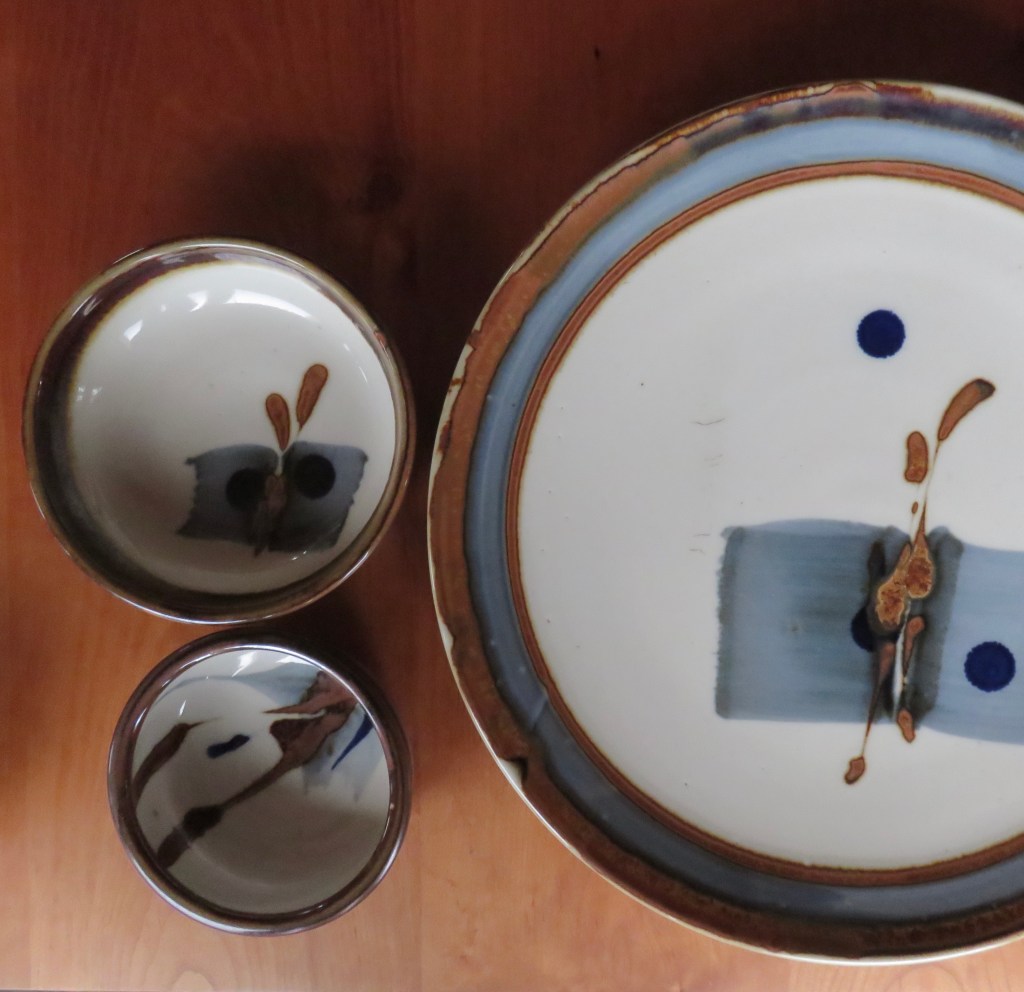
The result of the experience changed Sam’s work. Turned out he loved white clay and began throwing with a porcelain clay body as he had previously thrown stoneware—thicker than people generally throw porcelain but a perfect canvas for his iron and cobalt brushwork. (Another friend threw stoneware thin as porcelain.) My family was hard on the many pieces I bought from him, but I managed to hide a few survivors. A massive platter and some bowls. They are handsome pieces.
Eagles are doing well. We see the mated pair that live on the cape nearly every morning.
Gary complained I had not posted. It is barely raining a little drizzle, there is sand, and we will have our walk. Lately, we find we cannot get more than a mile north because Shark Creek’s runoff is too high for us to cross, but we will go out as soon as there is light. Gary is dressing in the dark, and I will have a last sip of coffee. Neither of us have yet been vaccinated and we miss our family.
In the mean time, like so many others, we listen to music and hope for comfort, conversation, and more communal days.
Today is a bread-baking day. I will make two loaves and a few savory rolls, I think. Usually I start first thing in the morning in order to have bread for lunch, but today I am still winding a warp and typing away.
Pussywillows are out but the place where I have been picking them the last few years was pruned back hard last fall. There are other places.
The daffodils are in bloom too. In our yard, “February Gold” is a small, early variety. They are only about eight inches tall and ours have been blooming their fool heads off for most of the month. The escalonia has given up its last carmine blooms, but rosemary is all over tiny blue-violet flowers, the rhubarb is coming up, and the primroses never stopped.
Waves were sweeping up over a hundred feet across the sand to break finally in the basalt rock. Every few minutes a wave will rush in, putting the place where that child is walking several feet under water.
We like to be among the first out on the beach. Sometimes in summer than means walking out by 6am. This week low tide is after noon and we began our morning walk on the road, the last half mile north on the rocky shore and then home. We note how the sand moves, the gravel shifts into rolls and then is buried under larger stones, the new and broader rivulets of runoff, the places where shoreline vegetation is undermined, and where high banks have failed entirely this winter in the unrelenting wet.
Yes, that’s just the way the beach foam was. Gary told me I should take a photo.
From romance to plastic trash to how we can all be in this together. I’ll try to explain.
When I was a graduate student studying literature, I first heard the theory that romantic love was an invention of European novelists. People felt lust and loyalty, but actual love between two people—sexual and romantic love—was a figment of playwrights’ imagination. (It’s a silly theory.) Canadian psychologist Nathaniel Brandon claims that “in primitive cultures the idea of romantic love did not exist at all.” Even Margaret Mead declared: “Romantic love as it occurs in our civilization, inextricably bound up with ideas of monogamy, exclusiveness, jealousy and undeviating fidelity does not occur in Samoa.” Freemason Lewis H. Morgan proposed the concept that marriage was the earliest human domestic institution but also judged “the passion of love was unknown among the barbarians. They are below the sentiment, which is the offspring of civilization and super added refinement of love was unknown among the barbarians.”
[Gary argues that most of what we have assumed about physical and cultural anthropology and archeology has been turned on its head in this century.]
However, a few decades ago this idea that romance was an invention of Western culture was taken seriously enough by an anthropologist that he decided to construct a research project. He used the archetypal story of star-crossed lovers—two people who abandon convention and family in order to be together. We might argue that such passion does not necessarily lead to a golden anniversary. Even Shakespeare, after all, was poking holes in the relationship between R & J. Nevertheless, the star-crossed lover story is not merely the story of lust or friendship, but of a passionate devotion that creates more than inconvenience, where two people defy their community, faith, and family to be together. He considered such stories might provide a warning, but their existence also demonstrated emotions that most of us would not hesitate to describe as romantic love. He searched for traditional stories and folktales from all over the world. Surprise! The star-crossed lovers story exists everywhere. In ancient Greece and the forests of Brazil and Madagascar and India, China, Europe, the Middle East, and the South Seas, such traditional stories exist everywhere. Individuals do fall in love and occasionally make enormous sacrifices, even of their lives, in order to be together. They fall in love and sacrifice for their devotion. The story exists in non-literate and literate cultures in every inhabited continent and within island cultures all around the world, even in cultures that otherwise seem to have no “romantic” tradition.
It’s possible that people lied. Maybe anthropologists, like everyone, found what they wanted and expected to find. More likely, love exists.
We are human beings and part of our shared humanity is that some stories persist in all cultures, in every corner of the world, and throughout time. Like the hero’s journey, the star-crossed lovers is likely a universal narrative. Lovers who defy convention and are willing to sacrifice safety and comfort in order to be together might be one of them.
Did I need an anthropologist to prove that to me? No, I actually did not. It is what I want and expect to find is true. It is Eurocentric hubris that inspired some foolish English-speaking academic to claim that romance was invented in Northern Europe. It is shallow to assume that the only way couples stay together is reproduction, envy, jealousy, rivalry, habit, boredom, or convention. Romance lives!
So. Take-out food.
“Few of us are equipped or inclined to cook three meals a day for ourselves.”
—Tom Sietsema, food critic for The Washington Post
Tom Sietsema wrote about his discovery that the take-out food he was eating during the pandemic creates a lot of trash. He was shocked, shocked to discover how much plastic his food required.
The article was titled “All my takeout has delivered a mountain of trash. So I asked experts how to minimize it.” Apparently he had not noticed how much trash his occupation as a food critic created until he was personally responsible for disposing of it. “For three weeks this summer, I saved every scrap of takeout packaging… The cups from cold-brew breaks and the cartons from sushi and burrito runs that used to be tossed out at the office and forgotten about are now our responsibility, up close and personal — in our faces. The problem is literally knocking at our door. We have to answer it.” (I want to know where he found grass to spread out his trash in Manhattan?)
How he had not known this already?
Soda and milk products came in glass when I was a girl. But the oil industry looked for a larger market and chose plastics, spending millions to convince us of a lie—that plastic was safe, cheap, and recyclable. Ultimately it is none of those things. The lesson here? Distrust the profit motive?
People were particularly irritated by this line: “Few of us are equipped or inclined to cook three meals a day for ourselves.” Commenters pointed out that preparing three meals was exactly what they did every day. We do not need to actually cook three meals because what about cold cereal and leftovers? A survey conducted in 2019 found that only 6% of Americans eat out daily. Gallup found that dining habits have been stable between 2003 and 2016 and close to 40% of those surveyed had not eaten out for even one meal in the previous week. Apparently even Sietsema’s readers don’t all eat the way he does. We should use containers made of materials that break down completely and quickly, he says. We should use our own flatware and reusable shopping bags.
Romantic love and plastic take-out containers—we assume that others’ habits and passions are just like ours. Maybe a literary critic had a bad break-up that lead to his cynicism about romantic love. A food critic assumed most everyone ate the way he does. We assume that what we do and value and desire is the same for everyone.
When I was in college, all shopping bags were still paper and the world did not come to a screaming halt because there were no plastic bags. The produce at Safeway was not continually misted with water and I put my veggies in paper bags. Milk only came in glass or waxed paper cartons. And in 1973, I carried my groceries home in a cotton canvas shopping bag imprinted with “Save a Tree.” I used that bag for years.
Today is Valentine’s Day and my husband is downstairs making coffee as I type. How we care for and feel about one another is not like anyone else. But love and passion, friendship and simple affection, loyalty and kindness, compassion and decency are all human emotions. We are all capable of changing our minds. We are all capable of fairness and altruism. We can figure things out. Maybe we fail sometimes. Perhaps all those good things are not functioning fully all the time or for everyone. But our best can be very fine indeed. We do not need to become a culture of outrage. Anger can drive needed change, but as a steady diet, love is healthier.
Take it easy on yourself today. Everyone needs a break sometimes. The human heart is vast; it contains multitudes.
Yeah, we knew it was coming. Despite the videos, the creepy calling after Nancy, the threats and racist catcalls that began years ago. Despite the ridicule of a disabled reporter, the ridicule of a Gold Star family, the infidelity during three marriages, the threats and bullying, we had every right to expect Congress, the Republicans in Congress to do the right thing. Gary likes to say: Didn’t they ever go to Sunday School?
Apparently all they learned was they were chosen.
Against the courage of Officer Goodman are the doors and windows broken, the officers who were broken, the oaths of office broken, the trust broken. The news has reported from the beginning that Republicans in Congress would never vote to convict. And those national media outlets were correct. Republicans in Congress chose party and power over people, party and power over the Constitution they swore to defend, party and power over morality and justice. It is unconscionable. The next time someone complains about partisan politics, look right.
To paraphrase Fiddler on the Roof:
"Rabbi, if there's a blessing for everything, is there a blessing for Trump?"
"Of course. May the good Lord bless and keep Trump . . . far away from us."

Or to quote Jesus Christ Superstar: "Could we start again, please?"
Some deep housecleaning is called for. As The New York Times reports:
“Forty-three Republicans voted to acquit Mr. Trump of inciting an insurrection against the United States—more than enough to prevent the two-thirds majority needed for conviction. Mr. Trump was found not guilty, a verdict he immediately celebrated.
“And yet seven Republicans voted to convict him, making this by far the most bipartisan impeachment effort in American history. It is worth remembering that until a year ago, when Mr. Romney cast the lone Republican ‘guilty’ vote in Mr. Trump’s first impeachment trial, no senators had ever voted to convict a president from their own party.”
“Representative Madeleine Dean of Pennsylvania, an impeachment manager, put it bluntly: ‘If we don’t set this right and call it what it was, the highest of constitutional crimes by the president of the United States, the past will not be past. The past will become our future,’ she said in closing arguments. ‘Senators, we are in a dialogue with history.’ ”
“ ‘The people who stormed this building believed they were acting on the wishes and instructions of their president,’ Mr. McConnell said, ‘and having that belief was a foreseeable consequence of the growing crescendo of false statements, conspiracy theories and reckless hyperbole, which the defeated president kept shouting into the largest megaphone on planet earth.’ ”
Mitch McConnell voted to acquit. History will judge their failure.