6 WORDS about the awful year

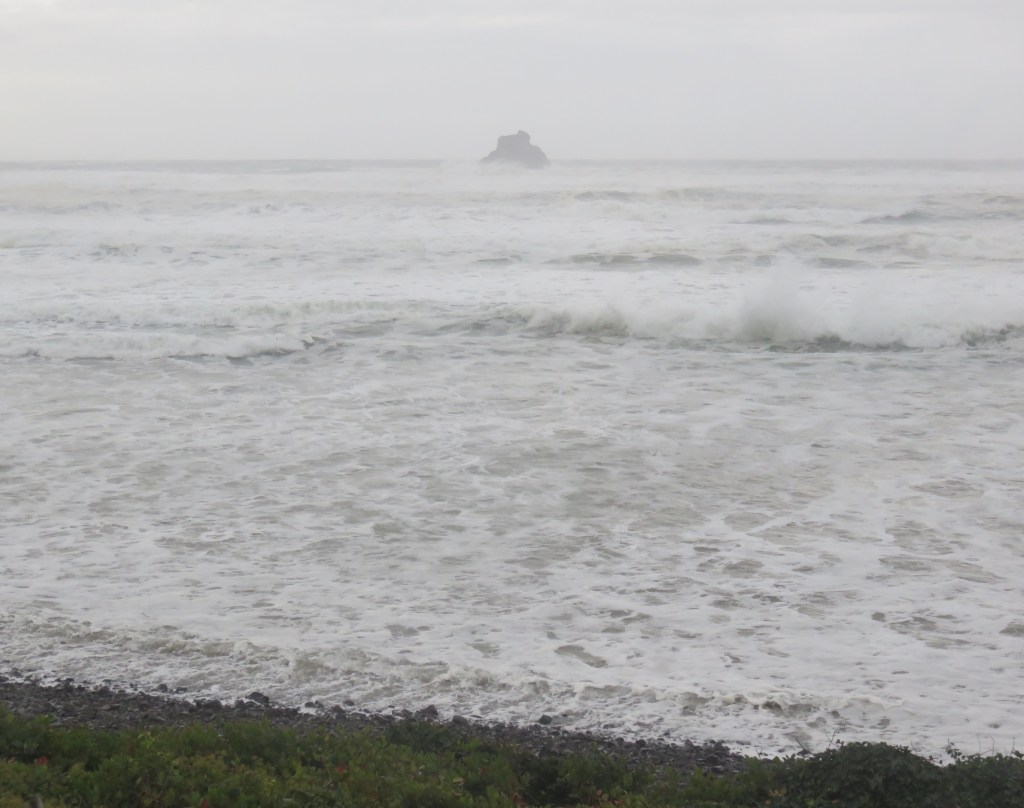
You might think sunset—but this is dawn wrapped clear around the sky to the west.

Education Week asked teachers and administrators for a six-word review of “the awful year.” Here are three examples:

Bars are open. Schools are closed. 

Chad Aldeman, Bellwether Education

No one in my family died. 

Janet Keller, Santa Monica, California

We’re doing the best we can.

Shari C, elementary school principal
Continue reading

BOXING DAY

And it’s not even over.

Here we are on the day we delivered gifts to Portland—our fourth trip away from home since the beginning of March. We found out later our youngest grandchild was so upset we stayed for only a minute that she cried, then cried again when she understood she could not open the gifts yet, then was appeased when she found the winged turtle, which she was meant to have.

Gary and I defied expectations and began losing weight in the last weeks. We did not gain even over Thanksgiving, but I do not dare weigh myself to find out what damage the mince hand pies might have done.

As of today, I am three kokeshi dolls and four books richer, and our son Alan and Gary gave one another the exact same bottle of whiskey.

Continue reading

NORMAL

Under the waterlily dome are two little cheeses, under the glass are the mince pies. I took the last loaf of cranberry bread out of the freezer, washed raspberries (an out-of-season treat). and made heart-shaped cookies out of the leftover hand pie dough. A candle burns.

We woke at the usual time, before 5am, only today I walked downstairs before Gary had finished making the coffee, and we sat together before the fire. This is not a “normal” morning because it is Christmas. It is not like last year when we soaked in the pool at the Kennedy School and watched our grandchildren unwrap gifts.

Continue reading

from REBECCA SOLNIT

Republicans are standing up to Trump. Unfortunately, it’s too little, too late

Rebecca Solnit

Republicans like Gabriel Sterling – who are horrified by the torrent of death threats facing electoral workers – are voicing their outrage very late in the day
‘The measure of our humanity is our ability to care for people unlike us, who are not in our clique, gang or church.’ 

Fri 4 Dec 2020 06.49 EST

The first time I watched Georgia voting systems implementation manager Gabriel Sterling’s furious tirade about the threats against him and his coworkers, I was impressed. Here was a Republican, a self-described conservative, telling off the president and all the people making those threats. “Death threats. Physical threats. Intimidation. They have lost the moral high ground. I don’t have all the words for this because I am angry.” He was clearly furious. He talked about a young contract worker: “There’s a noose out there with his name on it. This kid just took a job and it’s just wrong. I just can’t begin to explain the level of anger I have right now … Mr President, it looks like you probably lost the state of Georgia. Stop inspiring people to commit acts of violence.”

It didn’t take long for me to sour on his indignation. They never had the moral high ground. The death threats and intimidation against him and his co-workers are wrong. However, they’re not the first people to get them but in some sense the last, and if you care about people the president has attacked verbally and urged violence against, you could have started caring during the 2016 campaign. Nothing suggests Mr Sterling did, since he belongs to a party that has supported Trump and, more broadly, campaigns of hate and discrimination for the last 40 years and more. In recent years, Trump has urged police to treat arrestees more roughly, audiences to harass and even rough up journalists and dissidents in his crowds, and is well-known for the 26 credible accounts of sexual abuse and violence with which women have charged him. He’s the guy who pardoned Sheriff Joe Arpaio in 2017 for his conviction for disobeying a judge’s order to stop racial profiling.

In Georgia, the far right has finally turned on its own in its furious demand to have an election that serves Trump and the party rather than reflects the will of the people. I admire the integrity of Georgia’s secretary of state and other officials who have, in the face of great pressure to corrupt an election for their own party, refused. It does make you wonder why they’re in that party, though. Because this is the party of intimidation and corruption and voter suppression, the party that undermined a free and fair election in that state two years ago. And because the measure of our humanity is our ability to care for people unlike us, who are not in our clique, gang, church, on our team, side, who are not our color or our kin and who are not near to us in spatial distance as well as in affinity.

That generosity is evident in the medical workers risking their own lives to care for patients with Covid-19, including many who don’t believe they have the disease and didn’t take precautions against it. It’s in the Auntie Sewing Squad, which has sewn more than a hundred thousand cloth masks to distribute to frontline, vulnerable and devalued groups from farmworkers to former prisoners. It’s present in the activists and organizations defending refugees, including the children put in cages and separated from their parents by the Trump administration. It’s present in the work of the ACLU, the Southern Poverty Law Center, Planned Parenthood, the Sunrise Movement, the housing rights advocates and activists demanding police and prison reform. It was present in the demonstrations this summer in response to the police murder of George Floyd.

All these things the Republican right has opposed. The war against empathy is always a war against the imagination, against that expansion of feeling to care about others. There’s another kind of expansion, through science and natural history or direct engagement, to understand the systems that connect us, our inseparability from other species, the climate, the environment, and Republicans have waged war on that too, in search of their apotheosized individualism as radical selfishness.

If you care about nooses as threats or actual murder weapons, you have a lot of nooses to care about, especially in the south.

This summer several Black men were found hanging from trees across the country, in cases police ruled were suicides and many believed were lynching murders; similar cases happened in recent years in Georgia. In 2016, 22-year-old New Jersey resident Michael George Smith Jr. was found hanging in Piedmont Park in Georgia. Another Black man was found dead in public by hanging in Georgia the year before. 

If you care about threats more generally, you could have cared about the threats against a Pickens county, Georgia, school superintendent for implementing a trans-inclusive bathroom rule at local schools in 2019; they were his justification for reversing the decision. Trans students paid the price. Just before the 2018 election, in which Stacey Abrams was defeated by Brian Kemp, back when the Georgia election system didn’t seem so uncorrupted, she too faced threats. The Root reported, “One of the merry band of bigots that came to the event to harass and threaten Abrams was James J Stachowiak, a multiple convicted felon who regularly posts videos instructing his viewers to shoot black people on sight.” Brian Kemp, then the Georgia secretary of state competing for the governorship with Abrams, posed during the campaign with Stachowiak while he was wearing a T-shirt reading “Allah is not God and Mohammed is not his prophet.” And it wasn’t just threats. Ahmaud Arbery was shot to death by white men in Brunswick, Georgia, this February, while out jogging: not a hanging but definitely a lynching. Racial killings, police killings, domestic-violence homicides, mass shootings are some of the violence that runs through the fabric of this nation.

Mr Sterling was apparently silent on all of this until the dogs turned on him. He made me think of the famous words by the German pastor Martin Niemoller after the second world war, “First they came for the socialists, and I did not speak out – because I was not a socialist,” and on and on about who he did not speak out for, “then they came for me.” Then they came for Gabriel Sterling. Who was granted police protection and had the safety and standing to speak out for himself.

‘CHRISTMAS PARTY’

In the 1980s and 90s, we hosted an Open House on the Sunday before Christmas. For weeks I would make and freeze holiday cakes and appetizers. We cleaned house and invited neighbors, co-workers, and friends. No alcohol was served, which is probably why nothing awful ever happened. Well, there was the incident with the dog . . .

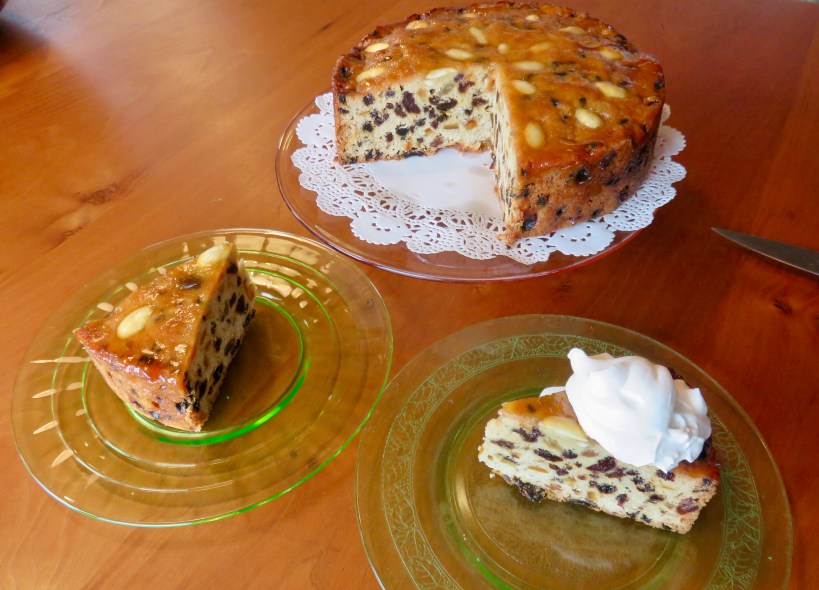
A full-size Dundee Cake from another year, served with whipped cream

We stopped throwing these parties after the year both my brother and mother failed to attend. It seemed sad to work so hard if my local family couldn’t be bothered.

But I am retired now and I love any excuse to bake. We had talked about reigniting the tradition this year, but then, you know, this pandemic.

No gatherings here or in Portland for Thanksgiving. The up side of this is that I do not have to avoid the foods people do not or cannot eat. I can cook with gluten, eggs, dairy, nuts. I could make my spiced carrots. My pumpkin pie can include cream. There was an article in The New York Times this week about traveling and arriving exhausted and still having to cook, about adjusting to individuals’ preferences and dietary needs, and about having to eat multiple Thanksgiving feasts with each partner’s family. (Gary and I did that until we moved to Oregon.) Apparently other women have found the same silver lining. Less work, less stress when it’s just the two of you. Articles have acknowledged that holiday expectations are especially hard on women, and offered all sorts of suggestions about easing into a lockdown Thanksgiving: cook everything but in smaller amounts for two, cook the one thing you like best, cook nothing and order take-out, or reheat something frozen or just drink.

My solution was different. I am cooking a complete meal in easy stages. One dish a day. I made the wild rice and mushroom casserole a few days ago and we’ve eaten half of it. The rest is for tomorrow. I made twice-baked potatoes with cheese, and we’ve sampled that too. Yesterday I made my regular vegetarian herbed dressing using my own sourdough bread cubes (thank you again, Mary Jo and Dale), celery, onion, parsley, herbs from the garden, homemade stock, and cranberries. We had some of that for dinner last night. I might bake two loaves of cranberry bread this afternoon, but at least the pumpkin pie. (The Delicata squash I am using for the filling was roasted and puréed earlier too.) The trick will be keeping Gary out of the pie—pumpkin pie is the holiday dish he’s most fond of.

Stretching out the Thanksgiving feast preparation has been relaxing. I enjoy cooking, but it’s a lot of work for just one meal. We have enjoyed the Startbefores even more than the Leftovers in past years. It means that tomorrow I will make the apple salad with dates and walnuts first thing in the morning and we’ll have some for breakfast, and later roast Brussels sprouts for the big meal. I only have to reheat everything else.

The next holiday is Hanukah beginning 10 December, and we will burn candles. I was afraid I’d given away all the apricot jam, but after my initial panic, I found there is still one jar for the rugelach.

Then Christmas. The cards are more than half-addressed. I will miss not having Prissy’s wreath on the door, but we have lights and the just-for-show fake tree can go up soon after Thanksgiving. We are not buying a cut tree for the first year ever. (Even during the Big Mess when Gary and I, our two preschool children, and six dogs camped in 500 square feet for nine months including Christmas, we put up a tree.) My collection of clippy glass birds will stay in their boxes. The Swanson-Vance flying animals will hang on the pre-lit white paper “birch” tree from Costco. Just this once.

Another of Gary’s favorites is a Dundee cake, traditional for Boxing Day. My dried fruits—three kinds of raisins, pineapple, mango, and cherries—are soaking in rum as I type this. It only needs freshly grated lemon and orange peel. (I fear it will not be as good as last year when I used Scotch and home-candied orange rind.) There will be no one here to share that rich cake, so I plan to make us a six-inch round, which is still too much for two people.

In recent years our sons and their families have come for Twelfth Night in January. That’s not happening this season either, at least not as a physical get-together.

We are planning Jitsi or Zoom group meetings with family. Gary and I might watch Home for the Holidays, and certainly we will watch When Harry Met Sally. We will not stay up till midnight on New Years Eve—we almost never do. We will manage fine because we have remembered to tell people we love them. They might not be in the room, but there is room in our hearts,

FALSE EQUIVALENCE

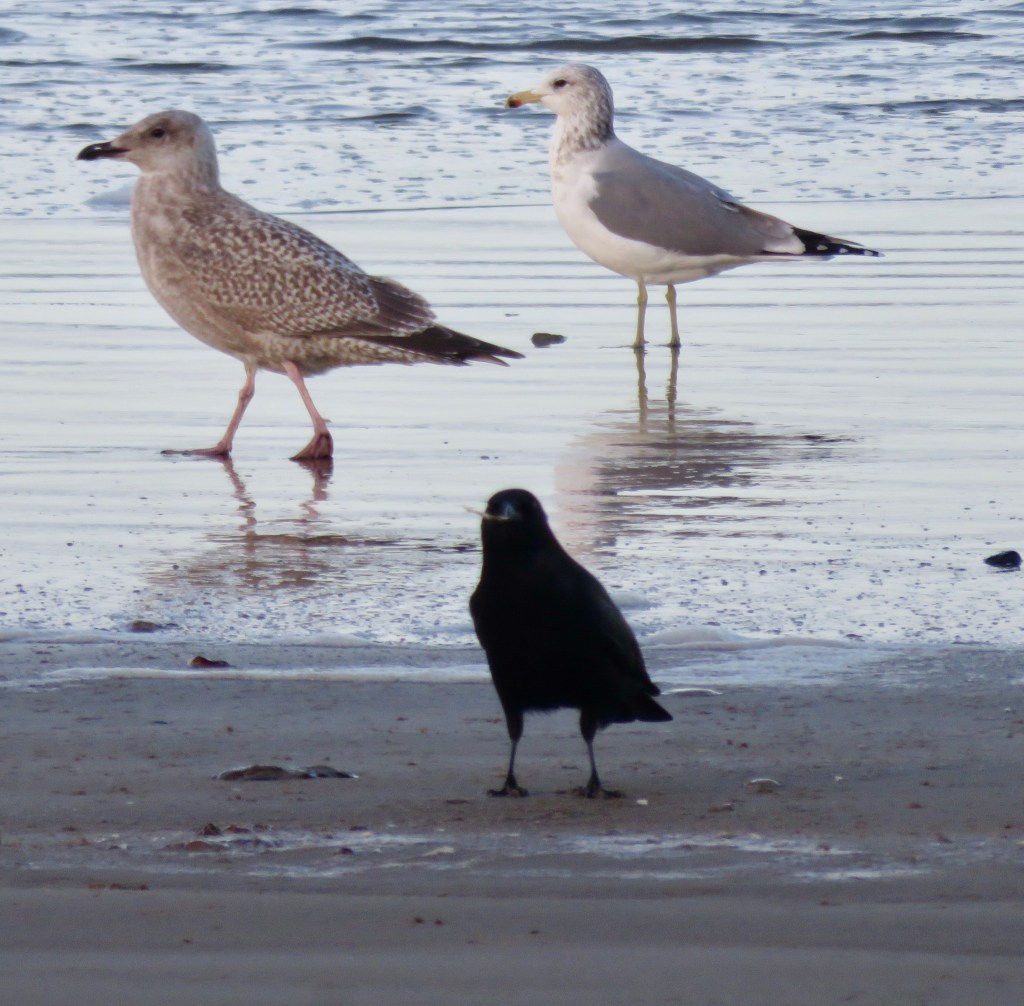
Gary’s upstart crow who hangs out with the gulls at the creek is front and center. Behind is a juvenile and a nearly adult gull. One juvenile gull is still weep-weeping to be fed every morning as we walk north.

Rebecca Solnit has a new essay about the false-fairness strategy of trying to meet bigoted, science-denying, narrow, and Trump-won-the-election fantasy halfway. “On Not Meeting Nazis Halfway: Why Is It So Hard for Democrats to Act Like They Actually Won?” Patience and kindness are one thing; pretending that we can find reasonable compromise with a dangerous minority, maybe not so much. Especially since only the left—the majority that won the White House—even tries.

There is no reasonable halfway between truth and bogus claims. We should stop pretending that there is such a place. Sometimes, however much some people want believe it, a lie is just a lie.

(I used to think that accusations of “Nazi” were overblown and unfair. Then I paid more attention to the signs, actions, and words of Proud Boys and other white supremacist groups. Are cries of “Nazi” unreasonable? No, they aren’t.)

Supreme Court Justice Samuel Alito just complained that “you can’t say that marriage is a union between one man and one woman. Now it’s considered bigotry.” This is a standard complaint of the right: the real victim is the racist who has been called a racist, not the victim of his racism, the real oppression is to be impeded in your freedom to oppress. And of course Alito is disingenuous; you can say that stuff against marriage equality (and he did). Then other people can call you a bigot, because they get to have opinions too, but in his scheme such dissent is intolerable, which is fun coming from a member of the party whose devotees wore “fuck your feelings” shirts at its rallies and popularized the term “snowflake.”

Nevertheless, we get this hopelessly naïve version of centrism, of the idea that if we’re nicer to the other side there will be no other side, just one big happy family. This inanity is also applied to the questions of belief and fact and principle, with some muddled cocktail of moral relativism and therapists’ “everyone’s feelings are valid” applied to everything. But the truth is not some compromise halfway between the truth and the lie, the fact and the delusion, the scientists and the propagandists. And the ethical is not halfway between white supremacists and human rights activists, rapists and feminists, synagogue massacrists and Jews, xenophobes and immigrants, delusional transphobes and trans people. Who the hell wants unity with Nazis until and unless they stop being Nazis?

—Rebecca Solnit

It is worse to be racist than to be called a racist. It is worse to be a misogynist than to be called out for sexism. It is worse to experience bigotry than to point a finger at the persons doing the oppressing. And climate change is happening whether we want to admit it or not. Truth is truth; fact is fact.

It’s a simple concept.

In the mean time, the State of Oregon has forbidden meetings of more than six people and two households and forbidden unnecessary travel, particularly out of state. There are five cars with out-of-state plates and more than ten people in the rental north of us. The last time I contacted the owners directly, they called me an f—ing b—. (Except that it was said many times without euphemism. Even after I tried to be “nice.”) The last time I went directly to the people offending (big beach fire during a high fire-danger burn ban) I got chewed out over the phone for that too. (From my point of view it was their job to apologize to me for failing to run their business according to law regarding short term rentals in my residential neighborhood.) I’ll get in trouble for complaining to the source.

But should I do as I was told: “shut up and go in your house” and pretend that this is okay? That they have a reasonable position that I should try to understand? Unless I want to be threatened, I should be quiet because their money trumps my community? I should pretend that laws apply only to other people rather than to them and only when those laws are convenient, because since they are Americans and do not consider themselves criminals, they get to do whatever they like?

Is that any way to live? Or is it just another lie of convenience and elitism over fact?

But I am not alone in my confusion.

“We [historians] pride ourselves in saying, ‘Don’t worry, this has happened before,’ or, ‘Worry, this has happened before,’ ” said Jeffrey A. Engel, the founding director of the Center for Presidential History at Southern Methodist University. “Right now, if all your historians can say is, ‘We are in entirely uncharted waters,’ I don’t even know how the rest of that sentence ends.”

—The Washington Post

WIND

The cloud-occluded sky was dove gray and Oregon chalcedony blue. A fragmented break to open sky over the ocean glimmered platinum that swept a reflection across wet sand. I did not have my camera with me, so perhaps you will take my word. It was beautiful.

November, the middle of autumn, is like this. We are just home from a walk in a dry gale wind. It was easy walking out north, hard work coming back, our heads bowed into the blow. We had missed our morning walk because of the fierce winds and drenching rain. There was no sand at all, though it was only an hour past low tide. When the weather cleared this afternoon we took our chance. It is the great advantage to retirement, I think. We can go out whenever we like.

Yesterday, we were out early to see what the ten foot tide had left us. We have walked the shore daily for so many years, we recognize rocks, the places where sand shows through, where there is a flat stone, where the rocks are rounded and fine like river gravel.

All is changed. The path Gary built in March is entirely swept away, even the heaviest stones set as steps through the hedge were tossed. They have survived a dozen winters. Water flowed right into our neighbor’s yard, a reminder that house is built over a swamp and creek. The ocean remembers and takes back.

In the spring we pull aside basalt stones lining our shore to create a meandering path to the sand, a task requiring gloves and sometimes metal garden tools. This path is a depressed passage two feet wide through the margin between sand and land. It makes our morning walk down onto the beach easier. Walking over the stones is unsteady and bumptious on the bottoms of our feet. It takes hours or a few days to dig away stones. Sometimes the sand is a few inches under the stones. Sometimes we must dig deep and have to carry sand up to fill the resulting trench. The work is satisfying, traditional. Sometimes a high wave in April will sweep the rocks back into place and we must build the path again. Sometimes it happens again and again and we threaten not to bother rebuilding. 

By summer, the sand has begun moving inshore from sandbars beyond the breakers. Most oceanfront homes have built paths through the stones to save their feet. The dry sand is untouched by most high tides, and low tide reveals a hundred yards of clean, hard wet sand. For three decades I ran on that smooth sand surface every other morning if the tide was out far enough to permit me. Now we walk our miles regardless. When I was a girl, sand swept all the way into the green by midsummer. That doesn’t happen any more.

Some of the sand is simply gone.

There has been less sand onshore for so many years, local newspapers don’t even mention it. Twenty years ago they offered several explanations. Most involve happenings far away up or down the coast. Barriers intended to protect harbors shifted the seasonal flow of sand, causing it to pile up. There are condominiums built on shore that did not exist so very long ago. A powerful wave in January of 1999 picked up not only sand, but the rocks themselves. Massive sandstones rolled amid the wet-blackened basalt. Strong waves push the basalt high. Some years there has been a ridge of rock five or even ten feet in the rocks up shore from us. We’d like to trust the seasonal shifts to level things out in summer. There is no counting. The tide is not dependable. 

In autumn, sand begins to slide back into the sea. Tide and wind swipe the basalt clean, drive sand into the ocean. Waves seem to rise higher. Low tide gives a narrower strip of wet sand than we saw in August. 

It is different all the time. Asbury turns hard right and flows a quarter mile south one day, and a week later it spreads straight west. Gulls rest there.

Everything changes, shifts from one tide to another, one month to the next, and year to year. It is a moveable feast. The people who bought the house north of us to use as a commercial rental asked us: “Where has our sand gone?” the first time they visited in the autumn. We could not help laughing. 

Yesterday on our walk, a wave swept in across a hundred yards. We had climbed into the rocks. When an outgoing wave flows back into an oncoming wave there can be a great crash—the sound is starling and water sometimes flies straight up into the air. The so-called “sneaker” waves are silent, and it is the sudden quiet that causes us to run. An incoming wave overtakes a wave also moving in, picking up energy and speed from the one below. Then a third wave over the top of that one. There is no predicting, no pattern. It is a random event.

No telling when the sea will swing her skirts.

ALL TOGETHER NOW

“Yes, sister, sometimes we may be the only one that looks like us walking in that room,” she told a largely Black audience in Fort Worth. “But the thing we all know is we never walk in those rooms alone — we are all in that room together.”

— Senator Kamala Harris of California,
who will become the first woman to serve as vice president
from The New York Times: “With her ascension to the vice presidency, Ms. Harris will become the first woman and first woman of color to hold that office, a milestone for a nation in upheaval, grappling with a damaging history of racial injustice exposed, yet again, in a divisive election. Ms. Harris, 56, embodies the future of a country that is growing more racially diverse, even if the person voters picked for the top of the ticket is a 77-year-old white man.”

She is also the hope for our nation, a smart person capable of finding a fair and just path for our collective future.

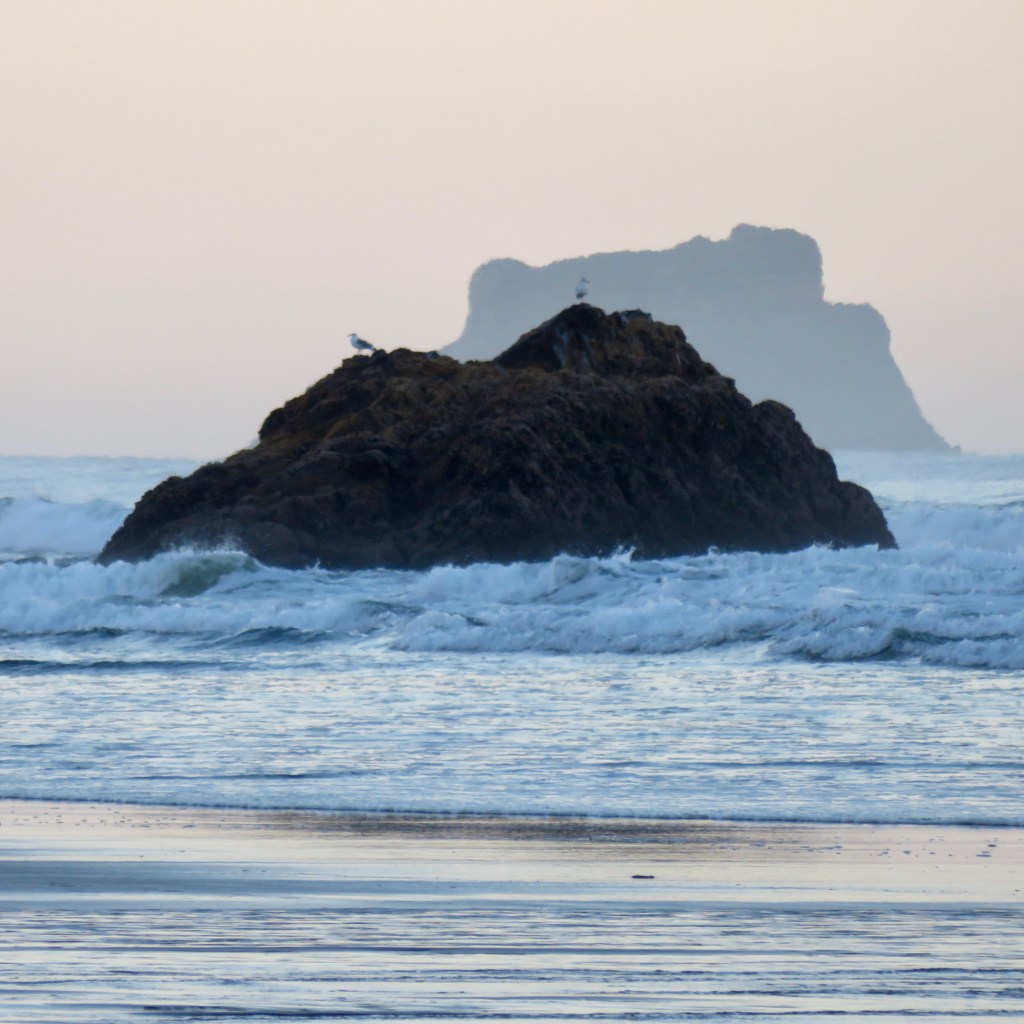
We see this bird perched at the top of a snag above the bluff north of us. She’s there most days on our walk, and sometimes a few others too.

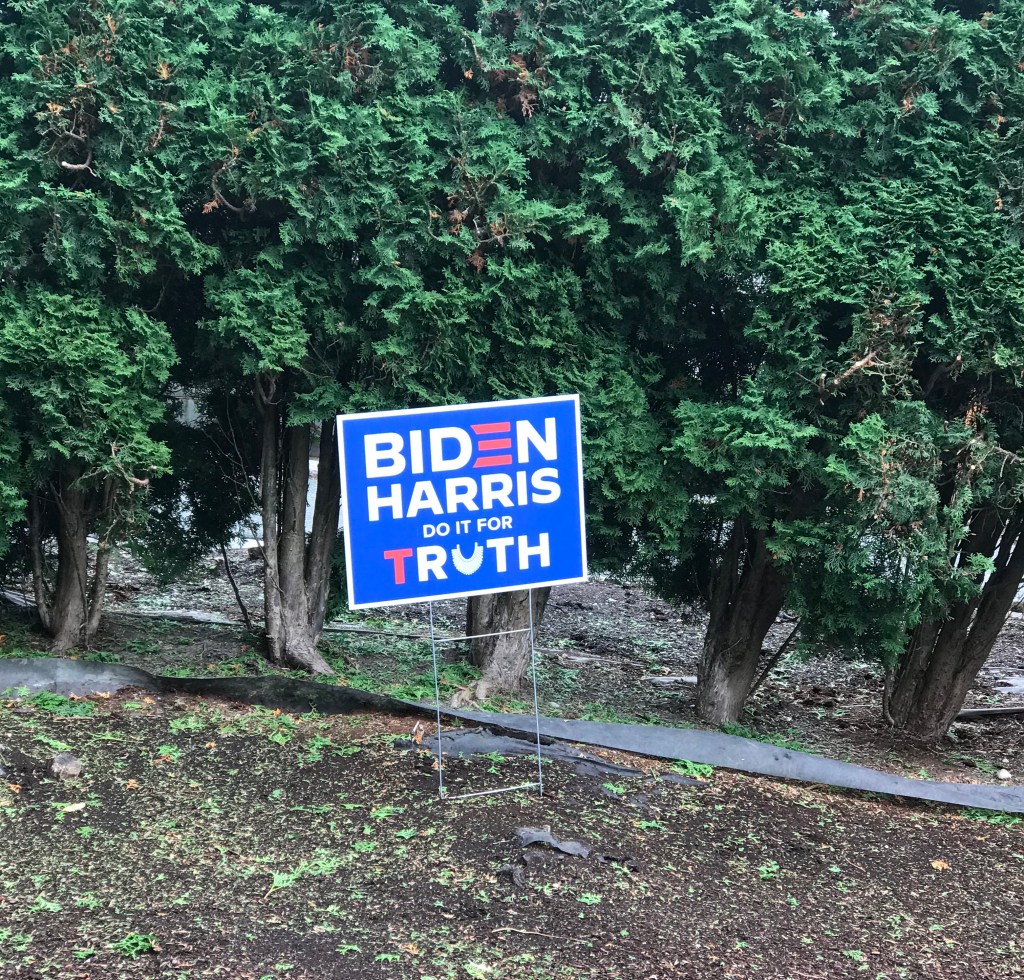
BIDEN WINNING

It looks likely that Biden will win the presidency (50.5% of the popular vote), and I am glad for that even though I am mostly excited about him because his intentions are to care for the nation, to respect the People, to serve.

Am I the only one who finds it sad that this seems like such a massive shift? Shouldn’t service be something I should, as an American, take for granted? The President serves his country.

Gary brought home a fill-in-the-blank poster:

The America I believe in ________________

Perhaps this is why I am not feeling celebratory. Yet.

So don’t read the rest if you are trying to work up a head of cheerful steam.

  • Of the national news networks putting the presidential race at the top of their page (all of them) only one lists the popular vote. If you’ve been paying attention, Biden has been ahead since Tuesday. He has 4 million more votes now that his opponent. But that doesn’t matter, not really. It’s all about the Electoral College.
  • Yesterday, we went to Portland to deliver our granddaughter’s birthday cake. Downtown was a mass of homeless camps and boarded-up storefronts.
  • That senator from Kentucky was reelected.
  • Almost 70 million people have voted to keep the current resident of the White House.
  • One reason he’s losing (and I have to love the irony) is that a reactionary rightwing third party is sucking up over 1% of the vote nationwide.
  • The Senate is still in the hands of people who oppose healthcare for all, addressing climate change, and “one man, one vote.”
  • The two QAnon people who are going to Washington DC.
  • The so-called Proud Boys and other wack-job reactionaries.
  • There is so much damage to undo, so much work that has been neglected for four years, and a tired nation wanting all the bad stuff to just go away.
  • Biden will be blamed if he is unable to work a miracle. And it’s late in the day for miracles.

So there you are. We have a lot of work to do finding justice and fair play for every single one of our people and for the Earth. We have a lot of work before us.

The America I believe in is better than this.

VOTE

Photo by Toni Burton.

I baked oatmeal bread and cinnamon rolls this morning (two for lunch) and made fried goat cheese medallions this afternoon (ate one), avoided the worst-case-scenario news stories, canceled my participation in NaNo, and in a few minutes I plan to watch the most mindless show I can find streaming. I have rewatched the opening of the pilot episode of The Mentalist, and while it did make me laugh for the hundredth time, I am still worried.

It might still be the sugar from this morning? I have become somewhat unused to sugar. I finished the first shawl on the new “Olive Grove” warp. Tomorrow I bake a cake for my granddaughter’s birthday. Thursday I pick up another painting from a Portland gallery just before delivering the cake. I am warmed by supporting women artists.

But I am still worried.