
The joke goes like this: What are the two saddest words in the English language?
What Party?
•
•
•
The joke goes like this: What are the two saddest words in the English language?
What Party?
•
•
•
Predictably made me cry in less than a minute in. Anger is not enough for me. I have to believe that we can do better and I have to want that enough to believe we can have it. So I cry in my grief and hope and love.
I read an article in The New York Times about 500+ people who gathered to discuss politics over a year ago. Before. Before covid and distancing and . . .
“Carole McGowan, a 74-year-old Democrat from Albuquerque, worries that Americans now seldom work together across different viewpoints, or prize a range of viewpoints at all.”
I hear you, Carole, and I have been hearing people ask for a multi-party system for several years. A multi-party system requires compromise and building alliances across parties, which we do not do in our country. Since before Mitch McConnell declared more than a decade ago that he would ensure NOTHING Obama wanted would get past him, most Republicans have refused to collaborate, compromise, or even discuss how to reach common ground. That so-called “Do-Nothing” Congress is now all on him. The Republican party has lost its soul.
By contrast, consider what the Democratic candidates managed to do in working through health care and global climate change and a dozen other issues, what Biden did in choosing Harris, what all those men and women did after arguing and talking talking talking and finally endorsing a man they trust. No one gets everything they want, but every single candidate got an American they could all stand behind.
Too many people have lost track of what conservatives used to be like, when even Republicans didn’t think people should die because they were too poor to afford a doctor, and Ted Kennedy fought for a national health care plan his entire public life, when we did not think that wealth and good fortune and good health and a family who could afford to support us meant we deserved every good thing while others got nothing but scorn. The time when we thought the right to life meant something beyond insisting the baby be born, but also that he got to eat and attend good schools and live in decent housing.
Gary found a poster that begins: “The America I believe in” and then leaves a blank for people to fill in.
The America I believe in is better than this.
•
•
•

Today on Brevity‘s blog, Lindsey DeLoach Jones illustrates “The Lost Art of Pretending: Imagining a Positive American Future” with her daughters’ play. Only by imagining what is possible, can we work toward a positive goal. Her idea of pretending focuses on our need for a “robust moral imagination.”
“We need a collective imagination like the one Martin Luther King shared at the Lincoln Memorial in 1963. King insisted, “Let us not wallow in the valley of despair… Even though we face the difficulties of today and tomorrow, I still have a dream.” At his core, Dr. King was a writer. His dream speech was wishful thinking, yes, but it was backed by action, protest, force of will. One man’s private imagination had untold constructive consequences in the real world. We seem to think we have outgrown this kind of thinking, that hope is for suckers. But to abandon the project of pretending is to abandon any hope for improvement.”
Lindsey DeLoach Jones
•
•
•
Gary is beginning to say: I am going to miss this. The madness and ridiculous claims. This is what red glitter party hats and alcohol can do for our mood.

Yes, we are not entirely responsible.
The “witch hunt” has landed. We turned the baby tree lights on and the sky in the west is cherry red. It took him forty-five minutes to say “beautiful.”
It took him an hour to say “the rapist and murderers” from Mexico. I will say that my Hispanic students, regardless of nationality, were good people. Oh yes, the “most racist president,” a “dog whistle.” The treatment of drug history or incarceration—oh, my goodness, Biden admitted a mistake. Trump keeps blaming Biden for every single thing (including a lot of imaginary things) that happened in past administrations. Obama’s was never allowed to do what it needed to do. The Republican Congress explicitly and deliberately (thank Mitch) obstructed every single thing the Obama administration tried to pass.
“Many other things.”
Biden attempts to be a reasonable human being; Trump says whatever occurs to him at the time.
Biden is hope, Trump is despair.
“”He’s actually president of the Unites States. I can’t believe it!”
We are watching New Tricks and then something funny to get the taste out of our mouth. Fortunately it’s about old bands from the 69s/70s (Blind Faith and Cream, the original Fleetwood Mac and someone playing a righthand guitar upside down and backwards) and so Gary keeps commenting about the guitars.
My husband ordered a pair of shoes identical to the pair he’s worn out and plans to use for gardening, replacing the identical pair before that, which has holes. In one day this order of shoes traveled via FedEx from Knoxville, Tennessee to Nashville. Three days later they made it to Troutdale, Oregon outside Portland, Oregon and more or less 100 miles east of our home. Three days after arriving in Troutdale, they had traveled further away, 167 miles north to Kent, Washington. I predicted that.
If a used paperback book purchased from a charity shop had gone USPS from the beginning, I would have found it in my box the last time I went to the post office. Instead it was shipped via a USPS “partner,” One Stop Mailing. That book’s journey started in Portland, Oregon, then it went to Illinois. It’s in Las Vegas today.
You can’t make this silliness up.
The painting shipped via UPS from the other side of the country is lost forever. Now, every time we see a shipment arrive in Hodgkins, Illinois, we hold our breath till it leaves that hub.
The hand sewn doll from Russia took months to get here. I suspect U.S. customs took her apart because she wasn’t put back together quite right. But at least she arrived.

The US Postal Service does not deliver to our physical residence. This is true for several communities in our county. The thing is, they do almost always deliver.
A FedEx delivery person walked into our garage unmasked a couple of weeks ago, and because of that I tried very hard to find a shipper of the popover pan that would deliver to our post office box. The shipper accepted our P.O. Box address but then could not deliver to the P.O. Box. “We never deliver to Post Office boxes,” I was told by FedEx, the shipper I had been trying to avoid. Well, then why accept the package and ship it across country . . . ? That led to a series of desperate measures on my part and eventual delivery of the popover pan to a drop-off station fifteen miles north, after a replacement popover pan arrived our Post Office box, and eventually yet another popover pan via FedEx. Gary is afraid we have been charged for all three; I am certain we have been billed for just one. I even contacted the company to ask how to pay for the excess, but they don’t want me to pay anything more. The pans are made in America and if I am right about what we’ve been billed, I will go order more stuff from them. (If they promise not to ship FedEx.) They really did go overboard making it right.
We order used CDs and books, fabric and handspun yarn, and the part Gary needed to repair the phantom flush of the toilet. He tried to buy that one locally, but the store was so crowded he decided it was safer just to order online.
Since we try not to pick up the mail more than once (or twice) a week, we pay close attention to tracking. The local drop-off station for private shippers (who eventually received and delivered two of the popover pans) says the rush of shipments has already exceeded what he would normally expect around Christmas. He’s a little concerned about how everyone will manage in a couple of months.
For a few weeks in midsummer, I ordered nothing except food. But yesterday I ordered a skein of yarn and then another skein from the same hand spinner in Texas. The vendor messaged me, suggesting that she refund the purchases so that I could reorder them together and earn free shipping. That was just so sweet! I look forward to yarn arriving though it does mean I will have to get the next warp on my loom sometime soon.
All of this fuss about shipping is trivial, we know. There are more important, life-altering events heading our way.
In the mean time, tracking provides much-appreciated comic relief.

•
•
•
If you can’t see this video here with many people seeming to sing, maybe go find it on YouTube. I did my best. It’s wonderful.
“NBC reportedly edited from broadcast the word ‘VOTE’ in large letters behind her during Lovato’s pre-recorded performance. The network published the original edit of Lovato’s performance on their website, with the large backdrop appearing at the end, but this version was not aired during the Billboard Music Awards telecast. Instead, Lovato’s performance ended with a closeup of the singer looking down at her piano, sans ‘VOTE’ visual. Before the telecast ended, the NBC Entertainment account tweeted out a photo of Lovato’s performance with “VOTE” being a dominant aspect. Even though this image did not air, Lovato retweeted it without comment.”
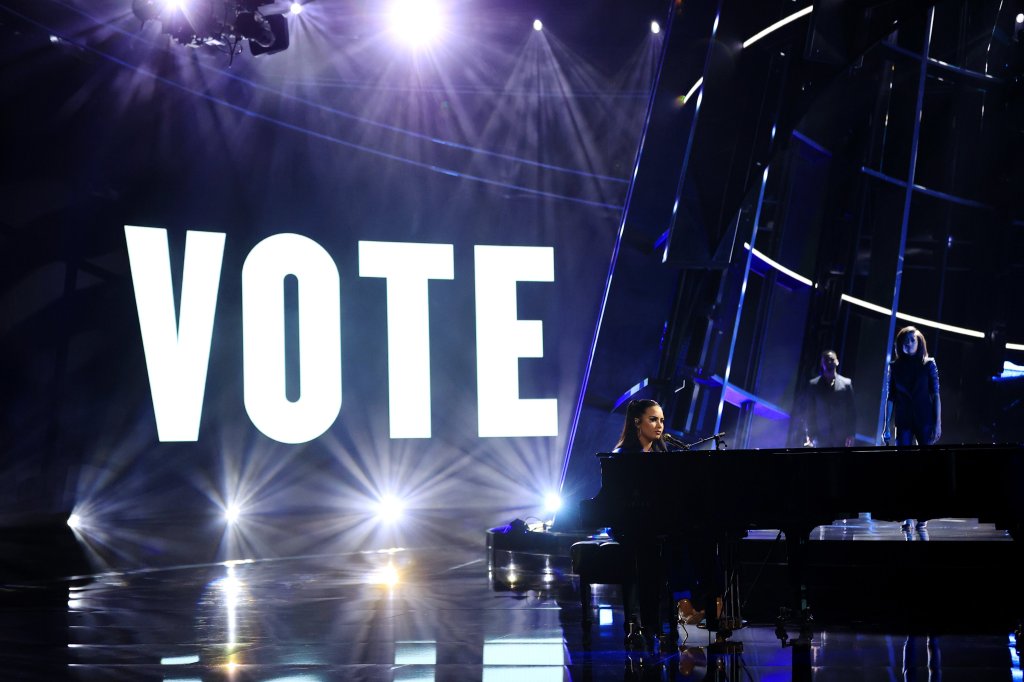
A reminder to us all, those of us who went to Sunday School or Temple or had parents who sat us down and reminded us to think how the other person feels, those of us who refused to accept the cynical message that winning is the only thing. You are not alone. We are not alone. America is better than this.
By facing the president head-on when other artists have been oblique, and confronting him on a human level, the US pop star’s song Commander in Chief has intense potency.
Dorian Lynskey of The Guardian
Responding to the scolding of a Republican fan on Instagram yesterday, Lovato wrote: “I literally don’t care if this ruins my career. This isn’t about that … I made a piece of art that stands for something I believe in.”
“I’m urging you to look out for one another, to support your loved ones, your neighbors, & those you may not have met yet in your community.”
—Demi Lovato on Instagram
•
I cannot discover who is signing on this video, but I break down every time she’s up. Anyone know who she is?
•
•
•
I cannot begin to do her justice. She was an uncaped crusader, an advocate for justice at every stage of her life—the finest role model I can think of. Ginsburg expressed a modest view of a Supreme Court justice’s role: “Judges are something like firefighters. They don’t make the fires, but they do their best to put them out.”

Supreme Court Justice Ruth Bader Ginsburg, a diminutive yet towering champion of human rights who became the court’s second female justice, died Friday at her home in Washington DC. She was 87.

“Joan Ruth Bader was born in Brooklyn, New York, in 1933, the second daughter in a middle-class family. Her older sister, who gave her the lifelong nickname ‘Kiki,’ died at age 6, so Ginsburg grew up in Brooklyn’s Flatbush section as an only child. Her dream, she has said, was to be an opera singer.
“Ginsburg graduated at the top of her Columbia University law school class in 1959 but could not find a law firm willing to hire her. She had ‘three strikes against her’—for being Jewish, female and a mother, as she put it in 2007.
“She had married her husband, Martin, in 1954, the year she graduated from Cornell University. She attended Harvard University’s law school but transferred to Columbia when her husband took a law job there. Martin Ginsburg went on to become a prominent tax attorney and law professor. Martin Ginsburg died in 2010. She is survived by two children, Jane and James, and several grandchildren.
“Ginsburg once said that she had not entered the law as an equal-rights champion. ‘I thought I could do a lawyer’s job better than any other,’ she wrote. ‘I have no talent in the arts, but I do write fairly well and analyze problems clearly.’ ”—Associated Press
The loss is enormous. Our loss. The nation’s loss. The loss to humanity.

from Heather Cox Richardson’s post “Letters from an American”:
Tonight, flowers are strewn on the steps of the Supreme Court, where “Equal Justice Under Law” is carved in stone. More than a thousand people gathered there tonight to mourn the passing of Justice Ruth Bader Ginsburg, who died today from cancer at age 87.
Justice Ginsburg was born in Brooklyn, New York, on March 15, 1933, in an era when laws, as well as the customs they protected, treated women differently than men. Ginsburg would grow up to challenge the laws that barred women from jobs and denied them rights, eventually setting the country on a path to extend equal justice under law to women and LGBTQ Americans.
Joan Ruth Bader, who went by her middle name, was the second daughter in a middle-class family. She went to public schools, where she excelled, and won a full scholarship to Cornell. There, she met Martin Ginsburg, and they married after she graduated. “What made Marty so overwhelmingly attractive to me was that he cared that I had a brain,” she later explained. Relocating to Ft. Sill, Oklahoma, for her husband’s army service, Ginsburg scored high on the civil service exam but could find work only as a typist. When she got pregnant with their daughter Jane, she lost her job.
Two years later, the couple moved back east where Marty had been admitted to Harvard Law School. Ginsburg was admitted the next year, one of 9 women in her class of more than 500 students; a dean asked her why she was “taking the place of a man.” She excelled, becoming the first woman on the prestigious Harvard Law Review. When her husband underwent surgery and radiation treatments for testicular cancer, she cared for him and their daughter, while managing her studies and helping Marty with his. She rarely slept.
After he graduated, Martin Ginsburg got a job in New York, and Ginsburg transferred to Columbia Law School, where she graduated at the top of her class. But in 1959, law firms weren’t hiring women, and judges didn’t want women—especially mothers, who might be distracted by their “familial obligations”– as clerks. Finally, her mentor, law professor Gerald Gunther, got her a clerkship by threatening Judge Edmund Palmieri that if he did not take her, Gunther would never send him a clerk again.
After her clerkship and two years in Sweden, where laws about gender equality were far more advanced than in America, Ginsburg became one of America’s first female law professors. She worked first at Rutgers University– where she hid her pregnancy with her second child, James, until her contract was renewed—and then at Columbia Law School, where she was the first woman the school tenured.
At Rutgers, she began her bid to level the legal playing field between men and women, extending equal protection under the law to include gender. Knowing she had to appeal to male judges, she often picked male plaintiffs to establish the principle of gender equality. In 1971, she wrote the brief for Sally Reed in the case of Reed vs. Reed, when the Supreme Court decided that an Idaho law specifying that “males must be preferred to females” in appointing administrators of estates was unconstitutional. Chief Justice Warren Burger, who had been appointed by Richard Nixon, wrote: “To give a mandatory preference to members of either sex over members of the other… is to make the very kind of arbitrary legislative choice forbidden by the Equal Protection Clause of the Fourteenth Amendment” to the Constitution.
In 1972, Ginsburg won the case of Moritz v. Commissioner. She argued that a law preventing a bachelor, Charles Moritz, from claiming a tax deduction for the care of his aged mother because the deduction could be claimed only by women, or by widowed or divorced men, was discriminatory. The United States Court of Appeals for the Tenth Circuit agreed, citing Reed v. Reedwhen it decided that discrimination on the basis of sex violated the Equal Protection Clause of the Fourteenth Amendment to the Constitution.
In that year, Ginsburg founded the Women’s Rights Project at the American Civil Liberties Union (ACLU). Between 1973 and 1976, she argued six gender discrimination cases before the Supreme Court. She won five. The first time she appeared before the court, she quoted nineteenth-century abolitionist and women’s rights activist Sarah Grimke: “I ask no favor for my sex. All I ask of our brethren is that they take their feet off our necks.”
Nominated to the bench by President Bill Clinton in 1993, she was confirmed by a vote of 96 to 3. Clinton called her “the Thurgood Marshall of gender-equality law.”
In her 27 years on the Supreme Court, Ginsburg championed equal rights both from the majority and in dissent (which she would mark by wearing a sequined collar), including her angry dissent in 2006 in Ledbetter v. Goodyear Tire & Rubber when the plaintiff, Lilly Ledbetter, was denied decades of missing wages because the statute of limitations had already passed when she discovered she had been paid far less than the men with whom she worked. “The court does not comprehend or is indifferent to the insidious way in which women can be victims of pay discrimination,” Ginsburg wrote. Congress went on to change the law, and the first bill President Barack Obama signed was the Lilly Ledbetter Fair Pay Act.
In 2013, Ginsburg famously dissented from the majority in Shelby County v. Holder, the case that gutted the 1965 Voting Rights Act. The majority decided to remove the provision of the law that required states with histories of voter suppression to get federal approval before changing election laws, arguing that such preclearance was no longer necessary. Ginsburg wrote: “[t]hrowing out preclearance when it has worked and is continuing to work to stop discriminatory changes is like throwing away your umbrella in a rainstorm because you are not getting wet.” As she predicted, after the decision, many states immediately began to restrict voting.
Her dissent made her a cultural icon. Admirers called her “The Notorious R.B.G.” after the rapper The Notorious B.I.G., wore clothing with her image on it, dressed as her for Halloween, and bought RBG dolls and coloring books. In 2018, the hit documentary “RBG” told the story of her life, and as she aged, she became a fitness influencer for her relentless strength-training regimen. She was also known for her plain speaking. When asked how many women on the Supreme Court would be enough, for example, she answered “nine.”
Ginsburg’s death has brought widespread mourning among those who saw her as a champion for equal rights for women, LGBTQ Americans, minorities, and those who believe the role of the government is to make sure that all Americans enjoy equal justice under law. Upon her passing, former Secretary of State Hillary Clinton tweeted: “Justice Ginsburg paved the way for so many women, including me. There will never be another like her. Thank you RBG.”
For many, she seemed to be the last defender of an equality they fear is slipping away. Robyn Walsh, a University of Miami religion professor, watched the outpouring of grief after Ginsburg’s death and wrote “It says a lot about us that the loss of one voice leaves women and their allies feeling so helpless. I am grateful for RBG, her advocacy, and her strength. I’m enraged that we find ourselves here.”
That rage, prompted by the prospect of a Trump appointee in Ginsburg’s seat, led donors to pour money into Democratic coffers tonight. Democratic donors gave more than $12.5 million in two hours to the ActBlue donation processing site, a rate of more than $100,000 a minute. The effect of the loss of her voice and vote on the court will become clear quickly. On November 10, just a week after the upcoming presidential election, the court is scheduled to hear a Republican challenge to the Affordable Care Act, also known as Obamacare. In 2012, the court upheld the law by a 5-4 vote.
Ginsburg often quoted Justice Louis Brandeis’s famous line: “The greatest menace to freedom is an inert people,” and she advised people “to fight for the things you care about, but do it in a way that will lead others to join you.” Setting an example for how to advance the principle of equality, she told the directors of the documentary “RBG” that she wanted to be remembered “Just as someone who did whatever she could, with whatever limited talent she had, to move society along in the direction I would like it to be for my children and grandchildren.”
Upon hearing of Ginsburg’s death, former U.S. Attorney and law professor Joyce Vance tweeted, “We should honor the life of RBG, American hero, by refusing to give in, refusing to back down, fighting for the civil rights of all people & demanding our leaders honor the rule of law. This is our fight now.”
Rest in power, Justice Ginsburg.
Tonight, flowers are strewn on the steps of the Supreme Court, where “Equal Justice Under Law” is carved in stone. More than a thousand people gathered there tonight to mourn the passing of Justice Ruth Bader Ginsburg, who died today from cancer at age 87.
Justice Ginsburg was born in Brooklyn, New York, on March 15, 1933, in an era when laws, as well as the customs they protected, treated women differently than men. Ginsburg would grow up to challenge the laws that barred women from jobs and denied them rights, eventually setting the country on a path to extend equal justice under law to women and LGBTQ Americans.
Joan Ruth Bader, who went by her middle name, was the second daughter in a middle-class family. She went to public schools, where she excelled, and won a full scholarship to Cornell. There, she met Martin Ginsburg, and they married after she graduated. “What made Marty so overwhelmingly attractive to me was that he cared that I had a brain,” she later explained. Relocating to Ft. Sill, Oklahoma, for her husband’s army service, Ginsburg scored high on the civil service exam but could find work only as a typist. When she got pregnant with their daughter Jane, she lost her job.
Two years later, the couple moved back east where Marty had been admitted to Harvard Law School. Ginsburg was admitted the next year, one of 9 women in her class of more than 500 students; a dean asked her why she was “taking the place of a man.” She excelled, becoming the first woman on the prestigious Harvard Law Review. When her husband underwent surgery and radiation treatments for testicular cancer, she cared for him and their daughter, while managing her studies and helping Marty with his. She rarely slept.
After he graduated, Martin Ginsburg got a job in New York, and Ginsburg transferred to Columbia Law School, where she graduated at the top of her class. But in 1959, law firms weren’t hiring women, and judges didn’t want women—especially mothers, who might be distracted by their “familial obligations”– as clerks. Finally, her mentor, law professor Gerald Gunther, got her a clerkship by threatening Judge Edmund Palmieri that if he did not take her, Gunther would never send him a clerk again.
After her clerkship and two years in Sweden, where laws about gender equality were far more advanced than in America, Ginsburg became one of America’s first female law professors. She worked first at Rutgers University– where she hid her pregnancy with her second child, James, until her contract was renewed—and then at Columbia Law School, where she was the first woman the school tenured.
At Rutgers, she began her bid to level the legal playing field between men and women, extending equal protection under the law to include gender. Knowing she had to appeal to male judges, she often picked male plaintiffs to establish the principle of gender equality. In 1971, she wrote the brief for Sally Reed in the case of Reed vs. Reed, when the Supreme Court decided that an Idaho law specifying that “males must be preferred to females” in appointing administrators of estates was unconstitutional. Chief Justice Warren Burger, who had been appointed by Richard Nixon, wrote: “To give a mandatory preference to members of either sex over members of the other… is to make the very kind of arbitrary legislative choice forbidden by the Equal Protection Clause of the Fourteenth Amendment” to the Constitution.
In 1972, Ginsburg won the case of Moritz v. Commissioner. She argued that a law preventing a bachelor, Charles Moritz, from claiming a tax deduction for the care of his aged mother because the deduction could be claimed only by women, or by widowed or divorced men, was discriminatory. The United States Court of Appeals for the Tenth Circuit agreed, citing Reed v. Reedwhen it decided that discrimination on the basis of sex violated the Equal Protection Clause of the Fourteenth Amendment to the Constitution.
In that year, Ginsburg founded the Women’s Rights Project at the American Civil Liberties Union (ACLU). Between 1973 and 1976, she argued six gender discrimination cases before the Supreme Court. She won five. The first time she appeared before the court, she quoted nineteenth-century abolitionist and women’s rights activist Sarah Grimke: “I ask no favor for my sex. All I ask of our brethren is that they take their feet off our necks.”
Nominated to the bench by President Bill Clinton in 1993, she was confirmed by a vote of 96 to 3. Clinton called her “the Thurgood Marshall of gender-equality law.”
In her 27 years on the Supreme Court, Ginsburg championed equal rights both from the majority and in dissent (which she would mark by wearing a sequined collar), including her angry dissent in 2006 in Ledbetter v. Goodyear Tire & Rubber when the plaintiff, Lilly Ledbetter, was denied decades of missing wages because the statute of limitations had already passed when she discovered she had been paid far less than the men with whom she worked. “The court does not comprehend or is indifferent to the insidious way in which women can be victims of pay discrimination,” Ginsburg wrote. Congress went on to change the law, and the first bill President Barack Obama signed was the Lilly Ledbetter Fair Pay Act.
In 2013, Ginsburg famously dissented from the majority in Shelby County v. Holder, the case that gutted the 1965 Voting Rights Act. The majority decided to remove the provision of the law that required states with histories of voter suppression to get federal approval before changing election laws, arguing that such preclearance was no longer necessary. Ginsburg wrote: “[t]hrowing out preclearance when it has worked and is continuing to work to stop discriminatory changes is like throwing away your umbrella in a rainstorm because you are not getting wet.” As she predicted, after the decision, many states immediately began to restrict voting.
Her dissent made her a cultural icon. Admirers called her “The Notorious R.B.G.” after the rapper The Notorious B.I.G., wore clothing with her image on it, dressed as her for Halloween, and bought RBG dolls and coloring books. In 2018, the hit documentary “RBG” told the story of her life, and as she aged, she became a fitness influencer for her relentless strength-training regimen. She was also known for her plain speaking. When asked how many women on the Supreme Court would be enough, for example, she answered “nine.”
Ginsburg’s death has brought widespread mourning among those who saw her as a champion for equal rights for women, LGBTQ Americans, minorities, and those who believe the role of the government is to make sure that all Americans enjoy equal justice under law. Upon her passing, former Secretary of State Hillary Clinton tweeted: “Justice Ginsburg paved the way for so many women, including me. There will never be another like her. Thank you RBG.”
For many, she seemed to be the last defender of an equality they fear is slipping away. Robyn Walsh, a University of Miami religion professor, watched the outpouring of grief after Ginsburg’s death and wrote “It says a lot about us that the loss of one voice leaves women and their allies feeling so helpless. I am grateful for RBG, her advocacy, and her strength. I’m enraged that we find ourselves here.”
That rage, prompted by the prospect of a Trump appointee in Ginsburg’s seat, led donors to pour money into Democratic coffers tonight. Democratic donors gave more than $12.5 million in two hours to the ActBlue donation processing site, a rate of more than $100,000 a minute. The effect of the loss of her voice and vote on the court will become clear quickly. On November 10, just a week after the upcoming presidential election, the court is scheduled to hear a Republican challenge to the Affordable Care Act, also known as Obamacare. In 2012, the court upheld the law by a 5-4 vote.
Ginsburg often quoted Justice Louis Brandeis’s famous line: “The greatest menace to freedom is an inert people,” and she advised people “to fight for the things you care about, but do it in a way that will lead others to join you.” Setting an example for how to advance the principle of equality, she told the directors of the documentary “RBG” that she wanted to be remembered “Just as someone who did whatever she could, with whatever limited talent she had, to move society along in the direction I would like it to be for my children and grandchildren.”
Upon hearing of Ginsburg’s death, former U.S. Attorney and law professor Joyce Vance tweeted, “We should honor the life of RBG, American hero, by refusing to give in, refusing to back down, fighting for the civil rights of all people & demanding our leaders honor the rule of law. This is our fight now.”
Rest in power, Justice Ginsburg.
May her memory be a blessing.
•
Generalizations about ‘the way women are,’ estimates of what is appropriate for most women, no longer justify denying opportunity to women whose talent and capacity place them outside the average description.
Justice Ginsberg, 1996, in arguing that Virginia Military Academy (a public educational institution) should open admission to women
•
•
•

This year I developed a new habit with books. As I finish a book, I make the decision: Will I ever want to read or refer to this book again? Will I want to lend it to a friend or give it to someone as just right for them? A couple of years ago, I went through my books and sorted out the ones I knew I’d read but didn’t like well enough to miss. Even so, I have thousands of books. Whatever anyone tells you, you CAN have too many books. When there is no longer room to place one more bookcase against a wall, start making the hard choices.
attempted comment on “Aspirational Clutter”
My comment (above) is awaiting moderation on a website I frequent. It’s been there for an hour. I cannot see how to either delete it or fix it. I do not know what I should fix. That’s never happened to me before. I was invited to describe personal decluttering challenges, and that’s what I did. I understand there is some sort of logarithm that determined my post might have violated the site’s “community standards”, I just can’t figure out what I did wrong. Can you? No vulgar words here. No personal attacks. It does not contradict another person’s comment—quite the opposite. Is the use of all caps in “CAN” the problem? But someone else did that too.
The editors are not censoring me. They only want me to be polite. At least I hope that’s the goal. They also want to protect their brand.
Of course I monitor all the comments on my own blog. I try to address them immediately, though I can do this only from my laptop. The only ones I do not let through would be spam, and the WordPress filter pretty much always catches that before I do.
That got me thinking: Surely the filters for FaceBook and Instagram could do better than this. They must. Assuming the effort is made to keep lies and cruelty off the sites?
On the other hand, the reason I left FaceBook was that I was tired of putting out fires. Metaphorical fires, but the similarity to the literal fires we are suffering from here in Oregon might stand. Ugly lies are spread because people believe them and fail to factcheck. Factchecking was about 20% of what I did when I was grading persuasive essays written by teenagers as a teacher. I got to be pretty good at it. And as a teaching professional, I took it upon myself even before FaceBook to confirm or debunk claims.
In the 90s, a medical resident who was also poetry editor for a prestigious literary journal foolishly (imo) revealed on a literary chat-site how he sorted the poetry submissions as they came to him. The first cut was whether they got his name right on the outside envelope. Then he tossed the ones that were not typed, had typos, etc. People were outraged, they threatened his safety, questioned his humanity. To be fair to the editor, the man received thousands of submissions in a week. Working through his inbox would be a nightmare for anyone, and he was almost a doctor. He was an unpaid volunteer doing the best he could. Plus publication in the highly-respected journal he worked for would be a professional coup for any poet. If the submitter didn’t care enough to spell the editor’s name correctly or know enough to type their work, they probably are too new to have earned publication. Let those who have devoted years to their craft advance to the front of the line. Younger, newer poets found his strategy for shortening his to-read pile arbitrary and cruel. I tried hard to balance acknowledgement of understandable outrage with the overwhelming and unpaid task the editor faced.
There have been other verbal firestorms I have attempted to douse and nearly always without effect. It was hard for me to accept that. I wanted to help, my intention was always to be helpful, but there is a kind of arrogance in that thinking—assuming I know best, and all that. Most people do not appreciate being corrected even if they are actually wrong and will resist changing their minds on principle. While trying to put out fires I sometimes fanned the flames.
Literal fire, on the other hand, is dangerous in other ways. The West is on fire and the very air we breathe is unsafe. However much we might want to place specific blame—the campfire that got out of hand, the homeowner allowing brush to build up to close to their home, the lack of funding to research wildfires and develop a proactive approach to fire—the truth is complicated and deadly.
The West is on fire, and I came to understand why east coast newspapers were giving so much space to the smoke when I realized it had drifted over Iceland and was approaching the European mainland. What happens here affects people many thousands of miles away.
Gary has a brother in Tennessee and a niece in Kentucky, but the rest of our close family lives in the PNW. Some of our friends and relatives are Trump supporters, some are solidly democratic. We have a friend who recently transferred his loyalty from Trump to Jesse Ventura. There is just no telling people what or who to believe.
In The Fire Next Time, James Baldwin explored the roots and responses to systemic racism. That is another fire we seem finally to have decided to fight—the burning devastation of bigotry. I highly recommend Baldwin’s book. Baldwin is brilliant, compassionate, and true. And yet, the feds have recently outlawed training that confronts “white privilege”. That term comes from an essay by feminist Peggy McIntosh, who made it simple in “White Privilege: Unpacking the Invisible Knapsack.” There are many versions of this 1989 essay available, and I can recommend it. I can also recommend a powerful response from another woman: “Explaining White Privilege to a Broke White Person” published in 2014. Between the two, they might just start a fire for anyone willing to read and think about them.
Some foresters have been trying for decades to explain why not all fires are bad, that some are necessary to make us safer in the future.
What we do here and now affects not just those around us but our entire world. What we are willing to research and factcheck makes a difference. Many fires are burning. The solutions are not simple, but they rely on all of us if we hope to thrive.
I have too many books, more than I can find space for on shelves. That doesn’t mean I will stop reading.
•
•
•
Below is yesterday’s entire post from Heather Cox Richardson that arrived in my inbox after midnight. I know people do not read my blog for political wisdom, but I need to clear the air. My grandchildren can’t breathe. Richardson has more than enough wisdom to share. I wish more people were reading her. It can be empowering to remind ourselves that the majority of Americans care about democracy and our nation, are concerned about truth and justice—what in my childhood was termed “the American way of life.” This is a reminder to vote.
Exactly a year ago, after about a six-week hiatus during the summer, I wrote a Facebook post that started:
“Many thanks to all of you who have reached out to see if I’m okay. I am, indeed (aside from having been on the losing end of an encounter with a yellow jacket this afternoon!). I’ve been moving, setting up house, and finishing the new book. Am back and ready to write, but now everything seems like such a dumpster fire it’s very hard to know where to start. So how about a general overview of how things at the White House look to me, today….”
In my roundup, I noted that we had just learned that a whistleblower from within the intelligence community had filed a complaint that the inspector general of the intelligence community, Michael K. Atkinson, deemed “credible” and “urgent.” This meant that it was supposed to go to the Director of National Intelligence to be cleared of anything that needed to be hidden, and then sent on to the House Intelligence Committee. But, rather than sending it to the House as the law required, Trump’s then-acting Director of Intelligence, Joseph Maguire, had withheld it. On Friday, September 13, the chair of the House Intelligence Committee, California Democrat Adam Schiff, had written a scathing letter to Maguire, telling Maguire he knew about the complaint—we now know that Atkinson had alerted him– and that Maguire had better hand it over. Schiff speculated that Maguire was covering up evidence of crimes by the president or his closest advisors.
Readers swamped me with questions. So I wrote another post answering them and explaining the news, which began breaking at a breathtaking pace. Within a week, we had learned that the day after Special Counsel Robert Mueller had testified before Congress and seemed to shut down any further investigation of the 2016 Trump campaign’s ties to Russia, Trump had tried to pressure Ukraine President Volodymyr Zelensky into announcing an investigation into former Vice President Joe Biden’s son Hunter. On July 25, Trump suggested to the new Ukraine president that he would release funds Zelensky badly needed to continue Ukraine’s fight against Russian incursions only after such an announcement. And people asked more questions, and I wrote another post…
And so these Letters from an American were born.
In the 365 days since then, we have lived through the Ukraine scandal, which revealed that the president was secretly running his own foreign policy team whose goal was to strong-arm Ukraine into helping the president’s reelection campaign. Their attempt to get Zelensky not to run an investigation but rather simply to announce one reflected backward onto the 2016 campaign. The 2016 Trump campaign hammered on the Clinton email “scandal,” and badly damaged her candidacy. But, in mid-October, the final report from the State Department concluded that there was no systematic mishandling of information, that people tried to follow the rules, and that none of the information that did get mishandled was classified at the time (some of it was retroactively classified by the Trump administration).
We lived through the abrupt withdrawal of U.S. troops from northern Syria in early October 2019, leaving our former Kurdish allies to be murdered by Turkish troops, just as experts had warned would happen if U.S. troops pulled back. ISIS freed compatriots from jails and launched new attacks, and Russian troops moved into the positions we had held in the region.
We have lived through the House impeachment hearings in October and November, when it became clear that the Republicans were not, in fact, interested in whether or not Trump had committed “high crimes and misdemeanors,” but rather in badgering witnesses to provide sound bites that could be stitched together into a fictional narrative on social media and the Fox News Channel. Then, on December 18, for the third time in history, the House voted to impeach a president. Driven by the Democratic majority, it impeached Trump for abuse of power and obstruction of Congress.
We lived through the Senate impeachment trial early in 2020, where Republican Senators refused to hear witnesses or subpoena documents. On February 5, the Senate acquitted the president of the charges. All but one Republican senator voted to acquit. Utah’s Mitt Romney voted to convict on abuse of power.
We lived through the purge of career government officials and their replacement with Trump loyalists that began two days after Trump’s acquittal. On February 7, Trump dismissed Lt. Col. Alexander Vindman from his position on the National Security Council, where he was an expert on Russia and Ukraine. Vindman had been on the July 25 call and testified before the House Intelligence Committee under subpoena, that White House officials had put the transcript of the call onto a high security server, where national security secrets are held. Vindman also explained that the readout Trump provided the public did not contain key parts of the conversation: Trump had explicitly mentioned both Burisma—the company on whose board Hunter Biden sat– and the Bidens themselves. Trump also ordered the ouster of Vindman’s twin brother, Lt. Col. Yevgeny (Eugene) Vindman, an Army officer on the NSC staff. Since then, Trump has continued to replace career officials with his own loyalists throughout the government everywhere from the Department of Homeland Security and the United States Postal Service through the CDC and the Voice of America.
On the same day he was retaliating against the Vindmans, Trump picked up the phone and called veteran journalist Bob Woodward to tell him there was a deadly new virus spreading around the world. It was airborne, he explained, and was five times “more deadly than even your strenuous flus.” “This is deadly stuff,” he said. He would not share that information with other Americans, though, continuing to play down the virus in hopes of protecting the economy.
This, almost 200,000 of us have not lived through.
And now, as the coronavirus continues to ravage our country, our people, and our economy, the president is trying to win reelection by dividing us, convincing enough voters that “radical leftists” are destroying “Democrat cities” that he can emerge as a “law and order” president. He is suggesting that any result other than his own reelection will be illegitimate, and that he should get a third term because of how badly he has been treated in the first.
It has been quite a year. Those of us who are exhausted have earned it.
But from the chaos and crisis of this past year has emerged a renewed dedication to democracy. You see it in Lt. Col. Vindman telling his father that he would be all right if he testified before Congress against the president, because “this is America… and here, right matters.” You see it in the incredible work of the House impeachment managers and their constant invoking of our Constitution, our laws, and our principles. You see it in how Americans have come together to take care of each other when the federal government went AWOL during the pandemic, and in people of all ages and background mobilizing for Black lives.
You see it in people donating money to candidates and causes, organizing voter drives, and making sure their children and their parents and their cousins and their friends are registered to vote and have a plan to do so. You see it in people working for a cause that is important to them, calling their elected officials at all levels, writing letters to the editor, and pushing back on the false narratives that spread through social media and from there to our communities.
For me, though, I see it most of all right here. I see it in how many of you bother to read these long and complicated letters and who write to ask questions, send me news articles or personal stories, make corrections, and say how afraid you are that we might lose American democracy. I see it in your insistence on facts and accuracy, your constant questioning, your dismissal of trolls and bots, and your kindness to the community you have built. Most of all, though, I see it in your overwhelming support.
I am not exaggerating when I say I have come to see myself simply as a translator. I could not do this without you.
Thank you all for being along on this journey.
Allegretto Lentissimo

Rain on our rooftop, dribbling, draining down
the side of the house and across the concrete
walkway my grandfather poured, all of this new
moisture pouring back toward the sea. The air
moves counter-tempo, slow rolls from ocean
onto land, a white mist upon thirsty soil, smoke
overlaid, rain gathering, silencing fetid reek
with wet. I am so very grateful for the patter
on skylights, the cooling air, the way my husband
wraps his arms around me as we look to changing
weather. Chosen, explored and confronted, it might
promise something beyond metronome ticking,
the warning of this new pattern, this heat. Dim
puddles from our past and of our future. Time
passes through like wind over water.

•
•
•
 &PRIDE Press