the NIX

Gutt_på_hvit_hest.jpg

Gutt på hvit hest (Boy on White Horse) Theodor Kittelsen
[the horse depicts the Nix]

You might remember watching the film Harvey, “a 1950 American comedy-drama film based on Mary Chase’s play of the same name, directed by Henry Koster, and starring James Stewart and Josephine Hull. The story is about a man whose best friend is a pooka named Harvey—in the form of a six-foot-3.5 in. invisible rabbit.” Harvey is a Pooka or púca. Something very old, a magical creature of Irish, and indeed of all Celtic traditions, though under other names.

“Years ago my mother used to say to me, she’d say, ‘In this world, Elwood, you must be’—she always called me Elwood—’In this world, Elwood, you must be oh so smart or oh so pleasant.’ Well, for years I was smart. I recommend pleasant. You may quote me.”

“Did I tell you [Harvey] could stop clocks? Well, you’ve heard the expression ‘His face would stop a clock’? Well, Harvey can look at your clock and stop it. And you can go anywhere you like, with anyone you like, and stay as long as you like. And when you get back, not one minute will have ticked by. You see, science has overcome time and space. Well, Harvey has overcome not only time and space, but any objections.”

The Nix (or singular masculine: Neck; feminine: Nixie) are water spirits living in calm waters, which like pooka may appear as human or as animals (especially horses) and are known for their beautiful songs that lure people to water. Stories of such beings interacting with humans are found throughout northern Europe, from Holland to Sweden. The Rhinemaidens of Richard Wagner’s opera, Der Ring des Nibelungen, are Nixie. The nykur of Iceland and Scottish Kelpie are also horse/human shapeshifters.

Though stories about them do not consistently see them acting malevolently, they can be problematic tricksters. Sometimes they are helpful or very dangerous. Iron is sometimes seen as a way of neutralizing the powers of such creatures.

The Orkney, Irish, or Scottish Selkie is related but a human/seal shapeshifter, and the the song, “The Great Selkie of Sule Skerry” is a reversal of a more common story of magical brides stolen from the sea.

I am a man upo’ da land;
I am a selkie i’ da sea.
An’ whin I’m far fa every strand,
My dwelling is in Shöol Skerry.

That used to be one of my favorite songs out of Joan Baez’s songbook. I played the guitar and sang it when I was young.

This post began because Neil Gaimon has a new book out of Norwegian folktales and the cover features a painting by Theodor Kittelsen. I have a book someplace that contains Kittelson’s illustrations because I was fascinated by trolls when I was ten or eleven years old. My father took me to the University of Washington’s largest library and there we found three books with information on trolls, in Norwegian. Gaiman claims that when he begins rereading the stories in his collection he completely forgets why and is immersed in the tales.

“I keep trying to write a measured and sensible introduction to this book, and I keep failing. I keep failing because in order to find out what I think I pick up the proofs and start to read—or rather, at this point, to reread and to rerereread—any one of the Norwegian folktales waiting between these covers, and then I’m swallowed by them. I don’t read them critically. I don’t even put my compare-this-story-from-this-tradition-to-this-other-story-that-it-somehow-resembles hat on. I just start to read, and I’m following the adventures of Ash Lad, or the Girl Whose Godmother Was the Virgin Mary, and I feel satisfied.”—“Neil Gaiman on the Good Kind of Trolls”

Ursula K. Le Guin found Gaiman’s first book of retold Norse mythology a bit bloodless but I do not have those or these more recent retellings before me, and I am lost instead in the work of the illustrator, in the connections between these stories from many seas and waterways, and in my own history and passion for them.

Lost and found in story.

FINDING HOME

fullsizeoutput_1070

Pieced squares from a dark corner—they have not yet been joined and this is merely twelve of eighteen pieced, of the eventual forty-nine in the center panel. I kept finding more golds and oranges for the stripes, so there will be another quilt, “Blue Streak,” once this one is done, I think.

Though the sky is clear blue and I sweat as I sew (which involves pressing with a steamy-hot iron after each stitched seam), I know the weather is changing. We can feel the cooling and are grateful for it. Our contractor assures me the duplex roof will be on “asap.” Our tenant does did not have water dripping from the ceiling during the recent rainstorm. And yesterday I found glass. All good.

Kids are back in school, we have less than a week left of summer, and last night I had a teaching dream. Most of my dreams about teaching from while I was actually teaching, at least the ones I remember, were about teaching a subject I knew nothing about. The Boer War or Physics. I would be standing before a class of teenagers, who listened intently to every word and took neat notes in a way teenagers never do in real life. I was aware, in a kind of horror, that they would remember what I was telling them, that they would recall all the details I was concocting about a historical event I could not claim to know. I was making stuff up and they trusted it. Is that every teacher’s nightmare? It was always mine, that I would mislead my students.

Last night’s dream was quite different. The dreamt students attended an elite private school, both boys and girls. (I taught for from 1976-1979 at Forest Ridge, a girls’ prep school in Bellevue, Washington.) Some listened and some were inattentive and a couple were rude, and I was teaching them something I am familiar with: “Thirteen Ways of Looking at a Blackbird,” which I taught most every year. I used to be able to recite Stevens’s poem, and in my dream I certainly got through introducing it as haiku and reciting several stanzas as well as the parody I wrote, “Thirteen Ways of Looking at Computers.” It was not a nightmare, nor yet completely peaceful. There was some rushing about toward the end, some issue with wearing only a tunic and underpants and searching for my pants? (Why dreams about nakedness?)

fullsizeoutput_1072

From the bottom, a chipped but well-buffed piece of blue-green glass and a beautifully rounded piece of faintly green glass, a rough agate, an “ugly clam,” and several “butterflies,” which are really the back plates of chitons. Two of those are fan-shaped “tail” pieces.

I slept long this morning, till after six. We were late out onto the beach for our walk, the surf is a tame animal today, and I do not need ice in my morning iced coffee. The coffee has chilled since yesterday and the heat has relented. I plan to complete three more pieced squares of the purple-and-orange quilt this morning, finishing the third row of seven. This afternoon, I mean to piece the entire fourth row of this center panel. That row will more clearly reveal the shift in background hue and shade. I might put this one on a bed.


IMG_4923Mom’s house, my parents’ house, the house I lived in from first grade until college, is owned by two delightful people who have remodeled and gardened. Marti showed me where she had transplanted the rhododendron and vine maple (acer), the way they used what we had called “the hut” as a workshop, the expanded master bedroom (just as I would have done) and second bath, the preserved paneling in the family room. They have lived in the house since buying it from Mom.

It was Gary’s idea to drive by last Saturday. When we slowed down, there she was working on the garden and Gary pulled the car over. Hello, I said as I approached her, forgive me but I used to live here. She smiled and said, Are you Mrs. Priddy’s daughter? and it was lovely. She and her husband Jay have lived here far longer than my family did. They have made it home.

Our home remains the Oregon coast. We have lived here now for over forty years. Gary was saying he had never lived anyplace for more than five or six years before we moved here. Often he lived in a place for a couple of years before moving on. There were the houses around Seattle, the three houses in seven Arizona years, more back in Shoreline and Seattle, the last two with me. I have only lived in six houses, counting the month with my grandparents in Portland before moving to Seattle in time for me to begin kindergarten. Most of my life has been in Oregon, more than forty-five years now. It is home.

I can see the ocean from here, and I should be knitting. I have thought of other ways to tell my butterfly SF story: as history or from the perspective of another character. I should be writing them. But there should be no shoulds. If it matters I will write it. If not, I won’t but do something else instead.

IMG_4919But I really must begin knitting my grandson’s sweater. I knit half the back before ripping it out last week. It was going to be large enough for him to grow into . . . in about five years! He chose the colors and was excited when I showed him the gauge sample. I need to start knitting again. Do I try using a top-down pattern, or merely revise my own so that it will fit him? Once I find an answer, I can begin again.

 

OH DEAR

IMG_4920

Another one.

Wasn’t I going to make something completely different? A story?

“Autumn Garden.” All batiks, about a hundred different fabrics so far here. All those skinny strips will be pieced into the squares.

STEP 8: Done, sort of

fullsizeoutput_1035

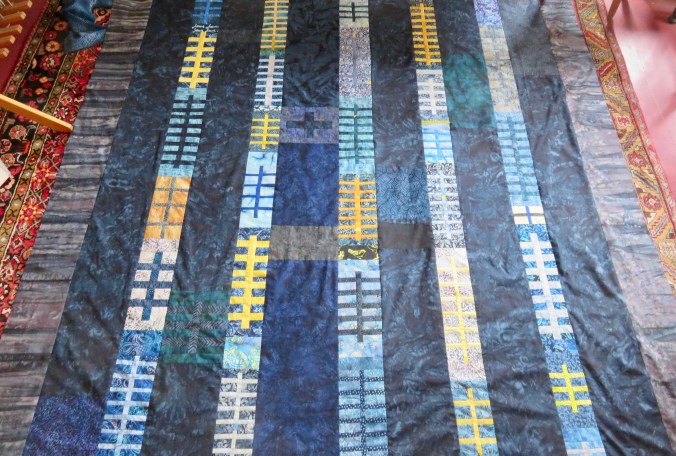
BlueToo, the second blue-and-yellow quilt top. In life, it is an 84″ square, not a trapezoid.

I completed two quilt tops this month, and pieced the back of one of them too. To be perfectly honest, I have completed two quilts at once before. But this was especially fun. I could, in the simplest form, sew two lengths of cloth together to make a front and do the same for the back, adding an additional strip because the backing must be larger than the front to accommodate the machine quilter. In real life, it’s not so simple.

The theoretical simplest quilt would require at least ten or eleven yards of 44″ fabric. And in the old days when quilts were created to use up scraps of fabric (a practice not actually as common as the mythology suggests), a quilter would gather bits of fabrics for years from making shirts and dresses, wool pants and skirts. In practice, many quilts were made with specially purchased fabric or fabric dyed for use in piecing a quilt. All quilts result in ever smaller scraps. I have a small mound of blue-and-yellow scraps and thread trimmings from my work this month.

I make quilts from ordinary fabric and still hand-quilt such quilts on occasion because I really do like the look and the control. Most of my quilts these days are made of Asian batik fabric which is hand-dyed and boiled making a tight, smooth cloth that is not easily pinned, much less hand quilted. I took a hand-quilted batik quilt in to show a friend who owns a quilt shop. (“You hand-quilted this?” she said. “Didn’t your fingers bleed?” Well, yes, as a matter of fact they did. I could only work for a short time each day until my fingers were too bloody to go one without staining the fabric.) She’s the one who urged me to find a machine quilter. “No one hand-quilts batik.”

I made a small quilt for my mother from Liberty cotton lawn. I made quilts for each on my sons when they turned two and when they went off to college and when they married. My grandchildren have each received three so far.

Each of these quilts incorporate dozens of fabrics, a few thousand yards of thread, and often have pieced backings. The two shown here, except for the backing on one and a third of the backing for the other, were made entirely from fabrics I have collected in what textile people would call my “stash.” I have, let us say, several large plastic bins (and several smaller ones) filled with fabrics to use in quilting. These cottons are mostly purchased in quarter-yard pieces (about 9″ x 44″) and some of them are over forty years old. The newest are a few months old.

I made my first pieced quilt when I was pregnant with Alan, my first-born son. That was thirty-nine years ago. I took the bus to Spokane to visit a friend and she took me to a quilt shop where I bought small pieces of red on white and white on red prints of conventional cotton. The quilt I made was a double nine-patch. I backed it with one of my grandmother’s pilfered hospital sheets. Over the years since, I made an Ocean Waves and a Snail quilt. I have made variations on log cabin several times. Mostly, though, I make them up. I think through not only the appearance, but the construction of the piece—what must be done first and how.

All this planning is not the result of an orderly and methodical personality. I am what is called an Abstract/Random. I am inclined to mess and disorder and risk.

I had to learn how to be linear and meticulous instead of lazy and meandering because the things I wanted to make demanded those processes that from me. I draw thumbnails. I make lists. I stare and stare and lie awake at night figuring things out.

There is a skinny line in the quilt above, the dark blue between the grayish outside border the bluer inside panel. That narrow piece is called a “frame.” I am fond of frames in my quilts, but this one was not supposed to have one. When I realized it needed that narrow dark blue frame, I felt a kind of despair, just for an instant. I was not sure the backing I had would be large enough to add two more inches both ways.  Otherwise I would have to dig through my stash to find enough fabric to enlarge the already-huge backing for my already outsize pieced top. I laid the backing out on the bare floor and measured. Fortunately it was plenty big, though out of square and longer on one side than the other from the way it was cut from the bolt (not my fault, that).

Most of my quilts run around 80″ square or a bit larger. I meant to make a pink quilt for a twin bed once and it turned into a 90″ square. Things just got out of hand. Making a special size is another whole struggle for me. I made one for a king-size bed that was a nightmare. The size (106″ square) was more than I could manage and I swore I would never do it again. I would do it differently now but smaller pieces would be nice for a change. Doll quilts are fun. A hanging would be fine but I do not have space to hang anything. But smaller, perhaps. I could try out ideas without committing eleven yards. Or I might be ready for the plastic bin with silks.

I have been collecting silks the way dress-makers did in the nineteenth century: an entire bolt of 14″ wide kimono silk, scraps salvaged from saris and other projects. I have a couple of yards of orange silk velvet, pink charmeuse, crepe with red apples on green. Bits and pieces. They would all be interesting to piece and quilt. Slippery and shedding but precious and variable in texture. It is the shifts in texture that attract me. I once pieced fabric for a jacket—all sorts of textures including corduroy—in long narrow strips. I wish I’d kept a piece of that. The textures are what I want, in addition to the play of color and value. Something quite different. Soon.

I cast on a knitting project last night and completed a couple of rows in a fancy pattern—unlike me in knitting. I like to think I can start something new because the quilts are done.

But first, these pieces go for machine quilting and when they return in a couple of months, I will still need to bind them. So . . . not really done. Close.

fullsizeoutput_1037

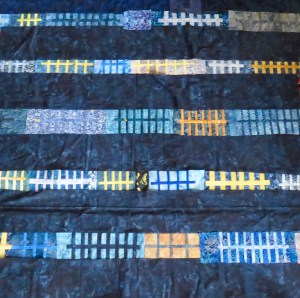
This is Blue Ladders, the quilt I originally set out to make this summer. I will negotiate with Linda Pinkstaff from Astoria Quilting about thread color tomorrow. Her advice is always good. I feel the need for a fancy quilting pattern here. We’ll see what Linda says.


HERE WE ARE

IMG_4717

Rabbits ate my new roses. Bother [both] of them. Every leaf. But the stubborn plants refused to die. They pushed out new leaves. One of them blooms. Last year a visitor asked my husband why he’d hauled a twisty drift-root up from the beach. “What are you going to do with it?”

This.

STEP 6: Accident

fullsizeoutput_1019

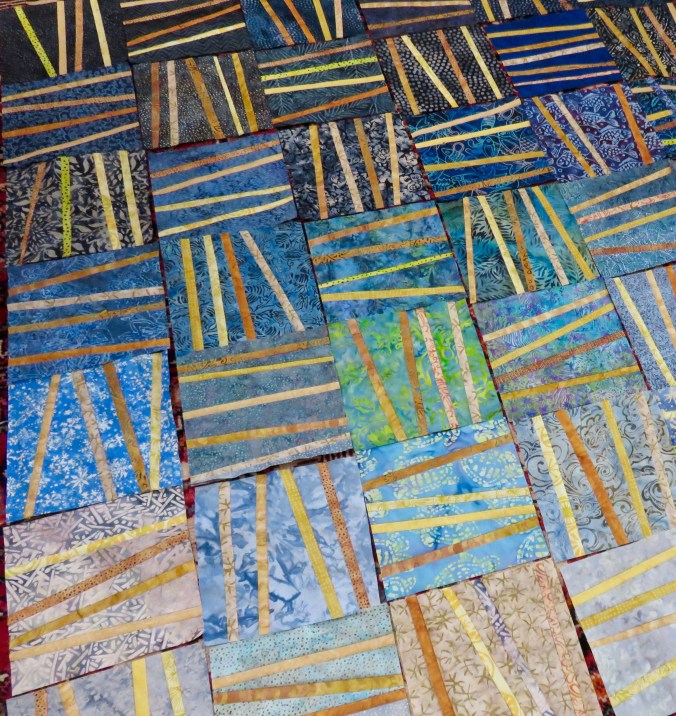
Above are a few of the forty-nine pieced square blocks laid out on the floor. The photo distorts them; they are each 8.5″ and carefully squared. So far I’ve used over sixty batik fabrics and cut over five hundred pieces of fabric. And this is only the center panel They will make a center panel 56″ x 56″ once they are stitched together, of an eighty-inch square quilt.

The second blue quilt was meant to be simple. I set specific, easy guidelines in order to piece it quickly and with a minimum of fuss. It’s that staring process, the decision-making at every cut and sewn seam. This color or that one, this way or that, rearrange and rethink the border? It was meant to be almost thoughtless but then the inevitable accidents. Most blocks were planned to be too large and I shave a quarter inch or as little as a sixteenth off the edges. A block might also too small or too dark or pushy or bland. I add another stripe or one going the wrong way, choose a different color or move the whole block to the other side of the quilt. Accident forces me to make decisions I might otherwise avoid, but accident has always served me as an artist. The writer Ron Carlson argues for something similar in writing fiction. Don’t allow serendipity to be cleaned out of writing. Let it flow. It is random chance that often hands us our finest work.

Decades ago, as a Metal Arts major, I was careless firing a base coat of enamel on square of copper sheet. The glass enamel color was called “Pigeon” a pale, perfectly transparent blue-gray. Fired over scrubbed copper it took on a lavender glow. Stenciled on copper, leaving some of the metal bare and then overfired to nearly 1700°F, the copper turned gunmetal-black, the enamel went palest blue-violet. The accidental firescale could be scrubbed off, leaving a line of black firescale on the edges of the enamel. I used that. Later, after deliberately overfiring sample tiles, I began using larger areas of firescale, enameling over the top and producing a unique metallic gleam. It was accident at first, and then a signature effect. It started by mistake.

Mistakes take time. Few are really useful. They are frustrating and not easily corrected. I have picked out stitches plenty of times making this quilt. Changed my mind in an instant. I could follow a quilt pattern or use a kit. There are plenty around that prescribe specific patterns and fabrics. I would not be constantly making choices, and choice is the hard work. But without choice, where’s the fun? I’m only barely interested in covering a bed. I am making art.

Mistakes push me, force me to reconsider, to change direction, to accept what happens sometimes and other times to fix it.

Mistake was at the first and will be at the last, so long as we don’t give up.

“The most important thing a writer can do after writing a sentence is to stay in the room. The great temptation is to leave the room to celebrate the completion of the sentence or to go out in the den where the television lies like a dormant monster and rest up for a few days for the next sentence or to go wander the seductive possibilities of the kitchen. But. It’s this simple. The writer is the person who stays in the room. The writer wants to read what she is in the process of creating with such passion and devotion that she will not leave the room. The writer understands that to stand up from the desk is to fail, and to leave the room is so radical and thorough a failure as to not be reversible. Who is not in the room writing? Everybody. Is it difficult to stay in the room, especially if you are not sure of what you’re doing, where you’re going? Yes. It’s impossible. Who can do it? The writer.”—Ron Carlson, from Ron Carlson Writes a Story

STEP 5: doubt

fullsizeoutput_1017

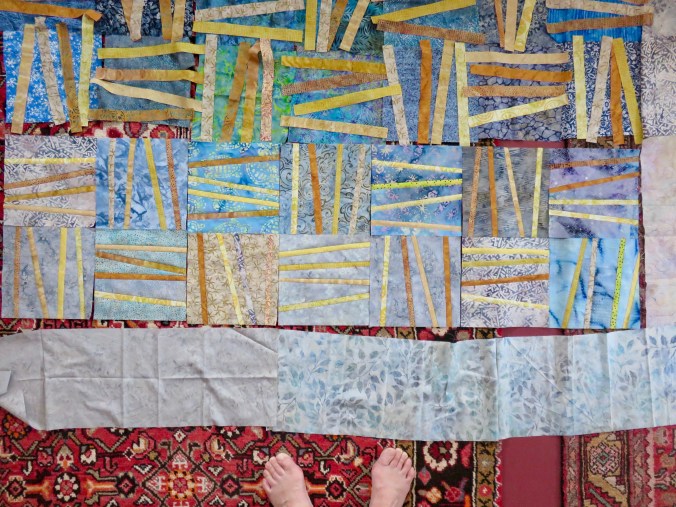
Here are the first two lines of seven. Maybe a little bland so far? Not quite what I had in mind? Once the squares are pieced and sewn, the effort in the first two rows is inevitably tame, inevitably distant from my vision. I began sewing the paler squares, the ones I like least. sigh

I fret and then will rush on to complete the more dramatic rows. I work vertically instead of horizontally, light into the dark. Maybe then I can find the stronger yellow-to-blue tension.

The inner wide border was to be two yellow or orange stripes on each pale blue bordering square (that’s the uncut band just in front of my feet). Now I think maybe dark blue stripes on the pale. Maybe three? Maybe even four? Maybe a narrow orange frame?

The narrower outer border? Four inches wide or thereabout. What do do about that? Color? Stripes? Once I have pieced all these squares, I might be stuck and will soon return to Blue Ladders, the other blue quilt.


More excitement from rentals. A neighbor filed a complaint about the people who pissed on our path, for the cars parked everywhere. This morning there are cars parked all over for another house, which would prevent a UPS truck passing. Not to mention a firetruck or Medic. Apparently there are rules about rentals and parked cars. Our neighbor will likely complain about this rental as well. People always assume it is me, but I have no idea where he is lodging his complaints.

Fireworks (illegal and all summer long) and people pissing in public . . . police and emergency vehicles will come if a life is endangered and that is reassuring. If only they can get here past the parking situation.


Step 4: stalling

fullsizeoutput_100c

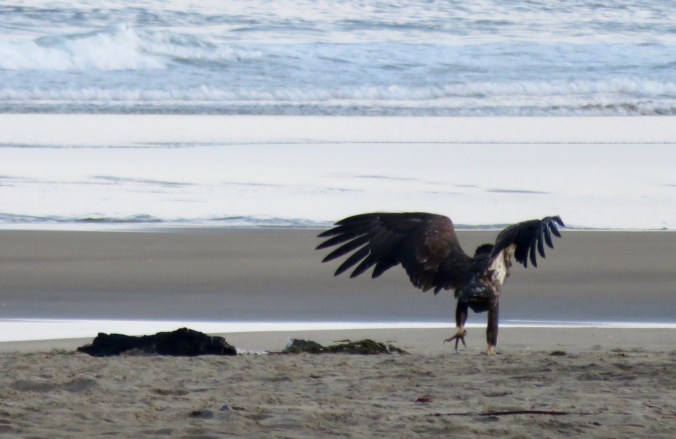
This is a new bald eagle, born this year and still in juvenile plumage. She was chased off by a tourist’s dog, but came back to feed soon enough.

This has been a bustling week. I am sipping ice water and Vera is playing on Acorn (my subscription runs out in a week or two). We are just back from an evening walk on the shore. Cool air blows in from the skylight and it’s hard to imagine knitting a sweater. Last weekend our younger son and his family were here and my grandson apparently thinks I am magic. He asked several times when his new sweater will be done. I think he expected me to answer: this evening or perhaps tomorrow. I told him perhaps by his sister’s birthday. That gives me until Guy Fawkes Day. I have four sweaters lined up. And just now the room is heated to over seventy degrees.

fullsizeoutput_1006I am stalling. Today I could have joined the blocks of the blue quilt at least into strips of dark dark blue and strips of lighter pieced strips. Instead, I have picked Blue Ladders up in stacks and laid out the beginning of the center panel of another blue quilt in squares. I won’t be casting on a sweater any time soon.
This has been a week. Monday was Scrabble. That was relaxing enough.

Tuesday, the neighbor’s dog Raven got lost. Gary went a little mad chasing around looking. He had seen the dog and recognized she was lost. The beach is overwhelming, sometimes even for local dogs and Raven is a rescue. But found again and safe at home.

Wednesday, we watched a paddle boarder thrashing about out past the surf line for an hour with increasing anxiety. He turned toward shore two or three times and paddled hard without making progress. He fell into the water over and over, a dozen times before I walked out onto the shore to get a closer look. Locals don’t usually surf this shore and maybe falling into the water every couple of minutes is normal? I called the Coast Guard thirty minutes after that, but then he seemed to change his mind and paddled south with the current. He’d been in the water a long time, but seemed to be wearing a wetsuit. Still, the danger was there, a current and an outgoing tide, night coming on soon. He came almost all the way in and then went out past the breakers again. I met others who were concerned. Cannon Beach Rescue showed up. He’d been out for over two hours by then and was a couple of miles south of where he’d first been spotted by a tourist staying well north of us. Eventually a member of the rescue team went into the water and swam to him towing her board. He finally paddled in on his knees and came ashore and I watched all that through binoculars. I called back to the Coast Guard, as I’d been asked to do. I apologized for wasting their time. The Chief Petty Officer thanked me for paying attention.

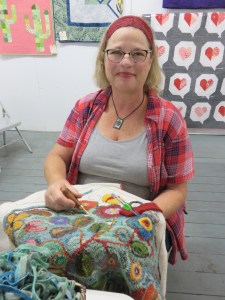
IMG_4672Thursday, we went to the Tillamook County Fair. I was a little disappointed in the quilts this year, but the rug tufters had lovely work, and as always I was tempted. (Just what I need, another project!)
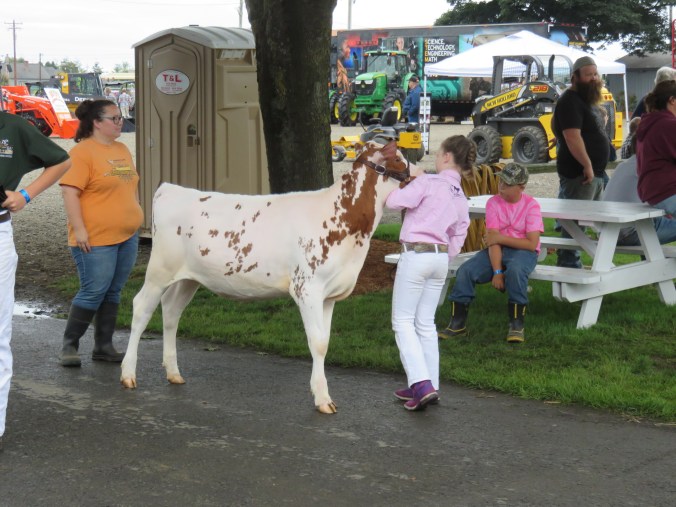
The pony rides had all appaloosas. The veggies were delectable, the cows looked at me when I told them they were beautiful, but there are fewer cows brought into the fair barns than when we first attended decades ago now. This year there were no goats or sheep or pigeons, but a strong showing of pigs and chickens and rabbits. Lots of children were showing their calves and fully grown cows too. This girl (below) got several wet kissy-nudges from her pretty calf.

IMG_4679

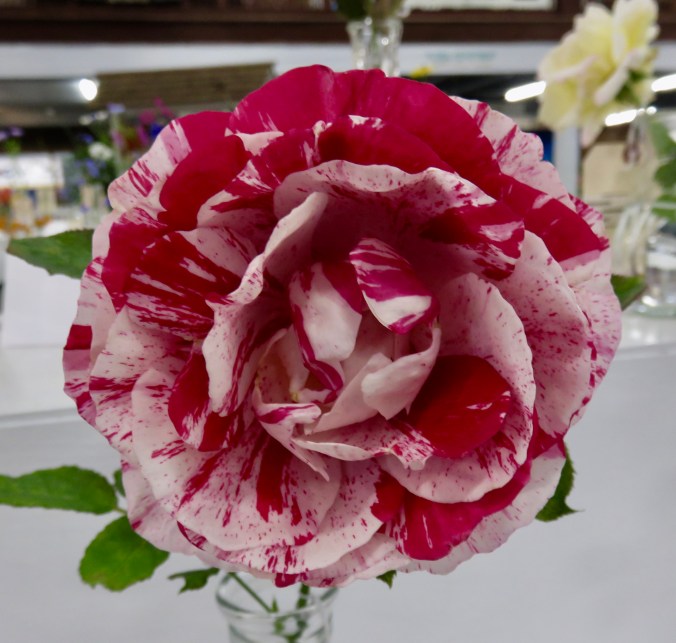
The flowers are among my favorite exhibits. The Tillamook ice cream cone was great, but the onion rings came in a half-size paper dish. Those are my gavotte fair foods. Gary bought a new belt and Gary drove to Astoria to renew his driver’s license.

fullsizeoutput_1013

fullsizeoutput_1008

Friday, the sun set spectacularly and today we decided not to drive into Portland.

I have not touched my sewing machine since making a skirt for Ruby last weekend. Maybe tomorrow I will work on a quilt. Maybe I will even sew. Maybe I will only make tortillas and enchiladas. Maybe I will sit on the sofa and read. It’s been a week.

STEP 1: vision

IMG_4589

The first step is staring at colors. This might last for a few days or weeks or even years. I had the defining fabric for my “Rain” quilt waiting for at least twenty years before I figured it out.

The patterns of these collected blue fabrics are all over the place: sea shells, blueberries, stripes and sailing ships, speckles and dots and stars, flowers, leaves, swirls and zig-zags. The flying geese fabric might be thirty years old—batiks, as best I can recall, were still relatively new on the market. The fabric itself is somewhat heavier than what I find today. They are all batiks. The yellow birds on black are a color on black—a combination I rarely find these days—purchased for my youngest grandchild’s baby quilt several years ago. One bird for this quilt.

The process is slow, but much of my process is invisible. I have laid out fabrics for weeks at a time, once I figure out the pattern. I think about what to do until I can construct the quilt in my head, and then I build that vision relatively fast, usually in a few days. Years ago a non-artist friend complained that I had completed a gouache painting in a few hours—yes, but she did not count the staring and the thinking, or even the preliminary sketches. She didn’t see any of that.

I have to see the work entire before I begin the easy part, that making.

A compilation of squares and rectangles, each with an X in the middle? I’ve done that before. All squares with skinny bands? I’ve done that too. Alternate the bands horizontally and vertically? Grade from light to dark? Shift the size outside to inside or top to bottom? I never use patterns and I am not generally fond of blue, so this one is particularly tricky. I have reorganized these colors since I took this photo. There are a few turquoises and purples mixed in with the cobalts. There is also a stack of yellows and golds, by way of contrast. I would like to add hits of orange.

I’ve been messing with these colors for well over a year. Gathering them longer than that, without those fabrics admitting they want to be anything. The other day, while dozing half-awake before dawn, I envisioned a blue quilt based on the old “Chinese coin” pattern, narrow bands of stripes, skinny on fat and divide by bands of solid color. That idea makes me squirm, so it’s probably the one I should pursue. The temptation is always to choose the easier option, and I have to work hard to resist doing the fast and easy thing. I have considered making two blue quilts—the easy one in squares, the harder in stacks of coins.

I’ll let you know.

A TASTE FOR SWEET

fullsizeoutput_fc1

My mother was pleased to read that as we age we lose our taste for sweet. She had a powerful sweet tooth and hoped this aging side effect would lesson her desire for cake and snickerdoodles. Alas, as she discovered later, the change in taste is not that we care less for sweet as we age, but that we lose our perception of sweetness. We do not crave the flavor less, we want more of it to satisfy our tongue.

There are other kinds of sweet.

Gary commented this morning on how I push off hard from my toes as I walk. “Especially the left one. While I graze the ground graceful as a dancer.” He laughed, and I wondered if the habit was left over from all those years of running.

We saw runners and dog-walkers. I followed a deer’s footprints from the tideline to the soft dry sand and lost her. Gary first spotted the raccoon prints. I found three back shells of my favorite “ugly clam” and three top shells that did not match. The back shells are always colorless, translucent, and shaped with a hole in the middle because the Pododesmus macrochisma shapes its home around the point of a rock. These C-shapes are even more delicate and far less common than the tops, which are rare enough. I found shells from four species of limpet. A tiny agate. We do not know what drew the adult bald eagle to the sand near Asbury Creek. She left no trace.