A TASTE FOR SWEET

fullsizeoutput_fc1

My mother was pleased to read that as we age we lose our taste for sweet. She had a powerful sweet tooth and hoped this aging side effect would lesson her desire for cake and snickerdoodles. Alas, as she discovered later, the change in taste is not that we care less for sweet as we age, but that we lose our perception of sweetness. We do not crave the flavor less, we want more of it to satisfy our tongue.

There are other kinds of sweet.

Gary commented this morning on how I push off hard from my toes as I walk. “Especially the left one. While I graze the ground graceful as a dancer.” He laughed, and I wondered if the habit was left over from all those years of running.

We saw runners and dog-walkers. I followed a deer’s footprints from the tideline to the soft dry sand and lost her. Gary first spotted the raccoon prints. I found three back shells of my favorite “ugly clam” and three top shells that did not match. The back shells are always colorless, translucent, and shaped with a hole in the middle because the Pododesmus macrochisma shapes its home around the point of a rock. These C-shapes are even more delicate and far less common than the tops, which are rare enough. I found shells from four species of limpet. A tiny agate. We do not know what drew the adult bald eagle to the sand near Asbury Creek. She left no trace.
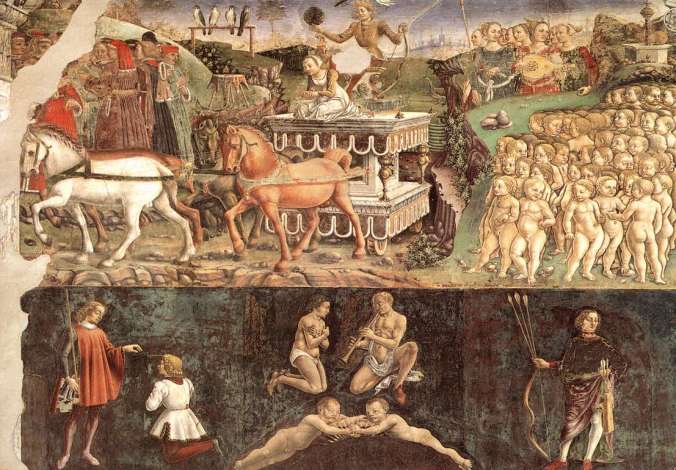
Francesco del Cossa

3may_1.jpg

Allegory of May – Triumph of Apollo, a fresco by Francesco del Cossa (c. 1430 – c. 1477) was an Italian Renaissance painter of the School of Ferrara.

“Cossa is now known for fresco decoration of the summer pleasure villa/palazzo known as the Palazzo Schifanoia, located just outside the city gates. Together, they painted a series of the elaborate allegories around the themes of zodiacal signs and months of the year. These were only partially restored in the 20th century, and there are three that are reasonably assigned to Cossa. Of these, one of the most remarkable images is the horde of naked toddlers in the Allegory of May – Triumph of Apollo.”

“The façade was originally decorated with a cornice of feigned battlements, its surface smoothly stuccoed and decorated with geometric designs of highly colorful imitation marbles, which have been lost, lending a somewhat dour public face to Palazzo Schifanoia that was not what Borso d’Este intended. The rich white marble entrance door survives, though its tinted colors have weathered away and art historians disagree whether it is to be attributed to the painter-designer Francesco del Cossa or to Biagio Rossetti. Above the arched door, flanked by pilasters, the Este arms are displayed and the unicorn, a symbol of ducal benevolence and the source of patronage. In 1493 the terracotta cornice was added to designs by Biagio Rossetti, who was also commissioned by Ercole I d’Este to extend the palace.

“From the Salone dei Mesi the visitor once passed directly into the gardens reached by a monumental stair from the summer loggia, structures that were demolished in the 18th century. After the Este left Ferrara in 1598, the palazzo was inherited through successive heirs, eventually by the Tassoni family, its frescoes whitewashed over. Eventually, during administration of the duchy as part of the Papal States, with a Habsburg garrison, it became a tobacco warehouse and manufactory. When Palazzo Schifanoia came into the possession of the comune of Ferrara in the aftermath of World War I, only seven of the months in the Salone remained legible.”—Wikipedia

Listing this under the category of “color” is a stretch. I had to create “ART.”