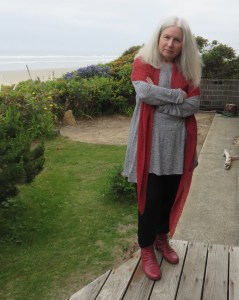
The Mentalist: Reward and Routine

fullsizeoutput_11be

Getting through a national crisis might be a little crazy like a police consultant following instinct and impression or it might be orderly like completing a knitted pair of socks. Maybe it’s a little of both. I have one sock of a pair in the works, knit top down. The leg part is done, the heel flap, and the heel is turned. I also have five book-length projects I could be working on just now, at least 350k words that need work. I could be working on revising those books, or I could be painting the hallway even though there is snow on the hills behind my house. (Because the paint is zero-VOC and I have brushes and a roller ready to go.) I could scrub dust from the baseboards or the molding of the bathroom door. I could sort my books or bake sweet rolls. I still have plenty of flour, five eggs, and sis sticks of butter. I could bake something. My husband says I should be doing our taxes. And I have the time. 

I am not going anywhere anytime soon.

Instead, I want to watch season 6 of The Mentalist. Continue reading

WEAVING STORY

fullsizeoutput_11bb

When my children were very small, and a long walk on the beach was not practical, I used to sing a little ditty I’d invented out of parental desperation: “Mommy’s going to run around, run around, run around. Everybody run around, run around, run around.” We would jog in circles from the living room to dining, past the kitchen and into the hallway to the entry and then back to the living room—all the while shouting that line over and over.

In the mean time, I am weaving.

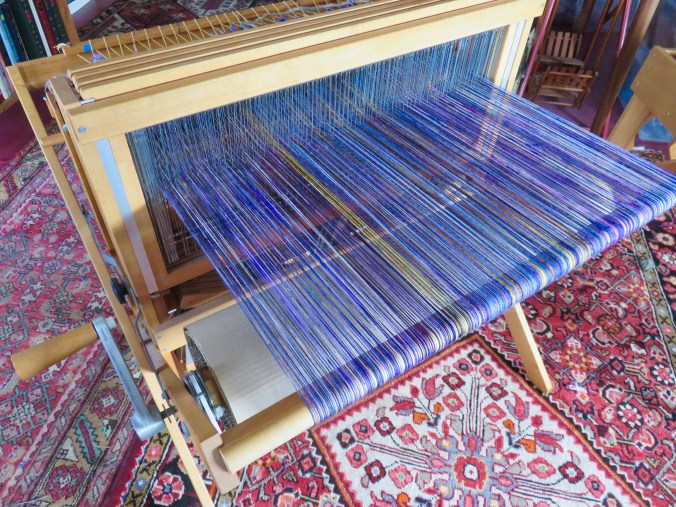
January I wove three shawls on a blue warp. February I completed a red one. Last Wednesday evening I began winding a purple warp of over 300 ends from my stash with one handspun skein from a spinner just a couple of hundred miles north. Less than 48 hours later I was weaving the first shawl with blues, teals, ands gold. Yesterday I began weaving the second shawl using mostly purple weft. I begin first thing in the morning and continue until after sunset.

The work is going well. These shawls are intended for a group show in December. That gallery is closed just now. The schools are all closed. Events are cancelled. One of our sons is working from home. The other who works in the theater is completely out of work. Gary kept talking about getting fuel for the car, and I stopped him right there. We are not leaving the house except for walks on the beach. Mail will have to pile up at the post office. We have plenty of food in the freezer, fridge, and pantry shelves. I am not hoarding, it’s always loaded. Gary only worries about running out of coffee. I want pasta and jarred tomatoes, coconut milk and pesto frozen at the end of last summer. I have half a bag of onions and a few sweet potatoes, and an entire dozen untouched eggs. When all of this is gone, we will go out to see what we can find.

IMG_4272My husband is 70 and I am 67. Neither of us have health issues except thinning bones. We walk for an hour or two each day on the beach without coming closer than ten or twenty feet from anyone other than dogs. Both of our tenants are over 65. One just had a triple bi-pass. When emergency vehicles showed up yesterday, we feared they were for him, but no. It was another neighbor who is also over 65 and had a heart attack, then a more serious one and was eventually Life-Flighted to a Portland hospital yesterday.

If you or someone you love has a high fever and other cold or flu symptoms, you might just have the flu (colds generally present with only a slight fever, if any) or you might have covid-19. You are unlikely to be offered a test to determine what’s going on because despite what other countries have managed and what the president keeps promising, our country is not yet, after two months, up to speed.

In the mean time, many people should be practicing social distancing. Many local governments are closing schools across the country, restaurants and malls, gatherings of all sorts.

Stay away from public places, avoid touching others or surfaces that others might have touched. Small children are as likely to become ill as anyone, but are unlikely to die. (In over 72,000 closely studied cases, China had no deaths of children under the age of ten.) But children are still carriers while they are sick. They can transmit the disease to more vulnerable populations, and we are all assumed contagious before we are symptomatic and for at least a day or two afterwards. There is also some evidence that even if it does not make a person ill enough to be hospitalized, covid-19 weakens the immune system and makes people more susceptible to other illness.

So be careful out there. Turn to your inner resources. Read. Tell your children stories. Run around the house. Make a mess.

Once the purple warp is completed, I will start another.


I will note that a friend’s son has a fever of 102°. They could not get a test (of course they couldn’t), but have accepted that their child’s having covid-19 is a possibility, and that it has likely spread everywhere. They are self-isolating.

TREASURE, TRASH, & TROUBLE

IMG_5417

This is a partially threaded warp, just strung through the reed, looking at the back of the reed. The new warp is red and soft violet-and-purples and ashy pinks. All hand-painted or dyed-in-the-wool fingering weight merino. I have begun threading the heddles since I took this photo and might begin weaving tomorrow. The weft will be half handspun and mostly red. Three shawls.

We picked up almost 40 pounds of trash yesterday. We meant to walk a mile north and not begin collecting until we turned for home. But there was too much to ignore and we were overloaded by the time we’d walked a mile.  On the way home we realized we could not even complete our stretch of the shore and left the beach to drag our load on the road. The beach was littered with tiny bits and pieces, but also major chunks of heavy stuff. Usually we find plastic bottle lids, but yesterday there were so many! Many blue and with embossed Japanese characters. Two short lengths of heavy braided rope, poly-styrene foam, and my favorite green plastic twine that I often find in four-inch sections, usually with a knot. There were plastic bottles and a huge hatch lid Gary found late and just in time to use as a sled to drag the junk home. Some trash was stashed and we hope to bring it home today. We will need an extra trash pick-up. Recycling will not take it. No one will take poly–styrene foam in any condition. It is an enduring menace to the environment.

Perhaps it’s understandable that halfway through our walk I held perfectly still when the dog ran up close to me barking. In the past I would have assumed that the wagging tail was counter to the bark. I will not be making assumptions anymore.

Continue reading

LIFE EXPECTANCY

fullsizeoutput_1185

completed last night: The “Shelley” warp with “Storm” (mostly blues) “Water” (mostly greens), and “Wave” (mostly peacock) shawls. Each woven with dozens of Canadian hand-painted merino wool and handspun dyed-in-the-wool yarns, and about 25″ wide by 65″ to 75″ long plus fringes. This is the first warp of the year and two of them will be in the sale this coming December.

People often look at life expectancy statistics and assume that people died at the age of 46 in 1900 because medical care was poor and that people seldom lived past age 46. In fact, anyone reaching the age of 46 in 1900 was probably as likely to reach age 75 or 80 or even 95 as someone is today. Life expectancy is an average, and children more often died of diseases and then-untreatable infections and pneumonia. Families died from eating tainted food or because their water system was poisoning them. People also died at work more often, but that has changed in the last hundred years.

Continue reading

ENOUGH

fullsizeoutput_1180

Years ago a friend who was visiting us looked at the shore and thought he was seeing soap suds or another form of pollution. It is, in fact, life. A heavy surf and a plankton bloom combine to make seafoam. There has been a great deal of it onshore this month.

We have been experiencing some “interesting” weather. Temps dropped down and there was snow in the Coast Range. Fortunately our son had already made plans to take vacation days to stay home with his daughter last week. We no longer drive in snow when we can help it.

Here the wind gusted to strong gales and we walked the beach anyway. High surf erodes the shoreline in some places and we find raw agates released by the tide. We get half wet day after day, pick up dozens of plastic water bottles, and the usual plastic bits and bobs—over 60 pounds of trash so far in January.

fullsizeoutput_1179A puffin died. We find dead seabirds on every walk. This one would be opened and the entrails and breast muscle eaten by the following day. It is our first dead puffin and so particularly sad, but seabirds die every day. And there is black oil all over the sand too. Crude oil? Someone illegally emptying bilge at sea? We can’t know.

Last week we watched the helicopters flying south fast to the next beach and we knew this meant something bad. Emergency Fire and Rescue, the EMTs, three sheriff’s cars all with lights and sirens. Two young children drowned near our home. It didn’t seem quite right to mourn a puffin.

When I tried to warn a couple about the tide—they laughed when their dogs ran into the ocean—the man said “we know.” Their dogs don’t know. The next wave swept up a hundred yards over the sand and drove us, dogs too, all into the rocks.

People think they know about sneaker waves and “king tides” but they don’t. We have lived here over forty years and keep an eye on the ocean, move up shore when the surf becomes silent. (The crashing is usually safest—the sound of outgoing and incoming waves meeting. A sneaker wave is quiet and swift.) We spent most of the last week walking on the basalt rocks because even at low tide, waves swept all the way in, higher and higher. We watched waves sweep up over our pathway through the hedge, nearly to our yard. It is fascinated from the safety of our home, but we go out whenever we can. Not so very much glass has shown up, but pumice and plastic, those agates. Drowning. Death.

Lately we’ve walked the “inside” path on roads when waves swallowed sand and basalt rock whole. It’s safer than risking the shore. We often get rained-on during our walks, but we never head out into a heavy downpour. Yes, we have rain gear, and yes, we get caught in drenching showers. We see them coming but do not deliberately head out into a rainstorm. These things just happen.


  • I have set goals for quilting and weaving on Ravelry. At least 16 items for the Hoffman, one completed the other day as a gift. I have chosen yarn for a warp and I did (yes, I did!) cut that narrow warp clean through. I will chain it off my loom today and maybe begin winding the new warp. I wound off the skeins yesterday and chose possible weft. Everything is from my stash plus a huge skein especially ordered from Koigu in December. These blues are not my colors, but for a friend who retires in a month so I need to get cracking on.
  • Zero clothing purchases so far this year (yeah!). I have ordered seven skeins (plus another five mohair/silk skeins that I returned because the color was wrong and I do not have time for that much knitting), tea for Gary, a book.
  • No new writing, but I withdrew work from two journals that failed to respond to queries after holding my piece for months past normal response time—one had a piece for months before shortlisting and since has held it for another year. Yesterday I submitted a revised essay to an unlikely journal with a history of quick responses. So I worked on that and sent it off. I mean to allow my Duotrope folder to go empty. That goal can’t happen for at least another three months. On Submittable, the new submission has already shifted from “Received” to “In Progress.” Two older ones have not.
  • The manuscript, Butterfly Fontanelle, occupies my thoughts on most days, but I have not opened the file in a while. Where does her protein, salt, oil come from? How does she store food? How does she clothe herself? Does she need to create shelter? Does she stay in place or move? Why? The story has become a meditation.


GOOD FENCES…

FullSizeRender.jpeg

You go girl! A friend just sent this to me. Isn’t it wonderful! This must have been originally published by a knitting or UK journal. No mainstream American newspaper or magazine would mention the 23 stitch repeat.


I was right about the source. It seems to track back to a Scottish blog post from 2012. This is the source of the photographs and excerpted text. KDD and Co. (Kate Davies Designs) sells yarns, patterns, knitting kits. I have actually purchased things from them: little wooden animals meant to be wound with yarn. The striped Datham pullover is a stunner, and the baffies (Scottish house slipper) kit is decidedly tempting—I ordered it.

CLOTHES HORSE

fullsizeoutput_10

The “Flamingo” quilt before being cropped and the edges bound. The white showing around the edges is cotton batting; the red showing on the very outside beyond the batting is the backing.) My quilts generally begin with a signature fabric that drives the design. In this case, I was captivated by an Indonesian batik in a Japanese plum-blossom pattern, imported and sewn in the United States. This is one of the pieces that will go into a local show in December 2020. (Assuming they allow me to bring such large works.)

Gary sewed a button on the other day. A few months ago I made repairs to quilts I’d sewn for our older son—quilts that are decades old and have been through the wash too many times. I recall my dad talking about learning to darn socks in the Army. I know, in theory, how to darn socks and I even have a favorite pair of wool socks that need darning. I also have a tweedy charcoal/brown silk noil sweater that I bought at Banana Republic that needs some attention under the right arm where the stitching has come undone. It was originally intended for one of the boys—it’s a man’s sweater—but none of them wanted it. I took it for myself and despite the label that says “dry clean only” have been machine washing it in cold water and hanging to dry for over twenty years. It will take me a few minutes to repair.

Repairs have become rare. Continue reading

FOR FREE

botticelli31500x900.jpg

[There’s a great link at the bottom—don’t miss it.]

“Art never responds to the wish to make it democratic; it is not for everybody; it is only for those who are willing to undergo the effort needed to understand it.”—Flannery O’Connor, Mystery and Manners: Occasional Prose

vs.

For some, reading functions “as class performance, literature fetishized for its ability to take educated people on false emotional journeys, so that they might afterward feel superior to the uneducated people whose emotional journeys they liked to read about.”—Sally Rooney, Normal People

“Art for Art’s Sake” was a popular slogan when I was in art school in the 1970s. There was a general attitude that artists were some sort of elite beings, that their work spoke to an exclusive club, and also that the only real art was paintings, sculpture, and architecture. The rest was mere craft.

Thanks to my future husband, I was taking not just the required studio and Art History series, but a lot of Anthropology classes. This meant that I understood that art was never reserved only for the precious few. What we regard as “art” served the wealthy aristocracy in Europe after the Renaissance. Before that, and even after, and at every time and everywhere around the world, art serves to satisfy the aesthetic needs of all people, expressing ideas, power, yearning, hopes, dreams, fears, and distinct perceptions of beauty. Art reflects appreciation and even affection for the objects and environments we touch and use and admire every day.

That is to say, that while I like Flannery O’Connor’s fiction and I get what she is driving at, and every advisor I had in my MFA program pushed her books onto my reading list (and I read Mystery and Manners: Occasional Prose), I think that quote from her above is elitist crap.

There is no great effort required to appreciate or understand most art. And it shouldn’t be all that hard or reserved only for the special few.

Art does not choose only certain individuals nor is it handed out as a gift via a Muse. Creativity is not reserved for some sort of intellectual or preordained elect. Appreciating art is not a gift from the Almighty who only allows understanding by those chosen few. Art is human creation. No, it’s simpler: Art is human.

I won’t argue that there are not great artists and that creating art does not require enormous effort and even talent. Spare me Hallmark cards and bad art—and there is bad art—but I refuse to accept the narrow view that art is accessible only to special people. I will argue that if only a few people can “read” the art, its message does not speak effectively to the human condition.

There is room for art that offends or challenges our notions of art. Certainly art must not merely sooth but provoke and wound. That too is the proper place of art, to wake and stir our souls. To break us open and heal us too.

“I think we ought to read only the kind of books that wound or stab us. If the book we’re reading doesn’t wake us up with a blow to the head, what are we reading for? So that it will make us happy, as you write? Good Lord, we would be happy precisely if we had no books, and the kind of books that make us happy are the kind we could write ourselves if we had to. But we need books that affect us like a disaster, that grieve us deeply, like the death of someone we loved more than ourselves, like being banished into forests far from everyone, like a suicide. A book must be the axe for the frozen sea within us. That is my belief.”—Franz Kafka

Maybe even Kafka was full of it. Everyone wants to argue that what they make or like or pay for is the only true art.

“What we have here is a failure to communicate.”  Yes, art is communication and if it only speaks to a tiny fraction of the population, that might only be because it is a small and narrow effort.

The painting above sat in a storeroom for decades. The woman who gifted it to her local museum thought it was a Botticelli, but the experts declared it merely the work of some unknown apprentice. They had studied for years and had been “willing to undergo the effort needed to understand [art].” They knew so much they put it away and didn’t look at it again for fifty years.

Perhaps someone might have noticed it is beautiful? Someone finally did. The collector, Gwendoline Davies was right. “National Museum Cardiff has put on display a painting of a Madonna and child that had for decades been dismissed as a crude copy of Botticelli’s style.” But it was the real deal. Not appreciating the art without the name? Major fail.

There’s a Joni Mitchell song about this, “For Free” on Ladies of the Canyon. It has been recorded by over sixty artists who know great art when they hear it. So have their audiences. No great effort required.

For Free

I slept last night in a good hotel
I went shopping today for jewels
The wind rushed around in the dirty town
And the children let out from the schools
I was standing on a noisy corner
Waiting for the walking green
Across the street he stood
And he played real good
On his clarinet for free

Now me I play for fortunes
And those velvet curtain calls
I’ve got a black limousine
And two gentlemen
Escorting me to the halls
And I play if you have the money
Or if you’re a friend to me
But the one man band
By the quick lunch stand
He was playing real good for free

Nobody stopped to hear him
Though he played so sweet and high
They knew he had never
Been on their T.V.
So they passed his music by
I meant to go over and ask for a song
Maybe put on a harmony
I heard his refrain
As the signal changed
He was playing real good for free

[Joni added these lyrics to the song during the 1983 tour]

Playing like a fallen angel
Playing like a rising star
Playing for a hat full of nothing
to the honking of the cars


In case you have read this far, allow me to recommend two older (than me) bloggers, “Margaret and Helen: Best Friends for Sixty Years and Counting… “. Helen Philpot has a lot to say this morning and says it better than I could. She generally does. Here’s a snip:

“Suggesting that 13 year old Barron Trump isn’t a Baron is unforgivable but mocking 16 year old Greta Thunberg for wanting to save the world will get you several hundred thousand likes in MAGA Twitter World.”
IT’S NOT YOU, IT’S ME

IMG_4937.jpeg

I hope to take my third quilt up to be quilted this week—that’s it above while it was about a third complete. I am waiting to hear when I can deliver it because I need to send my laptop in for repair. Again.

I have been using a Mac daily since 1990 and until this one I never needed a repair. I replaced my best laptop at the age of nine, about 112 years old in computer years. But this one I am working on right now is still under the original warrantee. Months ago, the screen started pixilating in dark areas. Shadows in images were no longer black but turquoise or peacock green or cobalt. Or white. Bold Helvetica showed up as outline text. The weird appearance got worse and worse. Eventually the entire screen turned to pastel snow in horizontal bands.

Imagine trying to explain to a young tech person what’s wrong. They kept wanting to see it, or have me email or send them something. I kept having to explain again that the computer was unusable and I have no smart phone. (One of my sons keeps trying to remedy that by giving me an iPhone. I probably should let him.)

Anyway, my computer went to the Apple store where it was diagnosed as troubled, then it was sent away, and shipped back to me good as new inside a week.

But now it’s doing it again. I can still use it, but I figure it’s heading again toward pastel snow. I hope if I send it in they will see the problem.

I’m not going to freak out about being without my laptop for a week. I no longer teach so I am not depriving students of immediate access. But just in case you try to get ahold of me in the next week or so, just so you know, my computer is in repair limbo.

It’s not you, it’s me.

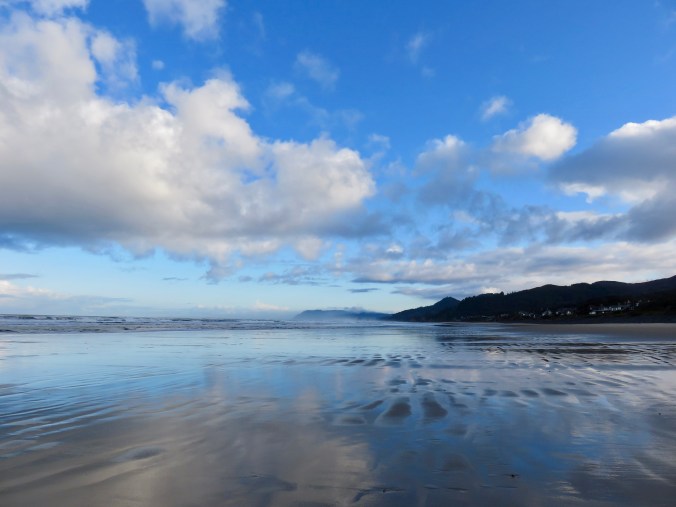
WET

IMG_4967.jpg

Yesterday there were deer tracks at the base of our path to the beach. This morning a coyote had passed by. We went out a bit late, and I did not put up my hair or even put on a hat because it wasn’t cold or windy, just cooler and damp the way we like it. I unzipped my jacket on the way north because the rising breeze hit my back and I was warm. By the time I thought I should put up my hood, it was already wet inside. I figured that was okay. I hadn’t worn the jacket to keep warm but because it was wet.

As a rule, we do not mind the wet. If we minded we would live someplace else.

We walked for an hour, north and then back south. On our way north, Gary mostly followed the tracks of the coyote on the sand, and I mostly walked in the basalt rubble lining the shore. The tide came right up over the sand and several feet into the rocks last night. I found plastic bits and bobs and leftovers from fireworks, a piece of quartz, a crumb of sand-buffed green glass, and a shell. On the way home, we walked with Tammy. She was dressed for weather—hood, rubber boots—though she’d decided it wasn’t worth digging out her rainproof pants. Like my hair, her pants were drenched by then.

IMG_4966.jpgRecently, juvenile gulls have been following me. One trailed me up and down the sand and over the rocks for a quarter mile the other day. I told him that was not wise. Humans are not to be trusted, and I would not feed him even if I had anything in my pockets he could eat. Yesterday, one came quite close, stood no more than four feet away and waited for a long time for me to do something. What?

There are too many dead birds on the beach, it seems to me. We always see one or two when we walk a few miles. This time of year the new seabirds who have failed to learn their survival skills start showing up, juveniles who have starved or done something stupid. Fully grown juveniles hunker down and call weep-weep at their mothers, who are done feeding them. After the first big storm or a crazy tide, youngsters are swept off Castle Rock and wash up onshore. This morning we saw a dead bird every five to fifteen yards, and that is not typical for late September or really at any time. We haven’t had a storm and many of the dead are adults. Three banded birds in as many yards—a seagull and two cormorants. Gary says the banding may have been enough to stress them, and there is no typical, no normal anymore.

Climate change has killed billions of birds, and millions of species are already lost or threatened.

But this morning we came home dripping and I sat comfortably watching the pale sky dissolve into pale sea. The osprey was fishing, the tide rushed in, waves swept across the sand, which has not begun moving back out into offshore bars.

IMG_4969I have finished a third quilt earlier than I expected (the last four rows of stitching completed Tuesday evening instead of Friday). Late next week I will carry it to Linda, or whenever she’s finished the two I pieced in August.

Yesterday I cleared out my work space, sweeping my work table, sorting colors into warm and cool and black&white bins, and finding storage for miscellaneous sewing and knitting tools and notions. The floor seems oddly empty without fabric spread out in patterns. The scraps from stitching and trimming—trimmed threads and bits of fabric less than an inch wide—made a heap on my work table. I dug through the little pile once more and then tossed it into a waste basket. I hope Gary might pluck out bits and pieces to save for birds’ nest-building in the spring. If we composted, they could go in as “carbon” I think.

The season is changing, weather and focus. There was Open House at the high school last evening, but we were at a restaurant visiting with mostly-retired school employees. Are you enjoying retirement? Some confess to having a hard time, missing students and the work. Some are simply relieved to stop. A friend in the former group is in the hospital. After decades of deep involvement and commitment to teaching, the way we are let go can seem rather heartless. And the way those with social connections are privileged and allowed to continue on their own terms can seem unfair. Six months out, I am still uncertain where I stand.

My kitchen floor is cleaner than it’s been in almost thirty years.

Change is inevitable. Not all of it is good. Not all bad.