I was reading an upbeat story about a species of dove native to a Pacific island that had become extinct in the wild since 1972 due to human activity and human-introduced species. Cats are often cited as the cause of the birds’ extinction, but the real damage to the birds’ survival had been domestic sheep that destroyed their habitat, explained a scientist with Mexico’s Institute of Ecology who is leading habitat restoration efforts on the island. The cats merely finished off an already decimated population. What is missing may be another cause, too often ignored: human-introduced rats.

Rats are the likely reason cats were brought to Socorro Island in the first place. And in case you missed it, rats are a prime threat to ground-nesting species. Not cats. My guess is that cats come second, as was suggested years ago in an article by and environmentalist. However as far as I can tell this isn’t something that’s been much studied.
Part of my attention to this is that for 35 years we had cats, for 30 of those years we had indoor/outdoor cats. Altogether, they killed one bird. [The dogs killed more, at least three. Birds would dive-bomb the dogs—I watched it happen—and underestimate just how high our Afghan Hounds could jump. The dogs didn’t bite the birds or eat them, merely jumped and caught them. Consider, there was by then nothing but river rock and dogs in what is now our courtyard garden. The birds teased the dogs and being caught apparently frightened them to death. Snowbird gave up the finch into my hand and I couldn’t find an injury, though it was certainly dead.]
By contrast, Zora and then Leakey killed a couple of hundred rodents, mostly mice. Zora, otherwise known as “Rat Cat,” was fond of chipmunks, but they moved away for the duration of her life. She’s the one who caught a bird, showed it off as was her custom, ate it, and apparently decided the feathers were too much trouble. She found shrews boring and let them go (I saw her do this), but she would display her mice before eating them, usually leaving the heads behind. Leakey ate mice but was fond of a challenge and would lay out rats on the sidewalk, uneaten. She was at war with a weasel for years, but I never knew her to kill a bird.
When I went looking, I found estimates that cats kill 1-4 billion birds a year. Researchers claim most of those are killed for food by feral cats. Domestic and housed cats are far less likely to kill wild birds. Another million to a billion birds die by flying into windows, 67 million are killed accidentally by exposure to pesticides, between 140,000 and 1.17 million birds are killed by wind turbines (this is the only industry that seems to have bothered checking), and 12 to 64 million by flying into power lines. In 2005, a study of the human impact of birds life from the USDA/Forest Service: “We estimate that from 500 million to possibly over 1 billion birds are killed annually in the United States due to anthropogenic sources including collisions with human-made structures such as vehicles, buildings and windows, power lines, communication towers, and wind turbines; electrocutions; oil spills and other contaminants; pesticides; cat predation; and commercial fishing by-catch.”
You’ll note that the government study figures conflict with the other estimates I found both in overall numbers and specific responsibility. Current studies mostly blame cats. Maybe that’s because the world has changed—there are more cats? But would anyone suggest buildings and power lines have become less common in the last 21 years? Unlike the popular articles, the USDA/Forest Service study blamed “collisions” with human constructs and vehicles for the bulk of bird mortality. Closer to home: “Many groups of seabirds have been reported drowned by fishing nets and gear (Atkins and Heneman 1987) and yearly mortality may reach hundreds of thousands.” But those seabird stats are among the “other” category.
Buildings, power lines and cats are estimated to comprise approximately 82 percent of [wild bird] mortality, vehicles 8 percent, pesticides 7 percent, communication towers 0.5 percent, and wind turbines 0.003 percent. Other sources such as mortality from electrocution, oil spills and fishing by-catch are also contributors but estimates were not made and we have not even considered the impacts from loss of habitat which could also be considered anthropogenic. [Excuse me, “could be considered anthropocentric”? Could be?]
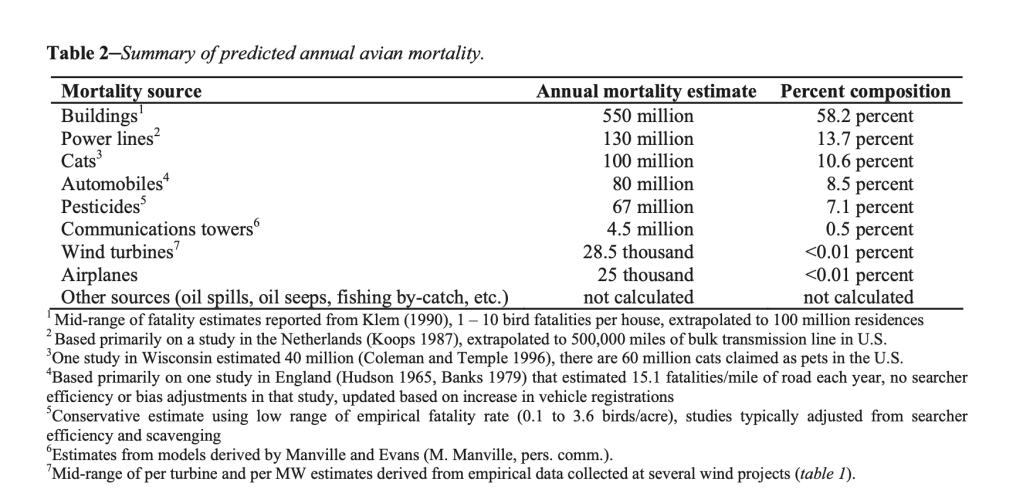
Because it focuses on kills directly related to human activity, this study doesn’t mention rats at all.
I couldn’t find a study that does estimate bird kills by rats. Researching the impact of rats on wildlife doesn’t seem to have been funded by… anyone.
Consider: there are an estimated 7 billion rats in the world, 342 million in the US alone, roughly equal to the number of people. Rats will eat anything and are generally considered a nuisance, but apparently no one has bothered to track their impact on wild birdlife. Rats will eat birds, their eggs, and nestlings, can climb straight up a brick or wood-clad building or a tree. We know we don’t want them in our garden, and some of us recognize wild rats are invasive species, but we fail to consider how the adaptable animal has impacted native birdlife.
It might be convenient to blame cats for the loss of wild birds. The truth is more complicated and requires a more challenging response than keeping pet cats indoors or in cages in the garden.
When we had a cat, we didn’t have rats in our attic or mice in our atrium. The chipmunks survived and birds flew overhead. There is little doubt that human activity of one sort or another is largely to blame for loss of birds, but we aren’t doing much of anything about that. We fail to consider the impact of reflective glass in our high-rises and homes, lights left on overnight that disrupt migrating birds, and what we have failed to do to preserve habitat and ensure our effect are nontoxic.
On top of that, rats aren’t going away despite centuries of effort.
So the next time someone tells you about the threat posed to birds by 76 million domestic cats in the US, remind them that millions or billions die in collisions and from poison, and that rats outnumber cats by more than 4 to 1 and might be an even greater threat.
Good news about the dove, though. They are breeding them and hope to reintroduce the species to Mexico’s Socorro Island in the next few years.
scary fact: Domestic mammals currently outweigh wild mammals by a factor of ten, accounting for about 95% of the world’s mammal biomass, while wild mammals make up only about 5%. That is, not counting people, the cattle, sheep, goats, and hogs raised for food is mostly all that left of mammals on Earth.
This sort of data is the reason my speculative novel killed off 10 billion of humanity and apparently everything else with a spine in 2054. Might the Earth benefit from a reboot? Turn it off and turn it on again. The Earth might be better off if we were mostly gone. ALL THE DAUGHTERS SING, will be available in January 2027.
 IMPERFECT PATIENCE
I can’t wait to read it!
LikeLiked by 1 person
Thank you. There will be a limited number of copies, determined by the minimum that the press I’ve chosen will print. Details forthcoming.
LikeLiked by 1 person
I too look forward to reading it !
LikeLiked by 1 person
Thank you. I think a few people might read it. I owe copies to those who read drafts and to my authenticity editors who were kind to give me perspectives I have not earned on my own.
LikeLike
18 and counting–where is that cat when you need HER probably reading somebody’s book or something
LikeLiked by 1 person