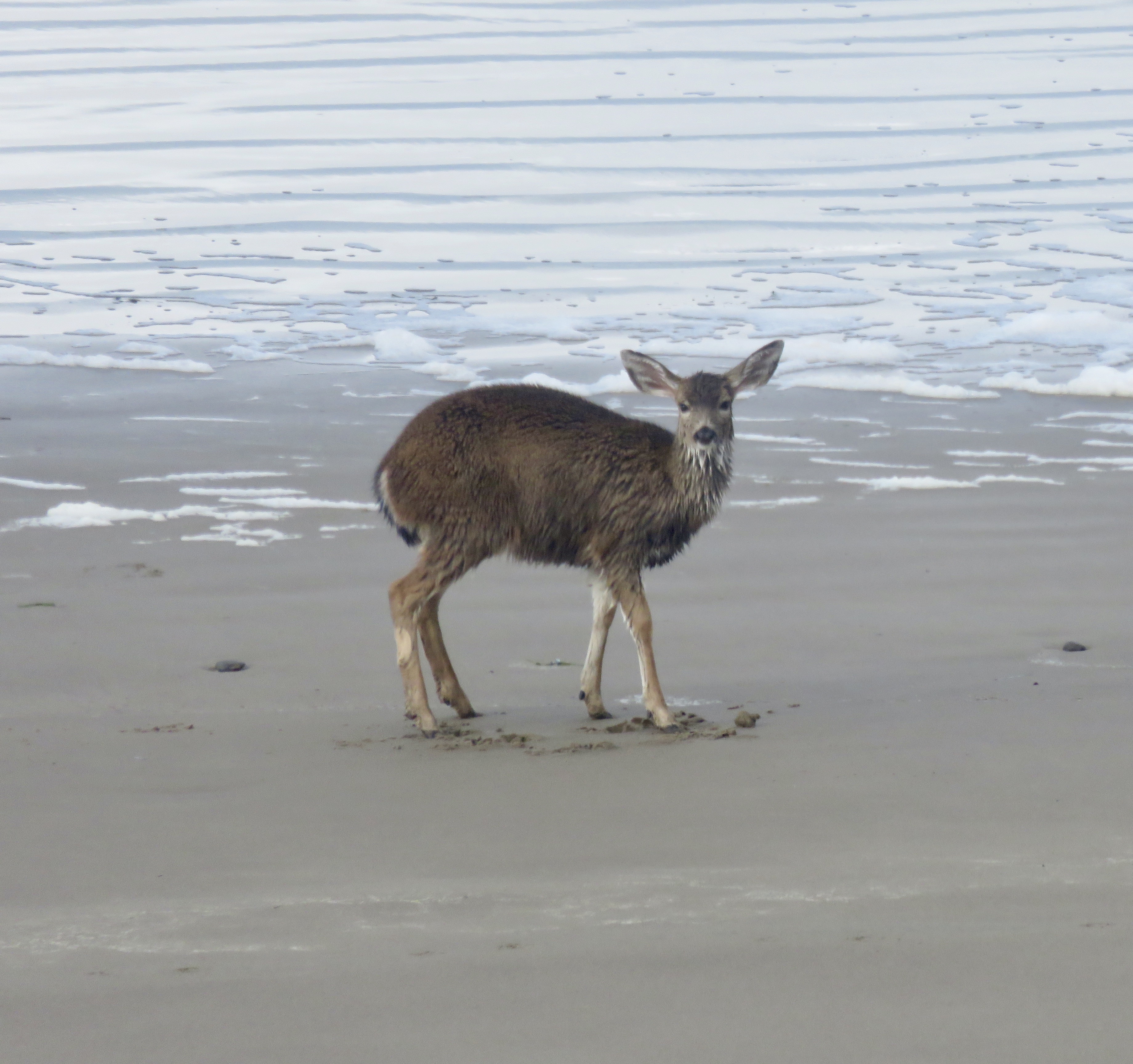
There was a doe on the beach in front of our house. It is not the first time we’ve seen a deer on the beach, but this one was distressed, maybe shocky. She stood hunched, ears drooping, head low, and perfectly still for a long time, wet from having been in the ocean, but no sign of actual injury. Our neighbors from Washington came over and asked Gary who to call. They both called Oregon Fish and Game.
The truth is that wild animals do best when they are left alone. Approach from a human being is stressful, and thus almost inevitably counterproductive. I will never recover from being present while a baby seal was chased into the surf by an unleashed dog. I tried but could not stop the dog.
Visitors want to “rescue” baby seals left onshore while their mothers fish. They want to “rescue” the elephant seals that are naturally molting. These wild animals do not need us to rescue them.
During our near-forty years here, we have picked up storm-battered birds and hidden them in the hedge from dogs and other predators. Sometimes they live—the rhinoceros auklet lived, a grebe, a crow, a couple of seagulls, several hummers. Each was unfledged or stunned and incapable of moving. We moved them to safety and left them. But it is really best if we don’t touch them at all. Regardless of our feelings, they are wild animals and human beings are their natural enemies. Sometimes they die. As sad as it might be for a human witness, it’s not our place to interfere. It is very rarely helpful. It is generally harmful when we try.
We watched the doe from the house for a long time, and then I thought she might be okay after all. She relaxed her stance, brought her ears up. She flapped her ears and shook her body from one end t0 another. Water flew from her coat. She lifted her head, turned and looked around as if seeking.
Maybe the deer would be okay, I thought. People were holding their dogs a quarter of a mile off, taking photos no closer than from 300 yards. Maybe she will find her way back to forest.
Then a couple approached the deer. One well-intentioned person with a long stick she used to poke at and drive the deer south . . . to where exactly? She was driving the deer south, further away from the place she entered the beach. Honestly, the deer is a wild animal, not a dog!
I went out and yelled as I came down to leave the deer alone. The couple had already moved the deer a hundred yards.
The woman walked toward me. She wasn’t pushing the deer, the woman insisted, she was rubbing the deer’s neck. I did not argue with her.
“It’s not a dog, it’s a wild animal,” I said.
Apparently I was “not nice” when I told her to leave the deer alone. “I know it’s not a dog. You should be nicer,” she said. “I am not an moron.”
Could have fooled me.
I softened my tone to what I would use for a frightened child. The woman looked like a frightened and wounded child, but this was not about her. It was about a deer. “Leave the deer alone, please. You can’t help her. Just let her be. Please,” I said again.
Turning, I walked back to the house. The woman went away, too, and the deer lapsed into the previous hunched-up stance, and then Fish and Game arrived. They sat in their huge vehicle for a while, drove in a wide circle around her, and then they drove away.
It’s best to leave them be. Sometimes they live.
A dozen more people approached the doe. Two people threw lettuce and bread to her. She did not touch it. They said they understood what I was trying to say about standing off, but they didn’t leave until the rain came. On my way back to the house, a longtime neighbor met me. He had been on his way out to tell them what I told them: They are making this worse.
Then two more tourists who did not stay long, and then eight people stood in a circle around her. They clapped at her. This group, like other people, kept moving her south. She was shivering this last time I went out to ask well-meaning fools to step away. “She’s been in the surf,” they tell me. “I know.” I watched people push her further and further toward the water. It was what they were doing themselves. Before I got close enough to them to ask them to please step back, the deer herself had kicked at one of the eight people surrounding her. They utterly failed to respect that.
I was polite and apologetic, and I acknowledged that they meant well, “but every minute you stand close to this deer you shorten her life. You are her natural enemy. It’s what her mother would have taught her and she believes her mother.”
The group mostly dispersed after I talked to them, but then there was another group of five. Yes, deer are beautiful. It is very sad. Go home and eat your hamburgers.
If they’d let her be, she might have had a chance. She probably will die soon, and at best in their arrogance and foolishness all these people have caused her distress. They will go back to their city homes so very sad and sorry for the poor deer, without understanding the part they played.
I won’t watch any more.
Sometimes they live. Not this one.


 IMPERFECT PATIENCE