
Last weekend, Saturday the 14th, I was in my hometown, Corvallis, Oregon, for the 50th anniversary of Calyx: A Journal of Literature and Art by Women. Gary doesn’t care for events (to be honest, neither do I), so I would have attended alone. Fortunately, I was joined in the day’s events by my friend, once-writing partner, former student, and current popular college professor Rebecca Olson, author of ARRAS HANGING: The Textile that Determined Early Modern Literature and Drama (2013) and Early Modern Reading and the Imagined Self (2025), as well as numerous articles on Shakespeare, early modern textiles, and inclusive pedagogy.
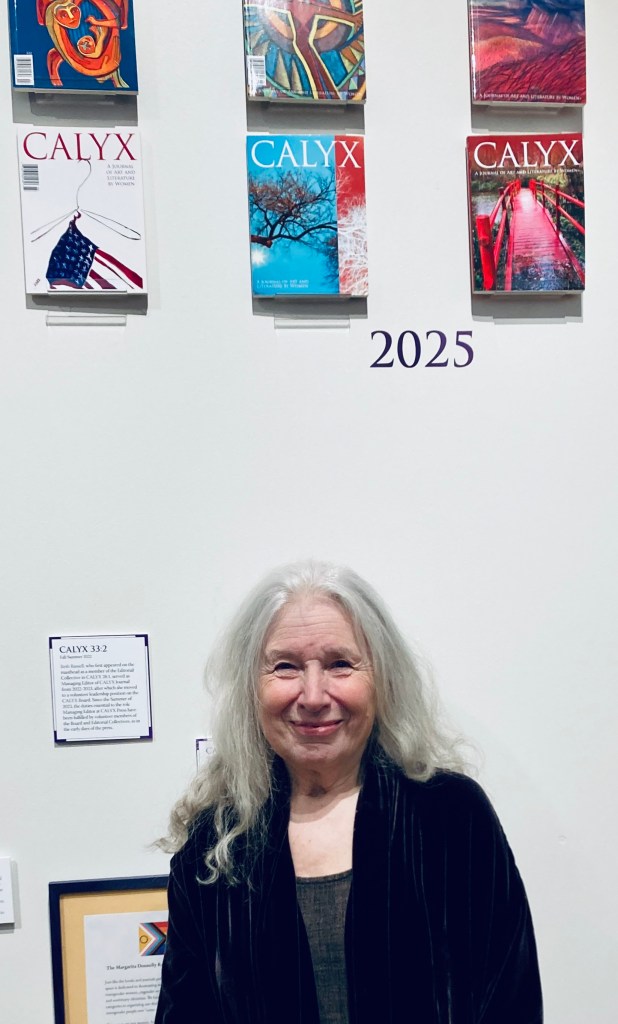
I didn’t take photos of the Herstory retrospective, but Sherri Levine asked me to take one of her pointing at the volume with her work, and so she took one of me. That evening, everyone dressed up for the Gala fundraiser, and I neglected to take a photo of Rebecca and me, but I have stories.
It is extraordinary that CALYX has survived all these years, that its founders began this work, that thousands of women contributed time and creative work, that hundreds of volunteers made it happen year after year, and current Board Chair Beth Russell stepped in a critical moment and has seen the journal into the black at a time when so many other nonprofits have come and gone, that women are not done, not mainstreamed. Not yet.
The county museum mounted a show detailing the “herstory” of the literary and art journal. You can find it in Corvallis at Benton County Historical Society’s CALYX Inc.: A Herstory of Radical Resilience. Hundreds of volunteers have kept CALYX alive and growing!
I don’t know how it happened, but I read the very first issue, of CALYX. I was a feminist as a teenager in the 1960s, marching against war and calling myself “Ms.” when people barely knew what that meant, and I had a subscription when we still lived in Seattle. Gary likes to tell people he didn’t change his name when we married. The truth is we each talked about what that would mean and even discussed inventing a new family name. So much was changing, so many things seemed possible
My fiction was first published by CALYX in 2006, and one of my [future] MFA mentors, poet and novelist Jack Driscoll, approached me at my first residency and said he’d heard my story had been accepted by Calyx. He said he’d read it and found Calyx an impressive publication. Indeed. That was the 30th Anniversary issue.
This past weekend, the opening choir was excellent, and early in the symposium, I was very grateful to hear Jean Hegland read from Into the Forest, a book I have much admired. That book, I learned, was essential to the survival of the press. It sold to a major press, found its way to France and translation. Today, it remains a huge hit around the world, translated into many languages, and soon to have a sequel.
That afternoon, I read the first pages of my early publication, “A Single Fact Can Spoil a Good Argument,” and when Beth Russell introduced me she called me “fierce.” [read: dangerous! or annoying! or loud! and generally bits of all that, I admit.]
An editorial panel led by Senior Editor Brenna Crotty, included the sole surviving founder, Beth McClagan spoke to those early days. They were four women at the start—Beth McClaren spoke, but Barbara Baldwin, Margarita Donnelly, and Meredith Jenkins have passed. They wondered aloud why there were “no women poets”? There were, of course, but they weren’t finding their audience through publication. With no funds, no experience, and only determination, the four met in living rooms and founded the publication 50 years ago, promoted, accepted submissions, designed, printed, and mailed the first issue all those years ago. Brenna Crotty was particular about highlighting that Calyx established a communal, feminist decision-making process quite unlike how most publications functioned then or now. Decisions are made collectively, rather than through hierarchy. All the editors read/view and discuss, offer diverse perspectives, agree and disagree, change their minds, and step aside. So it was at the beginning and remains today. Poetry, art, fiction and nonfiction editors attested to that.
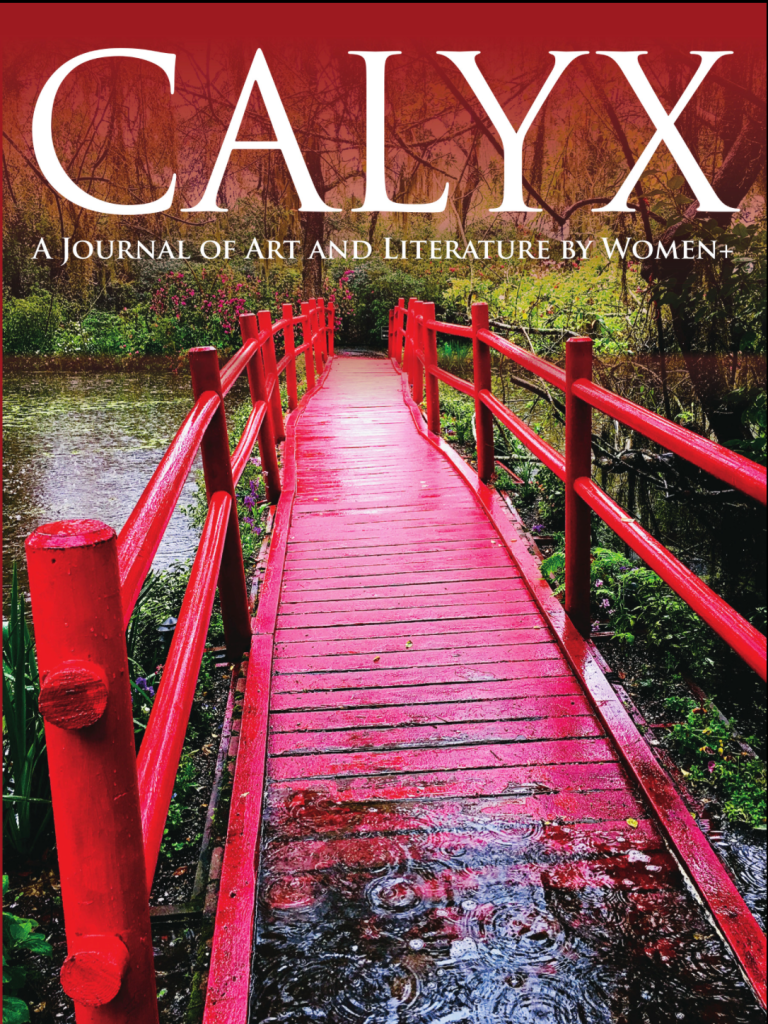
Calyx: A Journal of Art and Literature by Women+
As a late-comer, I spoke on that editorial panel as a representative of the visual arts for the journal. CALYX devotes 16 full color pages to visual art in each issue. Artists, please submit visual art! Personally I would appreciate more three dimensional art: metalwork, textile, clay, glass, etc. Preference for an exclusively narrow range of two-dimensional art does not live here. Calyx has published enamelwork, clay, sculpture, drawings, prints, collage, glass, and paintings. We want it all!
Many fine poets and prose writers read that day, musicians played and sang, and I must say that the history was overwhelming. In addition to writers, we heard from readers, assistants and interns, designers, bookkeepers, fundraisers, editors, and Board members. Volunteers built an archive and painted an anniversary mural. Beth did a fabulous job of celebrating the journals and introducing each speaker and performer and of placing people and events in context and in the chronology of the journal.
Wonderful music is not included in the journals but was with us throughout the day.
How did I find the first and still surviving women’s art journal? I recall the early issues coming in large paper envelopes. Most of my copies are gone, likely because everything went to school—I had bookcases and one four-foot shelf was filled with literary magazines. Over the years I subscribed to dozens. My more rigorous juniors did a first-term project using print sources. They were directed to find poetry and fiction in those journals.
My early rejections by Calyx to submissions during their narrow 1-month opening predate Duotrope and I am glad I have no record I care to search for of them. Rejections are no fun. The first story they published was rejected several times (many-many?) times before they took it. The second story they accepted had been submitted at least 62 times, and Calyx was the first to reject an earlier draft! It’s not a cheerful story, but answers the question that triggered it. A doctor I actually knew, who had been in practice locally, bankrupted his practice and killed his daughters and himself as a way of punishing his ex-wife. How does anyone recover from that? I wrote “The Promised Hour,” Like many of my stories, it was written to answer a question, and often the questions, for me, concern recovery. The trigger is never so interesting to me as what comes next. The closing scene of that story is something from my experience, though it was worse in 1970 when it was nearly impossible to report. This is why a journal of women’s literary and visual art, and this is why many poets and novelists and essayists are published today. It had to start someplace.
Credit the telling of stories for change. Women have been forbidden from telling the stories that offend or embarrass or question the truths of those in power. Telling is always hard, but the only way is forward. Can we recover from that brutal past?
How do we recover from terrible events? Because, my dears, we can and we do and we will.
At its founding, there were very few published women writers. The canon was entirely men, white men, every novel I was assigned in school, and every novel I was assigned as an undergrad, and even when I first went looking for a Master of Fine Art program in the 1990s, entire faculties were male. And white. It was part of the initial mission of the four founders that this should change.
In CALYX, you will find visual art, poetry, fiction, and nonfiction written by women from all over the world. Everyone from Ursula K. Le Guin and Sharon Olds to … well, most women authors from my time were once published in CALYX, in early or mid-career. It’s still happening, and you might be among those who read them first in the pages of CALYX. You might be among those published.
Subscriptions are just $15/year—three issues rich with the visual art, poetry, fiction, and nonfiction of women. [Soon to be a digital periodical.] You can also find book reviews for free online.
updated 3pm, the first day of spring, 2026
 IMPERFECT PATIENCE
I must admit that being allowed and invited to see a place where women create, share, and succeed gave me joy knowing that it’s enduring existence and survival
makes the necessity of it’s being both beautiful and hopeful
LikeLiked by 1 person
I remember early issues of Calyx were donated to the Isla Vista Community Women’s Center–which was a resource center that gave out phone numbers for crisis lines, and held a growing library of donated books, pamphlets, magazines and chapbooks from second wave feminist presses from the late 60s & early 70s. When the UCSB Women’s Center merged with the IV community women’s center, some of that library eventually found its was into the university library’s Special Collections. Some of my writing (submitted handprinted, mailed close to the deadline) was rejected by the Calyx collective, which was discouraging, although it didn’t stop me reading the newer editions when they were available. What I love about Calyx is its attention to and respect for all genres of Art, its inclusion of a diversity of women, and its ability to survive and grow with those of us who are still here, still trying to remain hopeful and creative as the world around us faces battles from all sides, for many reasons.
LikeLiked by 1 person
Thank you, Mimi—yes to all of this.
LikeLike