An imperturbable demeanor comes from perfect patience. Quiet minds cannot be perplexed or frightened, but go on in fortune and misfortune at their own private pace like a clock during a thunderstorm.—Robert Louis Stevenson
The signature CALYX image celebrates fifty years of CALYX: A Journal of Art and Literature by Women+ founded in 1976, on the 200th anniversary of our nation. It served as a reminder of the great ambition of readers and writers, makers and thinkers, a reminder that we have not yet reached our ideals.
Last weekend, Saturday the 14th, I was in my hometown, Corvallis, Oregon, for the 50th anniversary of Calyx: A Journal of Literature and Art by Women. Gary doesn’t care for events (to be honest, neither do I), so I would have attended alone. Fortunately, I was joined in the day’s events by my friend, once-writing partner, former student, and current popular college professor Rebecca Olson, author of ARRAS HANGING: The Textile that Determined Early Modern Literature and Drama (2013) and Early Modern Reading and the Imagined Self (2025), as well as numerous articles on Shakespeare, early modern textiles, and inclusive pedagogy.
NOTE: I should be working on fiction just now, but one of my shawls found a home far away from here, I am reminded of thankfulness, and I’m sharing an assignment I enjoyed doing myself over and over again.
My husband Gary worked in and managed a farmers’ cooperative for over nineteen years. It was a United Grocers store, but as manager he brought in products from many vendors. It’s been twenty-five years since he left that job, but he still has an eye for the way stores are stocked. When I ask him to pick up a particular product, he looks for the UPC number [the barcode] to be certain he gets exactly hat I want. While we were waiting for servicing on our car, I walked into a Hispanic grocery in Hillsboro. Even I knew he would admire the produce. It took some coaxing to convince him “you have to see this” because he wanted to get back to the car. He declared it wonderful. The whole store made him smile.
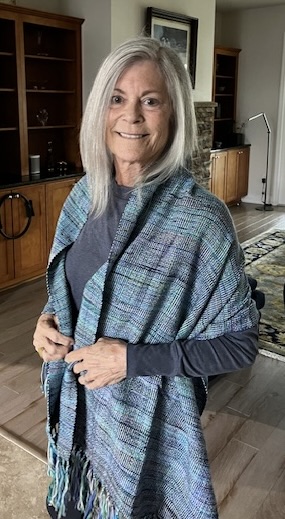
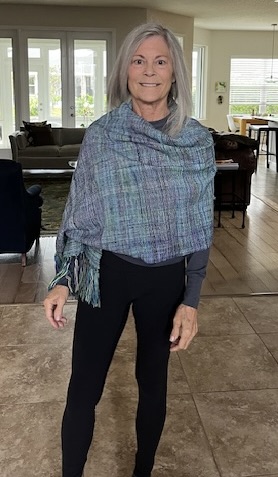
Kathy in Florida was visiting in Cannon Beach last month and bought this shawl on faith—I had barely begun weaving it in the gallery, but she liked the colors and trusted.Continue reading →
“Trigger” does not refer to the horse “Trigger” but the warning, though I am only talking about my own triggers, especially cigarettes. So this isn’t exactly a warning, but more about writing, and you can probably read this essay without needing to be warned.
When I first began teaching the essay, the concept of creative nonfiction was still relatively new. A student contacted me about his college elective choices and asked: What is creative nonfiction? The definitions I found were not entirely clear, but I assigned creative nonfiction even so. My students were to search back in their lives for a genuinely peaceful place, a idyllic place where they were comfortable and happy, and then describe it using all their senses. It could be a single recent experience they describe, or one they experienced many times, or someplace they went in young childhood. If they did it well enough, the essay they wrote was profoundly satisfying to write. Their ability to recreate their peaceful place on the page would remain with them as a calm place forever. At least one student got into a private college by revising this for her application essay—the acceptance letter told her as much. I have probably written here about this assignment before, but if I go look I will lose my main point which is about another essay assignment. The persuasive essay.
I got in a couple of running miles this morning. We have pretty much nailed down our weekly routine but I still have to think when I first wake: Where am I?
We found nineteen pieces of sea glass yesterday, seventeen the day before.
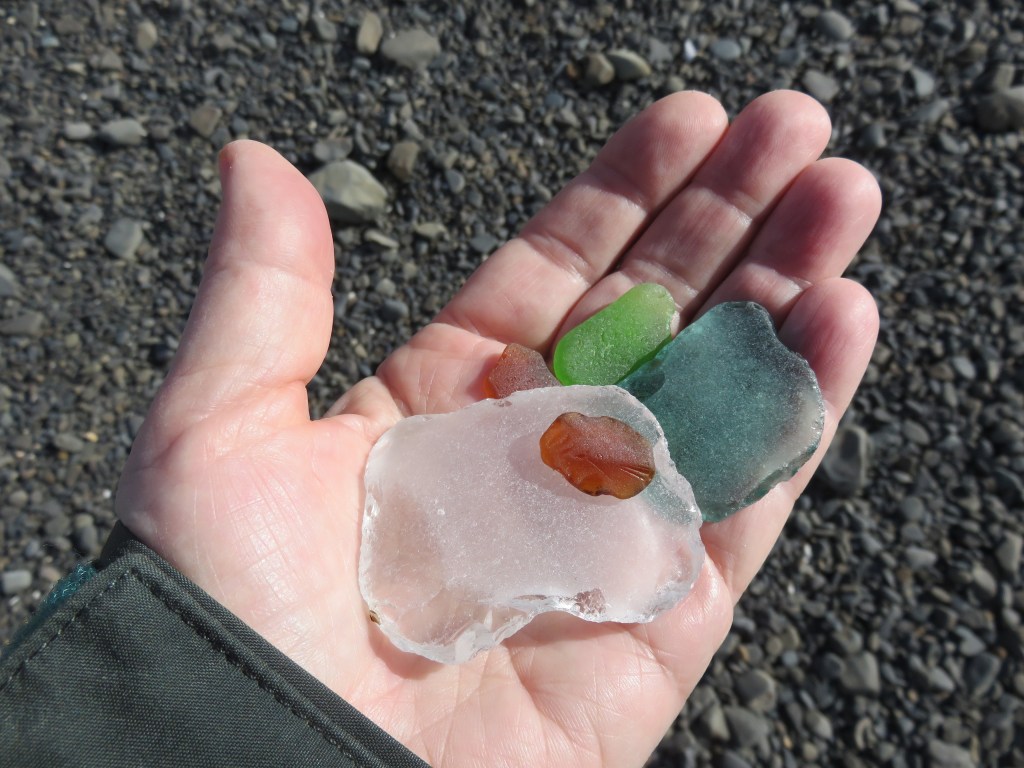
This photo isn’t from yesterday, big pieces but representative of the colors we most often find: colorless, pale greens, brighter greens, and brown. There are colors we each particularly rejoice to find. Gary once found a large cobalt blue piece. I love a peculiar intense and old blue-green.Continue reading →
Yesterday morning I was reading the Brevity blog, one of my favorite sites. Jeanne Bonner explains “The Obituary We All Need (To Write)” citing the one she wrote for her father. At 250 words it utterly failed to capture her father, the person he was, the parent, the complications of their relationship, her grief at his death. She felt she had to write more. She argues that many of us need to do this, to write the complete obituary with more thought, and that words pressing the bruise might be just what we need for our pain to begin healing. That a more complicated view might return the brightest moments we treasure.
A close-up of the backing and front of a quilt sewn entirely of vintage Indian cotton.
I am skipping my original Exercise #4 because it is only about how to express the same idea several ways in an academic essay (especially the thesis), which was what I was teaching. We’ll skip ahead to something more interesting.
Yes, I am writing this part of my Monday post early so that by the time you read it I will be someplace else and doing something other than writing. There, see how I did that? Present tense and future in a single sentence?
I ran two miles, only some of it uphill, on Friday morning. I earned my Kouign Amann pastry from the bakery. I do not, sadly, think they will hire me. The “Hiring” sign is still in the window and the back-of-the-shop manager I talked to was encouraging, but the two men I talked to the first time looked at me as if I were stale bread. I know that look.
This is not one of my new weavings but an image I found filed away. My December warp is greens and the one I just finished for January is blues and violets, some smokey and some near peacock-bright. February will be corals and copper reds with pale lavenders. Maybe. One warp a month—I’ll see where I am with my huge stash at the end of the year.Continue reading →
I began writing this on Tuesday, three days ago, and you won’t read it until Friday morning. It was a chilling, damp morning but we walked north to the headland, zig-zagging back home. We spotted the little shore birds on our way north, found sea glass walking both directions (35 pieces by the time you read), and heard five sirens and met a couple of friends and dogs we know on our way home on the inner road. A log truck drove off the road and into a muddy bank. I don’t know how that went or if anyone died. I will not even know by Friday morning.
Shorebirds waiting out the terrible weather. (Gulls ion the other side of the creek. Can you see the little birds on the near side, mostly with their heads turned away?) We missed our walk two days this week, but went out in damp and drizzle the other five days. My fingers chilled to pale and senseless on those days we went out for an hour or two as I bent over for dozens of rock and bits of sea glass.Continue reading →
2. The monster sentence. Begin with a simple short sentence—“I baked bread”—subject verb object—and then turn it into a “monster sentence” of at least 100 words. This exercise is straight out of Stanley Fish's playbook. Use every trick you know to ensure that the sentence is grammatically correct and not a run-on, use long dashes (em-dashes), semicolons, lists. Then explain what you’ve created, reviewing what you’ve written, phrase by phrase. NOTE: The explanation should be longer than the original sentence. Write nonfiction, then explain your work.
My assignment grew long, I mean reeeeealy long. I only needed 100 words and I have considerably more words… and that’s after I edited and carved it back a little. Then I revised and cut it back into shorter (but still with monster) sentences. And that’s when I found the point of it all.
In Seattle, especially while I was a student at the UW, people would ask, “Is the mountain out?” They meant, could you see Mount Rainier? Locally, it’s Castle Rock, 0.6 nautical miles offshore, that sometimes disappears behind a cloud bank or fog.Continue reading →
Writing Good Nonfiction Sentences… one exercise each Friday.
First the necessary introduction. NOTE: several of these exercises are inspired by How to Write a Sentence: And How to Read One by Stanley Fish, Steering the Craft by Ursula K. Le Guin, and other sources.
A good essay has a goal—to convince, delight, enlighten, instruct, warn, or to review and question. Part of becoming an accomplished writer involves understanding the work that every word must accomplish.
Each sentence has specific work to do. In a very real sense, sentences are the basic building blocks of writing. Lay down one word after another until you have created a logical idea in the mind of the reader and that is a sentence. Do it with grace and style and that’s good writing. But in order to write a good sentence (or to read and appreciate a good one), it helps to understand the various ways a sentence can function in the essay. Forget about content (for the moment) and try pushing the envelope with these exercises about sentences.
THE EXERCISES: These brief exercises require you to write a nonfiction sentence. Sometimes they require that you write several. Look at the examples and follow the directions after “assignment.” AND Whether this is specified or not in the instructions, on the same page you should also explain the sentence in detail. Don’t be surprised if the explanation takes up a lot more space and time than the sentence. What does the sentence you wrote accomplish? What did you learn by writing it and thinking about it? How might you have learned a skill you can transfer to other writing?
That said, this assignment is pushes sentence-length to create a single “monster sentence.” There is a model and explanation following. My students loved this assignment.
Gary is standing beside the larger stump revealed by the shifted coastline—note that I wasn’t exaggerating about it being four feet across.Continue reading →
REFLECTION: My nonsense rewriting of Lewis Carroll was tricky only because auto-correct kept fixing my words to make them sensible. I left all the ordinary words—articles and prepositions—while doing my best to watch Carroll’s verbs, nouns, and adjectives. The sensible version was much harder. I went to RhymeZone.com to hunt for my last word. The site offers many options for rhyming 1-, 2-, and multi-syllabic rhymes. I replaced a conjunction “and” with a preposition “with” and that felt like cheating. My use of “still” doesn’t quite work—the entire last line doesn’t work. And this is because I wrote it backwards—I found the words first instead of the meaning. What was I thinking? I hope you didn’t do that.
Reflection, metacognition, thinking about thinking. Thinking about writing. What works, what might work next time.
Perhaps I should call these “exercises” instead of “assignments” since I think many people have issues concerning assignments?
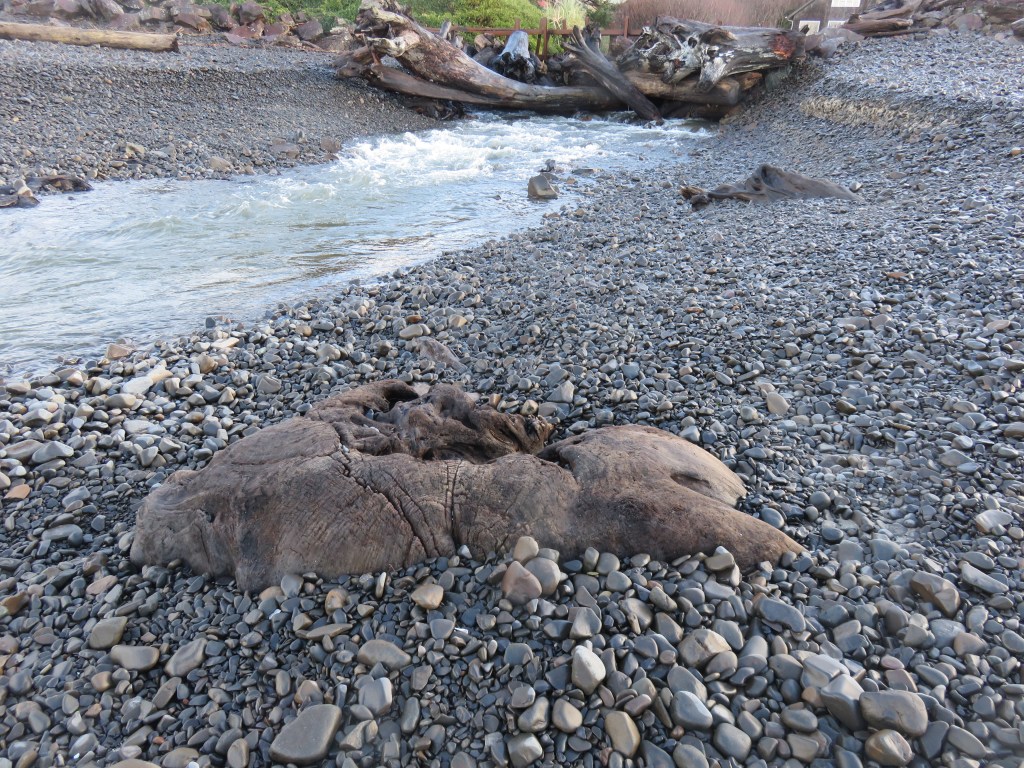
This is a creek that carries water from what used to be two creeks (Shark and Asbury) on my old map. There is a huge iron barricade to prevent (usually) drift logs from being carried upstream. That’s what you can see at the top of the image. In the foreground is the stump of an ancient tree, perhaps four feet across (not around, but across!) that Gary and I had never seen uncovered before. There are other “ghost trees” along the coast. Perhaps, as was suggested by visitors, these are remains from the tsunami resulting from the earthquake that occurred along the Cascadia subduction zone on January 26, 1700 with an estimated magnitude of 8.7–9.2. …Or not.Continue reading →




 IMPERFECT PATIENCE