Writing Good Nonfiction Sentences… one assignment each Friday.
NOTE: several of these exercises are inspired by How to Write a Sentence: And How to Read One by Stanley Fish, Steering the Craft by Ursula K. Le Guin, and other sources.
A good essay has a goal—to convince, delight, enlighten, instruct, warn, or to review and question. Part of becoming an accomplished writer involves understanding the work that every word must accomplish.
Each sentence has specific work to do. In a very real sense, sentences are the basic building blocks of writing. Lay down one word after another until you have created a logical idea in the mind of the reader and that is a sentence. Do it with grace and style and that’s good writing. But in order to write a good sentence (or to read and appreciate a good one), it helps to understand the various ways a sentence can function in the essay. Forget about content (for the moment) and try pushing the envelope with these exercises about sentences.
THE ASSIGNMENTS: These assignments require you to write a nonfiction sentence. Sometimes they require that you write several. Look at the examples and follow the directions after “assignment.” AND Whether this is specified or not in the instructions, on the same page you should also explain the sentence in detail. Don’t be surprised if the explanation takes up a lot more space and time than the sentence. What does the sentence you wrote accomplish? What did you learn by writing it and thinking about it? How might you have learned a skill you can transfer to other writing?
That said, this first assignment is mostly for fun.
1. Sounding sensible. Syntax is how we arrange words to make sense. The ordering of nouns, verbs, adjectives is familiar in ways that surprise us. We know quite a lot about our own language, even when it’s nonsense. Have a look at a nonsense sentence from Lewis Carroll’s “Jabberwocky.” You probably know, don't you, that "toves" is a plural noun, that "gimble" is a verb—you do, don't you?:

‘Twas brillig, and the slithy toves
Did gyre and gimble in the wabe;
All wimsy were the borogroves,
And the mome raths outgrabe.

Don’t bother trying to figure out what this verse means. It doesn’t. Instead, try something fun: Replace each nonsense word, matching with another of the same part of speech (e.g. noun for noun, adjective for adjective), using other words that have no meaning. “ ‘Twas” is an archaic contraction meaning “It was,” so you need not bother with that one, if you want to keep it. Replace: brillig, slithy, toves, gyre (this one is a real word, though I suspect Carroll wants us to mispronounce it), gimble, wabe, wimsy, borogroves, mome, raths, and outgrabe. You should also create a second verse that makes perfect sense—two four-line stanzas, one version that is insensible and one that makes sense. Match syllables, accents, and use rhyme (though not necessarily the same sounds) while you’re at it. Rhythm works in an essay in the same way it does in fiction, and while this is poetry, it’s still a powerful device to have in your toolbox.

ASSIGNMENT: Rewrite Carroll’s verse, twice, creating two versions by maintaining the original structure,  rhythm, placement of rhyme, linebreaks and so forth, by replacing words with others of the same function (verb for verb, etc.), one with nonsense words, another version with real words. Then explain what you did, why, and what you’ve created as a result. This assignment doesn’t seem like it could be nonfiction, but do it anyway. Consider it a warm-up and have fun.

Paste your assignment into a comment below. On Monday, I will share what I wrote, debrief, and suggest where to take this next.

———————————————————————
But first, I will share part of yesterday's Letters from an American by Heather Cox Richardson:

Just before sunrise on a November day in 1861, Massachusetts abolitionist Julia Ward Howe woke up in the Willard Hotel in Washington, D.C. She got out of bed, found a pen, and began to write about the struggle in which the country was engaged: could any nation “conceived in liberty and dedicated to the proposition that all men are created equal” survive, or would such a nation inevitably descend into hierarchies and minority rule?

Howe had faith in America. “Mine eyes have seen the glory of the coming of the Lord,” she wrote in the gray dawn. “He is trampling out the vintage where the grapes of wrath are stored; He hath loosed the fateful lightning of His terrible swift sword; His truth is marching on.”

She thought of the young soldiers she had seen the day before, huddled around fires in the raw winter weather, ringing the city to protect it from the soldiers of the Confederacy who were fighting to create a nation that rejected the idea that all men were created equal: “I have seen Him in the watch-fires of a hundred circling camps; They have builded Him an altar in the evening dews and damps; I can read His righteous sentence by the dim and flaring lamps, His day is marching on.”

Howe’s Battle Hymn of the Republic became inspiration for the soldiers protecting the United States government. And in a four-year war that took hundreds of thousands of lives, they prevailed. Despite the threats to Washington, D.C., and the terrible toll the war took, they made sure the Confederate flag never flew in the U.S. Capitol.

That changed a year ago today.
 One of the things going on in The Adventures of Huckleberry Finn, perhaps the main thing, has to do with the essential decency and indecency of human beings. Huck himself is an innocent, accepting the bigotry of his time because he assumes his “betters” are actually better. Even so, he will risk his soul for Jim. And the grown man and father, Jim risks his freedom and life to safeguard the life of a child, which makes him the most moral person in the novel.
 Last night, just before sunset, a deer appeared on the shore. Not a good thing in daylight. She was wet and confused and kept to the surf line. We see deer tracks frequently in the sand on our morning walks, but never the two deer themselves. This one moved along just fine, though she did not look happy, and the tourists with their dogs had all gone home. Local dog-owners came out on the beach, saw the doe, and leashed their dogs. Perhaps she had been separated from her companion, which I assumed from its smaller tracks was a yearling fawn? She stood right in front of our house, trotted north and then back south. And then the sun went down.
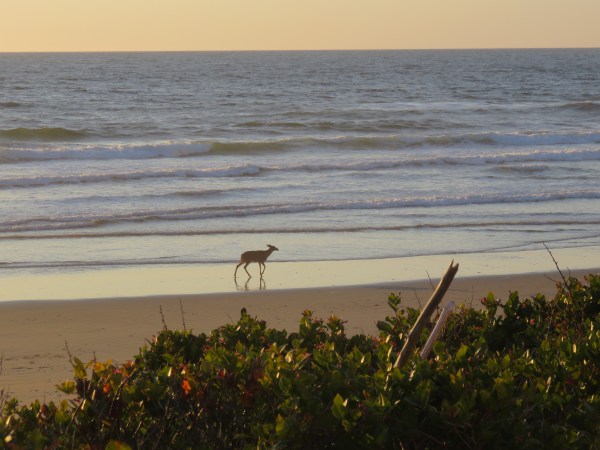 I should note that I took the photo above with a zoom from our deck. We are careful to avoid approaching wild animals. It is distressing for the animal and can make a bad situation deadly. Locals understand it is best not to “help” a wild thing.
 &PRIDE Press