I began writing fiction in 1990 as a result of a week-long summer class for teachers teaching writing. I had three art degrees and had taught art at an elite prep school but had been hired to teach English and Yearbook at the local public high school. On paper I was not remotely qualified for that position teaching English. The department chair urged me to apply because I’d subbed for her and she said i was better read that she was.
Over that long-ago summer of 1990 I prepared by passing the NTE exam, which granted me certification and taking graduate classes in English, writing, and computers. A writing-for-teachers class with Sandra Dorr offered assignments we might then use with our students. I did go on to use what Sandy suggested. Also, at the end of that intensive week, I went home and wrote my first short story, “Baptism.” Eventually, that story was published in Stringtown. I was teaching English part time to high school juniors and made it my policy from the beginning to write everything I asked my students to write. I stood by that policy for the next 25 years, despite a colleague telling me it was “ridiculous.” I’ve been a strong writer since I was a girl, but essays and poetry, not stories. That changed.

In the 1990s I began writing with a student over the summer. We met weekly to share progress and intended to each write a novella. But before mid-summer, it was clear we were writing full length novels. Hers was better than mine, and today Rebecca Olson is a tenured professor with many publications including two books. I am proud that two other former students have MFA degrees.
I continued writing short stories and completed a half dozen bad novels. I took classes and workshops from Judith Barrington, Marilyn Chin, Sandra Dorr, Karen Joy Fowler, Jason Friedman, Molly Gloss, Karen Karbo, Dorianne Laux, Ursula K. Le Guin, Bret Lott, and Suniti Namjoshi. Thanks to Ruth Gundle and Judith Barrington, I attended summer workshops at The Flight of the Mind from Molly Gloss, Janice Gould, Gish Jen, Lynne Sharon Schwartz, Charlotte Watson Sherman. I am deeply grateful to them all for sharing their skill and wisdom. I began publishing my work. I
n 2007, I completed a Masters of Fine Art in fiction after working with Claire Davis, Jack Driscoll, David Long and Valerie Miner. I was chosen Class Speaker at my graduation. I began teaching college writing and thought of myself specifically as a writer of fiction. I published several short stories. By then three instructors had encouraged me to write speculative fiction.
My sixth novel began as a short story in 2018 and evolved in a long process. It came to be called ALL THE DAUGHTERS SING, and it’s my last, best, and final effort. I found a publisher for the short story version—thank you, Morris Allen of Metaphorosis. I even found a publisher for the novel version back in 2023, withdrew other submissions, and that’s when things got messy. I was not working with one or four editors as I would have with most presses, but, as director of the program assured me, I would be fortunate to work with forty editors. This was meant to make me feel well-supported. What I thought at the time was about the old joke about a camel is a horse designed by a committee. However, I was just so very grateful to find publication, I ignored my concerns. These were young people building their resume, not trained professionals or even experienced amateurs devoted to literature. (My eventual Project Manager had an undergraduate degree in English but had never read anything by Ursula K. Le Guin. She hoped to become a cover-designer.) I should have heeded my doubts. I met deadlines and they never did, and there were misunderstandings (both sides) and contradictory suggestions (theirs, mostly in the 17k words of suggestions in a letter plus annotations) and incompetence (mostly mine). Still, we got through DE. The comparables they offered for the cover design were very smart, and someone knew enough to mention Charlotte Perkins Gilman’s Herland in the seven paragraphs of back cover copy. However, there was Ursula K. Le Guin’s name misspelled again after I’d already corrected it. The back cover copy failed to follow industry standards. Then four sample cover designs for my book arrived. I was offered a vote, along with the entire team—which meant my vote was 1 in 40? Typically, the author is offered several cover drafts (3-4 is typical) and is allowed to choose which one to go forward. The press always has the final word about covers. Remember, I have three art degrees, twelve years of Yearbook, and was a free-lance graphic designer for many years. One of the offered cover designs (sadly, the best one) featured the work of a pedophile painter, which they withdrew, and others were direct copies of covers and used ugly fonts—that may have been negotiable. The final straw was vigorous defense of a cover using a bad painting of a young white woman. That it was a poor quality painting initially bothered me more than the fact that there is only one white woman in my novel. She’s 80 years old. I could easily have been out-voted and saddled with that ugly nude on the cover of my book.
Now I can admit that this press was foolish to accept my inadequate manuscript and I was foolish to sign with them. Almost a year ago I offered to return the $500 advance and they took it. Done.
[In the mean time, my blood pressure was reading as stage 3 hypertension, Gary’d had surgery that went very badly and left him struggling throughout these months while I was dealing with the press, and we were concerned our tenant was going to kill someone driving drunk each day. He smoked a lot of weed and got himself thoroughly toasted each evening. Gary talked to him every day, and if you’ve been reading you know he totaled his car this past September without killing himself or anyone else.]
I was reading and writing book reviews and designing covers to calm myself.
I owe acknowledgments concerning ALL THE DAUGHTERS SING. I’d hoped to send copies of my novel, one way or another, but this is what I can do: I am grateful to my generous readers. Molly Gloss read my manuscript as novella and novel twice and talked me off a ledge more often than that; Bette Husted, Felicity Shoulders, David Moskowitz, and Tessie Word read various drafts, D.G.S. Burke said our novels would be friends, and my dearest reader and writing partner Rebecca Olson read and commented twice and has been supportive for as long as I have been writing. I am most grateful for people will to read my words! Angela Griffin and Emmily Tomulet, Rin Kane and Becca Moss of Ooligan acquisitions provided support. The authenticity readers I found—grad student Shamima Ahmed, language teacher Jaehyun Lim, Welsh translator Emyr Wallace Humphreys, linguist Jordan AG Douglas-Tavani PhD, and editor Ruth Gundle—read individual chapters and provided essential input about Muslim, Korean, Welsh, First Nations, and Jewish culture. My pelican beak exceeds my experience and errors were my own.
I acknowledge and honor the rights of indigenous peoples around the world to tell their own stories. This novel contains viewpoints far removed from my own because the world is more interesting than I am and I imagine a future humanity as diverse and surviving, cooperative and kind. I thank you all. I’m sorry I’ve failed to complete the work in publication
I was charmed by it, which is maybe an odd thing to say about a book in which almost the entire world dies, but it’s written with such a kind hand, how could I not be charmed.—MOLLY GLOSS, who is being kind herself, and is author of six spectacular novels including The Hearts of Horses and The Dazzle of Day, and the recent speculative story collection Unforeseen
In the past months, I’ve revised my 75,000-word novel to an 80k word novel, to an 82k novel, then cut in half to 40k, then revised again to make 50k. I continued to revise DAUGHTERS through this winter. It’s about sixty-one thousand words today, and I’m done.
My novel remains under consideration by 15 presses, and most of them are well into reviewing my submission so I won’t withdraw it because letting go is hard. They will respond over the next months. I’ve wasted money I can’t afford anymore entering contests, and small presses often need a year to make a decision. One of the slower presses has had my manuscript for 312 days so that one is close to responding, but another is eight months off. They will each send me a form rejection expressing their regret and wishing me luck placing it elsewhere. I will have wasted their time. Mine too. No one will publish my novel. I accept that.
As I write this post, my novel has already been rejected 118 times (one hundred eighteen rejections) by agents and small presses over the ten months. It’s not a record, not even including other rejections and withdrawals from two or three years ago leading up to that disastrous acceptance. The current draft has a new opening and the suggestion of a surprise at the ending. I’m pleased about that. It’s a lot stronger novel now, and there’s a decent chance that if I could start over from here, an agent might have considered it, or a small press might have seen some value in my story. Maybe. Or maybe it just isn’t as good as I like to think. I accept that too.
But I’ve handled this process badly and there’s no going back. It’s too late to finally figure it out and start over. I have no writer-friend I’m willing to ask for a further reading. Their lives are already busy. So let that be the lesson, a lesson I always taught about submitting work: Do your research both before and after drafting. Revise as you discover, rethink, and find meaning. Revise and revise until there is absolutely nothing more you can do. Read it aloud. Then read it again, before sharing. Find readers who will work with you. Accept all suggestions as possibly correct and work with them until you are genuinely certain what you have is done, not merely that you’re sick of the process. Achieve perfection. Even though, yes, you will find more typos and other errors every time you read it through. Then go through all that again concerning your submission packet: the synopsis, query letter, comparables and target audience, the shorter pitch, the one-sentence pitch, the tag line. That pitching materials process will take you back again to the manuscript and another round of revisions. Expect new drafts of everything. Have patience. Check with readers. Then submit to presses.*
I did all that but I submitted too soon—an amateur mistake. And my novel is a hard sell, what people call a “quiet novel” with no thrilling adventure, no romance, no violence. Grief and joy, struggle and wonder. I offer death and possibility. And that possibility isn’t enough and never has been. I’ll accept that. Done. I’ve deleted my “press kit” from this site, such as it was. I cut all the supporting links for the research and science. I’ve pulled back as much as I can. It’s time to give up.
[*And this “writing” process is only before the book seeks and finds a press. Most writers will insist what follows is harder: developmental editing (DE), line editing, copy editing, cover copy, interior design, and then ARCs, promotion, supporting obligations online and in person, and readings. The work of publication requires a completely different skill set from actually writing the book.]
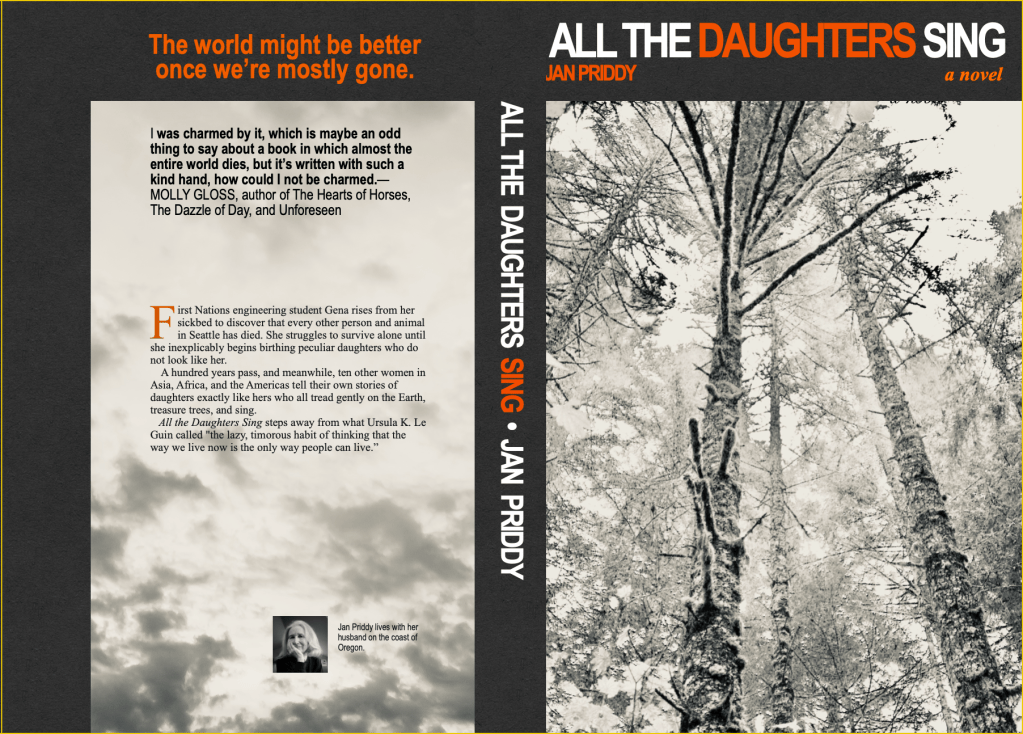
The image below shows a design of back cover, spine, and front cover at right. It’s mere play because authors never get to design their own covers. I enjoy seeing it here and I loved writing the novel and designing covers, even though I will never hold the book in my hands. I am allowed to give up. I am allowed to decide there are wonderful books I could read instead of pursuing publication.
Things never seem to go as planned. We meant to make a fuss for our 50th wedding anniversary. I managed to reconstruct Gary’s lost wedding ring I made for him all those years ago, but the rest of our plans fell apart. A pieced quilt top is hanging in my closet, waiting for me to find the money to have it machine-quilted. We had a vacation in mind this year, but instead we’re remodeling. Things happen. We’ve been cleaning, repairing, and remodeling our thrashed rental because we can’t afford to pay to have the work done—necessarily, a contractor, electrician, and plumber are doing what we shouldn’t.
We pulled the vinyl flooring out of the rental kitchen earlier this week and there is scraping and cleaning and painting to do. The cabinet doors are back on, but I expect to spend a day shaving edges until the kitchen drawers open and close as they should. The electrician suggested a “simple” shower ceiling that is not at all simple for us, and the electrical costs are potentially much worse than we feared. The plumber’s job will be to reset the toilet and check for a possible faucet leak.
It’s a sweet 1-bedroom with a bit of an ocean view. It’s clean and what my mother would have approved of as being “beachy.” Every contractor who has looked at it suggests a rent more than twice what we charged, We’ve done a good job making it comfortable so far, especially Gary cleaned from ceiling to floor, inside and out, and I am painting throughout. Just saying I would be comfortable sleeping in the unit now, at least once I’ve finished the kitchen floor, the electrician installs the new lights, and Jeremy comes to put the door on the bathroom. I hope to order blinds in a week or two, once my Social Security check is on its way. It’s a tricky balance between needing the rent to pay our taxes and savings through DIY. I’d hoped to find someone to rent it this month, but these things take time.
We are aiming for Gary’s target date: completion for rental in March. I hope to post before-and-after photos in a couple of weeks. Word of mouth has always made long-term renting easy for us because there’s very little long-term housing available on the coast. There’s nothing available here in Arch Cape at all just now. We’ve tried to keep our rent reasonable—enough to afford to live here. All our neighbors rent short-term, for which they are supposed to have a permit and pay fees.
Wish us luck getting our one-bedroom rented for March.
 IMPERFECT PATIENCE
I certainly enjoyed reading Daughters…now I want to go find our correspondence to see what I had to say about it that might have been more useful than “I enjoyed it”
LikeLiked by 1 person
Thank you, anon.
LikeLike
Sorry. This is David Moskowitz….I’m on strict FB quarantine hours, otherwise I would have responded there immediately.
LikeLiked by 1 person
I’m so sorry! I add my thanks to you, David. I appreciate you reading that draft.
LikeLike
Thank you for this glimpse into your (writer’s) life. I always enjoy reading about your experiences and your stories.
Jean M
LikeLiked by 1 person
Thank you, Jean.
LikeLike
If it’s of any comfort, I love the cover you designed for your book. Never say never (or give up) – maybe one day, if no one accepts your book for publication, you WILL have enough money to self-publish it and decide to do so. Life is a crazy journey, so hang in there! And thanks for continuing to blog – I enjoy reading it:)
LikeLiked by 1 person
❤
LikeLike
Hi!
I have a lot of time for you and of course would read Daughters again, self published or in progress!
Your cover design is gorgeous and a commercially successful fiction writer friend (Random House etc) often insists that he design his own covers. Why did your publishing experience unfold this way? Likely because you have integrity, grit, artistic conscientiousness and ultimately you are punk rock!
Love
Tessie
LikeLiked by 1 person
Too kind, dear Tessie
LikeLike
as Dafydd Iwan sang Yma O Hyd and so we carry on–keep moving-stay warm
LikeLike
Ha! I just found a post that might have been an answer to mine. “Some of the hardest questions I answer, besides what’s the next big trend? (¯_(ツ)_/¯), is how to know when an author should shelve the project they’re querying and move on. Some writers wonder if there’s a rejection count to hit, like after 59 or 87, or 312 rejected queries it’s incontrovertible proof that the book is not going to make it and you should shelve it.”
LikeLike