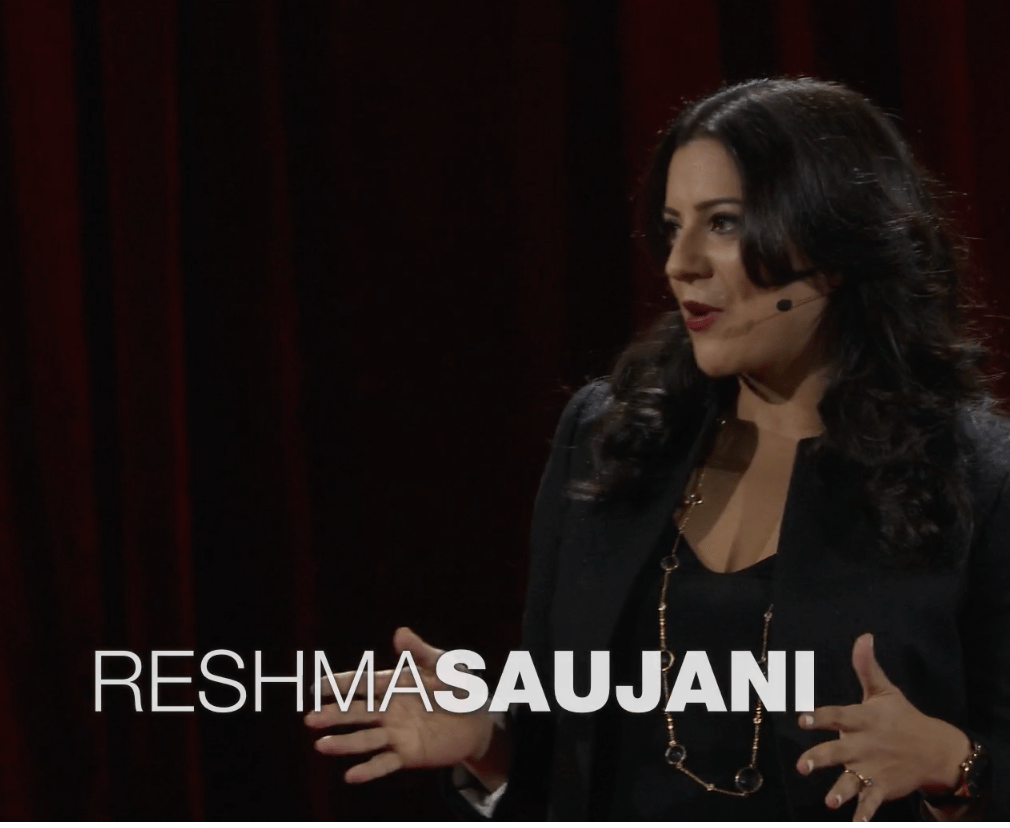
I watched a TED talk that insists women could be better. They should be more like men. We’re raising our girls to be perfect, and we’re raising our boys to be brave, says Reshma Saujani, the founder of Girls Who Code. Girls need to be more like boys, she suggests. They need to take more risks and demand jobs they are unqualified for. It works for the boys.
It’s a worthy goal to identify what holds girls and women back and to offer encouragement. Surely we underestimate the potential of girls and women in our culture. We actively stifle their potential. We should identify changes in their behavior and in our system that hold them back.
But. I am also tired of people urging women to behave more like men at their worst. Saujani describes how, in an experiment, 5th grade girls, especially the smarter ones, give up on “an assignment that was too hard for them.” I’d argue it’s a waste of time struggling against something they can’t do, an assignment specifically designed to be impossible for them. Recognizing that might even be termed smart because that’s not “giving up,” that’s sensible. Just as it’s possible to be persistent without being foolish, it’s possible to be sensible without being a coward.
Fifth grade boys, in contrast, will try to complete that assignment again and again, even hurting themselves (and others?) in the process. [I will say that that’s not my experience. Boys will kick their feet and scream that it’s not fair.] She calls the behavior of those boys unable to recognize they don’t have the skills for a task “brave” and “determined”. That bravery as she describes it, is recklessness and hubris. She describes boys jumping head first off the monkey bars as symptomatic of their bravery. Most of us would see it as… stupid.
There’s judgment of these children, but only of the girls’ choices. Children can be encouraged to be courageous without doing stupid. Failure doesn’t have to fail us; we can learn our limits without limiting our future.
I was not more than 7 or 8 years old when a group of older local boys dared me to jump out the second-story window opening of a house under construction. Those boys knew me as a tough little girl who climbed highest in trees. I thought I could do it, but I also remembered something my father had told me: People who dare you to do something are trying to get you to do something you can choose not to do. I looked down at the hard-packed earth below me and said, “no.” I wasn’t being a coward. When the boys jeered at me, I laughed. Saying no was the harder thing to do, but I learned that day to claim choice And that same day, one of those boys broke his arm jumping.
Girls are socialized from the instant of birth to be “good,” to conform, to smile, to appease, to be neat and small. Humility is insisted upon. Self-effacement. Modesty. In many families, it is the boys who are given preference and preferential treatment. Girls aren’t supposed to notice that, their egos are not supposed to be damaged because Daddy only cares about the son. [How many times have I seen that scenario—because she does notice and struggles to overcome a bias her father takes for granted. It’s enough to make a smart girl “crazy”, and I’ve seen that too. It’s enough to disguise neurodivergence, cause depression, and make a normal child simply give up trying.] Our children learn these prejudices at home, from our culture, in school where boys will be boys and girls should sit quietly, and later when they choose a college major and what jobs to apply for.
It’s well-documented that men apply for jobs they are unqualified to win and they present as self-assured and capable, and they win those jobs because employers trust that confidence over demonstrated skill. Men assume they should have the job, just because. That’s what some might call entitlement. [Hint, that’s what I call entitlement.]
There is a sense that women are to blame because they won’t apply for that job unless they are fully qualified. They “give up.” It’s sad, really, because that’s not giving up, that’s reality. She won’t get the job unless she’s fully qualified, and sometimes not even then. Yes, girls should be encouraged to be courageous and to know they don’t need to be perfect. At the same time, the ability to succeed despite imperfection only works when they can pass “imperfection,” because HR is looking for a man.
Boys and men need to learn a little humility and kindness. HR needs to hire the most qualified individual. None of that is happening, and blaming girls for the injustice is… ironically unfair. It perpetuates the problem without necessarily solving anything. Male entitlement is a problem, not an aspiration we should be serving up to girls, not an egotistical worldview we blame girls for failing to cultivate.
Henry Higgins sings in My Fair Lady: “Why can’t a woman be more like a man?” Completely oblivious to his grossly inflated ego, he is unable to acknowledge, much less accept, Eliza Doolittle’s value as a human being. That play and film is based on George Bernard Shaw’s stage play Pygmalion, which is itself based on the mythical story of a misogynist who creates a work of art in the form of a woman so beautiful he falls in love with her. Shaw’s superb satire allows the “creation” to talk back, but at the end of the musical version, Eliza abandons ambition and returns meekly to Henry’s side. Shaw himself suggested an alternative ending to his play, an ending he claimed to prefer. In that other ending, Eliza values herself enough to leave him, has her flower shop, marriage to the man who will sacrifice for her, and lives ambitiously and happily ever after. That ending is never performed.
We’re ignoring a place of balance. Is Saujani correct? Is she placing blame where it belongs? Ask other questions: While women seek courage, why can’t men behave more decently, honestly, and fairly? Is boasting really the best quality to prove competence? Haven’t we been seeing too much of that recently?
Do girls need to be encouraged to be brave? Sure. And maybe boys need to be encouraged to find self-control. Can we find a balance of ambition and courage and humility to deserve success?
We should all strive to be our best selves, neither fearful nor foolishly entitled.
 IMPERFECT PATIENCE
Although raised with lots of confidence (I was an “only” child while growing up since my older siblings had left the house), I was not raised to be brave. I’ve had to work on that part, especially in old age where the risk-taking is more like it was when I was just starting out. In my young years, the confidence got me out there, doing things; now I need the bravery to keep it up.
LikeLiked by 1 person
I was brave thanks to parents who encouraged that, but still a girl and small. Many years ago while I was judging field trials in the US and Canada, I was informed of my reputation as a force to be reconned with. It was a delightful surprise! In the classroom too. I used to get a splitting headache before faculty meetings because I was the only one who would speak truth to power, and power heard me. People would thank me later, but never in front of power. I’ve made my share of mistakes, but mostly regretted only my silences. I told my students about that too.
LikeLiked by 1 person
On the other hand, Gary tells me that the reason people fail to respond to me is because they only respond to the strong and that’s not me.
[I only discovered that a poster I’d designed by request and submitted for feedback was accepted was seeing it posted in our building. I can be persuasive but it doesn’t mean I am appreciated or thanked for that. Sometimes, I’m actively resented.]
Men who are accustomed to being considered first and assume it is their right to be considered first above lesser mortals, will understand my disappointment, but also hate that I have any expectations as a lesser mortal.
I am married to a wonderful person who gives credit where it’s due.
LikeLike