I may be repeating myself here. I found this essay on my computer, and it’s mostly about my novel, which I’ve been writing about too often and will remain my obsession until I start another one. I’ve finished three book reviews and two short stories recently, found a draft of one that is a long way from being finished but I’m working on it, and two collections of short stories that I might send out. And the novel.

For the long years I thought of myself purely as a visual artist, I learned to work linearly only because my media demanded it. [I was always writing in those years, everything but fiction.] Ceramic art and fabrication of metal require meticulous planning. I made lists and ticked off each step—draw the design; choose the colors; cut the copper to size; clean and pickle the metal, rinse and dry; wash the black enamel, dry it; spray the copper, sieve the powdered enamel; dry under a heat lamp; fire the counter-enamel on the back at 1700°; clean and pickle, remove all fire scale; rinse and dry; wash the next enamel color, dry it; spray the copper, cut and apply a stencil; sieve the powdered enamel on the front; remove the stencil; tidy the edges; dry under a heat lamp; over-fire at over 1400°; clean without removing the black fire scale; rinse and dry; wash enamel; sieve the powdered enamel . . . tedious, isn’t it? The creativity is all in the head, what comes before the piece becomes a thing. The actual process is methodical and slow and not nearly as interesting.
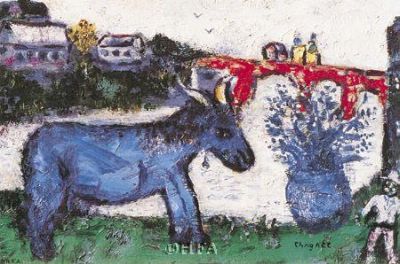
When I was teaching, I made a newspaper that outlined the week. The first week of class, I used this painting by Marc Chagall to illustrate a story by Suniti Namjoshi, “The Blue Donkey Fable.”
.
Habit and originality. In teaching and painting, there’s what we know about our vision and what we figure out as we go along. Writing is like that too. The creative part isn’t what appears on the page, but what appears in my mind before and as I write. And it isn’t only what I write, but what I discover as I work and rework the words.
Many years ago and several times after that, I was warned: Don’t talk about your writing project too much. People explained that talking about the story would wear it out and make writing it become irrelevant.
At the time, I wondered if this was true? Or maybe it was true for some people? Some stories I told over and over and I was certain the telling improved with practice. Memoir used as illustration while teaching taught me the truth about my creative process.
Sometimes I would tell a true story to my students, tell it again the next period, and have told it five times by the end of the day. The next year, I’d tell it again, five times. I would be telling that same story a little better, because I’d discovered what about the story was working for my students. And in the years after that for twenty-odd years I’d tell it once or twice or four times.
The story began with “My best friend Deana (not her name), wanted to marry money.” We went to school together beginning in first grade, by second grade we were best friend and in eighth grade she told me after school in her bedroom that she couldn’t afford to be seen with me at school because she wanted to be popular. We could still hang out after school the way we always had. So that happened. When we graduated from high school I went to college and she went to work in a bank because she wanted to marry a rich lawyer and banks were where the money was.
The bank paid her to go to school, she moved on in corporate American, moved to California, and married the rich lawyer. She lived in a rich community with a housekeeper, completed an MBA paid for by the company she worked for and earned a yearly salary three times mine. Then she divorced her husband when she realized she wanted children but not his. She fell in love and married a man about to be worth millions when he sold his start-up; he would soon be rich but she divorced him when she discovered he was calling his girlfriend from Florida while they were on their honeymoon. He took her for half of everything she’d earned. She married a third time, a man who earned less than she did and is still married to her third husband.
It’s a story about the danger of wanting one thing so much you nearly sacrifice something else you want even more. I learned to tell it well thirty years ago. This is the first time I’ve tried to write it down, because here’s the thing: They were right about talking and writing, about creating and birthing a story. Once you’ve got it figured out, there is less incentive to do the long, slow work of making it real on the page.
By contrast, there is a danger of creating such perfection and completion in my head that it never flows onto the page. There’s nothing left to figure out, which is what that old warning was about.
The opposite is also true. I am in such a rush to call the work done, and I move on before I should.
For those who emphasize in practice the “creative” in creative writing, the danger is of creating such perfection and completion in my head that it never flows onto the page. It doesn’t need to because I’ve already completed the creative process.
Too slow; too fast.
I that my excuse? That’s why I make a mess in my first drafts. I fear that I will lose the incentive to do that work if I don’t start before it’s completely figured out.
Once it exists, there are the endless rounds of revision before it’s anything like “done”. That process is different for different people—some work from beginning to end.
Once it’s written there’s a time for talking and talking about your writing. You want to sell it, both literally and figuratively. The “elevator pitch” is about that first sentence, about selling my listener with the first line. Now that I have a powerful novel to sell, I need to sell it. If I were teaching I would have found my elevator pitch by now. I’d have had practice.
From sharing anecdote I know the right response isn’t “I’m writing a novel” but:
“I’ve written a novel.”
“What’s it about, Ms. Priddy?”
What is it about? Answering that question was essential to making the anecdotes I shared with students. What was my point? I told students stories that warned about marrying for money, about standing up for others, about forgiving your mistakes. My stories that I write are built out of imagination and questioning just about everything. I spend a long time trying to understand events in my life and those on my page, and even then, I need to understand how to tell those stories.
I’ve worked with editors and friends for seven years, altered point of view and tense, read it aloud, and even now, I struggle to answer. That uncertainty might be an indication that I’m still not done. Or maybe I just don’t know how to let it go?
I need to walk around my old classroom while I tell teenagers about the near extinction of all life on Earth, everything that walks, flies, or swims and is larger than a beetle. How a dozen or maybe only eleven surviving women recreate human civilization.
I need that intriguing first sentence. The elevator pitch.
Mostly, I had a lot of questions when I started writing All the Daughter Sing in 2018. That wasn’t the title at the beginning because I wasn’t certain what I was writing. If I’d had the elevator pitch right at the beginning, would I have bothered writing eighty thousand words?
I don’t think it would work for me to have the pitch first, but I need one now.
If I were still teaching, I would have that pitch down pat by now because I’d have answered the question enough times to see how my students reacted. But the truth is my story is still a private possession, a vivid reality in my mind. My answer to what my novel is about will be different tomorrow. That’s a fact. The other truth is that I am doing what I’ve been doing all along, procrastinating.
This isn’t true for all writers. Creative writing can be negotiated like any transaction, like any passionate pursuit. Telling a good story doesn’t require all that much creativity—I tell myself that—simply an understanding of how to capture an audience while telling. Creative writing requires staring at the page until your eyes bleed, we say. Yeah, we say that and we laugh. Except it’s not entirely funny.
 IMPERFECT PATIENCE
lookie bobert, I know this may sound funny or something, but I know I speak for myself when I say that telling it like it is quickly turns into hearing it like it was-sometimes thats fun but most people don’t keep yesterdays papers unless you have a parrot which from personal experience I wouldn’t recommend especially these days what with all the upheaval and all. If people are listening, then the telling might be heard and absorbed even cherished, but I doubt it. Howevert, the solution to your problem only exists in someone else’s mind but just remember it is easier to walk in someone else moccasins if you can get them on which leads us back to wounded knee where once again the not so great white/orange farter unchief is bouncing up and down on the people’s hearts.
LikeLiked by 1 person
I recommend people read the classic BURY MY HEART AT WOUNDED KNEE by Dee Brown and the more recent THE COST OF FREE LAND by Rebecca Clarren.
LikeLike