This morning, I read a wonderful Brevity essay by Deborah Ann Lucas, a woman who struggled to read as a child. Her disability was never diagnosed as a child and only found out from her brothers partner as an adult. For years she was insecure about her abilities. The need to tell her story drove her to the page even so. This “Unlikely Writer” is a memoirist and concerned about others who struggle to read.
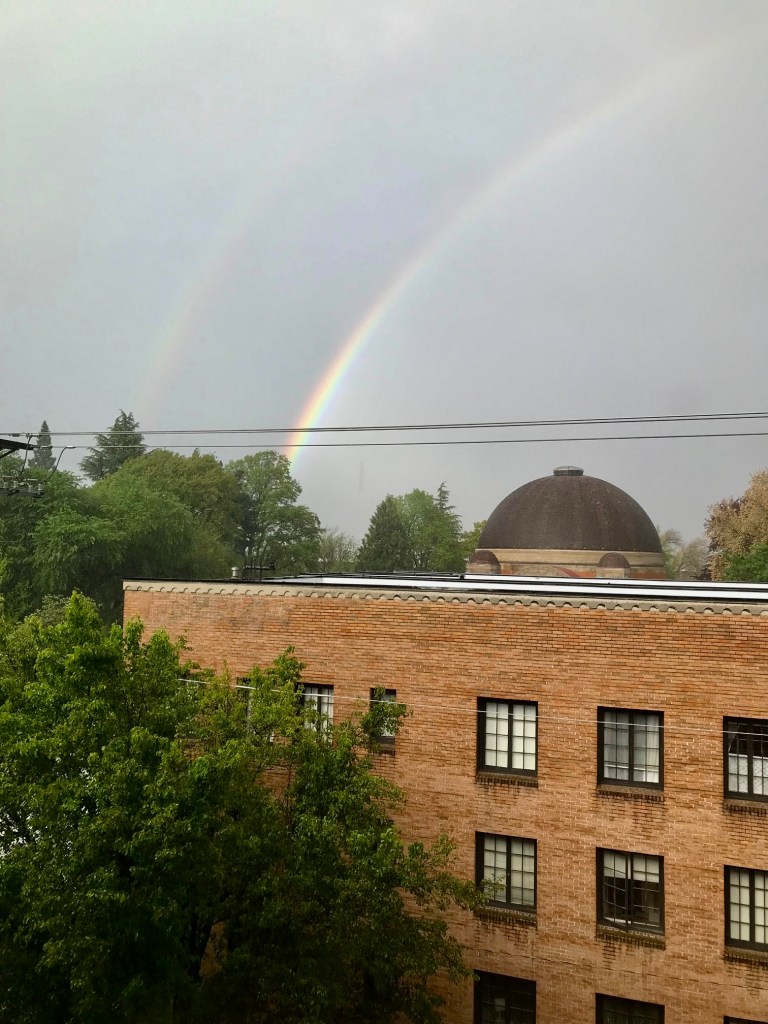
A double rainbow… always a good sign.
Hers is a wonderful story of persistence and determination, and her struggle is familiar to my experience. I taught high school for almost 40 years. Students exhibited learning issues and needs I could address in the way I assigned, presented, and defended assignments. Some students needed blow-by-blow, some needed to hear and ask questions, most benefited from a model of a successful assignment. Always, I told a story. Always, I had multiple goals to share. Always, I did the assignment too.
I had students who were legally blind or deaf or autistic, and also worked with students who were abused and hungry and homeless. Students with particular learning challenges had generally been identified years before they arrived in my Junior English classes, but some slipped through the cracks.
I recall one student in particular who I referred twice before he was finally diagnosed. He thought he was stupid because reading was so hard for him. It was clear to me he was smart and had some sort of learning disability. I taught a remedial class when he was a freshman and referred him then, which accomplished nothing—the powers that be insisted he was fine. He wasn’t. As a junior I referred him for testing at least once more. A different Resource Room educator pinpointed his challenge was. By then the only thing his diagnosis gained him was self-confidence, which is no small thing.
When I was a girl, we were taught not to touch the page to keep to our seat and not to mouth words. I learned to do what was asked and thrive; my brother was not so lucky. Eventually he was diagnosed with a reading issue back in the 60s. I do not recall that this was even named, but he went to summer school and was taught how to manage. It was only late in life I realized that I DO move my lips when doing math, because that physical movement is an aide. Perhaps that’s why I was always best at math.
Even reading specialists are sometimes “tone-deaf” about what makes us capable readers. One specialist leading a reading workshop told us that our students who were unable to read more than 300wpm were doomed. That is my speed, 300-350 if I am trying to read quickly. I must hear the words in my head and hearing the words as I read is the reason I love literature, make connections, and (usually) get the jokes.
After a few years teaching Junior English, I chose to have my students test their own reading speed in my class, just so they could know how long the assigned reading would take. I was adamant that reading speed was generally unconnected to other ability, and that I was not myself a fast reader. They must have believed me because they routinely shared their reading speed. I acknowledged that it was not fair that student A had less than a hour of homework for a reading assignment and student B needed two hours, but that’s just how it was.
[I sometimes cited my older son who was a very methodical and slow reader. This made some things harder in school. He needed many hours to complete assignments perfectly, because he needed to work on them in sequence and wanted his work to be perfect. His test scores as a little boy suffered because he had to learn to skip the questions that troubled him and move on. This frustrated him. As a software engineer, however, that kind of diligence and patience pays off.]
Reading is an auditory activity—processed in that part of our brain. Skimming is visual and processed differently. I would catch myself skimming while grading essays and step away from my desk.
My super-fast readers (600+ wpm) were not, in fact, reading but skimming, and routinely failed to catch humor in texts, complained about Huck Finn, and struggled with poetry. Even my weakest students laughed at jokes in texts when we read more slowly. Catching humor is a sign of intelligence, but those skimmers would often struggle with some great literature because they did not hear it. However, they were often strong in other subjects because they could get through material quickly.
We do not all think alike and it is our differences that allow much of human accomplishment.
The author of the essay mentioned above asked in a comment what a primarily kinesthetic learner needed. One thing a person-who-needs-to-move needs is the right to move around. They need to be allowed to touch the page, to shift in their seat, and get up sometimes to walk around.
At age five, my youngest son was given the Woodcock-Johnson by a grad student, and the results were a train wreck. The overseeing prof who had watched him being tested had the student retest him, “Let him move this time,” she said. He climbed over the table and under and around, and it turned out he tested as gifted. I already knew this, of course, he was doing algebra at age seven. No teacher picked up on his abilities through the remainder of his schooling, however. Like playing a video game level without the weapons he is supposed to have picked up on previous level (are video games still like this?), he handicapped himself in order to increase the challenge. In order to make things interesting, he would handicap himself in Calculus by only looking at the basics (do I mean proofs?), skipping class, and then taking the test without any other preparation …and he’d set the curve for the class. His teacher was annoyed. He was, according to the teacher, the best student in class, but th teacher gave him a B because he refused to complete worksheets the teacher knew he’d already completed in another class. My son wanted to do things, and refused to do the busywork. I should have fought the teacher about that.
[It is one of many failures I regret, not demanding more for my sons. Other students were accelerated and given accommodations appropriate to their needs. As an educator, I learned from my mistakes with my own children and to the benefit of my students. I fought hard for the student who could not write the essay until she had her entire argument clear in her head. Such seemingly arbitrary needs are characteristic of giftedness. They are not being difficult, only their process is their own and should be respected.]
Also today: I met with Ooligan Press editors this morning. It was a most reassuring Zoom. The press is clearly in good hands, I love working with students, and my concerns were set to rest. They will look at the cover I designed. Fingers crossed they agree to use it as well as my “tentative” title. They even raised a post-Dobbs angle I had not considered at all, so there is something I will need to address in further revision.
I confess now that I have been a wreck fretting about this meeting.
Also, my write-up of a high school assignment I used for many years, “The Idyllic Place”, has been accepted by the Oregon English Journal and will appear in their summer, online, edition this year. They want a 500-word introduction, so that and my weaving will be the work of this afternoon. Also, bread is rising and waiting to be formed into loaves.
 IMPERFECT PATIENCE
Thank you for caring about your students! I remember going to a high school parent teacher conference and the teacher had a huge notebook in front of her flipping through the pages quickly trying to find my child’s name to remember who she was. And I believe many mothers look back and feel they should have done better. My list is long.
LikeLiked by 1 person
Parenting is one long education that never really ends, yes?
LikeLike
Thanks for writing about Deborah’s essay. I no longer have any excuse for not working on my writing 😉
LikeLiked by 1 person
Oh, we all have many *reasons* for not working on the writing. Sometimes we just need to stew.
LikeLiked by 1 person
after only 40 years of teaching and learning from students there is no stopping now because there is more to be done even if it ain’t done by first person singular or plural pronouns—sooo if you need a boring moment or two just sit at the loom, look at the life becoming before you, and throw in an appropriate comma or two—maybe that will help. also nice photo of the rainbow over the drainboard and if you squint really hard, it’s possible to sea a crows’ nest in that tree, which is probably why and how you instinctively see what other ”professionals” fail to even notice—good job kiitos
LikeLiked by 2 people
You always tell me what I want to hear… sometimes what I need to hear, and always what I should pay attention to. 😉
LikeLiked by 1 person
Gary says he forgot to tell me that me teaching is like him facing shelves in a grocery store. We, neither of us, can stop.
LikeLiked by 1 person
Congratulations!
In other news, I read somewhere that all rainbows are double, but sometimes the second is faint.
LikeLiked by 1 person
We often see the double, and one is always faint.
LikeLike