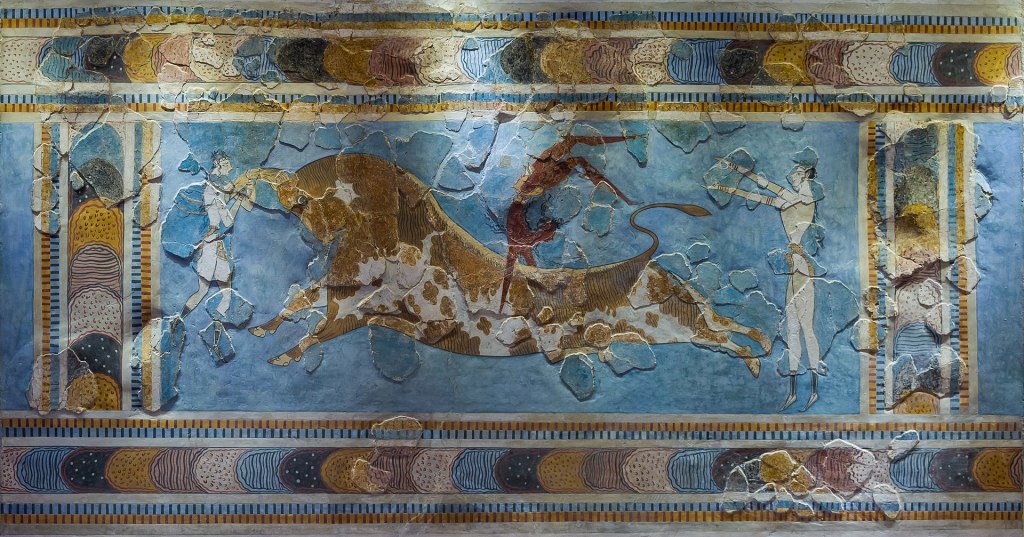
Even if you never took Art History, you might recognize this mural, a fresco in an ancient city on the Island of Crete. They put it on the cover of a recent translation of The Odyssey, which is a story about people living in a different part of the Mediterranean Sea and at least seven or eight hundred years later in history… which shows how much publishers care about accuracy, but never mind for now.
I want to brag about my progress in NaNo, but first I want to carp a bit about assumptions made any people who should know better.
The Minoans might have worshipped a goddess. They lived on islands near Greece, but predate the Golden Age, and while no one pretends to fully understand their language; it was not Greek but a language isolate. Nevertheless, they were a large and successful trading culture who sailed widely and trafficked in such goods as olive oil and wine. The only figure that might represent a deity is very definitely female—breasts and all. So language and religion are a mystery, but they seem to live beautiful lives with indoor plumbing, a sewage system, balconies, and broad windows. They vanished without a trace, but we know their culture because of stories from contemporary Egyptian and later Greek sources, surviving architecture, sculpture, paintings, and the massive jars stored in the basement of the palace of Knossos. There were many such palaces all across the Mediterranean, and all of them had a large decorated chamber with a directed view to a nearby rounded hill with a twin-peaked mountain behind that. My Architecture History prof posited that the rounded hill was a belly and the twin peaks were breasts. He showed us that view from several archeological sites. At least three peaks were featured in views from at least eleven sites. He believed the culture was matriarchal. (He was right about a lot of other theories since proved correct, the undiscovered shaft tomb in the Great Pyramid of Giza, for example. He was certain fifty years ago, and many such hidden tunnels and shafts have been found in more recent years.).
About that “bull dancing,” twin peaks, and underestimating equity and overestimating knowledge of animal biology.
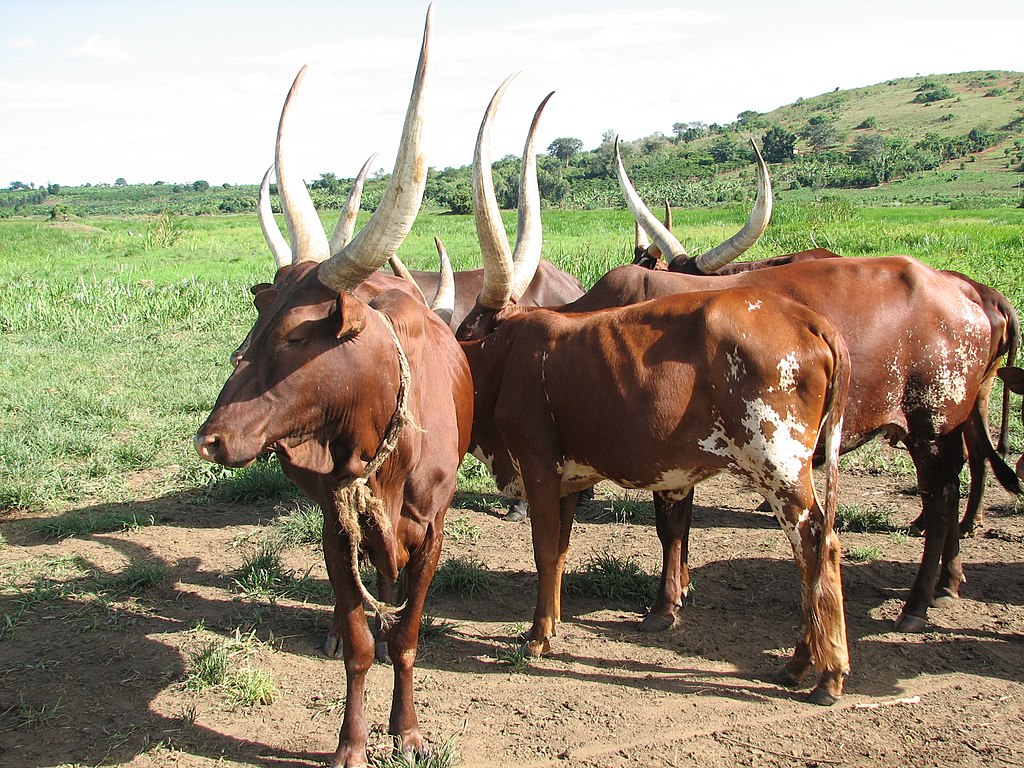
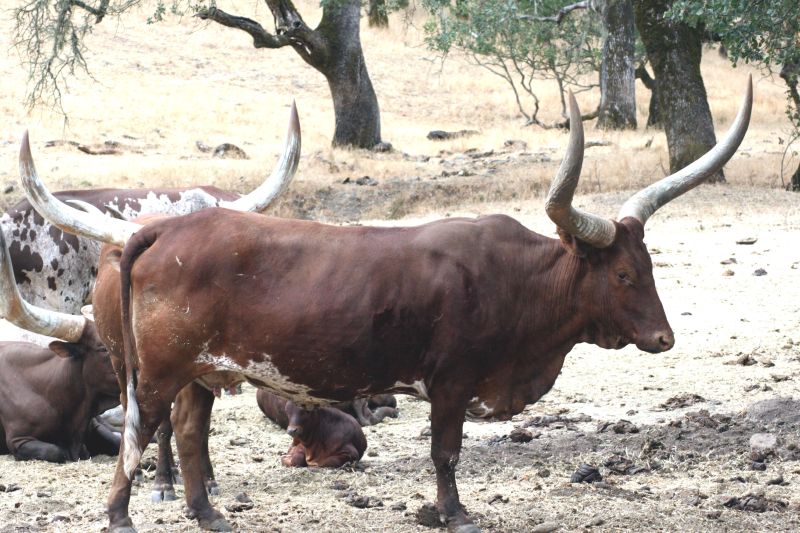
At about that time when I was taking all that art and architecture history and Anthropology in the 1970s, I discovered a photograph of Ankole cattle, originally a north African species in which both cows and bulls have enormous, sweeping horns.
Since then I have most often found any depiction of a large-horned bovine labeled a bull. Always bulls. Sometimes, “obviously a bull.” I wonder sometimes just how much these archeologists understand about the animal kingdom. Among deer and elk, the larger males have huge racks of antlers that they shed once a year. Cattle have horns that are never shed. According to Wikipedia, “Horns are distinct from antlers, which are not permanent.” In case I’m not being clear enough: cattle are not deer. And the sexual dimorphism (gender differences) found between males and females of members of the Cervidae (deer) family including size and antlers, is not so apparent among some ancient breeds of cattle and their headgear.
And then this morning I read a seven year old article in the Smithsonian about “Mystery of the Varna Gold.” The first gold was found in 1972 and later an entire graveyard was excavated. They have found “gold everywhere—11 pounds in all, representing most of the 13 pounds that were excavated between 1972 and 1991… There are pendants and bracelets, flat breastplates and tiny beads, stylized bulls and a sleek headpiece.” Most of the gold in the graves of three men, perhaps. The gold pieces are generally flat with patterns of indents (or concavities—they really should not make assumptions about which side is the “right” side either). They also have holes that might have allowed them to be sewed on clothing. (I just read an article about the study of prehistoric clothing, none of which survives… another time.)
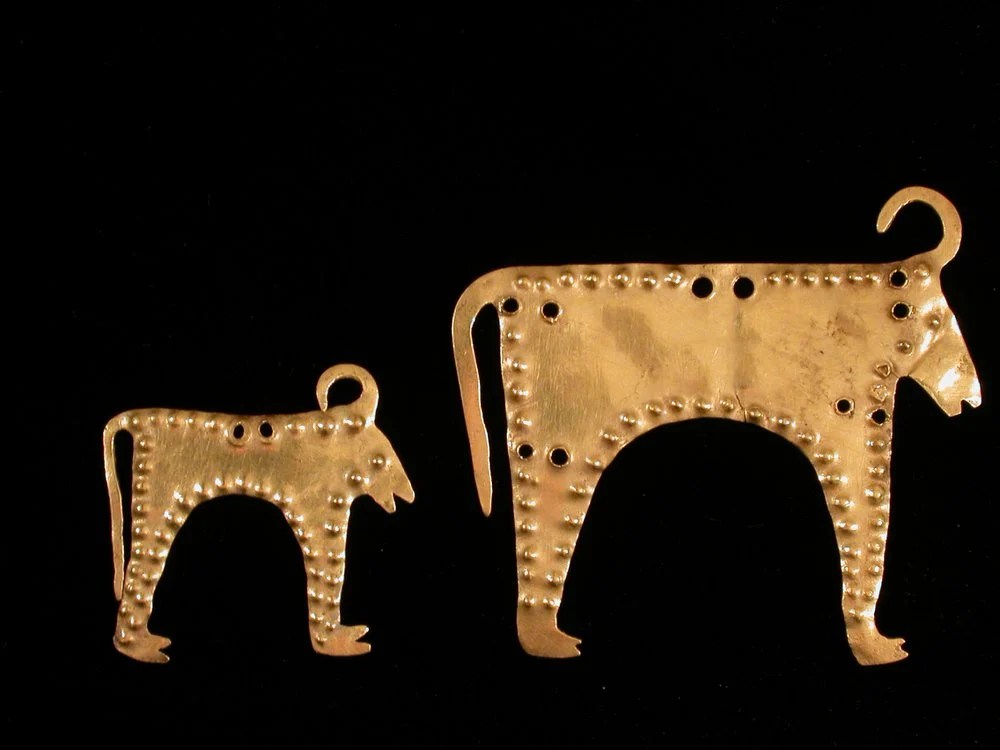
captioned: “This gold appliqué, more than six millennia old, appears to be a bull but has buffalo-like horns. Natsionalen Istoritcheski Muzej, Sofia, Bulgaria; De Agostini Picture Library / A. Dagli Orti / Bridgeman Images”
Setting aside the “buffalo-like horns,” it’s a “bull”? Really. Really? What about this gold figure indicates that it’s male? Penis? Nope, no penis. Not the horn either. Maybe he is a she, a cow? Maybe the “bull” is really a goat or sheep? It doesn’t look like a bull any less than it doesn’t look like a sheep. I’m voting for sheep. A female sheep. A baby sheep. That pattern of dots doesn’t suggest coarse cowhair to me, but could indicate the curling coat of a sheep. So, a ewe and a lamb.
They found a great deal of gold in one gravesite of a 40-year-old male and conclude from this that men had all the power in this ancient culture. Huh. Maybe he was a shaman or his body was sacrificed to the god? Maybe he needed that tiny gold cap for his penis (there’s a photo of the artifacts, the body and clothing are long gone to dust) because he was a chaste religious man? Maybe the little thimble-size gold cup they call a cap for his penis was, in fact, a thimble? Okay, maybe this all sounds silly, but so do their assumptions, at least to me. They are so certain about their guesses. The flat rounds with holes in their middles “believed to represent pregnant women” might just be circles with a hole in the middle. Jewelry. Decoration. The 1.3″ tall curved gold object they call a “crown” might be something else entirely.
These archeologists really don’t know how this culture lived or why they died. They are making up a story that fits their own bias and assumptions. They do that a lot. I like stories, but I have plenty of my own.
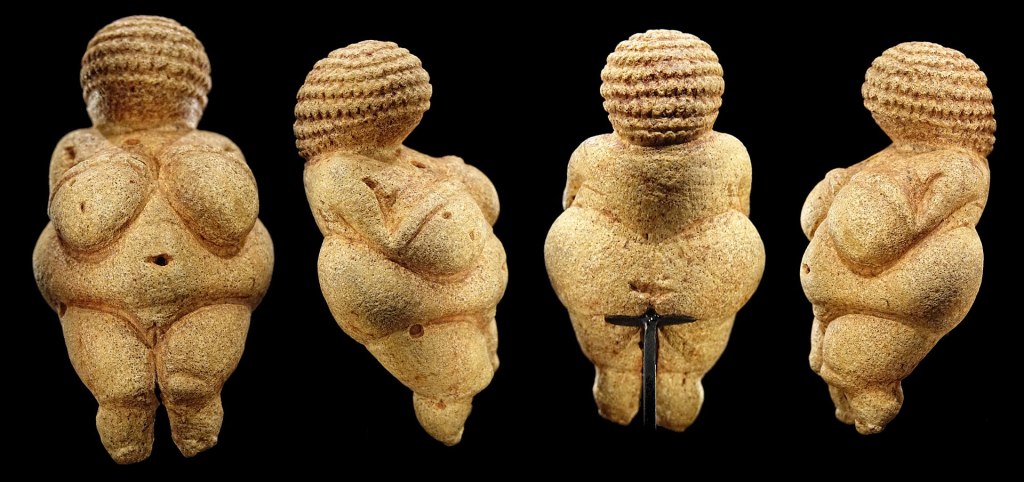
But is she all about fertility, a pregnant woman? What I see is a fat woman, which is not quite the same thing. It’s what I thought when I first saw these hand-sized carvings in college. Setting aside our current hysteria about weight, what her obesity tells me is that people of that era knew what fatness looked like—that’s an accomplishment in an only partially-settled, marginally hunter-gatherer culture. They had eaten well enough that some people were able to store energy as fat, and that suggests to me the figure is asperasional—something to pursue. Fat helps people survive famine. Very skinny women do not even ovulate.
And why no feet? Why has no one come up with a theory about their missing feet? Sure the feet could have broken off every single figure. Uh-huh. But maybe… Could they have been used as pestles to grind food or herbs? The timing is close. Human beings were grinding in mortars with pestles at least by 35,000 years ago, and that “Venus” figure would be a comfortable fit in my hand. Or maybe it’s art.
When I was in high school, we’d look at something like the Venus of Willendorf and accept that we could not know for certain what the figure was, what it meant, or how it was used. Our standing joke was “it must have some deep religious significance.” In other words, a big shrug. We really, really do not know. It is all guesswork. And it’s guesswork by people who do not seem to know much about animal anatomy, or with enough humility to admit they are guessing.
I read in a best-selling science book that herding of sheep certainly predated spinning wool. Say what? Tell that to Americans—the real ones who have been here longest. They spun yarn from the coats of domesticated dogs and from wool gathered during springtime when wild goats and sheep shed their winter coats. They never domesticated goats or sheep, but they spun. In the Old World, that shedding was bred out of domesticated flocks because it was judged more convenient to sheer than gather.
But a story from ancient times in the “Old World” describes gathering wool from wild sheep. A human woman who distrusts her lover who only come to her in the dark. She holds a lamp over his sleeping body and spills oil on him, burning his skin. As a result she is forced to undergo a series of four trials to pay penance: sort grain, gather wool, collect enchanted water, and visit the underworld. (It is the myth of Psyche and Cupid, written down in Latin less than eighteen hundred years ago, but “Greek.”) For each labor, Psyche is aided. The second trial requires gathering golden wool from murderous sheep. Psyche is terrified of the sheep, despairs. and considers drowning herself. A divinely inspired reed (the sort used to make musical instruments) advises her to avoid the sheep but gather wool caught in the thorny shrubs, and thus she is successful. (Psyche is successful in all her trials and is forgiven by Cupid, marries him, and is made immortal. C.S. Lewis’s novel Till We Have Faces (1956) is a retelling of this story and a genuine stunner compared to his children’s stories. I would urge anyone to read it.)
The scientist who made his claim about domestication of sheep predating spinning of wool did not know his myths and also has never plucked fleece from a thornbush. I assure you, having plucked wool from bushes and spun it, yarn likely predates domestication of sheep.
Let the bragging commence!
The goal for this month was to read nothing but my own novel. I almost managed that though I have read the news and other nonfiction, done research for the novel, and written blog posts. Even so, I completed both draft 2 and draft 3 of my novel! After today, I will be relieved to wake up in the morning at 3am and go right back to sleep instead of reading and revising until our walk and breakfast, then back to work until lunch, and then back to work again. My eyes crossed. And now I’m done with twelve hour days!
Let there be joy and celebration! Seriously, we could all use some glee. I do not use drugs other than coffee and aspirin, but a glass of wine is surely called for.
I printed the new fourth draft. Over 80k words, single-spaced, and I will begin reading this printed draft aloud to Gary tonight. By mid-May I will be looking for a Muslim reader to vet a 4k-word section to be certain I have not committed an atrocity. There are weaknesses I suspect and will try to repair in draft four, but I will need an editor to catch other issues I cannot resolve or am so far blind to recognizing.
Wish me luck—I’m going to need it. It’s not a good sign that I’ve managed to leave my phone in Portland. Wait! No phone calls for a few days? Probably a good thing.
 IMPERFECT PATIENCE
Prehistory explained by those who weren’t there always should be taken with a grain of asphalt—there are many interpretations—myself thinks the Venus figures were early attempts at porn or strung together in groups of three or more surely would have been wonderful wind chimes and added flare to the drab decor of any abode—probably the experts’ theories will be listened to more than jan’s or mine—oh well, cold chisel anyone?
LikeLiked by 1 person
If you are reading others’ books now, or maybe later?–as a weaver you might be interested in (–if you haven’t read it already) Elizabeth Wayland Barber’s fabulous book: “Women’s Work, The First 20,000 Years: Women, Cloth, and Society in Early Times.” Barber is both an archaeologist and a textile artist, weaving and spinning and dying and she made her own trial versions of ancient textiles, challenging many prior assumptions about the textiles (usually by male archaeologists who had no idea how to weave or spin). She’s an incredibly good writer, this is a pager-turner of a book, and that’s saying something for a history book “woven” from archaeological records.
LikeLiked by 1 person
Thank you for this recommendation! I went immediately to look for her.
I recently read an article about sewing tools, which are all that survives to give hint of earliest clothing.
LikeLiked by 1 person
Congrats on your novel! I’ll need to make a similar effort if I’m ever to finish my novel 🙂
LikeLiked by 1 person
Ha! It’s not “finished” though. Still working, but finished in the sense that the story I meant to write is on the page. I have eyestrain, seriously.
LikeLiked by 1 person