At this point, what I did: I learned how to do things. I had experiences. Some sad. Some pure glory.
…and future plans.

At this point, what I did: I learned how to do things. I had experiences. Some sad. Some pure glory.
…and future plans.
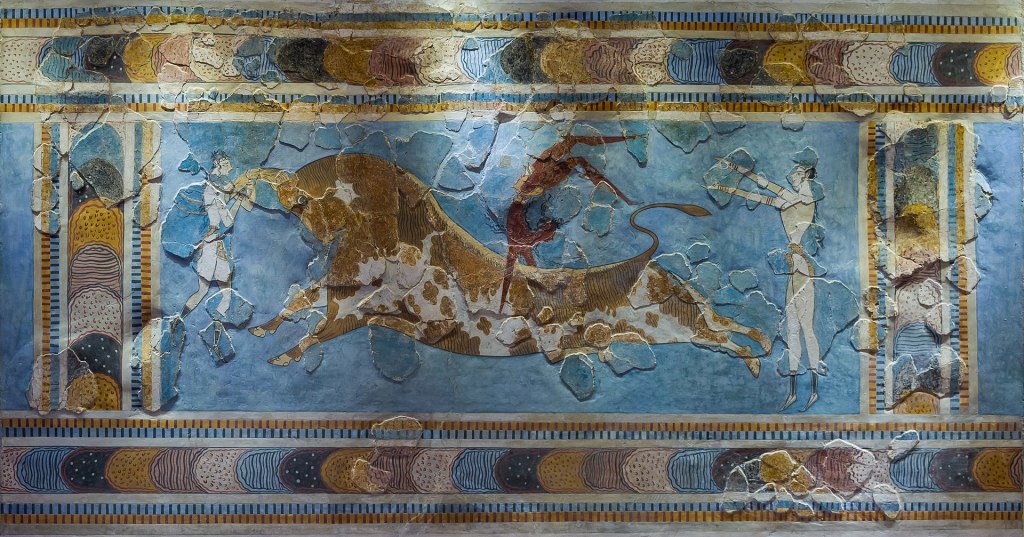
Even if you never took Art History, you might recognize this mural, a fresco in an ancient city on the Island of Crete. They put it on the cover of a recent translation of The Odyssey, which is a story about people living in a different part of the Mediterranean Sea and at least seven or eight hundred years later in history… which shows how much publishers care about accuracy, but never mind for now.
I want to brag about my progress in NaNo, but first I want to carp a bit about assumptions made any people who should know better.
Continue reading
When I became licensed as a K-12 Art teacher in 1976, I knew it was unlikely that I would find a job teaching students younger than high school age. Those little kids I worked with in my field experiences would never be mine for more than a few hours during my one-week assignment. Most districts considered arts a “frill” and that cutting out construction paper hats would do as an introduction to the visual arts.
Even then, elementary programs rarely included arts specialists, though junior high and middle schools did. However, while completing my program at the University of Washington to become an Art teacher, I worked in the art programs of several school districts, including the Northshore School District which then employed arts specialists at all grade levels. It was also ranked as the finest public school system in the state. It was, and is, a wealthy school district, but a recent book by Sir Ken Robinson, PhD, and Lou Aronica reinforces my experience in 40+ years teaching in private and public schools, 25 of them as an English teacher. Increased focus on “the basics” and teaching to tests has done our children no favors.
It may seem counter-intuitive to insist that spending all day on math and reading (often out-of-a-box instruction) may actually make our children weaker in those subjects, but that has been my observation. The much-lauded Finnish school system seems to bear this out. Only a creative and richly diverse education will produce the citizens we want in our future.
Allow me to indulge in a when-I-was-young digression:
Most of my elementary education was in a public system north of Seattle. We had choral music and instrumental music specialists, physical education specialists, and individual teachers with particular skill in math and science as well as history and literature. I was introduced to musical instrument with an assigned recorder when I was eight years old. My parents would not allow me to study the oboe (I failed to practice my recorder and they were unconvinced I would last long enough on the clarinet to get to the oboe). Nevertheless, I continued taking Music Appreciation classes required of all students through Sixth Grade. That year I also took pre-Algebra, observed the life cycle and behaviors of meal worms, designed an experiment to determine if white cloud mountain fish could perceive color (maybe), and wrote reports citing a variety of sources from books and periodicals. I attended the second best school district in the State of Washington. While there was no art specialist at Echo Lake Elementary School, we’d begun learning to play musical instruments in 4th grade and later had Band, Music Appreciation, and so forth throughout.
Cordell Junior High (7th-9th grade) had, according to my yearbook, about 980 students. There were 43 teachers, 3 councilors, a vice-principal, and a principal. It had two full time art teachers. My seventh grade Algebra teacher was also the Jazz Band director. There were also full time choir and band teachers in this public school. Many of us went on to college.
By contrast, the small school system where I still teach college classes employs two music specialists (Choir and Band) who teach elective classes in grades five through twelve (over 800 students), and a single teacher who teaches art electives 4/5s time to grades nine through twelve (over 400 students). There is no art specialist teaching at the middle school. At the elementary level, there has not been an art specialist, so far as I know, ever. But there are still a music specialist and and P.E. teacher (one of each for 800 students) in our athletics-obsessed community.
The art and music and physical education specialists have been protected by an administration determined to hold onto “frills” that are necessary for so many of our students.
Money is the motivator we pray to. We focus on “basics” because we believe they will profit us more. Lost, in this dynamic, are thought, analysis, critical thinking, and creativity. There is almost nothing creative about read-the-passage-and-identify-the-following. There is almost nothing creative about addition or memorized times tables. Reading and arithmetic can be taught in creative ways, but rarely are. Creativity itself is a maligned and neglected step-child of our current educational system.
How will this profit us in the future? we ask. And “profit” is spelled only with dollar signs. Despite the idealism associated with youth, new high school students are told too often that doing well in school will earn them a higher income. Too often we fail to explain how education might make them wiser voters, better spouses, or more creative individuals.
According to economist Dan Pink, “When profit becomes unhitched from purpose . . . bad things happen.” Watch his video it’s brilliant! Once basic needs are met, humans want autonomy, mastery, and purpose. Self respect goes a long way. Creativity is about all those three motivators. The opportunity to make, invent, envision, create—that is the essence of humanity.
In the late 20th century as the U.S. lost ground in manufacturing, we still led the world in ideas. This is changing now too. As we focus on mechanical skills, how can anyone be surprised that we have lost ground in invention and innovation? Creativity not only feeds our souls, it allows us to advance in other ways such as technology.
What happens when we prioritize art? Experience and studies suggest: GOOD THINGS.
 IMPERFECT PATIENCE