An imperturbable demeanor comes from perfect patience. Quiet minds cannot be perplexed or frightened, but go on in fortune and misfortune at their own private pace like a clock during a thunderstorm.—Robert Louis Stevenson
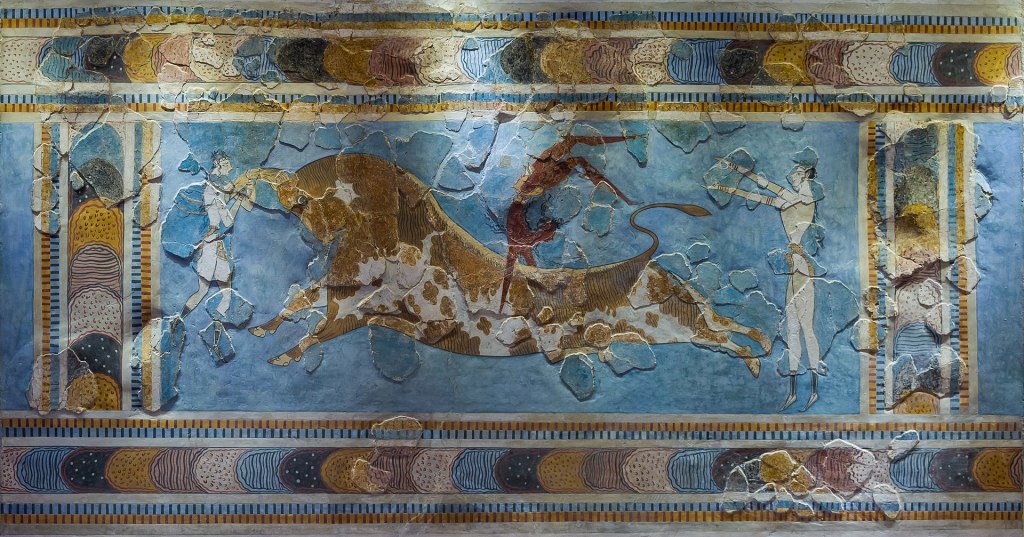
Fresco found in Knossos palace, Crete, Greece, dated 1600 – 1450 BCE. And generally referred to as the “Bull Leaping Fresco.” It is substantially restored, repainted—much of the original painting had cracked off the wall.Johnbod has released this to the public domain.
Even if you never took Art History, you might recognize this mural, a fresco in an ancient city on the Island of Crete. They put it on the cover of a recent translation of The Odyssey, which is a story about people living in a different part of the Mediterranean Sea and at least seven or eight hundred years later in history… which shows how much publishers care about accuracy, but never mind for now.
I want to brag about my progress in NaNo, but first I want to carp a bit about assumptions made any people who should know better.
On May 25, 1911, a catastrophic event changed public opinion forever. A factory building in Manhattan caught fire but all exits, including firedoors and stairs had been locked or chained shut. Workers (mostly women) could not escape the building. In desperation, 62 people died when they fell or jumped from windows to escape the flames and smoke that killed others. In total, the infamous Triangle Shirtwaist Factory fire killed 146 people and injured another 78. The deaths were almost entirely preventable. Americans were outraged and as a result laws were enacted to protect workers and laws that had been ignored were enforced.
Some things are preventable, but we resist. Most of us use seatbelts, as required by law, and fewer people die in accidents as a result. Drunk driving went from a social convention to an affront against decency thanks to Mothers Against Drunk Driving (MADD). Today, most people call an Uber. But I just read an essay wherein the author bragged she’d driven only a few miles rather to a friend’s home rather than fifty minutes to her own home while drunk. People smoke despite knowing throughout their entire lives that tobacco products are poisonous. Some insist they need guns for protection despite statistics proving gun ownership make our lives less safe. We take unnecessary risks that are life-threatening not just for ourselves but for others. Isn’t it time for a little healthy anger?
Since I began weaving in earnest, I’ve been rewatching television online, shows I’ve already seen, or tried to see, when they first aired. Monk. Psych.
Just now, it’s Grey’s Anatomy.
How this tree had grown. Sometimes a log drifts onshore and is just too incredible to ignore.
But I’m not really all that interested in these shows or even in telling about the weaving I am getting done, though that will surely be part of my post today. I’m interested to see what else…
There are many healthy-looking purple and orange starfish again! Nine in this photo. The green rounds are anemones folded in against the receded tide. Little pink rounds in the upper left are anenomes too.
Ripper: I don’t know how well I could stand up under torture.
Mandrake: Well of course the answer to that is, boy, no one ever does. And my advice to you, Jack, is to give me the code now. And if those devils come back and try any rough stuff, we’ll fight them together, boy, like we did just now, on the floor, eh? You with the old gun, and me with the belt and the ammo, feeding you, Jack! Feed me, you said, and I was feeding you, Jack.
—Dr. Strangelove: or, How I learned to stop worrying and love the bomb
Yes, that’s just the way the beach foam was. Gary told me I should take a photo.
From romance to plastic trash to how we can all be in this together. I’ll try to explain.
When I was a graduate student studying literature, I first heard the theory that romantic love was an invention of European novelists. People felt lust and loyalty, but actual love between two people—sexual and romantic love—was a figment of playwrights’ imagination. (It’s a silly theory.) Canadian psychologist Nathaniel Brandon claims that “in primitive cultures the idea of romantic love did not exist at all.” Even Margaret Mead declared: “Romantic love as it occurs in our civilization, inextricably bound up with ideas of monogamy, exclusiveness, jealousy and undeviating fidelity does not occur in Samoa.” Freemason Lewis H. Morgan proposed the concept that marriage was the earliest human domestic institution but also judged “the passion of love was unknown among the barbarians. They are below the sentiment, which is the offspring of civilization and super added refinement of love was unknown among the barbarians.”
[Gary argues that most of what we have assumed about physical and cultural anthropology and archeology has been turned on its head in this century.]
However, a few decades ago this idea that romance was an invention of Western culture was taken seriously enough by an anthropologist that he decided to construct a research project. He used the archetypal story of star-crossed lovers—two people who abandon convention and family in order to be together. We might argue that such passion does not necessarily lead to a golden anniversary. Even Shakespeare, after all, was poking holes in the relationship between R & J. Nevertheless, the star-crossed lover story is not merely the story of lust or friendship, but of a passionate devotion that creates more than inconvenience, where two people defy their community, faith, and family to be together. He considered such stories might provide a warning, but their existence also demonstrated emotions that most of us would not hesitate to describe as romantic love. He searched for traditional stories and folktales from all over the world. Surprise! The star-crossed lovers story exists everywhere. In ancient Greece and the forests of Brazil and Madagascar and India, China, Europe, the Middle East, and the South Seas, such traditional stories exist everywhere. Individuals do fall in love and occasionally make enormous sacrifices, even of their lives, in order to be together. They fall in love and sacrifice for their devotion. The story exists in non-literate and literate cultures in every inhabited continent and within island cultures all around the world, even in cultures that otherwise seem to have no “romantic” tradition.
It’s possible that people lied. Maybe anthropologists, like everyone, found what they wanted and expected to find. More likely, love exists.
We are human beings and part of our shared humanity is that some stories persist in all cultures, in every corner of the world, and throughout time. Like the hero’s journey, the star-crossed lovers is likely a universal narrative. Lovers who defy convention and are willing to sacrifice safety and comfort in order to be together might be one of them.
Did I need an anthropologist to prove that to me? No, I actually did not. It is what I want and expect to find is true. It is Eurocentric hubris that inspired some foolish English-speaking academic to claim that romance was invented in Northern Europe. It is shallow to assume that the only way couples stay together is reproduction, envy, jealousy, rivalry, habit, boredom, or convention. Romance lives!
So. Take-out food.
“Few of us are equipped or inclined to cook three meals a day for ourselves.”
—Tom Sietsema, food critic for The Washington Post
Tom Sietsema wrote about his discovery that the take-out food he was eating during the pandemic creates a lot of trash. He was shocked, shocked to discover how much plastic his food required.
The article was titled “All my takeout has delivered a mountain of trash. So I asked experts how to minimize it.” Apparently he had not noticed how much trash his occupation as a food critic created until he was personally responsible for disposing of it. “For three weeks this summer, I saved every scrap of takeout packaging… The cups from cold-brew breaks and the cartons from sushi and burrito runs that used to be tossed out at the office and forgotten about are now our responsibility, up close and personal — in our faces. The problem is literally knocking at our door. We have to answer it.” (I want to know where he found grass to spread out his trash in Manhattan?)
How he had not known this already?
Soda and milk products came in glass when I was a girl. But the oil industry looked for a larger market and chose plastics, spending millions to convince us of a lie—that plastic was safe, cheap, and recyclable. Ultimately it is none of those things. The lesson here? Distrust the profit motive?
People were particularly irritated by this line: “Few of us are equipped or inclined to cook three meals a day for ourselves.” Commenters pointed out that preparing three meals was exactly what they did every day. We do not need to actually cook three meals because what about cold cereal and leftovers? A survey conducted in 2019 found that only 6% of Americans eat out daily. Gallup found that dining habits have been stable between 2003 and 2016 and close to 40% of those surveyed had not eaten out for even one meal in the previous week. Apparently even Sietsema’s readers don’t all eat the way he does. We should use containers made of materials that break down completely and quickly, he says. We should use our own flatware and reusable shopping bags.
Romantic love and plastic take-out containers—we assume that others’ habits and passions are just like ours. Maybe a literary critic had a bad break-up that lead to his cynicism about romantic love. A food critic assumed most everyone ate the way he does. We assume that what we do and value and desire is the same for everyone.
When I was in college, all shopping bags were still paper and the world did not come to a screaming halt because there were no plastic bags. The produce at Safeway was not continually misted with water and I put my veggies in paper bags. Milk only came in glass or waxed paper cartons. And in 1973, I carried my groceries home in a cotton canvas shopping bag imprinted with “Save a Tree.” I used that bag for years.
Today is Valentine’s Day and my husband is downstairs making coffee as I type. How we care for and feel about one another is not like anyone else. But love and passion, friendship and simple affection, loyalty and kindness, compassion and decency are all human emotions. We are all capable of changing our minds. We are all capable of fairness and altruism. We can figure things out. Maybe we fail sometimes. Perhaps all those good things are not functioning fully all the time or for everyone. But our best can be very fine indeed. We do not need to become a culture of outrage. Anger can drive needed change, but as a steady diet, love is healthier.
Take it easy on yourself today. Everyone needs a break sometimes. The human heart is vast; it contains multitudes.
I created this “TEST” with the new Editor for WordPress. I find the “Classic” version I have been using and which suited me perfectly has lost function.
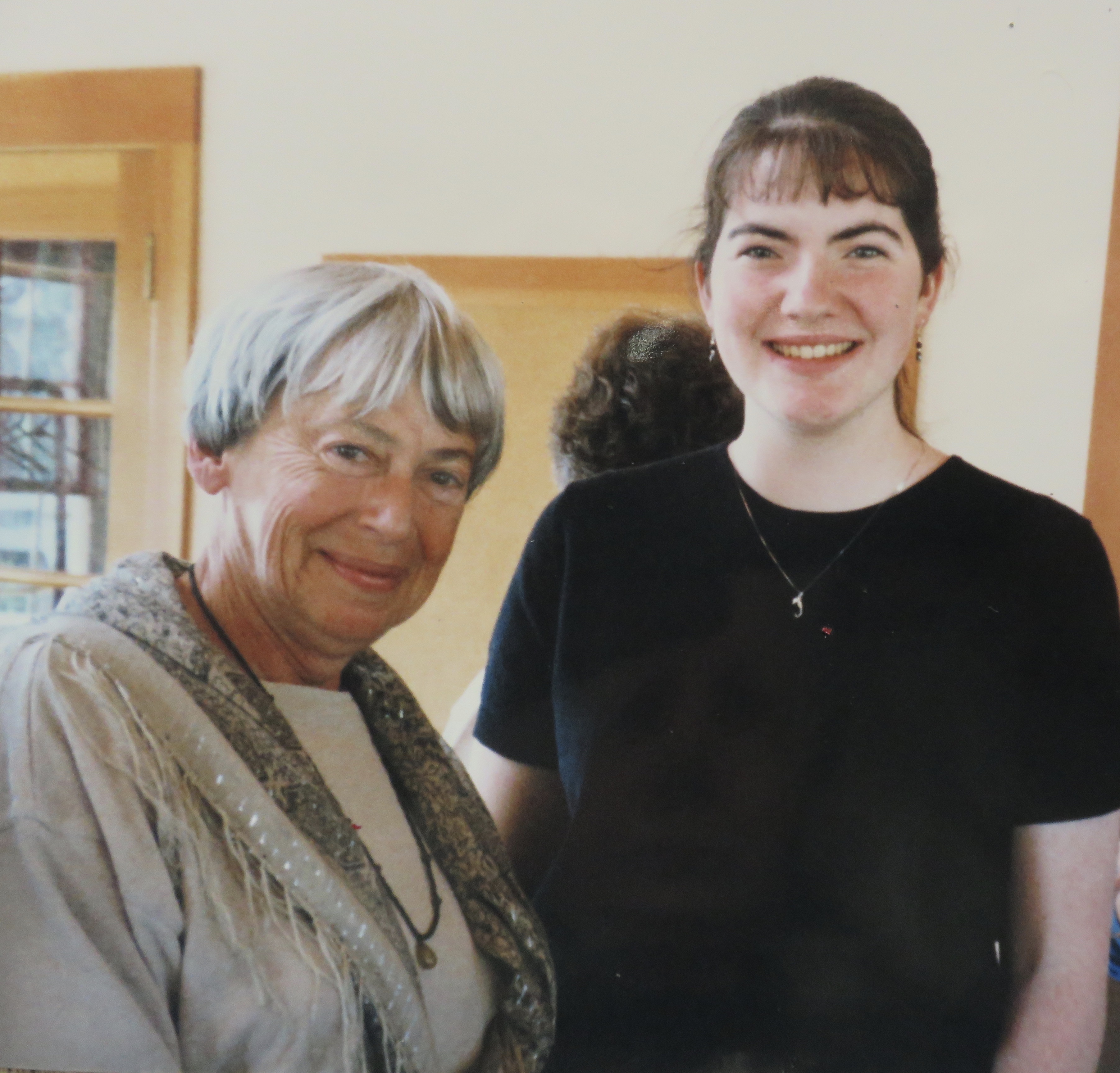
One of my former teachers and one of my former students. This was taken a long time ago. One has “left the planet” and the other is now a tenured professor of English. We are taught and we teach and sometimes those we teach become teachers.
We need teachers. We need teachers who are not merely well-educated and kind and hard-working. We need teachers who are smarter than most of their students. My original post “WHY YOU DON’T WANT TO BECOME A TEACHER” went up on my previous blog while I was actively teaching in a public high school. I reposted it here in February of last year, a month before I retired completely. Nearly two thousand people have looked at it just since, a thousand just this year. Google leads people to it from all over the world. People in Thailand, South Africa, Nepal, Greece, the UK, and France read it while I am asleep. It is my most-read post. Again.
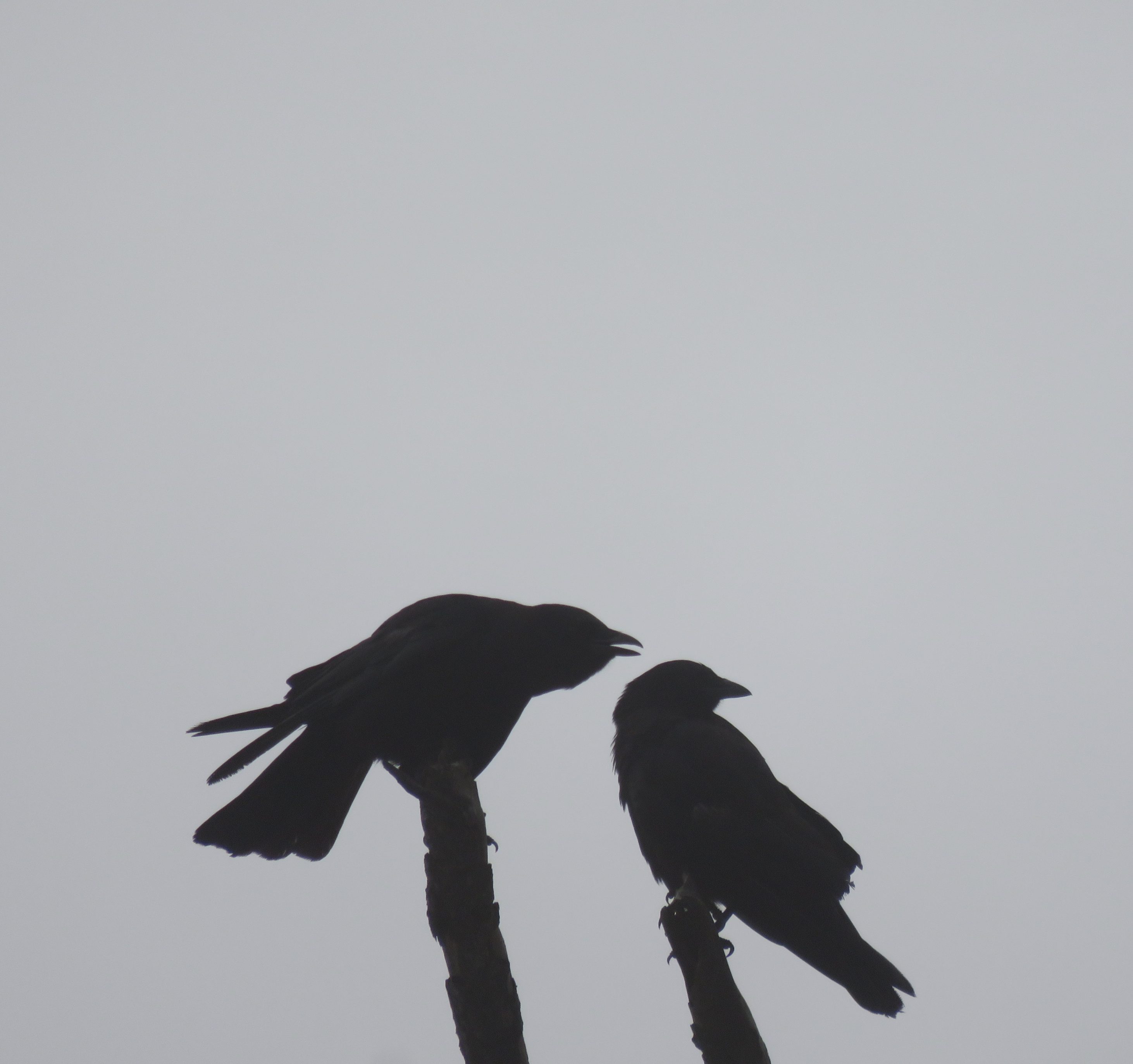
Crows perched high up on a massive drift log south of our home. I can rarely zoom in this close and still have the photo be in focus. And in the fog. (In case you wonder—we love fog.)
A friend asked me what local schools in my area are doing this fall. So this will be a rant. Don’t read more if you don’t care to know what I think. Continue reading →
I drive a small car, my husband’s little red Honda Civic hatchback, and one thing I that makes me crazy is when drivers of giant SUVs come right up behind me and tailgate.A couple of days ago I was driving home from work and an SUV merged from highway 26 onto highway 101 right behind me.I could tell the driver was mad at me that I didn’t brake to let him in in front of me because he waited till his merging lane ended before he slowed and cut in about five feet behind me.The speed limit changes to 55 mph right about there and I was speeding up but I kept speeding up to a little above the speed limit and even so he tailgated me all the way to the passing lane.He whipped on by me in the left lane and then moved back into my lane about a hundred feet ahead of me and slowed back to the same speed he was going before he passed me.So what was the big deal about passing me if he didn’t actually want to go any faster?He just had to be in front of me. It just shows America is a dangerous place to drive. I am more likely to die on American roads than in most nations of the world. There are 15.2 deaths/100,000 in the U.S. compared to 6.0 deaths/100,000 in the United Kingdom. In fact, a German data base survey of twenty-eight participating countries showed most reporting death rates in the single digits with only Portugal, Poland, Greece, Korea, and Luxembourg showing higher death rates than the U.S. (“Selected Risk Values”). We’re all a little crazy on U.S. roads. Something must be done to make the road safe from crazy drivers.
There should be some way to safely respond immediately to the stupidity of drivers who tailgate, cut people off in traffic, or drive way too slow or too fast.My solution is to issue an “idiot pistol” to all drivers in good standing.This gun would be turret mounted on the top of my car and respond to verbal direction.I would simply say the license number or describe the location of an offending driver’s car and say “fire.”The idiot pistol would shoot a dart directly into the back of the car where it would harmless attach itself and release a large two-foot orange and purple flag saying “IDIOT!”I would feel revenged right away and for a month the driver would have to drive around with a sign proclaiming him an idiot.There would be no permanent damage to the car, but if a single driver accumulated four flags in a four week period while offending four drivers in four separate incidents of stupidity, the car would be impounded.Of course, everyone makes mistakes once in a while and this would act as an immediate reminder and lesson to all drivers, while seriously punishing drivers who consistently drive like idiots.
I like the idea of punishing offenders on the spot and firing darts into the back a cars could certainly make me feel better when I’m cut off in traffic, but even I can see there are problems with my plan.I’m as susceptible as anyone to irritation, bad temper, and error.My goal is to make the roads safe from foolish drivers, but shooting at them could be counterproductive.I could end up acting like an idiot myself and chase down another driver, succumb to road rage, or pay more attention to getting even than driving safely.I might overreact to an honest mistake or choose to pick on someone I have a grudge against.Four friends could gang up on a common enemy in order to cost him his car.Most people can’t afford to rush right out and replace an impounded car.I know I would be in a bad spot if that happened to me.Finally, aside from issues of safety and fairness, this system would definitely be expensive to set up and monitor and there isn’t any existing technology to safely shoot the harmless but non-removeable darts in the way I recommend.
Nevertheless, idiot drivers are a real and ongoing problem and all sorts of strategies should be considered in order to address the problem.There are laws dealing with these things.We all need to respect the need to abide by laws designed to guard us against our own deep, sincere need to drive like fools at time.I think it should be against the law to use cell phones on the road as it is in many other countries.All drivers need to more considerate of existing laws regarding speed limit and other traffic signs, as well as use common sense about recommended speeds, spacing on the highway, and demonstrate courtesy when merging and passing.We could brand or tattoo notice of traffic violations on people’s foreheads.That would certainly get their attention.Maybe it’s not legal or nice, but driving like a creep isn’t very nice either.Too many people behave as if laws apply only to criminals and not to them.Maybe more police on the road would help, better education when learning to drive, remedial classes for people with bad driving records.Maybe some rock star, Sting perhaps, would take up the slogan, “Don’t be an idiot, drive sensibly” and make it cool to be a cool driver.
In desperate moments I’ve considered desperate measures to get even with drivers who scare the pants off me.I would like them scared too, and at least publicly embarrassed by their poor driving habits if not thrashed and arrested.But I drive a little car and I’m not interested in declaring war on the highway.The truth is that I can’t make others drive better, I can only practice what my husband suggests:“Drive like they’re all crazy, because some of them really are, you know.”His attitude is international.The Chief Superintendent of Police Traffic Headquarters in Hong Kong said just the other day: “smart drivers always assumed that other drivers were inexperienced and careless.” After a widespread courtesy campaign, death rates in Hong Kong dropped to the record low of only 3/100,000, a fraction of what they are in the U.S.So I think I’ll be safer if I listen to the experts and my loved ones and take care of myself without seeking revenge. I will be polite. If someone wants to merge in front of me I’ll try to let them.If they want to drive faster, I’ll look for a place to pull over.If some motorhome is creeping along at 35 mph in a 55 zone with no passing lane for a mile, I’ll take a deep breath and ask myself why I’m in such a hurry.I don’t want to get so bent out of shape about other people’s idiocy that I become another idiot myself.Though I can’t change the rest of the world, I can try not to let the rest of the world ruin my day.
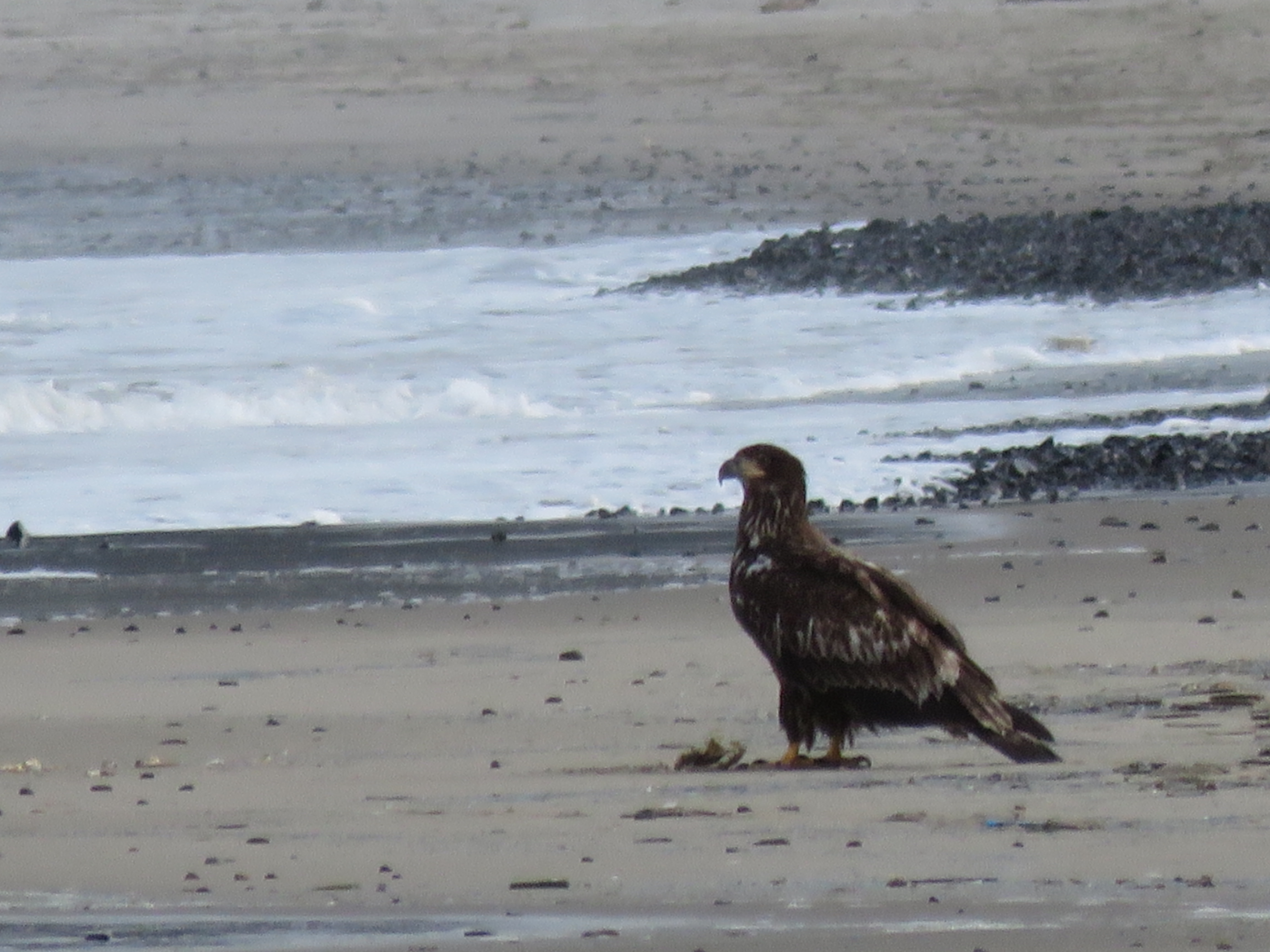
The first few times a juvenile eagle lands on shore they stand around for several minutes (up to an hour). I always assume they are unhappy to be wet and to be forced to launch from flat sand.
Today, a walk creek to creek, a juvenile eagle, meditation on the value of lies, and a little brainstorming to prepare for Monday’s writing assignment. The best one is above, the lies below. So brainstorming.
Monday’s nonfiction writing assignment was a great favorite with my students, the assignment they completed early in the year and which they still loved by the end. It will be satirical and more than a little silly. It concerns a trivial annoyance.






 IMPERFECT PATIENCE