A man called his girlfriend a “chick” the other day to me. He didn’t notice my expression. I was thinking: If you knew me well, you would know I don’t like hearing women called “chicks.”
A man called his girlfriend a “chick” the other day to me. He didn’t notice my expression. I was thinking: If you knew me well, you would know I don’t like hearing women called “chicks.”

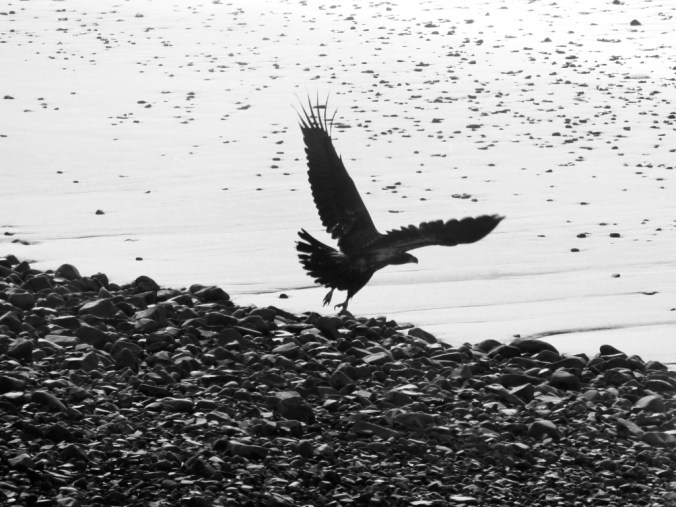
Many times crows forage beside eagles. The crows cannot pierce the skin of most dead creatures, but the eagle can. (In the wild, ravens hunt in tandem with wolves. The raven spot game, the wolves open the body.) I have seen crows drive raptors from a wounded gull and from their own nests. The smaller birds win their point.
“A man has been arrested after antisemitic abuse was directed towards Jewish children on the London Underground. … Wearing a cap and hoody, the man is seen in the video threatening a man off-camera after he tries to intervene before a woman in a hijab – Asma Shuweikh – confronts him.”—The Guardian
The Muslim woman is a mother of two and wishes more people would intervene in such situations.
“Wilshire Bus,” a short story by Hisaye Yamamoto, concerns a woman taking the bus to visit her husband in a VA hospital post-WW2. Japanese-American herself, Esther says nothing while a drunk harasses an elderly Chinese-American couple on the bus. She bursts into tears when she reaches her husband’s hospital bedside. He believes this is because she misses him, but readers understand that she is suffering from guilt that she failed to defend the couple on the bus. When I first read the story in graduate school, the obvious ironies of the situation and her feelings of guilt reminded me immediately of my own experiences.
I would have been twenty-one or twenty-two, an undergraduate student at the University of Washington and taking the bus home alone. My husband and I had bought a house on the other side of the zoo. I was sitting toward the back and a drunken man began harassing an adolescent child. People nearby looked nervous but avoided eye contact. I thought we all hesitated to say anything because the man was big and we were afraid. A young black man stood up from his seat and told the drunk that he needed to stop what he was doing. It’s been over forty years and I do not remember everything, just that the young man was slender and the drunk outweighed by fifty pounds at least. I remember that the drunk got off the bus at the next stop. I remember we were grateful to the young man. I remember thinking the drunk was twice my size and wishing I had done something myself and trying to think what I should have done.
The next time was also on a bus, and I was also alone, but instead of the route that ran east-west on 45th, I was heading downtown. I can no longer remember the bus numbers, but this one took Eastlake Avenue NE, traveling south from the U District. Again, I was seated near the back and again a man began harassing someone smaller, a racist harangue. I got up from my seat almost immediately and walked to the front to tell the bus driver. By the time I got to the driver, there were three of us. And this is very clear: The bus driver did something I would never have thought could happen. He pulled his bus over the the side of the road, on University Bridge. He stood and walked to the back of the bus and told the drunk, “You’re going to have to get off my bus, or I am calling the police.” And the man got off and passengers clapped and cheered.
Sometimes doing the right thing is frightening. It might even be dangerous. I did not directly confront a drunken man who outweighed me by close to a hundred pounds, but I found a safe way to intervene. In Yamamoto’s story, many people were offended by racist language, and every one remained silent until after the drunk had left the bus. Esther suffers from her sin of omission. She fails to act as she knows she should have.
So did I.
Fortunately, I learned my lesson and I like to think so did Esther. I think the courage to act in such situations sometimes requires rehearsal. We need to think it through in our heads and balance what we know is right with known risks.
Mob rule is not right and speaking up can be dangerous—we mostly all learned that in school. Silence in the face of abuse can be more dangerous. The assumption when we are silent in response to abuse is that we agree with what is being said and done. And that perpetuates the evil.
How many times do we need to learn that lesson?
just for fun.
“On the Decay of the Art of Lying” is a short speech (or essay) written by Mark Twain in 1880 for a meeting of the Historical and Antiquarian Club of Hartford, Connecticut.
Observe, I do not mean to suggest that the custom of lying has suffered any decay or interruption–no, for the Lie, as a Virtue, A Principle, is eternal; the Lie, as a recreation, a solace, a refuge in time of need, the fourth Grace, the tenth Muse, man’s best and surest friend, is immortal, and cannot perish from the earth while this club remains. My complaint simply concerns the decay of the art of lying. No high-minded man, no man of right feeling, can contemplate the lumbering and slovenly lying of the present day without grieving to see a noble art so prostituted. In this veteran presence I naturally enter upon this theme with diffidence; it is like an old maid trying to teach nursery matters to the mothers in Israel. It would not become to me to criticize you, gentlemen—who are nearly all my elders–and my superiors, in this thing—if I should here and there seem to do it, I trust it will in most cases be more in a spirit of admiration than fault-finding; indeed if this finest of the fine arts had everywhere received the attention, the encouragement, and conscientious practice and development which this club has devoted to it, I should not need to utter this lament, or shred a single tear. I do not say this to flatter: I say it in a spirit of just and appreciative recognition. [It had been my intention, at this point, to mention names and to give illustrative specimens, but indications observable about me admonished me to beware of the particulars and confine myself to generalities.]
No fact is more firmly established than that lying is a necessity of our circumstances—the deduction that it is then a Virtue goes without saying. No virtue can reach its highest usefulness without careful and diligent cultivation—therefore, it goes without saying that this one ought to be taught in the public schools—even in the newspapers. What chance has the ignorant uncultivated liar against the educated expert? What chance have I against Mr. Per—against a lawyer? Judicious lying is what the world needs. I sometimes think it were even better and safer not to lie at all than to lie injudiciously. An awkward, unscientific lie is often as ineffectual as the truth.
Now let us see what the philosophers say. Note that venerable proverb: Children and fools always speak the truth. The deduction is plain—adults and wise persons never speak it. Parkman, the historian, says, “The principle of truth may itself be carried into an absurdity.” In another place in the same chapters he says, “The saying is old that truth should not be spoken at all times; and those whom a sick conscience worries into habitual violation of the maxim are imbeciles and nuisances.” It is strong language, but true. None of us could live with an habitual truth-teller; but thank goodness none of us has to. An habitual truth-teller is simply an impossible creature; he does not exist; he never has existed. Of course there are people who think they never lie, but it is not so—and this ignorance is one of the very things that shame our so-called civilization. Everybody lies—day; every hour; awake; asleep; in his dreams; in his joy; in his mourning; if he keeps his tongue still, his hands, his feet, his eyes, his attitude, will convey deception—and purposely. Even in sermons—but that is a platitude.
In a far country where I once lived the ladies used to go around paying calls, under the humane and kindly pretense of wanting to see each other; and when they returned home, they would cry out with a glad voice, saying, “We made sixteen calls and found fourteen of them out”—not meaning that they found out anything important against the fourteen—no, that was only a colloquial phrase to signify that they were not at home—and their manner of saying it expressed their lively satisfaction in that fact. Now their pretense of wanting to see the fourteen—and the other two whom they had been less lucky with—was that commonest and mildest form of lying which is sufficiently described as a deflection from the truth. Is it justifiable? Most certainly. It is beautiful, it is noble; for its object is, not to reap profit, but to convey a pleasure to the sixteen. The iron-souled truth-monger would plainly manifest, or even utter the fact that he didn’t want to see those people—and he would be an ass, and inflict totally unnecessary pain. And next, those ladies in that far country—but never mind, they had a thousand pleasant ways of lying, that grew out of gentle impulses, and were a credit to their intelligence and an honor to their hearts. Let the particulars go.
The men in that far country were liars, every one. Their mere howdy-do was a lie, because they didn’t care how you did, except they were undertakers. To the ordinary inquirer you lied in return; for you made no conscientious diagnostic of your case, but answered at random, and usually missed it considerably. You lied to the undertaker, and said your health was failing—a wholly commendable lie, since it cost you nothing and pleased the other man. If a stranger called and interrupted you, you said with your hearty tongue, “I’m glad to see you,” and said with your heartier soul, “I wish you were with the cannibals and it was dinner-time.” When he went, you said regretfully, “Must you go?” and followed it with a “Call again;” but you did no harm, for you did not deceive anybody nor inflict any hurt, whereas the truth would have made you both unhappy.
I think that all this courteous lying is a sweet and loving art, and should be cultivated. The highest perfection of politeness is only a beautiful edifice, built, from the base to the dome, of graceful and gilded forms of charitable and unselfish lying.
What I bemoan is the growing prevalence of the brutal truth. Let us do what we can to eradicate it. An injurious truth has no merit over an injurious lie. Neither should ever be uttered. The man who speaks an injurious truth lest his soul be not saved if he do otherwise, should reflect that that sort of a soul is not strictly worth saving. The man who tells a lie to help a poor devil out of trouble, is one of whom the angels doubtless say, “Lo, here is an heroic soul who casts his own welfare in jeopardy to succor his neighbor’s; let us exalt this magnanimous liar.”
An injurious lie is an uncommendable thing; and so, also, and in the same degree, is an injurious truth—a fact that is recognized by the law of libel.
Among other common lies, we have the silent lie—the deception which one conveys by simply keeping still and concealing the truth. Many obstinate truth-mongers indulge in this dissipation, imagining that if they speak no lie, they lie not at all. In that far country where I once lived, there was a lovely spirit, a lady whose impulses were always high and pure, and whose character answered to them. One day I was there at dinner, and remarked, in a general way, that we are all liars.
She was amazed, and said, “Not all?”
It was before “Pinafore’s” time. so I did not make the response which would naturally follow in our day, but frankly said, “Yes, all—we are all liars. There are no exceptions.”
She looked almost offended, “Why, do you include me?”
“Certainly,” I said. “I think you even rank as an expert.”
She said “Sh-‘sh! the children!”
So the subject was changed in deference to the children’s presence, and we went on talking about other things. But as soon as the young people were out of the way, the lady came warmly back to the matter and said, “I have made a rule of my life to never tell a lie; and I have never departed from it in a single instance.”
I said, “I don’t mean the least harm or disrespect, but really you have been lying like smoke ever since I’ve been sitting here. It has caused me a good deal of pain, because I’m not used to it.”
She required of me an instance—just a single instance. So I said—
“Well, here is the unfilled duplicate of the blank, which the Oakland hospital people sent to you by the hand of the sick-nurse when she came here to nurse your little nephew through his dangerous illness. This blank asks all manners of questions as to the conduct of that sick-nurse: ‘Did she ever sleep on her watch? Did she ever forget to give the medicine?’ and so forth and so on. You are warned to be very careful and explicit in your answers, for the welfare of the service requires that the nurses be promptly fined or otherwise punished for derelictions. You told me you were perfectly delighted with this nurse—that she had a thousand perfections and only one fault: you found you never could depend on her wrapping Johnny up half sufficiently while he waited in a chilly chair for her to rearrange the warm bed. You filled up the duplicate of this paper, and sent it back to the hospital by the hand of the nurse. How did you answer this question–‘Was the nurse at any time guilty of a negligence which was likely to result in the patient’s taking cold?’ Come–everything is decided by a bet here in California: ten dollars to ten cents you lied when you answered that question.”
She said, “I didn’t; I left it blank!”
“Just so—you have told a silent lie; you have left it to be inferred that you had no fault to find in that matter.”
She said, “Oh, was that a lie? And how could I mention her one single fault, and she
is so good?—It would have been cruel.”
I said, “One ought always to lie, when one can do good by it; your impulse was right, but your judgment was crude; this comes of unintelligent practice. Now observe the results of this inexpert deflection of yours. You know Mr. Jones’s Willie is lying very low with scarlet-fever; well, your recommendation was so enthusiastic that that girl is there nursing him, and the worn-out family have all been trustingly sound asleep for the last fourteen hours, leaving their darling with full confidence in those fatal hands, because you, like young George Washington, have a reputa— However, if you are not going to have anything to do, I will come around to-morrow and we’ll attend the funeral together, for, of course, you’ll naturally feel a peculiar interest in Willie’s case—as personal a one, in fact, as the undertaker.”
But that was not all lost. Before I was half-way through she was in a carriage and making thirty miles an hour toward the Jones mansion to save what was left of Willie and tell all she knew about the deadly nurse. All of which was unnecessary, as Willie wasn’t sick; I had been lying myself. But that same day, all the same, she sent a line to the hospital which filled up the neglected blank, and stated the facts, too, in the squarest possible manner.
Now, you see, this lady’s fault was not in lying, but in lying injudiciously. She should have told the truth, there, and made it up to the nurse with a fraudulent compliment further along in the paper. She could have said, “In one respect this sick-nurse is perfection—when she is on the watch, she never snores.” Almost any little pleasant lie would have taken the sting out of that troublesome but necessary expression of the truth.
Lying is universal—we all do it. Therefore, the wise thing is for us diligently to train ourselves to lie thoughtfully, judiciously; to lie with a good object, and not an evil one; to lie for others’ advantage, and not our own; to lie healingly, charitably, humanely, not cruelly, hurtfully, maliciously; to lie gracefully and graciously, not awkwardly and clumsily; to lie firmly, frankly, squarely, with head erect, not haltingly, tortuously, with pusillanimous mien, as being ashamed of our high calling. Then shall we be rid of the rank and pestilent truth that is rotting the land; then shall we be great and good and beautiful, and worthy dwellers in a world where even benign Nature habitually lies, except when she promises execrable weather. Then—But am I but a new and feeble student in this gracious art; I cannot instruct this club.
Joking aside, I think there is much need of wise examination into what sorts of lies are best and wholesomest to be indulged, seeing we must all lie and we do all lie, and what sorts it may be best to avoid—and this is a thing which I feel I can confidently put into the hands of this experienced Club—a ripe body, who may be termed, in this regard, and without undue flattery, Old Masters.
NOTE: I have made “corrections” for the sake of modern grammar, punctuation, and spelling, and suspect Twain would laugh about that. I realized as I did so that my youthful fondness for Twain might help explain other fondnesses—for the em-dash, as an example.
I have avoided saying his name or typing it, but it’s really getting out of hand now. I am sorry if you disagree. (Trump supporters had best avert their eyes. I am not likely to devote another post to this particular issue. It will be safe to return.)
Recent events and words are beyond offensive. They seem to me insane. And much of the medical community and even the more circumspect political analysts are speaking out. This is not my rant, but another’s. Follow the link and read the whole thing.
from James Fallows in The Atlantic, “If Trump Were an Airline Pilot”:
“But now we’ve had something we didn’t see so clearly during the campaign. These are episodes of what would be called outright lunacy, if they occurred in any other setting: An actually consequential rift with a small but important NATO ally, arising from the idea that the U.S. would “buy Greenland.” Trump’s self-description as “the Chosen One,” and his embrace of a supporter’s description of him as the “second coming of God” and “King of the Jews.” His logorrhea, drift, and fantastical claims in public rallies, and his flares of belligerence at the slightest challenge in question sessions on the White House lawn. His utter lack of affect or empathy when personally meeting the most recent shooting victims, in Dayton and El Paso. His reduction of any event, whatsoever, into what people are saying about him.
“Obviously I have no standing to say what medical pattern we are seeing, and where exactly it might lead. But just from life I know this:
“Yet now such a person is in charge not of one nuclear-missile submarine but all of them—and the bombers and ICBMs, and diplomatic military agreements, and the countless other ramifications of executive power.
“If Donald Trump were in virtually any other position of responsibility, action would already be under way to remove him from that role. The board at a public company would have replaced him outright or arranged a discreet shift out of power. (Of course, he would never have gotten this far in a large public corporation.) The chain-of-command in the Navy or at an airline or in the hospital would at least call a time-out, and check his fitness, before putting him back on the bridge, or in the cockpit, or in the operating room. (Of course, he would never have gotten this far as a military officer, or a pilot, or a doctor.)
“There are two exceptions. One is a purely family-run business, like the firm in which Trump spent his entire previous career. And the other is the U.S. presidency, where he will remain, despite more and more-manifest Queeg-like unfitness, as long as the GOP Senate stands with him.
“(Why the Senate? Because the two constitutional means for removing a president, impeachment and the 25th Amendment, both ultimately require two thirds support from the Senate. Under the 25th Amendment, a majority of the Cabinet can remove a president—but if the president disagrees, he can retain the office unless two thirds of both the House and Senate vote against him, an even tougher standard than with impeachment. Once again it all comes back to Senate Majority Leader Mitch McConnell.)
“Donald Trump is who we knew him to be. But now he’s worse. The GOP Senate continues to show us what it is.”

The beach is empty when we go out most days. On weekends there are crowds sometimes. Houses owned by people who do not live here sometimes have a dozen or more “guests.” The world is more crowded, but it doesn’t have to be.
I have always supported abortion rights because I believe all children should be born wanted. No child should be born because their mother made a mistake or a man did or because she had no choice. Despite statistics suggesting that many (or even most) pregnancies are unplanned, it has always seemed to me that a person should not ever be born into this world because of an accident.
An article posted today suggests another reason that birth control and abortion rights are critical:
I simply could not have existed, as I am, in any other preceding time or place. . . I could have been a professional writer at any period since the 17th century in Britain or in France. But I could not have combined this latter with a life as a sexually active woman until the introduction of contraception.—Angela Carter
The third excellent reason, perhaps the most critical reason, comes up in most articles discussing women’s health. When given the choice, women have smaller families because they can do better for two children than for six. For every kid who grew up in a large family, loving every minute there is an overworked parent. For every one of those happy-childhood kids there are a dozen with worse memories, with fewer opportunities, with hunger and necessary neglect. Often the boy of the family is spoiled—so common it is a cliché—because for some reason the parents know that child is the last. Hysterectomy, in past generation, was a common stopping point.
Paley had an abortion when she was married, pregnant for the third time, unwell, and “exhausted with these two tiny little kids; it was just about all I could do to take care of them. . . My whole idea in my heart had always been to have five, six children—I loved the idea of having children—but I knew I couldn’t have this kid.”
The planet could do with fewer humans in it. World population has quadrupled in my lifetime and is chairing ahead toward ten billion before the end of this century. The depletion of resources, global warming, starvation, disease . . . population is always controlled. Better women had the choosing and control.
Yet this morning I read in a national newspaper that Japan is alarmed that women are choosing not to marry and have children. The author puts blame this on a culture where women are expected to shoulder the burden of housework, childcare and elder care. It is possible that men are making the same choice, but the article did not explore that possibility. It is possible, too that overwork makes marriage and child raising a challenge for almost everyone in Japan. Yet, throughout this discussion, the fact remains that Japan is seriously overpopulated, that it is as highly vulnerable to global warming as any country. (Tokyo will not likely be under water in fifty years, but Shanghai and many European and American cities will be. New Orleans anyone?) It cannot produce all the food it needs to feed its population. People choosing to remain single and without children, despite inconvenience to the labor force, is probably good news.
Birth control, reproduction as a choice instead of as a burden is an inevitable result of opportunity. And not everyone wants that opportunity to be available, particularly not for women. Barefoot and pregnant was very much a strategy for keeping women down.
“What men frequently do when they want to manage and govern women,” Toni Morrison has commented, is to “focus on their babies—whether they’re having them or not having them. Reproductive organs become the focus.” Adrienne Rich wrote that “Women are controlled by lashing us to our bodies.”
My community is far more populous than it was when I was a little girl or when my mother was small or before that when only one person lived here alone in the nineteenth century. Of course, he is rarely counted because he was a Native person. None or one or two children. That is what we are entitled to. Having a large family in this world today is a sin against the planet and our future on this planet. I believe that, have believed it since I was a young girl and first understood the population bomb. I watched the woods and pastures where I had played be paved over, split level homes springing up like dragon’s teeth in a terrible mythology.
Give us emptiness. Give us land not relegated to “highest and best use” which translates as development and dollars. Give us wild place of beauty and possibility.
A little peace and quiet please.

Camp NaNoWriMo word count: 41,478 by Saturday morning, 27 April 2019
One thing: I could go the rest of my life without yet another version of Les Miserables. I never liked that story to begin with.
And second, watching Shields and Brooks on PBS Friday evening, I am reminded that I would prefer not to have to vote for yet another old white man for president. [Insert here every disparaging remark spoken by white men about Hillary Rodham Clinton during the last election—and remind yourself that she still won the popular vote—and apply those terms to any old white man currently running for 2020. Many of the women too, but it is the old white men who irritate me—old white men talking about other old white men. Then apply narrow and smug to the men you are thinking of.) No, I never liked Biden. No, not even if he were the “reassuring” choice, and no, I do not think he gets it. Those who think saying he is sorry if he offered because “times have changed,” do not get it. His perpetual invasion of women’s personal space is not merely offensive because times have changed, it was always creepy. His intentions are largely irrelevant because sexual harassment is not based on the perp’s intentions but on the victim’s perceptions. All those offensive men after the Anita Hill hearings who said they thought women liked being harrassed, that they were flattered by the attention. Can’t you take a joke? That is the essence of sexual harassment law—and Biden is dodging responsibility with the way he talks about his actions. Admittedly, his behavior bothers some people less than others, it was always troublesome whether anyone complained or not. The only thing that has changed with the times is that women feel freer today saying they are offended.
Don’t get me started about BS.
A review on Rotten Tomatoes has the writers of The Avengers series talking about what death in a film most shocked them, and all I could think of was: more middle-aged white guys talking about the deaths of imaginary white guys after writing a series about yet more imaginary white (mostly) guys. And look at the image on top. Seriously. Does no one even notice?
We deliberately chose to stay at a place without media or internet access. And the greatest thing about being at the Sylvia Beach Hotel for most of three days is that I did not have to see or hear a thing about Trump. He is not a decent human being.
I ran into a former student Friday at the coffee shop—these happy meetings happen often—whom I had not seen in 19 years. It was impossible to believe she is in her later 30s; she looks just the same. Friday was my last writing-meeting with another former student, which has left me a little sad. I know many writers who have writing groups. For years I tried to find a writing group. One group liked getting high, another did not like fiction. One did not like me. I spent most of yesterday writing, feeling sad, and accomplishing nothing beyond that. I had left soup in the fridge when we went away and we had that for breakfast. I made toasted cheese sandwiches for lunch. I did not walk on the beach. We have nothing for certain planned for today. Three more days till the end of April, the end of the Camp NaNo challenge. The sun shines. It is time to shut down.
 IMPERFECT PATIENCE