Finally getting cell phones (yes, two, one for each of us) and putting together a simple Ikea bookcase on the same day was probably not a good idea. We took long naps, each had two drinks, and went to bed early. I did not read or work on my novel. This morning I ran two miles. Then I attended a Board meeting that lasted nearly three hours. I will not be reading much today either beyond budgets and emails.
Over the course of a year, I generally read fifty to seventy books. I have always read a wide range of books going all the way back to grade school when I was mostly reading books with horses, but also How to Raise and Train everything from goats to hamsters, Winnie the Pooh, a biography of George Washington Carver, and even struggled through Huston Smith’s World Religions. These days I read nonfiction, poetry, memoir, history, and fiction. All sorts. There are a few books I have read over and over when I was teaching them, and several I reread for pleasure. One of those is Dreamsnake.


The first story I taught to my high school juniors every year was “The Wife’s Story” by Ursula K. Le Guin. I won’t explain the plot, because it’s too much fun to read it for the first time and it’s only about five pages long. In class I would usually read it aloud and then ask the class: What happened? Eventually one student would manage a brief retelling of the plot, and invariably someone else in class would cry, “What?” Le Guin had once said to me that people often misunderstood what that story is about, that it’s really about betrayal. I shared that tidbit with students and then we charted betrayals on the whiteboard. Eventually, there would be an ah-ha! moment.
I’m writing about science fiction today because I read a bad review the other day of a book I particularly love and because on that day I learned a friend died at the same time I was reading a novel that had connection to her life. Those sorts of coincidences happen all the time in my reading life.
- what we learn from reading fiction is as real to our brain as actual experience
- we are as likely to make choices based on a fictional “experience” as on a lived experience.
I used to teach the Vonda McIntyre’s Nebula-winning novelette “Of Mist, and Grass, and Sand” that Dreamsnake was built from, which was widely anthologized (I first found the story in Pamela Sargent’s collection, Women of Wonder). I love the novel and handed it off to students on occasion. I have the hardcover because a student replaced my borrowing copy with the first edition. The imagined future in Exile in Waiting and Dreamsnake is one reason I learned to love science fiction. Foundation didn’t make me love SF. Dune didn’t do that. They are ambitious and justly famous, but there is no room for me in their stories. Those famous novels of the Golden Age of science fiction are about power and exploitation, war and machinery. (Yes, there are female characters in Dune and some even consider that it has powerful woman characters, but I have read enough of Herbert to suspect he doesn’t like women very much, or perhaps anyone?)
A short story, “Of Mist, Grass, and Sand” (1973), introduced readers to Snake, a healer who travels to remote lands after a nuclear holocaust to heal sick people with venom from her genetically engineered rattlesnake (Sand) and cobra (Mist), and to ease their pain with her rare alien dreamsnake (Grass). Snake is asked to save the life of a young nomad boy, Stavin, who has a brain tumor.
“The cobra reared and struck, biting as cobras bite, sinking her fangs their short length once, releasing, instantly biting again for better purchase, holding on, chewing at her prey,” Ms. McIntyre wrote. “Stavin cried out, but he did not move against Snake’s restraining hands. Mist expended the contents of her venom sacs in the child and released him.”
—The New York Times obituary for Vonda N. McIntyre
Vonda McIntyre died almost three years ago. While I corresponded briefly with her, I never met her in person. I will be 70 this year, the age McIntyre was when she died. Such connections are meaningful and meaningless. Still.
Dreamsnake offers a world where gender is not destiny, where being a generic female (window-dressing damsel in distress or villain) is not the sole role for women characters. Her women were healers, tribal leaders, officials, revolutionaries. Her characters “happen to be” female; not beautiful women merely because the hero needs someone to rescue. Women are the heroes often enough. That meant a lot to me in the 70s.
Keep in mind what most SF/F was like in those days: weapons and spaceships and presumptive homophobia and racism and sexism and ablism. Women existed for menial tasks and sex, romantic love and occasional motherhood and did not actively participate in the plot at all. Passive victims, at best. People of color? Nonexistent. Families and children? Irrelevant to the action. Even today, much science fiction and a great many movies fail the Bechdel Test.
Women writers seemed to be the among the first to push science fiction beyond technology and warfare. Look past early Le Guin’s “weak as women’s magic” and there is Tehanu, but all along Le Guin was looking at a different sort of science than machinery, to the social sciences. McIntyre looked at biology. There was Zenna Henderson writing about children. Eventually find Octavia Butler and Sargent. On December, I picked up a book because of the cover with a girl, and discovered Rite of Passage by Alexei Panshin. That is still the one that cleaves closest to my inner life and the exploration of philosophy and ethics I actively pursued as a child. Not enough to escape Earth in a generation ship. Not enough that his science is spot on. Planet colonists and ship-dwellers develop competing cultures. Children struggle to understand what is right.
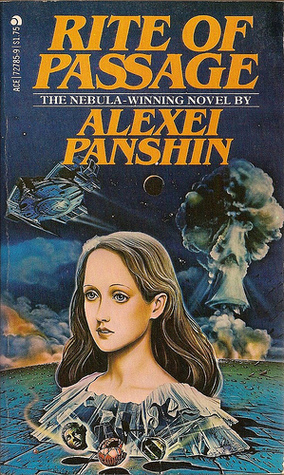
On the first page, we learn that Mia Havero, the POV character, has short black hair and her eyes are not blue. Science fiction illustrators still sometimes neglect to read the copy before designing covers.
I trolled shelves looking for books that included women as actual characters rather than objects. Books written by women, or with a woman on the cover where she was not being carried. Le Guin always invested in anthropology and eventually expanded her cast of characters to include women with agency. McIntyre was not focused on weapons or war but on fiddling our preconceptions about biology and how this might be altered and function in a different sort of society. Hers were realities that did not keep saying to me as a person that I was a second class person when what they really meant was that only white males mattered.
Yes, that was what this book does for me. [And I will mention here my experience with Maxine Hong Kingston’s Woman Warrior—the first time I tried reading, I quit in frustration on page 143, the second time I did not even recognize it was a reread till I got to that same page and realized how much I was loving it the second reading. Books are deeply personal and deeply connected to our experiences and preferences, where we are in life as we dive into fiction, and what we need at that moment to find in our fictional plunge.]
Foundation predates McIntyre by a generation, written before I was born. I began reading science fiction as a young girl when Foundation still defined the canon. I rarely found my self in those novels but willingly identified with main characters unless brutality or injustice set me off. Still…
By the time I was in college, working at the University Book Store in Seattle, and looking for books to read between terms, I wanted something better. I walked up and down, investigating the science fiction shelves, seeking books with woman authors or a woman in the cover who was not being carried. Do I need to mention how rare such books were in the early 1970s? How rare they seem to be even today? (Please, no bare-chested men either.)
What I appreciate about McIntyre’s novel (and others by this and other authors) was and REMAINS the revolutionary assumption that people are people, not two species male and female, not people who count because they are educated and white and male, but because they are alive and yearning and human. I appreciate her assumption that machines are less interesting than the people who wield them, the societies that must deal with them. (Here, I can recommend a contemporary SF author, Molly Gloss). That is her underlying given, I think, and as necessary for me to find on the page today as ever it was in the 70s. Her story is not about egalitarianism (it’s not the “message”), her characters exist in a world where equity on the part of the narration is simply taken for granted—what I still look for in fiction.
That is what I wanted to find: not women seeking equity, but how equity functions as the assumed reality.
Is this Anthro101? Too easy to dismiss a new take on culture as basic, when it is, in fact, the hardest thing to do. Yet authors do go beyond the easier task of inventing future machines to the far more radical task of inventing future societies. Le Guin did this again and again.
My husband was an anthropology major and I took several classes. “Women and children” were a separate category in the ethnographies I was assigned, as if only men determined the mainstream culture. I challenged the grad student teaching Intro to Physical Anthropology when he bizarrely compared ancient human culture to “primitive” societies of today, as if cultures remained stable for fifty thousand years and “primitive” were not a pejorative. His education should have warned him against such assumptions. Sexism in the sciences is not gone, not by a long shot. But times change and officially, sexism in academic writing is soundly condemned.
There are many SF/F writers today of every description (age, gender, sexual orientation, able and not, all races and nationalities and ages, etc. etc.), but most of them still use old-fashioned Western definitions of power and identity and conflict that are offensive and old news to me. I am not naive or out of touch. That is, I know how my world works. I am an intelligent and well-educated, able, elderly, cisgender white woman living modestly but not in poverty in the most powerful nation in the world, with all the many advantages and a few disadvantages that come with those identities. I know how my world works today. I want to read about it might work better.
When I read science fiction, I do not need to discover more of the same. These stories may explore the options as given fact. Not just interplanetary travel, machinery, technology, and weapons, but a new view of society, of biology and sociology and psychology. For all the thrill of Star Trek* and Star Wars, those series really only transport familiar narrative from the “wilds” of Earth to outer space. I am looking for an alternative narrative.
Technology doesn’t make things easier; that’s a common misunderstanding. Technology raises our standards and makes things more complicated, maybe better, but certainly not simpler.
—a computer engineer
If faster-than-light travel were possible, how would it impact people’s lives? If the Earth were destroyed, how might we rebuild society so that it was more fair to everyone? If we could recombine DNA from different species, how might human beings choose to change? What if? And if we can answer these questions in fiction, we might even be able to answer them in life. We can only create what we first imagine. Stretching our minds to consider better answers to human problems might be the best science fiction can provide.
In the mean time, cell phones. I used computers daily for decades, was perfectly comfortable using design software PageMaker and InDesign, and could coax software to do all sorts of weird stuff it was not meant to do. But I deliberately avoided cell phones because everyone I knew stared at them continuously. Not me. I have made a call on my fancy new phone. I have sent a text (I could not do this twice.) I have taken a photo and sent it, but that was accidental. Stay tuned.
*McIntyre wrote the novelizations of Star Trek movies. I still have them on my much-weeded shelves. They were better than the movies, more richly diverse and complex tellings. Not everyone liked that. I liked her own stories better, but I appreciated what I could see her doing with the material of Star Trek.
 IMPERFECT PATIENCE
Speaking of emails I have sent you a couple in the last week?
LikeLike
Jan, the books you describe here, the ones you are still now looking to find, are exactly the sorts of books the new Ursula K Le Guin Fiction Prize seeks to honor. The submission period opens this week (Feb 1) and anyone—READERS, authors, publishers, anyone—may submit a book for consideration. It must be a book published between May 1, 2021 and April 30, 2022, and you can find the guidelines on Ursula’s website. https://www.ursulakleguin.com/prize. If you or any of your readers have read and loved a recent book that you feel might be right for this prize, submit it for consideration!
LikeLiked by 1 person
Thank you for this, Molly!
LikeLike