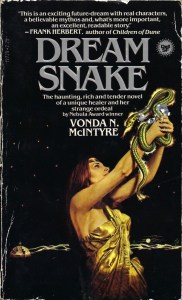
The novelette “Of Mist and Grass and Sand” was expanded into the novel, Dreamsnake (1978), winning the 1979 Hugo Award, the 1978 Nebula Award, and the 1979 Locus Award. This is the cover of the copy I first read and not representative of the story at all.
In addition to classes called “What If” about speculative fiction and “Utopia and Dream” about idealistic societies both real and imagined, I taught genre fiction to my sophomores and juniors. Science fiction, fantasy, mystery . . . I found short story examples and we read and discussed the expected tropes and the real-life satisfactions, explorations, and potentials of each.
One story I enjoyed teaching was “Of Mist and Grass and Sand” by Vonda N. McIntyre, which I first read in editor Pamela Sargent’s collection, Women of Wonder (1975). The story was originally published in Analog Science Fiction Magazine magazine in 1973, and the editor who accepted it describes how the shift to a broader definition of science fiction may have begun through McIntyre’s story:
“I can still see her sitting across the luncheon table, asking earnestly, ‘Does every story you publish in Analog have to be about rocket ships and super technology? Can’t a story be based on chemistry or biology?’
“I assured her that, as editor of Analog Science Fiction Magazine, I was open to stories about chemistry or biology—or witchcraft, for that matter. But they had to be good stories, about interesting people (who didn’t necessarily need to be humans).
“Vonda and I finished our lunches. A few weeks later I received in the mail the manuscript ‘Of Mist, and Grass, and Sand.’
“It was quite a bit different from the usual Analog fare. And it knocked me out.
“It still does.”—Ben Bova
I once got into an argument with a fellow MFA student about SF. Though she did not read SF, she insisted it was all about future space travel, but that focus is too narrow. Such a definition ignores the broader use of technology and fifty years of Le Guin’s writing which explore implications of cloning and genetic engineering, virtual reality and mind control, as well as cultural and social opportunities—not what is magical, not what is here, but that third thing we might call possible.
“Outliers” by Emily Hockaday and Trevor Quachri on the Analog website celebrates expansion of the genre, using publication of McIntyre’s story as their initial example: “inherent in science fiction, especially those stories or tales that deal with first contact, alien cultures, and a humanity that has extended far into or outside of the Galaxy, are the ‘softer’ sciences, including anthropology, sociology, psychology, and more.”
Ursula K. Le Guin’s focus was nearly about hardware but focuses on culture, an anthropological approach to science, and like other authors explores the potential of other scientific possibilities. McIntyre was uniquely disposed to consider what was possible biologically in cloning and genetic manipulation. Clearly science, clearly possible, and just as clearly prescient.
McIntyre’s “Of Mist and Grass and Sand” creates a post-holocaust Earth in which biological manipulation of snakes develops treatments for tumors common among a contaminated and sparse population. Snake is a nomadic healer, committed to providing medical care among peoples who have no home in a world where technology has not only brought ruin but where modern technology is mostly lost and unfamiliar. Among her tools are two snakes capable of creating venom that can attack and cure tumors, and a third that offers dreams to ease death. Grass is an imported off-world snake, so there is still an element of space alien here, but the story is not space opera but humanity struggling to survive, finding family structures and community and new solutions in a damaged world.
My students liked or often loved the story. To more ambitious readers I would sometimes hand over Exile Waiting set in the same future or Dreamsnake, McIntyre’s novel built from that story. Both novels respond to the well-known dangers of radiation in humane and scientifically probable ways. In fact, the imagined possible science of gene splicing and cloning have become old news. The humanity of these novels remains compelling.
Pamela Sargent’s Women of Wonder: Science Fiction Stories by Women About Women introduced me to many fine authors and expanded my understanding of science fiction beyond what I’d found in male authors such as Issac Asimov’s galactic empire Foundation novels. It seemed to me that many SF authors merely moved the setting of war stories into the future of space without exploring beyond technology are hardware.
I wanted SF to do more than reflect what I already knew. How do technology and nuclear holocaust impact culture? As a feminist I was well aware by my teens of the limitations imposed by our patriarchal society. What might exploration and nations and the future function without sexism. I had spent my entire childhood and most of my adolescence and teens reading adventure stories about boys. What if a woman were the main character?
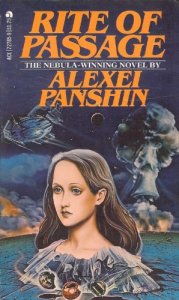
This is the cover of my first copy of Rite of Passage. Like most of the many covers, this one is inaccurate. The main character is introduced on the first page as Mia Havero. Hello.
Throughout college I read a great many books, most required by my coursework. During breaks between terms I read SF/F (science fiction and fantasy). Walking the long aisles of the ASF/F section at the University Book Store, I looked first at the covers. If a woman was carried by a hulking man in body armor, I knew not to bother picking it up. If the cover showed no people at all, or if the author was a woman, or if a woman was pictured on her own two feet, I read the first pages. I found one of my favorites that way, Alexei Panshin’s Rite of Passage.
Was my goal in feminism merely to have what men have? Not at all. I wanted something better. I wanted all human beings to shed the role of dominant male and subservient female and create a better world.
A year ago April, McIntyre died at the age of seventy. I was too busy with the pandemic to give that sad anniversary the attention it deserved. Her novels have had a huge impact on my perception of what SF can do. Like Ursula K. Le Guin, she created something unique in literature. Her stories and novels (and her novelizations of the first Star Trek films) considered all sorts of change, took racial and sexual fairness as a given, and were rollicking good adventures all at once.
Vonda N. McIntyre was one of the authors who looked into our future and created 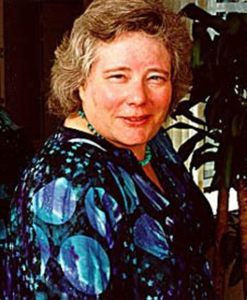 something genuinely new—not just a recasting of characters or a shift of setting, but an adventurous and new exploration of the possibilities of human existence.
It’s possible.
I am not going to write about the 4th of July. It was just too awful. I would like to tell about the black oystercatchers and the bald eagles and the hundred pelicans. Maybe later.
Stay careful, stay well, tell people you love them.
•
•
 IMPERFECT PATIENCE
I came late to science fiction, not in my teens but late in my 20s. Thanks for this post reminding me of those early years as I was just beginning to read in the field. Sargent’s Women of Wonder was important to me, as an introduction to the women writing F/SF, and I used to do as you did, scanning covers for women authors or women depicted in their own right, not carried in the arms of men. (I did the same in Western fiction. All those awful covers of men bending over the heaving bosoms of women dangling sunbonnets from their trailing fingers.) Vonda’s work along with Ursula’s, was enormously important to me. Have you read Cherry Wilder? She is largely forgotten now, but I loved her novel Second Nature (1986). She should be much more famous than she is, IMO.
LikeLiked by 2 people
Thank you, Molly. I read Foundation when I was 16 or 17 because my dad loved it. By the time I was a hundred pages in, I pointed out the appalling sexism, but kept reading. And then I looked for more, only looking for better vision. (To be fair, even Asimov recognized his failure much later.)
By the time Cherry Wilder was publishing, I was far from a bookstore that would have her books and raising children. I will look for her. (Today. Thank you for that too.)
LikeLike
by creating worlds where hope existed in the past present and future, they were telling us and hoping we would listen
LikeLiked by 1 person
I hope you write about July 4th eventually. I am blissfully ignorant about the effects here, as opposed to Haystack Rock which is often discussed.
LikeLiked by 1 person
Too close (both north and south), too loud (why?), too smokey (thick clouds visible even in the dark), too late into the night (after 11) with ash in our middle garden! All illegal and toxic and too near birds and our home. After ten minutes we gave our beach fire to a couple of tourists* and returned to the house.
In Portland, our son’s dogs were completely distraught and he swept up a pile of firework debris that fell in his back yard, and I do not know what local friends did who generally leave the country to spare their dogs.
*They enjoyed the fire, added wood and used the bucket of water Gary left them to put it out.
LikeLike