CATCHING UP

A lot. My injured foot is still a problem. No publisher for my novel. We’ve canceled an anniversary vacation. A neighbor is not doing well. And I am assured by a former student that, “There is hope in this world, ya know. And it’s okay to get depressed; it just means you’re paying attention. And while anyone is still paying attention, there is still hope for everyone who is not.” Walking, submission, altruism, A Christmas Carol, righteousness, and hope. The ocean of my business.

A couple of weeks ago on a trial 1-mile walk that went well.
Continue reading

SHE IS NINE & FINE

Only invasive flies die in her story.

Three months ago a nine year old girl, a Fourth Grader wearing pink glasses and named Bobbie Wilson was collecting Spotted Lanternflies. She’d learned about the dangerous-to-trees invasive species and how important it was to stomp them out. That’s what she was doing on the sidewalk where she’d lived since she was a baby: stomping on huge flies. The man who lived across the street watched her out his window and became frightened. He called the police to report her.

“There’s a little Black woman walking, spraying stuff on the sidewalks and trees on Elizabeth and Florence,” Lawshe told the dispatcher, according to a call obtained by CNN.

“I don’t know what the hell she’s doing. Scares me, though,” Lawshe added.

NPR, 3 February 2023
I feel certain that there is more brownish beer bottle glass on the beach than any other color, but we don’t often find it. Beer bottles are thin and their color is harder to spot, easily mistaken for rock, wood, or other debris. Old glass is thick. That big green piece is exceptional and probably from the base of a bottle.

Want to guess the race of the two people in this news story?

Continue reading

MISTRAL

It’s been many years since I took a class from Ursula K. Le Guin and in one of them she talked about the Chilean poet Gabriela Mistral. She was incensed at how little work of hers was available in English. After all, Mistral was a Nobel laureate, and her work was important. Le Guin had majored in French in college, but over the years she indulged in translation. (I taught a speech from one of essay collections called “Hunger” from a speech she delivered to a fundraiser-luncheon. In it she translated a poem from the Spanish by Pablo Neruda. Students struggled sometimes with Le Guin’s short speech, even to identifying the main idea, which was hunger, as set up immediately by the title.) She determined to study Spanish to do justice to Mistral. Other readers will judge how well she managed to maintain the music and meaning of this poem.

NOTE: On the Poets.org website, the translation is listed before Mistral’s words. I have placed the original Spanish first.

La Contadora (The Teller of Tales)
     by Gabriela Mistral 
    Cuando camino se levantan
todas las cosas de la tierra
y me paran y cuchichean
y es su historia lo que cuentan.

    Y las gentes que caminan
en la ruta me la dejan
y la recojo caída
en capullos que son de huella.

    Historias corren mi cuerpo
o en mi regazo ronronean.
Tantas son que no dan respiro,
zumban, hierven y abejean.
Sin llamada se me vienen
y contadas tampoco dejan…

    Las que bajan por los árboles
se trenzan y se destrenzan,
y me tejen y me envuelvan
hasta que el mar los ahuyenta.

    Pero el mar que cuenta siempre
más rendida, más me deja...

    Los que están mascando bosque
y los que rompen la piedra,
al dormirse quieren historias.

    Mujeres que buscan hijos
perdidos que no regresan,
y las que se creen vivas
y no saben que están muertas,
cada noche piden historias,
y yo me rindo cuenta que cuenta.

    A medio camino quedo
entre ríos que no me sueltan,
el corro se va cerrando
y me atrapa en la rueda.

   Los ribereños me cuentan
la ahogada sumida en hierbas,
y su mirada cuenta su historia,
y yo las tronco en mis palmas abiertas.

    Al pulgar llegan las de animales,
al índice las de mis muertos.
Las de niños, de ser tantas
en las palmas me hormiguean.

    Cuando tomaba así mis brazos
el que yo tuve, todas ellas
en regalo de sangre corrieron
mis brazos una noche entera.
Ahora yo, vuelta al Oriente,
se las voy dando porque no recuerdo.

    Los viejos las quieren mentidas,
los niños las quieren ciertas.
Todos quieren oír la historia mía
que en mi lengua viva está muerta.

    Busco alguna que la recuerde
hoja por hoja, herbra por hebra.
Le presto mi aliento, le doy mi marcha
por si el oírla me la despierta.


Mistral's "The Teller of Tales"
        translation by Ursula K. Le Guin

    When I’m walking, everything
on earth gets up
and stops me and whispers to me,
and what they tell me is their story.

    And the people walking
on the road leave me their stories,
I pick them up where they fell
in cocoons of silken thread.

    Stories run through my body
or sit purring in my lap.
So many they take my breath away,
buzzing, boiling, humming.
Uncalled they come to me,
and told, they still won’t leave me.

    The ones that come down through the trees
weave and unweave themselves,
and knit me up and wind me round
until the sea drives them away.

    But the sea that’s always telling stories,
the wearier I am the more it tells me...

    The people who cut trees,
the people who break stones,
want stories before they go to sleep.

    Women looking for children
who got lost and don’t come home,
women who think they’re alive
and don’t know they’re dead,
every night they ask for stories,
and I return tale for tale.

    In the middle of the road, I stand
between rivers that won’t let me go,
and the circle keeps closing
and I’m caught in the wheel.

    The riverside people tell me
of the drowned woman sunk in grasses
and her gaze tells her story,
and I graft the tales into my open hands.

    To the thumb come stories of animals,
to the index fingers, stories of my dead.
There are so many tales of children
they swarm on my palms like ants.

    When my arms held
the one I had, the stories
all ran as a blood-gift
in my arms, all through the night.
Now, turned to the East,
I’m giving them away because I forget them.

    Old folks want them to be lies.
Children want them to be true.
All of them want to hear my own story,
which, on my living tongue, is dead.

    I’m seeking someone who remembers it
leaf by leaf, thread by thread.
I lend her my breath, I give her my legs,
so that hearing it may waken it for me.


From Selected Poems of Gabriela Mistral: Translated by Ursula K. Le Guin. Copyright © 2003 Ursula K. Le Guin. Courtesy of University of New Mexico Press. Published in Poem-a-Day on September 27, 2020, by the Academy of American Poets. Pulled from The Academy of American Poets online site.
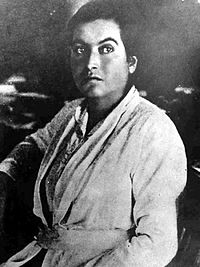
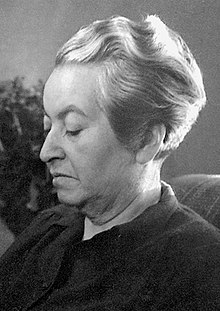
The Chilean poet, Gabriela Mistral, also known as Lucila Godoy y Alcayaga (1889-1957), was the first Latin-American writer to receive the Nobel Prize in Literature (1945). Born to a family of teachers, she mentored Pablo Neruda who would also with the Nobel. Unlike him, however, not enough of her work existed in translation to English.  (A bi-lingual edition by Doris Dana published in 1971, 272 pages, and some translations by Langston Hughes.) Ursula K. Le Guin studied Spanish in order to change that. 
As a younger woman

Mistral may be most widely quoted in English for Su Nombre es Hoy (His Name is Today):

We are guilty of many errors and many faults, but our worst crime is abandoning the children, neglecting the fountain of life. Many of the things we need can wait. The child cannot. Right now is the time his bones are being formed, his blood is being made, and his senses are being developed. To him we cannot answer ‘Tomorrow,’ his name is today.

—Wikipedia
Gabriela Mistral 1945.jpg
In later years
Most mornings…

BIRTHDAY

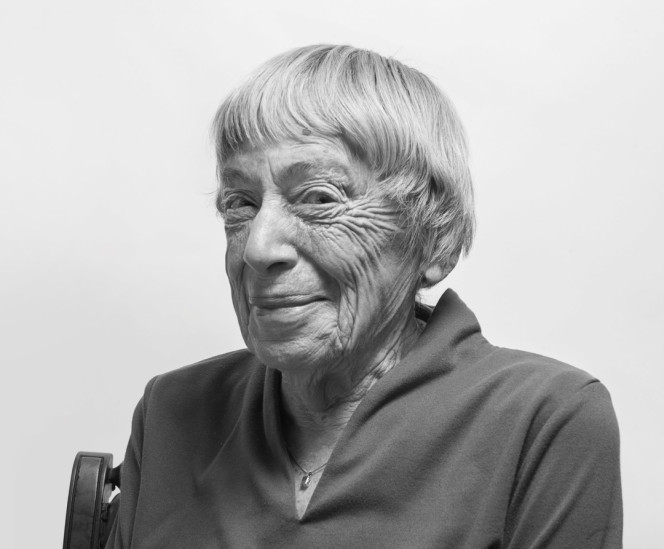
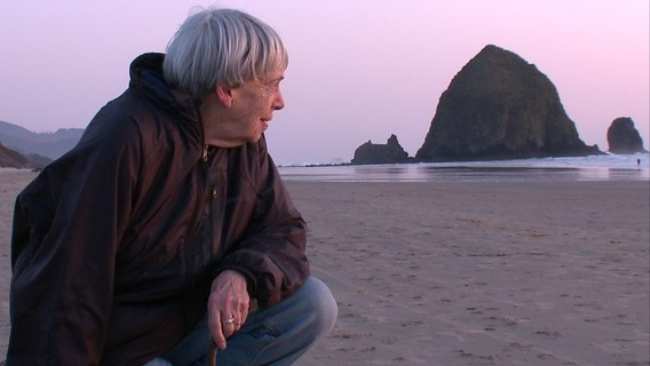
Today would have been her 91st birthday. Ursula K. Le Guin was born in 1929. I just read through the story collection, The Wind’s Twelve Quarters, which contains Le Guin’s earliest work and “The Ones Who Walk Away from Omelas.”

We do need her now.

from Brevity January 2018:

As soon as I open a document and before I begin typing, I select ‘Layout’ to indicate margins on my page. The guidelines do not show when I print, but they help me know where I am as I write.

Ursula K. Le Guin helps me know where I am.

She is not gone.

from Brevity

The obituaries are respectful. They list her more obvious accomplishments—the awards, the publications, her activism and generosity to other writers. They want to label her a “popular fantasy” writer, though these are not terms she would have chosen. “Why Are Americans Afraid of Dragons?” she asked in 1974. We dismiss what we consider “unrealistic” in our country, but that is a mistake. In the hands of a philosopher with substantial anthropological credentials, essays and poems, novels and stories are not escapism but challenges to our imagination.

For more than twenty years, I began my Junior English classes with Le Guin’s “The Wife’s Story” (1982) from Buffalo Gals. I read the five pages aloud, and then we talked about the nature of betrayal until the bell rang.

That most famous story, “The Ones Who Walk Away from Omelas” (1973), provokes questions: Would readers walk away or stay in paradise. Are we willing to allow another pay for our perfection? They are troubling questions, but contain another, underlying moral assumption: Must someone pay? In our superstitious faith in balance, do we demand another’s pain for our pleasure?

She gives us the suffering child in the basement because we insist that child exist.

“If you cannot or will not imagine the results of your actions, there’s no way you can act morally or responsibly,” Le Guin said in 2005.

My husband was standing at an information desk in Powell’s Book Store, a couple of years ago, when he recognized Ursula coming up the wide stairs and duck around into the Purple Room.

“There goes Ursula Le Guin,” he said to the millennial behind the counter.

“Who?”

We laughed about this again just the other day. Young sales clerks being what they are, they will learn.

Imagination is not mere child’s play, it is the only way we pursue what is possible, what is grand and just and beautiful.

She should have had the Nobel. She should have lasted longer because we need her here. We should have appreciated her more while we had her. My deepest sympathy to her family, her closest friends, and to all the rest of us.
___

Jan Priddy took classes from Ursula K. Le Guin, took tea in her Cannon Beach kitchen, ferried her to readings, and attended Jane Todd’s writers’ book club where Molly Gloss sat on her right, Ursula next, and Cheryl Strayed on her left. She read her books. They both had two years of Latin in high school and loved the beach.

POSSIBLE

iu

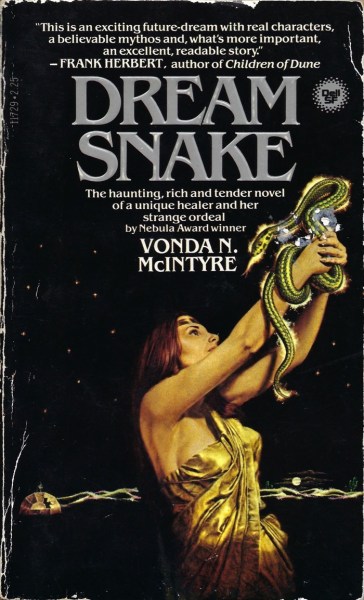
The novelette “Of Mist and Grass and Sand” was expanded into the novel, Dreamsnake (1978), winning the 1979 Hugo Award, the 1978 Nebula Award, and the 1979 Locus Award. This is the cover of the copy I first read and not representative of the story at all.

In addition to classes called “What If” about speculative fiction and “Utopia and Dream” about idealistic societies both real and imagined, I taught genre fiction to my sophomores and juniors. Science fiction, fantasy, mystery . . . I found short story examples and we read and discussed the expected tropes and the real-life satisfactions, explorations, and potentials of each.


One story I enjoyed teaching was “Of Mist and Grass and Sand” by Vonda N. McIntyre, which I first read in editor Pamela Sargent’s collection, Women of Wonder (1975). Continue reading

A BETTER WORLD

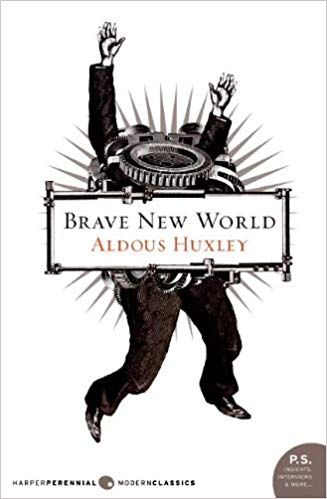
41l+4UobkRL._SX325_BO1,204,203,200_.jpgDystopias extrapolate the fears of the day while utopias project our dearest hopes and ideals.

Science fiction writers from the Golden Age of post-WW2, for example, often address the disastrous impact of the potential for nuclear powers to obliterate the planet. They were concerned about global and intergalactic peace and the trade-off in freedom resulting in a governing body with so much power. They recognized how population pressure and a shift toward manufacturing with machine rather than human power might dehumanize our future.

Huxley missed all that.

Brave New World was written at a time when the world economy was in the midst of a Great Depression and there was concern about finding the minimal 1000 calories necessary to maintain human life. Huxley addressed the need to stimulate the economy, reinforce social class and bigotry concerning gender, sexual orientation, race, and language. In a world rapidly opening to new ideas, Huxley maintains the status quo.   

Most languages are defunct, which is nice for the UK when English remains the lingua franca, but most languages from Polish to Spanish and French are so far extinct as to be gone from general consciousness. Women (always referred to as “girls”) exist as nothing more than inferior beings necessary for procreation. Sex. It is a white and male future. Casual lines about “negroes” within the first pages had my hackles up. There is ample evidence that he actually failed to notice that some of what he presents in his nightmare future, was already a nightmare. What Huxley knew was the rigid class system (which he then codifies here into biological law) and the need to regulate markets via absolute control of both production and consumption.

It is satire, with a lively and smug tone that reports in dizzying detail about a society that is irrational and repressive. Perhaps most societies are, but this is not a warning but arrogant. Not to mention how much he gets wrong.

What does he get wrong? Basics of biology, psychology, technology, communication, education, gender, race, nationalism, and the future importance of the British Empire. As one example, exhaustive detail about artificially breeding and rearing children is ridiculous. From specifics of harvesting eggs to programing children to be fearful of flowers, none of it is plausible. His story advances hundreds of years into the future, without considering how unimportant physical human labor is to society—a shifting paradigm evident in his day. He should have seen that coming.

What else does he miss? Dangers of post-WW2 pesticides and poisons, nuclear energy, wars, global warming, population pressure. These are the threats on which most science fiction of the 20th and 21st centuries focus. It is fair to note that Huxley could not have foreseen that the “War to End All Wars” was only the beginning, that military might would overtake social controls as a threat to world peace, that toxins such as DDT would create havoc on the natural environment, that global warming would alter climate and coastlines and food sources, that all these changes and the threat of nuclear war and a world population four times larger than the one he knew would threaten human existence.

Even Huxley recognized within a decade or so that his options of “Utopia or Savagery”/insanity or idiocy are inadequate, and he belatedly offers a third option, also inadequate.

Abuse of power is central to any dystopia, but Huxley’s book is hopelessly inaccurate in terms of science and fails to predict specific concerns nearly everyone in the world worries about today. His cheeky voice and sex-driven plot (in a future where the very word “father” is vulgar) may appeal to some. He can’t be faulted for most of his mistaken assumptions about the future, but the rampant nationalism, sexism, and racism in the novel do beg the question: Why is anyone still assigning this novel to high school students?

And I know the answer, surely I must. But still.

Utopias are harder. We do not accept them as a possibility. With a unique human determination to find fault, we grasp at the dystopia as representative of everything that might go wrong. But perfection? Oh, no, we cannot imagine that.

9636460.jpgAnd then most utopian novels I have read are no better at creating perfection than Huxley was at predicting disaster. Walden is utopia, but somewhat false as nonfiction since Thoreau did not actually live the life he writes about. The novel Walden Two, by behaviorist B.F. Skinner, on the other hand, does a a more honesty job by not pretending to be true.

“We are only just beginning to understand the power of love because we are just beginning to understand the weakness of force and aggression.”—Walden Two

B.F. Skinner asks if you knew how to manipulate people into living in an ideal society, wouldn’t you do it? We are all products of our experiences and responses to societal conditioning. Wouldn’t it be best if we deliberately created a society that conditioned us to live harmoniously and happily?

If readers are looking for a conventional novel, there is a plot here, a beginning and middle and end. But that story is mostly beside the point.

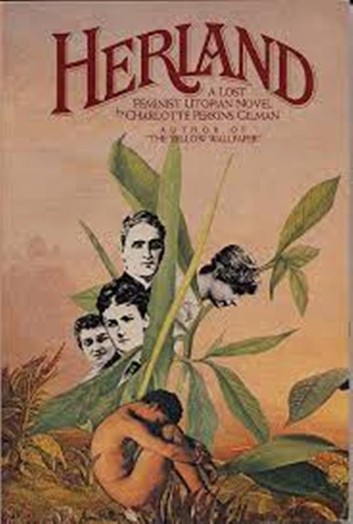
The story is a thought experiment first conceived immediately after WW2. Here an academic psychologist Burris visits another psychologist, Frazier, taking with him a pair of veterans, their “girls,” and a philosopher Castle, also an academic. The structure of visitors observing and interacting with members of a utopian community has been used many times. Herland by Charlotte Perkins Gilman (1907) is an earlier example. The visitors argue against the workability of a society that clearly is working just fine.
herland-14.jpgIn 1970, my first term at the University of Washington, I took a psychology class taught by a recent retiree from the US Navy. The man was a behaviorist, of course, and had spent 20 years training porpoise to commit acts of war. I worked hard in that class, harder than was typical for an intro class. I read the novel and wrote a paper about Walden Two. Mostly what I remembered was the clever way work was set up in this imagined utopia. Everyone had to do at least a little manual labor, but all work was chosen. Payment was in credits and each member of the community had to earn 4 credits per day. Some jobs such as cleaning out sewers earned more than a credit/hour. Some, such as working in a flower garden, earned less than one credit/hour. “Payment” was adjusted if more or fewer workers were needed than takers. I loved that system.

I also recall that the founder, Frazier, was not liked much but was tolerated in his utopia, and was actually not very good at following his own utopian guidelines.

There was a great deal I did not recall after all this time, and mostly that is because Skinner got so much wrong. Like Huxley, he even got the science wrong. He is wrong to remove children from one-on-one care by parents. He is wrong in the way he describes “teaching” young children to withstand frustration, and ironically he is wrong to underestimate the impact of “delayed gratification” as a necessary skill for adolescents and teenagers. I would have recognized some of this at the time since I was aware that group-raising infants in the USSR had proven unsuccessful. Promoting childbearing by age 15 or 16 is not “much better” than waiting to have children when the body is mature. Child-bearing is not something to be got out of the way while still a child. And since Skinner is squeamish about religion and extra-marital sex, he fails to address the issues that come with promoting marriage among very young teenagers.

“In a cooperative society there’s no jealousy because there’s no need for jealousy.”

He insists there are no laws in Walden Two, yet there is a Code and violating the Code has consequences. That is law. His Managers and other officials are not government because government is irrelevant unless it is local. Citizens of Walden Two are told how to vote in local elections.

“The majority of people don’t want to plan,” the novel’s protagonist insists. “They want to be free of the responsibility of planning. What they ask for is merely some assurance that they will be decently provided for. The rest is a day-to-day enjoyment of life. That’s the explanation for your Father Divines; people naturally flock to anyone they can trust for the necessities of life… They are the backbone of a community—solid, trust-worthy, essential.”

Skinner argues hard for his scientific approach and claims that his invented society is egalitarian about race and gender. What he refers to as “Girls” and women are supposed to be on an even footing, yet we have mostly all men everywhere in charge in this novel. There is a cheerful woman dentist. All the childcare givers are women, though he insists men help too. All the characters seem to be white, and all the girls are pretty—this is actually remarked upon early. Men are “caught” by women—an out-of-date notion about marriage. (“The man chases the woman until she catches him.”) The character Castle is said to be a strong debater, but he is a peevish straw man opponent here, often failing to make his point in arguing with Frazier. Frazier himself is set up as a failure to his own cause, which is probably the most compelling and realistic detail.

There is a great deal to argue with in the specifics of this imagined utopia. I might wish he knew more about biology and anthropology, especially the latter. I am sorry he demeans history repeatedly as mere “entertainment”, while freely referencing [Western European white] history to make his case. He is actively hostile to every other scientific field. That last is particularly unfortunate.

Yet I am still intrigued by his underlying question about a perfectible society, by his approach to labor, and his emphasis on cooperation rather than competition. He might have made a stronger case had he focused less on specifics such as his tea carrier and more on how humans have cooperated for millennia, for all time. He failed to see the population bomb coming and his setting this confrontation in an agrarian society during summer is a sort of naïve cheat that repeats in many discussions and debates between characters. Remove the favoritism of parents and their poor knowledge of scientific method, remove competition, use behavioral principles and there will be no envy or jealousy? Snap! Problem solved. (I can hear the whining from here.) I found myself repeatedly thinking that Skinner’s daughter was fortunate that it was her mother who was the primary caregiver.

I still contend that Skinner’s task was more difficult than Huxley’s, and neither accomplished it very well.

“In the summer of 1945, B. F. Skinner wrote The Sun Is But a Morning Star, a utopian novel he published in 1948 as Walden Two (Skinner, 1948). An impetus for the book arose over the course of a dinner conversation in the spring of 1945 with a friend whose son-in-law was stationed in the South Pacific as World War II was coming to an end. Skinner mused about what young people would do when the war was over. “What a shame,” he said, “that they would abandon their crusading spirit and come back only to fall into the old lockstep American life—getting a job, marrying, renting an apartment, making a down payment on a car, having a child or two” (Skinner, 1979, p. 292).
. . .
“Skinner’s utopian vision, then, was not about any of Walden Two’s practices, except one: experimentation. His vision was to search for and discover practices that maximized social justice and human well-being. This was Skinner’s unique contribution to the utopian genre; it distinguishes Walden Two from all the others. As he later exhorted, “Regard no practice as immutable. Change and be ready to change again. Accept no eternal verity. Experiment” (Skinner, 1979, p. 346).—B. F. “Skinner’s Utopian Vision: Behind and Beyond Walden Two” by Deborah E Altus and Edward K Morris

And then there is Ursula K. Le Guin’s classic short story, “The Ones Who Walk Away from Omelas.” She knows we find it hard to believe in perfection—how certain we are that someone else must pay for our pleasure.

EMBRACING THE CRONE

Ursula K. Le Guin once talked about embracing that word, “crone” as an honorific. For most, it is pejorative, inherently agist and sexist, but Ursula argued for a different take. The crone has experience and perspective, intelligence and awareness. The crone is old because she has lived long and prospered. She has earned respect, even though she rarely gets it.

“In her essay, ‘The Space Crone,’ Ursula Le Guin wrote that old women would make the best space explorers. Free from the daily tasks of rearing helpless children, free to see and comprehend without vanity, loving life because we know we may have to leave it soon, we would embark on our journey to the stars not for ego or planting flags but only for information to transmit back to our grandchildren for their future explorations. We know by then that we are part of the flow of life.”

I heard her talk about crones in the 1990s when she was about what my age is now. She wrote this essay twenty years earlier in 1976, when she was in her late 40s and I was in my 20s. It’s the first essay in Dancing at the Edge of the World, which includes her speech “Hunger” that I teach each year. Half that volume is made up of collected book reviews about writers such as C.S. Lewis, Doris Lessing, and Molly Gloss.

Kate Atkinson objects to book reviews written by authors, and particularly to a reviewer declaring her a “matron” in The New Yorker. I understand she considers the term disrespectful. I get it. She’s right. It wants to connect to “society” as in society matron, some woman with grown children who works on charitable committees without ever dirtying her hands. Matron, according to common use and the dictionary is a married woman, especially a dignified and sober middle-aged one. Like “bitch” maybe it’s time we took back the label of matron, the way Dick Gregory took back “Nigger” when he used it to title his memoir, so his mama would know that when she heard that loaded word, it was someone talking about her son’s book. Except that never quite worked and the n-word is still a bad’un.

Like racism and sexism, agism is something we’d like to pretend does not exist. In our youth-obsessed, age- and death-denying society, everyone past high school feels pressure to be young. How many times have people declared: It’s only natural to want to be young? Maybe. But in most past cultures, even the feeble old were regarded as having earned respect. They are the holders of what we now call institutional knowledge.

A woman I worked with on the local arts council assured me decades ago that “the great thing about being 70 years old is that no one expects you to look young anymore.” She made me laugh. We both laughed. I admired her home, her view, the wooden blackbird hovering over her dining table. I admired her ability to be who she was. I was 30-something at the time, no longer “young” but still uncomfortable with “middle aged.” I clung to Gloria Steinem’s incredible birthday riff about turning forty. “This is what forty looks like. We’ve been lying for so long, who would know?” Except, she was always beautiful, still is, and she’s 84 now. Gloria Steinem is old. She is even that worse thing, elderly.

I will be 66 next week, and I am old. (In medical terms, I am also elderly, but I resist that term. It belongs to my next decade and the one or ones after, should I be so lucky.) I am old, not middle-aged, not young. And I am not “66 years young” which is a pathetic claim to my mind. I am not living backwards. I am not trying to look 35 or 45. I am what I am. I am tired of guilt about youth. I am weary of being told I should yearn for youth, that I should strive for it, that I must always be forever young. I am not young.

from On Golden Pond:

Ethel: “Hey, I just met the nicest couple…. In the woods.”

Norman: “Couple of people?”

Ethel: “No, a couple of antelope. Of course a couple of people. Their name is Migliori, I believe…. They’re a nice middle-aged couple, just like us.”

Norman: “If they’re just like us, they’re not middle-aged. Middle-aged means middle, Ethel. Middle of life. People don’t live to be 150!”

Ethel: “Well, we’re at the far edge of middle age,” she says: “That’s all.”

Norman: “We’re not, you know. We’re not middle-aged. You’re old, and I’m ancient.”

Ethel: “Oh, pooh! You’re in your seventies, and I’m in my sixties.”

Norman: “Just barely on both counts”

[In fact, Hepburn was 74 when she said those lines. Henry Fonda was 76. Both were genuinely old, but not ancient. Hepburn was 94 when she died in 2003, but this was Fonda’s last theatrical film—he also made a TV movie that year. He passed early the next year, in 1982.]

There is nothing I want back from youth but the ability to run distance. I could still do that when I was 58. I would like that back. Yes, I truly would. But it won’t happen. I can walk for 2 hours and run short distances, but I will never run 6 or 16 miles again.* I mourn for the loss of that running freedom, but I honor what living, reading, and thinking have given me at my age.

I have experienced much, read many books, and thought deeply. I have never stopped reading and thinking and observing the world. There is still learning in my life. I am subject to change. That last should be another posting.

In the mean time, I have lived long and prospered. I have earned my age. Give me the credit I am due.

______________________________

*UPDATE: In October of 2022, the week before my 70th birthday, I ran a 10k in 71 minutes, 9 seconds. That’s 6.2 miles and I was 8th of two-hundred-something in the 65-69 age group. Whoo-hoo for me!

further UPDATE: I completed the same run the next year, a little slower but came in 2nd in my age group of over 200 runners because at a week before my 71st birthday, I was 70-74. Yeah, elderly now.


NOSTALGIA

IMG_2836.JPG

[CLICK TITLE TO READ MORE] I made my youngest grandchild a birthday cake for her party today. She is two years old. I also made a 2-year-old quilt, something I also did for each of her cousins. Pink is her favorite color. For now.

IMG_2631

EV’s quilt, completely pieced but before it was quilted.

The quilt is cotton with a cotton filling and a pieced backing that is partially pink with metallic gold dots. The cake is yellow, some of it tinted pink from the addition of black Oregon huckleberries. I made lemon curd and raspberry jam for the fillings, and a huge batch of blackberry buttercream for the frosting. It is the most incredible pink. I knew this trick with blackberry juice in buttercream from a previous series of cake made to please my oldest grandchild, who turned six last fall. Fresh organic raspberries. Organic everything, because we do not like to take chances with toxins.

Two cake batches, blackberry syrup to flavor and color the double batch of buttercream, and lemon curd. I completely thrashed the kitchen. Powdered sugar everywhere. Crumbs. Gary was cleaning my mess for me as I began typing this.

Gary is good to do this cleaning, but he reminds me that I was in the kitchen all day. He had a hard day himself. We had to make a correction to our taxes, he cleaned the walkway and trimmed shrubs on the north side of the house, and his brother called to complain and then hung up on him. This brother is afraid of all sorts of things that might not worry me in the slightest. That’s because he is mentally ill and unable to step away from himself long enough to think about others. Others are always dangerous to his mind.

Years ago I heard the poet Naomi Shihab Nye say that even as a child she felt this strange homesickness for a place she’d never been. She realized that what she missed was the place where poetry resides. At least, that is what I remember her saying.

Another poet, the marvelous Tracy Smith, recently discussed the terrible hunger she sees for literature: “I have this belief that we are so vulnerable when we open ourselves up to literature. We’re reminded of these real parts of ourselves.” Perhaps it is that willingness to be vulnerable, that we pursue. It is some vestige of glory in our souls—not paychecks or adoring crowds or battlefields, but something more like what e’re inclined to term humanity.

Some see vulnerability as weakness, when it is actually strength. To be open and accepting requires that we have the strength to remain standing under the weight of chance, of betrayal and error. Not everyone can manage that.

The alternative is continual anger and fear. No one is wise while continually angry and fearful.

Ursula K. Le Guin writes: “All old people are nostalgic for certain things they knew that are gone, but I live in the past very little. So why am I feeling like an exile?” No time to lose—yes, that’s it exactly.

I willingly call myself old and I am grateful to Le Guin for reinforcing my sense that aging is inevitable, but has its perks. I will die, but I have lived long enough to know what might be missed if I fail to pay attention.

The past is not my usual space to dwell, though I fret over lost friends and family. I fret over misunderstandings concerning recent history and that my students do not know the parts of speech or how to construct a formal outline. I am nostalgic for my own excellent education. More often, I look ahead to what I might still accomplish. Most often I am here and now, figuring out my life one step forward at a time.

I have thought about my place in time often over the years. Just now, reading Le Guin’s last book, I am thinking a good deal about what I might do with whatever time I have left. I might have as many years as Ursula. She was younger than I am now when I first met her, and her lifespan suggests I might still be living and writing sensibly into my 80s. I hope during this time to find the poetry in myself.

More of us might seek that strength that risks communion, that loves and forgives, that locates the heart of our hearts. I think, at least, that I might have time to do that, to continue looking forward. To open myself. To hear. And to give voice without fear.

And pink cakes.

SaveSave

THE LAST CHANCE

IMG_0523

[CLICK TITLE TO READ MORE] Just now, sitting up in bed, I have already updated my progress on Ursula K. Le Guin’s last book No Time to Spare. Le Guin ruminates about, among other things such as her cat and overpopulation, the meaning of spare time. Here I have to stop for a moment.

Through my email inbox, The Literary Hub offers links to various articles and I read one or two of those. The New Yorkers sends me the frequent Borowitz Report. I read the headline and kicker, but I do not click through.

The New Yorker wants me to subscribe. This is my “last chance.”

I read a good deal every day. I read stories from three newspapers (I subscribe online to two of them) and some days I read stories on NPR or The Atlantic. I read Brevity—both the blog and the magazine. I read short fiction on four SF/fantasy websites. I receive daily posts from three poetry websites, and occasional ones from a poet and an educator, plus a handful of others. Sometimes I even read whatever book I am carrying around. In the school library I look over a magazines.

I do not read The New Yorker cover to cover, though I have a friend who has been doing that since we were both in high school, going on 50 years ago. I have an attitude about The New Yorker. I am not their target demographic.

Even when Jamaica Kincaid was writing Talk of the Town, I found the magazine elitist and representative of a view from, as Walter Lee Younger declared, “a bunch of hustling people all squeezed together being Eastern.” Richer than me, too. It is one of the magazines I find in the library. I enjoyed Zadie Smith’s essay about (finally) discovering Joni Mitchell. I sometimes read the fiction, which used to be common in magazines and is still featured there. I routinely urged students to check it out for full length literary analysis essays, another increasing rarity in mainstream magazines. I do not subscribe.

These days, I subscribe to Poets & Writers, which I fail to read, and occasional other literary journals, which I also fail to read. This failure to subscribe has not always been my practice. There were years when I subscribed to many journals and read each one cover to cover, particularly making note of fiction. One year, when The Best American Short Stories (BASS) came out, I had already read all but two of the award-winning stories.

Then my thesis adviser, as I was completing my MFA, asked: “Why bother to submit to journals? No one reads them.”

And I realized that I didn’t read them anymore either. It was the most depressing thing anyone had said to me since my mother began dying. I felt that my literary goals had been shot dead on the spot. Certainly this was not the intention of my mentor, but it bit deep, even so.

The New Yorker wants me to subscribe, and I am a reader. But no. I will read in the library and I will read periodicals online and save the paper.

I will not be subscribing. It is not my last chance. I receive such emails at least once a week. The New Yorker will offer many others.

In the mean time, I am not done myself. This is not my last chance. I will go for a walk this morning once it is light enough to see. I was asked to bake a birthday cake for our youngest grandchild’s 2nd birthday party. EV just turned two. She likes pink and she like berries so there will be wild huckleberries in the cake, blackberries tinting the buttercream pink, and raspberries on top. I will be busy today making lemon curd, a layer cake, and buttercream. There is a lot to get done and I have only an outline of my day. I have not yet begun.

At 65, I accept that some things are pretty much over for me. No plans to run another 10k. I will not be teaching full time again. Not ever. But I am still doing most things I love. I am writing every day. This is not my last chance.

What I do now is not my last chance, but I have no time to spare.


SaveSave

WISE WORDS

“When there’s no social pressure behind it, respectful behavior becomes a decision, an individual choice. Americans, even when they pay lip service to Judeo-Christian rules of moral behavior, tend to regard moral behavior as a personal decision, above rules, and often above laws.

“This is morally problematic when personal decision is confused with personal opinion. A decision worthy of the name is based on observation, factual information, intellectual and ethical judgement. Opinion—that darling of the press, the politician, and the poll—may be based on no information at all. At worst, unchecked by either judgement or moral tradition, personal opinion may reflect nothing but ignorance, jealousy, and fear.”

—Ursula K. Le Guin, May 2013 from No Time to Spare (pp. 14-15)

It is tempting to see this as prescient. It might be wise to consider what it says about our national character and how we find ourselves in the political situation under which we now suffer.