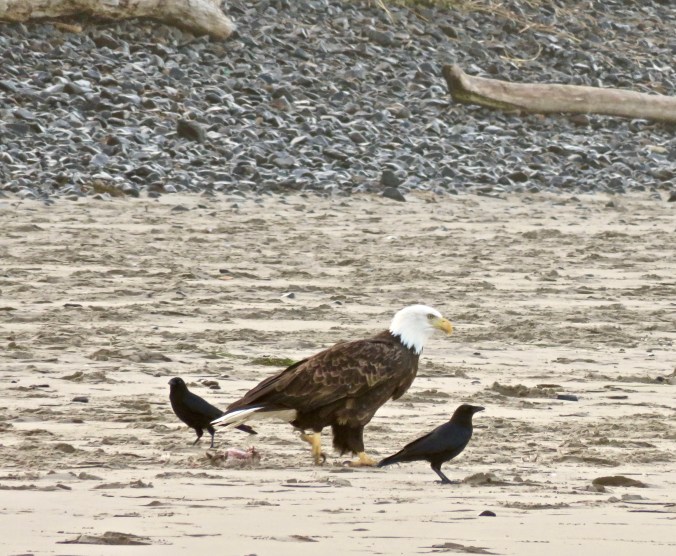
Many times crows forage beside eagles. The crows cannot pierce the skin of most dead creatures, but the eagle can. (In the wild, ravens hunt in tandem with wolves. The raven spot game, the wolves open the body.) I have seen crows drive raptors from a wounded gull and from their own nests. The smaller birds win their point.
“A man has been arrested after antisemitic abuse was directed towards Jewish children on the London Underground. … Wearing a cap and hoody, the man is seen in the video threatening a man off-camera after he tries to intervene before a woman in a hijab – Asma Shuweikh – confronts him.”—The Guardian
The Muslim woman is a mother of two and wishes more people would intervene in such situations.
“Wilshire Bus,” a short story by Hisaye Yamamoto, concerns a woman taking the bus to visit her husband in a VA hospital post-WW2. Japanese-American herself, Esther says nothing while a drunk harasses an elderly Chinese-American couple on the bus. She bursts into tears when she reaches her husband’s hospital bedside. He believes this is because she misses him, but readers understand that she is suffering from guilt that she failed to defend the couple on the bus. When I first read the story in graduate school, the obvious ironies of the situation and her feelings of guilt reminded me immediately of my own experiences.
I would have been twenty-one or twenty-two, an undergraduate student at the University of Washington and taking the bus home alone. My husband and I had bought a house on the other side of the zoo. I was sitting toward the back and a drunken man began harassing an adolescent child. People nearby looked nervous but avoided eye contact. I thought we all hesitated to say anything because the man was big and we were afraid. A young black man stood up from his seat and told the drunk that he needed to stop what he was doing. It’s been over forty years and I do not remember everything, just that the young man was slender and the drunk outweighed by fifty pounds at least. I remember that the drunk got off the bus at the next stop. I remember we were grateful to the young man. I remember thinking the drunk was twice my size and wishing I had done something myself and trying to think what I should have done.
The next time was also on a bus, and I was also alone, but instead of the route that ran east-west on 45th, I was heading downtown. I can no longer remember the bus numbers, but this one took Eastlake Avenue NE, traveling south from the U District. Again, I was seated near the back and again a man began harassing someone smaller, a racist harangue. I got up from my seat almost immediately and walked to the front to tell the bus driver. By the time I got to the driver, there were three of us. And this is very clear: The bus driver did something I would never have thought could happen. He pulled his bus over the the side of the road, on University Bridge. He stood and walked to the back of the bus and told the drunk, “You’re going to have to get off my bus, or I am calling the police.” And the man got off and passengers clapped and cheered.
Sometimes doing the right thing is frightening. It might even be dangerous. I did not directly confront a drunken man who outweighed me by close to a hundred pounds, but I found a safe way to intervene. In Yamamoto’s story, many people were offended by racist language, and every one remained silent until after the drunk had left the bus. Esther suffers from her sin of omission. She fails to act as she knows she should have.
So did I.
Fortunately, I learned my lesson and I like to think so did Esther. I think the courage to act in such situations sometimes requires rehearsal. We need to think it through in our heads and balance what we know is right with known risks.
Mob rule is not right and speaking up can be dangerous—we mostly all learned that in school. Silence in the face of abuse can be more dangerous. The assumption when we are silent in response to abuse is that we agree with what is being said and done. And that perpetuates the evil.
How many times do we need to learn that lesson?
 IMPERFECT PATIENCE
I know that crows will attack eagles in the sky driving them off but I have never seen a occurrence such as this.
Your article made me think of the two men who defended the Muslim women on train in Portland and died for it.
LikeLiked by 1 person
When I taught “Wilshire Bus” we always talked about being safe. It’s risky to speak out, but there is also risk in silence because the overall safety of our society is compromised. I did not confront the man on the bus, but went to the driver. Yes, I was scared.
The eagle attacking the gull was particularly interesting as it was the crow who first came to defend the gull, and only late on other gulls. (But then, crows are smart.)
LikeLike
I thought of that too.
LikeLiked by 1 person
Thank you for this post! I’m sure that nearly everyone who reads it will connect in one way or another. I’ve been on the receiving end of being bullied on a subway, and have been on trains where others were being bullied. Confronting an aggressive person is terrifying, but it often leads to them stopping the negative act they’re doing. As you mention, it is much easier (and preferable) when group mentality sets in and there’s strength in numbers. It makes you really appreciate the community too. We’re all in this together. I attended a workshop by POP Gym on the topic of self-defense and standing up for others who are being harassed. We discussed some ways that we can be assertive and de-escalate situations in real-time. It was very helpful! Thankfully I haven’t had to employ these techniques and skills since then, but it is nice to have the knowledge and confidence in tow! Here’s POP Gym’s website: https://popgym.org/about/
LikeLiked by 1 person
Thank you for the link—I’ll check it out. And thank you so very much for your post. You have triggered all sorts of connections for me.
The courage and self control and intelligence necessary to de-escalate a situation is what we need more of. It is far too easy to ramp up the anger and fear, and unfortunately we see far to little training in how to bring things down, lesson tension, remind one another what we need. Both the young man and the bus driver in my two scenarios used very calm voices. Neither shouted or postured. They stated fact—telling the abuser that he needed to remove himself, that his behavior was inappropriate and must stop. It amazed me, and to some degree it was beyond me. This was not merely because I was small and female, but because I fear my own anger. I do not respond well to yelling.
I had a student who lost control in class, screaming at me at length. I managed to remain still and quiet and when he finally wound down, I d=told him he needed to leave the classroom. Inside I was a wreck, but apparently I looked completely calm. I sounded completely in control. The student left the room. In 40 years of teaching, I have calmed many students, but only seen four lose their temper in a way that was directed at me. Three times other teachers lost it and unjustly dumped on me. An administrator. I am fine with debate, but being on the receiving end of yelling has never been easy.
It does not help that disagreeing, clear disagreement coming from a woman tends to make some people see red. I am old enough and feminist enough to recognize how inequitable this can be.
LikeLike