not a YEAR END REVIEW


fullsizeoutput_116b

I just reread my year-end reports from 2018. (I have some work to do.) One of those posts was about what I had read. One of them had to do with paying for college. My mother was famous as a worrier, which was not great but did result in a daughter who was careful about money.

My husband and I have managed full retirement quite well financially. We are maintaining a small reserve in the bank, taking a day now and again to travel nearby and stay the night, and thinking ahead to what we need for the future. We need a new roof and some other major repairs. Our wood-burning stove needs replacing—it’s necessary in a location where the power routinely goes out in the winter, usually for a day at a time, but sometimes for a week. All of this means we have decided to budget more tightly in 2020 in anticipation of these expenses. We got through college without debt and entirely under our own steam because we had cheap habits and careful spending. Some of that is still true. We still do not smoke or use drugs. We drink good coffee and cheap wine. We have not eaten most meat for decades, not because we disliked meat, but because it felt morally wrong the way animals are raised, and increasingly dangerous to our health and the health of the planet. We eat organic food but plan to be completely vegetarian for the rest of this new year, abstaining from our habit of seafood once or twice a week. We’ll see how that goes. But cheese. We both think we will always have cheese.

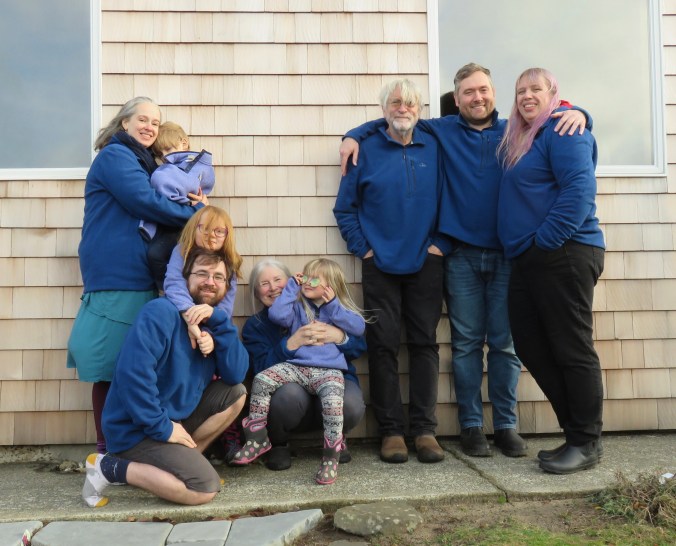
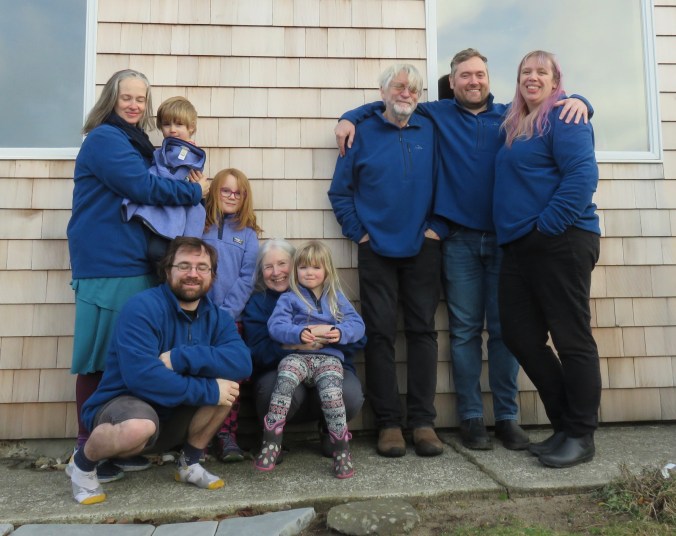
This past couple of days we had our children and their children here for a visit. The the tea party for the kids was a bust, but we walked the beach and I knit with Ruby. There was a scavenger search around the house with written clues (thank you, Emily), The Family Stone (thank you, Kerris), and eleven for dinner last night. There was a lot of food. My baking and cooking plan included a detailed timeline for chili verde, sautéing mushrooms and onions, roasting various vegetables, poaching salmon, putting together frittatas, frying latkes, Waldorf salad, pumpkin custards, cranberry bread and also orange-cranberry sauce, wild rice, and rugelach. I made vegetable stock. I cooked like a crazy person. Saturday morning, I baked two loaves of bread—which was not even on the list!

We managed. Everyone is gone now because of work tomorrow, and I would be feeling pretty great about now but did not sleep last night.

You do your best, and the best is never perfect, not even close. But you hope that the people you love most in the entire world understand you are imperfect but trying hard.
fullsizeoutput_1161

SIN OF OMISSION

fullsizeoutput_1117

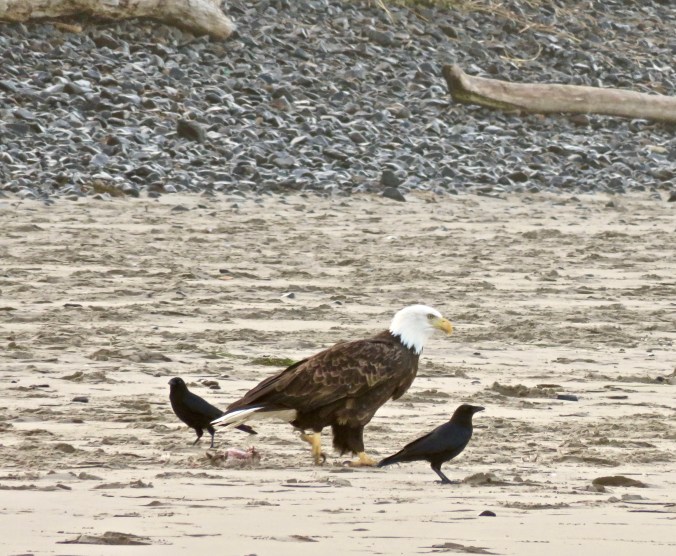
Many times crows forage beside eagles. The crows cannot pierce the skin of most dead creatures, but the eagle can. (In the wild, ravens hunt in tandem with wolves. The raven spot game, the wolves open the body.) I have seen crows drive raptors from a wounded gull and from their own nests. The smaller birds win their point.

“A man has been arrested after antisemitic abuse was directed towards Jewish children on the London Underground. … Wearing a cap and hoody, the man is seen in the video threatening a man off-camera after he tries to intervene before a woman in a hijab – Asma Shuweikh – confronts him.”—The Guardian

The Muslim woman is a mother of two and wishes more people would intervene in such situations.

“Wilshire Bus,” a short story by Hisaye Yamamoto, concerns a woman taking the bus to visit her husband in a VA hospital post-WW2. Japanese-American herself, Esther says nothing while a drunk harasses an elderly Chinese-American couple on the bus. She bursts into tears when she reaches her husband’s hospital bedside. He believes this is because she misses him, but readers understand that she is suffering from guilt that she failed to defend the couple on the bus. When I first read the story in graduate school, the obvious ironies of the situation and her feelings of guilt reminded me immediately of my own experiences.

I would have been twenty-one or twenty-two, an undergraduate student at the University of Washington and taking the bus home alone. My husband and I had bought a house on the other side of the zoo. I was sitting toward the back and a drunken man began harassing an adolescent child. People nearby looked nervous but avoided eye contact. I thought we all hesitated to say anything because the man was big and we were afraid. A young black man stood up from his seat and told the drunk that he needed to stop what he was doing. It’s been over forty years and I do not remember everything, just that the young man was slender and the drunk outweighed by fifty pounds at least. I remember that the drunk got off the bus at the next stop. I remember we were grateful to the young man. I remember thinking the drunk was twice my size and wishing I had done something myself and trying to think what I should have done.

The next time was also on a bus, and I was also alone, but instead of the route that ran east-west on 45th, I was heading downtown. I can no longer remember the bus numbers, but this one took Eastlake Avenue NE, traveling south from the U District. Again, I was seated near the back and again a man began harassing someone smaller, a racist harangue. I got up from my seat almost immediately and walked to the front to tell the bus driver. By the time I got to the driver, there were three of us. And this is very clear: The bus driver did something I would never have thought could happen. He pulled his bus over the the side of the road, on University Bridge. He stood and walked to the back of the bus and told the drunk, “You’re going to have to get off my bus, or I am calling the police.” And the man got off and passengers clapped and cheered.

Sometimes doing the right thing is frightening. It might even be dangerous. I did not directly confront a drunken man who outweighed me by close to a hundred pounds, but I found a safe way to intervene. In Yamamoto’s story, many people were offended by racist language, and every one remained silent until after the drunk had left the bus. Esther suffers from her sin of omission. She fails to act as she knows she should have.

So did I.

Fortunately, I learned my lesson and I like to think so did Esther. I think the courage to act in such situations sometimes requires rehearsal. We need to think it through in our heads and balance what we know is right with known risks.

Mob rule is not right and speaking up can be dangerous—we mostly all learned that in school. Silence in the face of abuse can be more dangerous. The assumption when we are silent in response to abuse is that we agree with what is being said and done. And that perpetuates the evil.

How many times do we need to learn that lesson?

WHAT THEY NEVER TOLD US

I taught high school beginning in 1976, and except when my sons were little, I taught in private and then public schools until I almost-retired a few years ago. I am grateful forever that I fell into teaching, that I was honored to know and work with thousands of people, many of whom remain my friends. If some wondered if the hearts I sent on birthday greetings were sincere, I can say that every day tears come to my eyes when I think about my students. When they share joy I cheer; when they experience loss, I am saddened.

Most of what I recall about students is tender and delightful and cherished, but there are some incidents that still trouble me. Wednesday evening another high school teacher announced that she wanted to teach a class for future teachers with everything we were never taught in teacher training. We compared notes. 

We cannot save them all. We will make mistakes that haunt us. Students will ask questions we cannot answer and need help we are unqualified to give. Our students will die. They will die in car crashes and of drug overdoses. They will suicide. They will make horrific mistakes and never recover. 

They will test our ability to allow them to be wrong because that is how they want their world to be. It is not our right or responsibility to remake them in our image. When they seem gullible or cruel, I have to step away because it is not my place to stop them.

In a Junior Research Paper, many years ago, a student advocated for the slow death by torture of anyone convicted of a serious crime. That was how the thesis was written: People convicted of a serious crime should be slowly tortured to death. 

Hamid Debashi wrote an Op-Ed on Aljezzerra saying “What the US was doing to the world at large is what Americans now fear Trump might do to the US.”

“Liberal America is now scared that Trump will do to America what America has done to the world. It was just ‘foreign policy’ when America set up lunatic puppet dictators just like Trump to torture, maim, and murder their own people around the globe to protect its ‘national security interest’.

“It was just something ‘Daddy’ did at work. When he came home he was all good, kind, and cuddly—just like Obama. Now the Daddy is about to become a nasty, vicious, domestic abuser—like Trump.

“Trump is the poetic justice of the world. So long as America was only doing to the world at large what America now fears Trump may do to America, there was no outcry. There was consensus. The world deserved what America did to the world.”

Well. I guess the author is speaking to me. I hear him. I know that his outrage and anger are not without foundation. I have tried over the years, as gently as I could manage, to open the eye of students living in what has been a largely white and isolated Oregon community. 

Allow me to be clear. It is not my job to reinforce or alter the deeply held convictions of my students. It is a part of my job to help students understand that there are other people in the world who may not share their view. 

I asked the student with the the death-by-torture thesis for clarification: Define “slow.” At least two or three days. Define “serious crime.” Yes, the student meant the serial killer, but also the robber, mugger, and someone who holds up a bank. I took a breath and pointed out the obvious, that our Constitution forbids “cruel and unusual punishment” and that studies suggest about 1 in 20 murder convictions are in error, AND that the paper needed to address strong opposing positions. In the end, the paper acknowledged that sometimes mistakes are made and an innocent person might be tortured to death, but “that is the price you pay for living in America.” Those words. 

The completed paper followed the assignment. It was weak in either conceding or countering the opposing view, but the student completed required research, drafted, and finished with a good grade. I did not tell the student that the paper was horrifying, though I did confide this judgement to another teacher. 

I will never forget it. 

I was raised to believe in a different America. I was raised to believe that We the People, live together to protect and serve the general Welfare not only of today but of our Posterity. 

I still believe that. It is in our Constitution. And a final word about students who make “horrible mistakes and never recover”—the truth is that most do recover. They might wander in the desert for forty years and then find themselves someplace they never thought would be theirs. They hang on and hang on, and then one day realize they are safe and happy at last. Sometimes being lost is the only way we are found.