LETTING GO & 50k for NaNo

This morning I passed 50,000 words on NaNo. I’ve given up on the plan to stitch ornaments to go in the holiday cards. We stayed home last weekend and I was supposed to be stuffing squashes and making applesauce this afternoon. Instead I spent four hours recreating the emergency manual for our condo because I only had the pdf and could not figure out how to revise it. So the document got another complete edit, which is a good thing, and I sent a brand new pdf off to the man who did most all the original work. And I looked up photos of my classes.

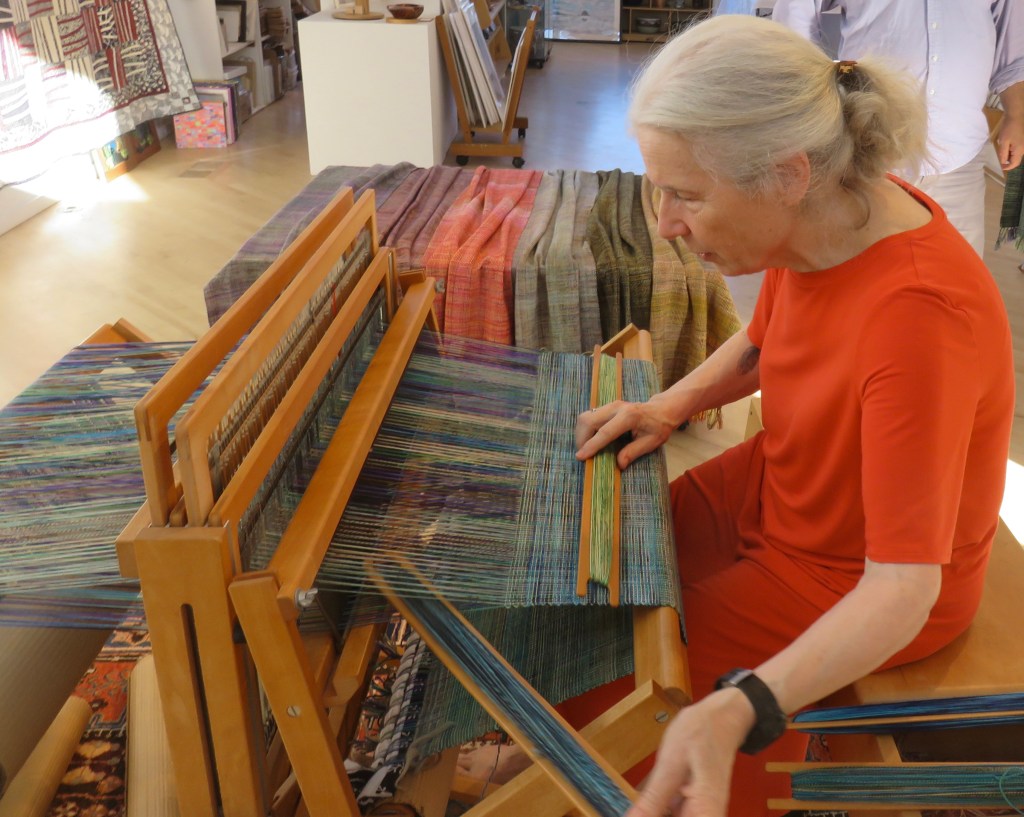
Weaving during the opening of the textile show last month at Cannon Beach Arts Association Gallery. A former student bought the one I am weaving in this photo, thank you, Josh. Gary wants credit for the photo. Thank you, Gary.
Continue reading

LAND LINE

No one calls us. No. That’s inaccurate. We have friends in Canada who call sometimes to touch base and one of our sons often calls us during his breaks working from home, especially while he is on a walk.

Our younger son got us each a cell phone and pays our new phone bill, so the land line became a useless expense. Even so it took us months to cancel and unplug our big landline phones. We finally did last week. We dickered about who and how to alert this change. In the end, family. We figured most everyone everyone has my email.

Retirement, gray hair, gardening, beauty and telephones in no particular order—

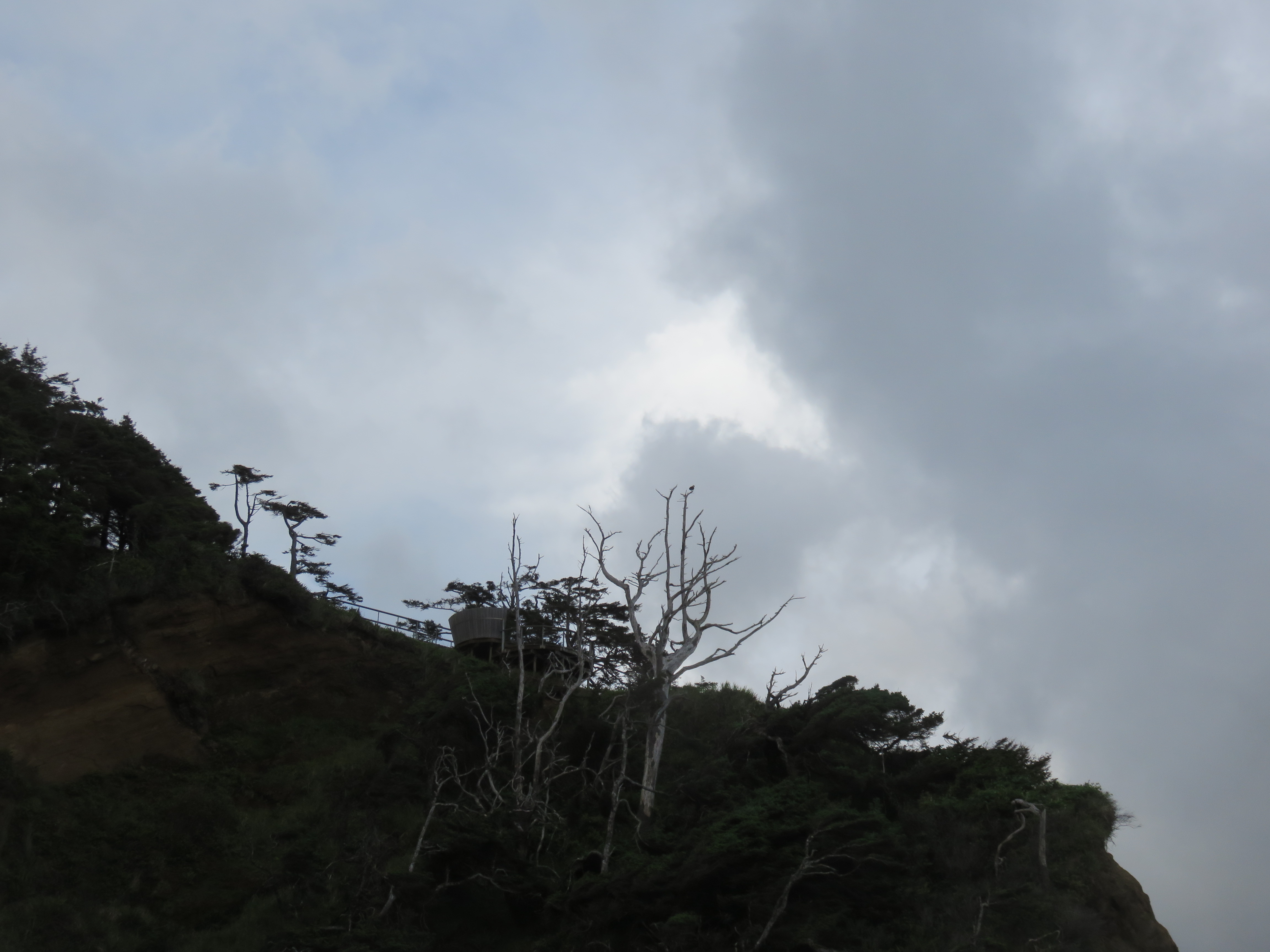
Last week we saw this osprey land on the snag at the headland north of our home. Usually there is an eagle there, or a raven or crow. We had never seen an osprey there and my zoom struggled in the wind, shot from the north in the next beach. She flew right over us in a long lazy turn.

Continue reading

WHOOPS

Sunlight over the Pacific Ocean.

I played around with other WordPress themes yesterday and managed to completely misplace the one I started with. Gone. The sidebar with personal and site information now appears way down at the bottom of this page. That is not convenient. I could pay the “Happiness Engineers” to help me, but I am so offended by that title (not to mention the cost) that I will put up with this ugliness. [Why did I ever think it was a good idea to leave Blogspot?] I do not like this layout, but it’s the best I can do.

Discuss.

[NOTE: Managed to find a “theme” with the sidebar, but now the header photos do not show on the home page and are overlaid on their own page. Better, though. imo. Yours?]

Continue reading

DOLLHOUSE

fullsizeoutput_1105

When I was a little girl, I was already fascinated by Japan—the architecture particularly, but also the clothing and food and toys. The fables. Because I lived in a suburb of Seattle, it was easy to visit the House of Rice or Trident Imports and lust after kimono and sandalwood chests.

I did not play with dolls much as a girl, but I had a pretty toy geisha on a stand that held place of honor in my bedroom. My farvorite model horse was made of paper and lacquer, gray with a traditional fancy saddle. I didn’t like that his mane stood straight up, but I could not coax it to lie over. I have that Japanese horse to this day. It must be nearly sixty years old.

There are few other things I still have from my grade school obsession. I read a book about how to build a Japanese doll house and I sewed bedding, made the storage box of balsa wood—those things are gone, but the scale vases from an import store are carefully stashed.

My father worked for the Bureau of Commercial Fisheries. I ate sushi for the first time in the early 60s. This was during a Japanese/American fisheries conference. I didn’t like sushi then, but I did later. I have gathered books on Japanese building, on the impact of Japanese woodblock prints on the Impressionists.

This is National Novel Writing Month, and I am writing first thing each day in pursuit of at least 70k (NaNo’s goal is only 50k).  This morning of Day 4, I have written past ten thousand words. My intention was to take a very old manuscript of 80k that I began in 1996 and update it. That isn’t quite what I am doing, as it turns out. I have outlined 25 chapters and I am writing beginning to end, a chapter a day. When I was writing that earlier novel that inspires this one, I wandered all over the place, beginning the middle to end and back, from the points of view of eight characters. So far I have hardly looked at that old manuscript to write this one. Instead, I am sticking with the here and now. There is a ghost cat, maybe. There might be a diary, which was the center point of the earlier novel. Maybe not. I haven’t gotten to that chapter. I write my 1667 words and then some more, and then a bit more, and when the chapter is done and I have my words, I stop.

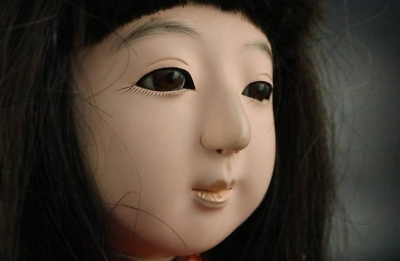
s-l400.pngWhen I meet my daily goal, I am allowed to do something else like look at Japanese dolls that I cannot afford on Ebay or watch a Korean historical romance (Rookie Historian Goo Hae Ryung) and admiring the costumes, one more episode till the end.

For many years, my life was cluttered like a Victorian drawing room—my time so tightly compressed, I barely had space to breathe, much less turn around. I worked eight hours, then came home and worked most of the evening. I neglected the house. I probably neglected my family and friends, though I did not notice at the time. The weekends were almost never time off—the shocking thing when I retired to teaching just a pair of college classes was discovering I did not need to work on Saturday and Sunday. I am still getting used to that now I am not teaching at all and all my time is wide open. Grace is emptiness.

Life can have space like a Japanese home. Floors empty to the walls, I cross freely from one side to another. There is the freedom to chose to sit on the floor and regain composure.

This clearing of space, this abandonment of possessions—well, the fabric for quilting, the yarn for weaving and knitting still arrive—this new-won spareness and simplicity.

But I am not talking literally. I am not living a cluttered life, but a gradually simplified, cleared away life.

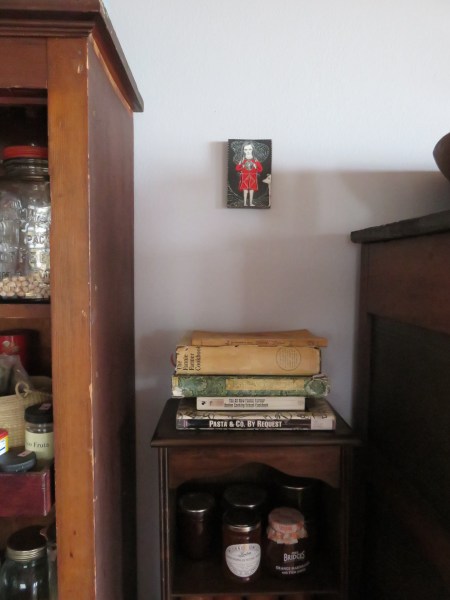
IMG_5098My obligations are easier to count, easier to recognize and balance. My clothing is spaced in my closet. I keep removing what I do not wear. I give away what I do not use. The little girl with the red dress and white ghost dog greets me each morning in my kitchen—hanging just there above the jelly cabinet and between the Forest Ridge bookcase I use as my pantry and the pie safe with my grandmother’s porcelain custard cups.

I have a cake to bake, birthday gifts to wrap today. My coffee is cold. I need more sleep.

I am speaking literally.

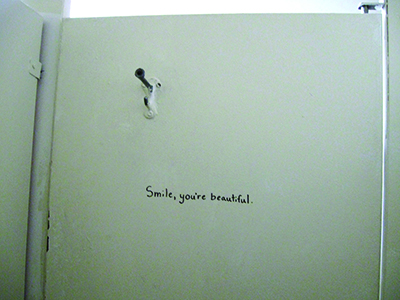
“Smile, you’re beautiful.”

Priddy-21.jpg

from 19 April 2013 in The Humanist

This afternoon a student passed me, grinning. She’d just visited the eastern-most toilet stall in the “senior” bathroom. The room is decrepit, the soap dispenser is often empty, and the stall doors don’t latch. But on the inside of one door is a hand-written message: “Smile, you’re beautiful.”

I’ll admit that part of the reason I smile when I read this is because it’s spelled and punctuated correctly. But there’s more to it—a student wrote that note. It’s something to think about.

I have always loved teaching. I love sharing what I know. I love seeing the glow when a student gets it and realizes they can achieve excellence. I love watching worlds open up. I love being around young people on the cusp of life—fully aware and capable of thinking and questioning and growing. Their lives flutter with possibility.

But there are days when it’s hard to smile. As a fellow teacher posited to me: “It shouldn’t be this hard to be a kid.” A student discovers she will be homeless this weekend, and the boy across the room hasn’t had a full meal since his free lunch ticket expired two weeks ago—his mother is too embarrassed to fill out the forms. Another girl couldn’t go home last night because the crack dealer next door burned out the entire apartment building, and the boy beside her couldn’t go home for other reasons. One boy sees violence as an inevitable solution because it’s the only one he’s ever seen garner results. Another won’t listen to facts if they favor a viewpoint other than his own.

I’ve often been told that teenagers think they’re immortal. They don’t. They behave like cocky animals and they talk big and they take risks and make stupid choices because they know they’re going to die. They’re terrified and worry their lives will end before they can make a difference in the world.

“What does Egypt look like?” a female student asks during a class discussion about protests around the world, including the strategies of Henry David Thoreau, Mohandas Karamchand Gandhi, and Martin Luther King Jr. “Is it sandy like in the desert? Are there buildings like in India with goats in the streets?” I talk about Cairo’s 17 million people and modern hotels, adding, “but yes, there is sand.”

“What do they want?” she asks. “Why are they in the streets?”

I tell her I can’t say for sure, but that they probably want the same things she does. They want a free country, they want some power over their lives.

I’m intrigued by her questions. This student has been practically nowhere and seen almost nothing. Usually shy, she stares off, perhaps imagining camels and traffic jams. “I want to go and see it,” she says.

Not one student in three classes has ever heard of Thoreau before today. A few recognize the name of Gandhi. “Mahatma,” one boy suggests.

“That means  ‘great soul,’” I inform them.

One girl knows he went on a hunger strike to protest British rule in India. But no one has ever heard of how American men and women sat down at luncheon counters to order a cup of coffee and were abused, spat upon, beaten, and finally arrested merely because they were black. My students are shocked. I hope they’re equally impressed by the courage of those sitters who took abuse to call attention to injustice, and were incarcerated in order to publicize their goals. They have their place in making the world a better place. We talk about that.

The goal in school is to get an education, but for some students the overwhelming goal is survival. They are hungry, homeless, embarrassed by their clothing, their transportation, and by their families. They have no quiet place to study and no one at home to encourage them. They have undiagnosed and untreated health and emotional issues. They deserve so much more than they have. They deserve someone to expect more from them. All of them—every one—wants to be successful, but only rarely do they have a personal, practical, or emotionally satisfying image of what success looks like.

“Make a list of things you want to do before you’re old,” I tell them.  “A bucket list,” they say back. They want to graduate and make money. They want to make their parents proud. Some say they want to buy their mom a house. Or go to Egypt. One wants to dance in the street in Chelsea. It’s good that they dream. They need these grand and beautiful dreams.

Too often high school culture concerns nothing much beyond sports and clothing, grades and money. Earning a living is necessary, but money by itself is a sterile goal. They worry too much about prom—it’s unlikely they’ll ever get to dress that way again—and not enough about mathematics. They read all their friends’ posts on Facebook and not nearly enough novels or history books. They use technology without mastering it. They know how to slip through the system without understanding that it’s here to serve their future. They earn grades without gaining an education. They worry about the wrong experiences of high school.

I can’t say who is at fault. Parents tell them the great lie: this is the best time of your life. I warn them that it shouldn’t be true. Life doesn’t go downhill after age eighteen. “It’ll get better,” I tell them. There is so much more.

Teachers try to provide incentives and rewards. I see possibility spread out before my students, waiting for them to find their way. I try to throw doors open to the world, but find students are too busy keeping on their feet to venture out. I see the world wide open to them, but they fear electric fencing. They fear failure. They fear the future. And because of these fears, some of my students will remain right where they are all their lives, turning in ever smaller circles, wearing a hole in their own tiny scrap of rug. I’d like them to fly. Get on a magic carpet and out the door. I’d like them to know the world.

Smile, you’re beautiful. Who wrote it? I wonder. All these students who walk the halls of my school—the future is still open and some of them will make beautiful lives despite bumps along the way, and they’ll return one day to tell about it. And even on a day like today when too many children are moving in frightened circles, I smile. They’re beautiful.

WHAT THEY NEVER TOLD US

I taught high school beginning in 1976, and except when my sons were little, I taught in private and then public schools until I almost-retired a few years ago. I am grateful forever that I fell into teaching, that I was honored to know and work with thousands of people, many of whom remain my friends. If some wondered if the hearts I sent on birthday greetings were sincere, I can say that every day tears come to my eyes when I think about my students. When they share joy I cheer; when they experience loss, I am saddened.

Most of what I recall about students is tender and delightful and cherished, but there are some incidents that still trouble me. Wednesday evening another high school teacher announced that she wanted to teach a class for future teachers with everything we were never taught in teacher training. We compared notes. 

We cannot save them all. We will make mistakes that haunt us. Students will ask questions we cannot answer and need help we are unqualified to give. Our students will die. They will die in car crashes and of drug overdoses. They will suicide. They will make horrific mistakes and never recover. 

They will test our ability to allow them to be wrong because that is how they want their world to be. It is not our right or responsibility to remake them in our image. When they seem gullible or cruel, I have to step away because it is not my place to stop them.

In a Junior Research Paper, many years ago, a student advocated for the slow death by torture of anyone convicted of a serious crime. That was how the thesis was written: People convicted of a serious crime should be slowly tortured to death. 

Hamid Debashi wrote an Op-Ed on Aljezzerra saying “What the US was doing to the world at large is what Americans now fear Trump might do to the US.”

“Liberal America is now scared that Trump will do to America what America has done to the world. It was just ‘foreign policy’ when America set up lunatic puppet dictators just like Trump to torture, maim, and murder their own people around the globe to protect its ‘national security interest’.

“It was just something ‘Daddy’ did at work. When he came home he was all good, kind, and cuddly—just like Obama. Now the Daddy is about to become a nasty, vicious, domestic abuser—like Trump.

“Trump is the poetic justice of the world. So long as America was only doing to the world at large what America now fears Trump may do to America, there was no outcry. There was consensus. The world deserved what America did to the world.”

Well. I guess the author is speaking to me. I hear him. I know that his outrage and anger are not without foundation. I have tried over the years, as gently as I could manage, to open the eye of students living in what has been a largely white and isolated Oregon community. 

Allow me to be clear. It is not my job to reinforce or alter the deeply held convictions of my students. It is a part of my job to help students understand that there are other people in the world who may not share their view. 

I asked the student with the the death-by-torture thesis for clarification: Define “slow.” At least two or three days. Define “serious crime.” Yes, the student meant the serial killer, but also the robber, mugger, and someone who holds up a bank. I took a breath and pointed out the obvious, that our Constitution forbids “cruel and unusual punishment” and that studies suggest about 1 in 20 murder convictions are in error, AND that the paper needed to address strong opposing positions. In the end, the paper acknowledged that sometimes mistakes are made and an innocent person might be tortured to death, but “that is the price you pay for living in America.” Those words. 

The completed paper followed the assignment. It was weak in either conceding or countering the opposing view, but the student completed required research, drafted, and finished with a good grade. I did not tell the student that the paper was horrifying, though I did confide this judgement to another teacher. 

I will never forget it. 

I was raised to believe in a different America. I was raised to believe that We the People, live together to protect and serve the general Welfare not only of today but of our Posterity. 

I still believe that. It is in our Constitution. And a final word about students who make “horrible mistakes and never recover”—the truth is that most do recover. They might wander in the desert for forty years and then find themselves someplace they never thought would be theirs. They hang on and hang on, and then one day realize they are safe and happy at last. Sometimes being lost is the only way we are found.

TEACHERS AS STUDENTS

Cameron-Diaz-in-Bad-Teacher.jpg

I have not seen and never will see this film. Up the Down Staircase, a novel, was written by a lifelong teacher. Most people who write books about their incredible experience and wisdom as teachers last 1-3 years in the profession before moving on to something that pays better.

A message arrived this morning via email with the image above and the headline below:

Why Teachers Make the Worst Students
As a snarky high school teacher, here’s what I came up with: Teachers don’t make great students.

The author offers a list of reasons teachers are bad students and she is pretty much spot on that they are uninterested in educational or brain theory, have too much to do already and resent being pulled from their classroom, and generally behave like the difficult and only marginally teachable students sitting in the back of their own classrooms. She doesn’t know quite why this is true and asks for help in explaining why teachers are often so unteachable.

It’s a funny post and she uses the complaints of her own students to illustrate common teacher complaints. She’s spot on.

Me? I am generally a sit-at-the-front sort of person with an exceptional academic record. Honest. I read newspapers each day. I have a lot of books in my house, fiction and nonfiction, and I have read those books. “Metacognition” is not an annoying word I dismissed once I knew it was no longer going to appear on a test I had to pass but a concept critical to my profession. I am fascinated by brain theory and willing to stir up curriculum even though it makes more work. I like the work. It’s why I teach.

My own explanations for why some high school teachers are such terrible students:

  1. Teachers are already waaay too busy trying to keep up with classwork to take time out of their day to attend a poor presentation. Liz Oppelt was right on target with this one. This is always true and is the biggest reason for their inattention. They already have a job waiting for them and truly do have more important things to do and most would prefer to be doing those things. Unless the in-service helps make that job easier, they would prefer to be doing their job.  or perhaps . . .
  2. That one teacher would rather not be there at all. There was a teacher in my building who was smart and effective in front of students but also only pretended to grade work and was easily swayed by fellow-travelers who charmed their way through their education. Being clever was enough. Another teacher in my building lay down each day during his prep period and napped or read the newspaper or anything rather than scoring papers or preparing for a class or counseling students. Some rare teachers kept a 40-hour work week schedule. This sort of behavior is not typical among teachers, probably less common than in some other professions. I have known shopkeepers who fail to ring out the registers, health care professionals who never bother to review records, bookkeepers who ignore illogical figures. It is incredibly rare to find a lazy teacher, but this 1-in-100 teacher is texting during in-service presentations. The rare Administrator too.
  3. The presentation is a genuine waste of time. We know bad when we see it because it’s our job. Yes, some presentations are bad. Sometimes really bad. Once in a long while a mandatory presentation is entertaining and held during an in-service week when teachers are in a great mood, even though the lesson doesn’t teach much other than how to play for an hour without actually learning more than four words in Spanish. But more often it is delivered by a hired person who was never a very good teacher to begun with (and maybe that’s why they went to work for the ESD or a private company or administration, jobs that all pay much better and involve shmoozing), or they are presenting material under contract and they do not themselves understand or care about it, or they have forgotten everything they once might have known about teaching and now want to tell about how much they love skiing or about their recent divorce. Or all of the above. (Seriously, this happens.)
  4. Some teachers do not want to be taught. Some teachers are bad students because, frankly, they were never very good students to begin with. (see #2) They are still not any more curious or proactive or ambitious about their subject or teaching as a profession than they were in high school. (Again, I see this in every profession—bankers, contractors, health care providers, small business owners who merely drift through their job.) Some teachers only want to get through their day. (see #1) They are not interested in how to do their job better. If they are teachers, they don’t care about educational theory or brain science now and never were interested because they do not care how people learn and never did. They want activities to keep students busy, or they want to be entertained, which is why they liked the terrible art/Spanish lesson delivered in Spanish that required an hour to teach four words and no art. (See #3)

Some people enter teaching because they thought teaching would be easy. It isn’t. But some small minority of teachers keep no books in their homes, waste time at school, never their profession whenever they walk out the door, and are incurious. They never do the best job they could because that would require too much work.

I love teaching and I love teachers. Most often we are overworked and tired. (see #1 again). We are inattentive because we have more important concerns on our minds as we do our best to educate. Give us something to help us do a better job for our students and you will have our full attention. We are always trying to do a better job.

But seriously, we know a bad presentation when we see one.


RANDOM FACTS

IMG_3392

Years ago, long before non-GMO became a common label on foods, before Safeway even had an “Organics” section, and before “gluten-free” became a thing, a junior came to class with an idea for her research paper. “It sounds interesting. They are altering the genes of food,” she said about the NPR broadcast she’d listened to on her way to school. ”

“What do you think about it?” I asked.

“I don’t know,” she said. “I want to find out.”

Her eventual essay included the word “Frankenfoods” in the title, so we can see where that led.

Over the years, students rarely choose to write about topics they begin by knowing little about, but those papers are most often the best. Writing a research paper should be as much about finding out truth as proving it.

Changing our mind is probably one of the greatest struggles any of us have. We get an idea in our head and simply cannot move. For a teenager to research a topic with an idea already clear in their head about what they want to say is pretty typical. For a reversal to occur is rare indeed.

Recently, a junior was writing about forcing sports teams to change what some perceived were racist logos. She argued this would be unnecessarily costly and inconvenient, would destroy honored traditions and history, and anyway, “racism” was not the intent and probably not even effect of these logos. She got through two drafts, and then the day before the next draft was due, the one that was supposed to be done other than minor word-smithing, she came to see me after class.

“I have a problem,” she said. “My thesis is wrong, or anyway I disagree with my thesis. I made a mistake and now I don’t know what to do.” She had, the night before, read an opinion piece about the damage racist stereotypes, including the images used as sports logos, do to young people living on reservations. Such images preserve and inflate prejudices and contribute to a sense of exclusion and hopelessness for children already living in poverty and on the margins of society. “I’ve seen that,” she said. “It’s true.” She had worked as a volunteer on a reservation.

“Change your thesis,” I said.

“But I don’t have time to start over.” She sounded surprisingly reasonable, given her sense of her dilemma. This had to feel like a disaster in her world and she was struggling to maintain her calm. She began to rattle off all the arguments that supported her original thesis.

“But one article convinced you that you were wrong.”

She nodded.

“So use everything you already have, and then show me how you were convinced. Concede everything—inconvenience, costs, fan outrage—and show me how there is something more important at stake. It convinced you; convince me as a reader.”

She did it too. Changed her hook, reversed her thesis, fiddled her body paragraphs, and concluded with a bang. Her argument was logical and emotional, reasonable and persuasive.

It can be done. We can change our minds.

Long ago, another junior showed up before class, the day before a draft of the same assignment was due. She was in tears. “They have to shoot them,” she wailed. “They have to do it as a symbol, and the sea lions aren’t even the real problem.” She had been writing a paper to argue against killing the sea lions that were eating salmon at the base of a dam spillway. She could prove that the sea lions were not the cause of dwindling wild salmon populations, but she also came to understand that the issue was not as simple as she’d hoped.

Another student, in his senior research paper (SRP) was struggling to prove his thesis, that welfare recipients should be drug tested as a condition of receiving public assistance. Why should people on public assistance be allowed to abused those funds? The trouble was that drug-testing had been tried and had proven that few people do abuse drugs and it cost a great deal more to test for drug abuse than was gained by cutting such people off from public services. Ten or twenty times more. There were also issues related to privacy and other forms of public assistance and contracts that he did not even want to address. He had not changed his world view, but he did change his point of view on this particular policy.

Students have proposed legislation that was eventually adopted (hat off to you, Russell for advocating pleasure boat pilot licenses), as well as the use of artificial turf, graphite bats, and golf carts during tournaments. I read about forty essays on allowing or banning abortion, most of them on both sides rather hysterical and unconvincing, before I banned the topic altogether. One senior cried so hard every time she tried to work on her pit bull essay that I chose to put that topic, too, on the banned list.

Religious arguments? Mostly banned. When a student used Thomas Jefferson’s faith as part of his proof that we are a Christian nation, I suggested he had better read the work of our third President. When his mother argued that no Christian ever owned slaves, I gave up trying to reason with her. In order to use a faith-based argument, you would first have to convert your audience. I was teaching in a public school.

I readily confessed the obvious. I have opinions. I am opinionated, but I am more interested in the writing. I have been convinced by students, and even when I am not convinced, my purpose is to evaluate their skill, not to make them agree with me. One of my all-time favorite essays, one I still recall vividly and with respect, was written to support preserving “under God” in the Pledge of Allegiance. It was a hot topic one year because of a California lawsuit. Three students wrote supporting restoration of the original form of the Pledge. Two wrote supporting the current form. One of those last was brilliant. I still don’t say “under God” because my mother taught me not to, but I respect and honor that student’s essay. Her exploration of the history and implications of the Pledge were more complete than anyone else. She won me over.

It is one of the side gifts of teaching researched persuasive essays: I learn a lot. Sometimes I find I know random facts I cannot even explain. I have no reason for knowing about water rights and road-building, statistics about rape and fishing, the costs of medical insurance and how many student athletes are injured by sport. Part of scoring their papers involves reviewing their research, verifying their claims, checking for additional overlooked aspects of a problem. I read a great deal.

And as determined as students are to avoid interviews, talking to the right person will yield solid facts and details available no other way. Even so, the right questions of the right person are critical. A student asked an engineer working with nuclear power via email what health risks were associated with nuclear power? The man emailed back that he was “unaware of any health risks.” The student quoted this as proof that nuclear power was non-polluting and harmless. I had to break it to the student that “he may be joking.” An engineer would not be the right person to ask about health issues, and he needed to research nuclear accidents. Plus, you know, the long term effects of The Manhattan Project . . . “Look it up.”

I am a good researcher, and with the internet and experience evaluating sources, it is surprising even to me what I can find out if I look hard enough. The key is a willingness to look beyond what supports my prejudice.

Skepticism is a good thing, I have found. Finding multiple sources to confirm the same information is important. Avoiding the crazies. Doing the math. Recognizing that a minority opinion is not necessarily wrong. But it isn’t necessarily right either. What’s worth arguing is never simple.

In the face of personal experience, we might alter our perspective. In the face of evidence and logic, we must be willing to consider other perspectives.
 

MY WRITING LIFE

IMG_2766

I began writing fiction in 1990 when I was hired to teach English at Seaside High School. I believed myself wholly unqualified to teach English (and others have agreed), but I had taught art in an elite prep school for three years, picked up a Social Studies endorsement through exam, and substituted in the Seaside District for eleven years. I had 20 undergraduate English credits. I had never considered teaching English. Nevertheless, the Chair of the English Department at that time knew me well as a substitute teacher and argued that I was better read than she was and urged me to apply.

My hiring was contingent upon gaining a certification in English. I took another test and began taking graduate classes that summer. In the fall, I was teaching English. Among my advantages were an excellent public school education and substantial experience as an essayist.

My first novel was written over the summer of 1995, working with a student who also wrote a (better) novel. Both were read my the editor of a major publishing house. My student’s manuscript received the better response.

My second novel, Clean Away, was written from multiple points of view, nine women representing several generations of a family over many decades. Certain experiences seem to repeat themselves through the generations. I began that in 1999 and it was funny.

My third novel, A Single Fact written in 2002, was the very rough draft I later rewrote in 2017. The main character of this novel is a teenager who is having a rotten senior year and afraid the only thing worse than high school might be that nothing better will come next. The title story was published by CALYX in 2006 as “A Single Fact Can Spoil a Good Argument.”

All this time I was working 60-80 hours a week teaching English and advising the yearbook. When I crawled out from under the yearbook in 2002, I found I could not slow down. I wrote more.

In 2007, while completing my MFA, I compiled Blonde Indian, later retitled Living in Snake Land. These linked stories about a poor white boy are set in 1961 in Phoenix, Arizona. That novel-in-stories is number four.

In 2007 I completed an MFA in fiction from Pacific University. Three of my dearest friends came to my graduation—two of them from Seattle. It was a great day, and Gary preserved that for me by not telling my that my mom had been back in the hospital until all my obligations in defending my thesis, a public reading and craft talk, were complete. She died a week later.

I dropped 40 pounds in the next few months. I stopped writing. I struggled to regain optimism, to regain my stride, whatever that might be.

Revision happens in people’s lives, too. I retired from teaching full time in 2015 after nearly 40 years of teaching art and English in private and public high schools. I think I am, I was good at my job. My greatest joy is hearing from former students who discover I taught them something useful. I think most of us hope to be useful.

In November of 2016, I  took the 4k short story, “The Promised Hour,” that I wrote to apply for my MFA and wrote from there. I had rewritten that story dozens of times (literally) and submitted it dozens of times but it couldn’t find a home. I hoped that maybe what it needed was to become a novel. National Novel Writing Month (NaNoWriMo) offered me an opportunity to race through a much longer version of that story.

Since then, I revised the novel going-on eight times. I originally hoped for 60k but did better than that, ending the month with over 75,000 words. By it’s 8th draft, it was retitled Escape My Heart of Sorrows. By the eleventh draft it had seen several new names, the best of which was suggested by a former student who got it from her husband, Painting Over. I am working on draft 14 now and still dithering about the title. Maybe Everybody’s Mother Dies. This is novel number five and it is not finished.

My work has earned many awards including an Oregon Literary Arts Fellowship, Arts & Letters fellowship, Soapstone residency, Pushcart nomination, and publication in the Brevity blog (several times), The MacGuffin, CALYX, Work Magazine, Raven Chronicles, Ink Filled Page, The Humanist, North American Review, and anthologies about running and race. There is a list of all my publications, or most of them, under “Publications” on this site. There are links to all the works available online.

I thought my second NaNo year in 2017 was time for something completely different, stories or fantasy, but I changed my mind at the last minute. Instead of a new piece, I returned to an earlier effort, the novel from 2002. I altered verb tense, added and changed characters, and introduced the crime I originally intended to provide more tension. So those were the differences. A familiar first person voice but an entirely new book. I hoped to complete 80k and I got 75k. I was okay with that, but since then I have completely lost track of that novel and begun working in a new direction.

Last year I surprised myself by writing a fantasy story, “If It Were True Owls Dream,” which will be published in August in Liminal Stories. (When that goes live, I will provide a link.)

In April 2018, I wrote 15k of a science fiction novelette. Writing science fiction is new for me though I have been a fan for many years. In the fall I intend to add 50k to an existing short manuscript. But I might be still busy rewriting novel number five, the one that began as “The Promised Hour”:

The way back from loss may seem unimaginable, but people do it all the time. Thena Justice was building a new life near Seattle after the death of her mother and breakup of a terrible marriage when her former husband murders the babysitter and their daughter before committing suicide. Lost in grief and guilt, Thena first hides in a friend’s converted garage, then in a tiny cottage on the Pacific coast, thrashing her way through anguish, apathy, anger, and routine. Instead of returning to Puget Sound, she moves to Portland, Oregon, the city where she was born, takes the bus to a retail job each day, and keeps her head down until a child crying in the night wakens her sense of agency and hope.

It sounds a sad book, I know, but it is all about survival, about hope. My interest is in how we regain an active role after a calamity and that is the focus of this story. Would you read it?

For several years I blogged at Quiet Minds, which is now renamed and active here on WordPress as Imperfect Patience. I send work out. I am still teaching college writing in Winter and Spring Term, at least I hope I am.

I walk the beach. I weave. I write. I am mostly retired, but I am not done.


SaveSave