Camp NaNo day 9: REVIEW

Camp NaNoWriMo word count: 12,802 as of 7:30am on Tuesday, mostly journaling again though I wrote on another blog and also on The New York Times.

Revised novel EMD word count holding steady: 74,883

Local drama! It has come out that one of our neighbors whose house rents by the day has built two structures in his back yard with concrete footings, and a concrete walkway along the house without permits. Another neighbor who is trying to restore a wetland feels bad because his plans require inspections that may reveal the un-permitted work of that rental. It would be sad except that the neighbor who built without permits or inspections has done this before. The owner doesn’t believe in paying taxes or getting permits unless he’s caught. He pretty much yelled that at me a dozen years ago. It seems that attitude has not improved. 

He’s caught. 

More local Drama. It seems our bathroom window obscure glass is not so obscure. I have put up a curtain.

And I am writing a review of the nonfiction I finished.

A friend expressed her frustration as a student about reading assignments. “I’m a slow reader and rarely could I finish an assigned novel even once through, knowing that some analysis would be expected. It took a bit of the pleasure away from reading, even though I know that wasn’t the intent of the professor.”

Yours is a very common concern. I tried hard to address it. Over the two terms I offered students multiple strategies for both reading and note-taking. The goal was for them to discover a method that worked for them, a way to enjoy and recall the text so that they could talk about it. I am not a fast reader myself, much slower than is average for someone with my education, though I can skim. My “fast” readers were usually not reading at all, but skimming. They read only for content and missed the art, missing the music of the language because they often couldn’t (or wouldn’t) slow down to hear and enjoy it.  

Some books I read aloud in class, just the beginning or every other chapter.* When we read Cisneros’s The House on Mango Street, each student chose a short story (1-2 pages) to read aloud and I read all the rest. Sometimes hearing the novel, hearing the voice of the book is enough to catch interest. The reader becomes invested. We focused on the poetry of Mango Street, and of how our understanding of characters changed—the girl who seems so selfish and superficial rides with a dying young man to the hospital, a man she doesn’t even know but whom she grieves for. We find there is more to her than the careless ambition we first recognize. 

* I will always remember the girl who came to school excited about a book. I had read the first chapter of Dorris’s A Yellow Raft in Blue Water on Thursday and then she was home sick over Friday and the weekend. Her family went off without her and the cable was out so she picked up the book and read to the end. She said she couldn’t stop. She said she had never read a book all the way through. She was college bound and smart, but this was the first assigned book with a person of color and women narrators and women at the heart of the story. That book often turned students around (though I cannot talk about Dorris). It was the boys who wanted to come back and give it a testimonial. In anonymous reviews it was rare for a student to give it less than top marks. 

The sky is pouring rain and so we may not get our walk till later perhaps.
Camp NaNo day 8: REST (maybe?)

Camp NaNoWriMo word count: 10,266 as of 7am on Sunday, mostly journaling here. I wrote a brief dialogue yesterday afternoon that may have moved me along in toward figuring out a story I began last year. This morning I watched my counter hit exactly 10k and then kept typing.

Revised novel EMD word count: 74,883 This draft is still just sitting. I have not even peeked.

We went out yesterday morning and did not get home again for almost three hours. As the crow flies we probably covered three miles of ground, but since we were seriously beach combing (11 pieces of sea glass) we walked a considered distance, up and down up and down the rocky part of the shore. Everything had moved around.

Gary says we have been intensively combing the shore and gathering trash since our last dog died. We lost Yeti in June of 2017. Our last dog. Last year we picked up a thousand pounds of plastic. We go out nearly every morning with a bag to gather trash and I usually return with pockets full of agates and perhaps a few bits of glass in one hand.

Yesterday morning was the first time we met another couple gathering trash. Gary talked to them but did not ask where they were from. “They must have been local” he concluded because the woman talked about bringing her kitty litter scooper out to sift bits from the sand without bending over so far.

I had to reread the passage in Shawl/Ward that defines “the unmarked state”—the taken-for-granted aspects of a story: that it is set on Earth, here-and-now, that the characters are human and white and English-speaking, and male. “A character in the unmarked state has a certain transparency”—of “someone” rather than a particular person who brings a broad range of expectations.

This resonated.

Usually on the first day of my Junior English classes I taught either Suniti Namjoshi’s “The Blue Donkey” or Ursula K. Le Guin’s “The Wife’s Story” and I always taught the latter in the first week. Always. I chose these stories not only because they are very good and also short, but because they offered a certain degree of misdirection that allowed me to teach lessons about the unmarked state, though I did not call it that at the time. The author begins with the unmarked state and certain assumptions she or he might make about the reader and the reader’s expectations. Generally, the author can be relied upon to tell a story that in setting occurs where and when the author him- or herself is writing from. Le Guin turns that on its head. She apparently told an interviewer that the story was about betrayal (and later told me she did not recall saying that, but never mind) and so, once we understood who the characters were in the story, we talked about betrayal, notably of the reader. Le Guin breaks that fundamental rule about where-and-when-and-who and she gets away with it because rule-breaking is pretty much the point in that story. The stories we read in class were all “good” stories. I assured students that authors worked and reworked a story. If they found a line of poetic rhyme in a narrative (such as in “Yellow Woman”) it did not happen by accident. What is the author asking us to pay attention to? Look again. If we hear the story as well as seeing it, what does it sound like, what do those sounds reveal? In Leslie Marmon Silko’s “Yellow Woman” the rhyme indicates the point in her story where the narrator tips into her story, accepts the reality of her participation in a myth. The goal of all of this was to make students pay closer attention, to help them gain awareness of craft, and to encourage them to value the process of writing.

Some of this I learned, or was reinforced, in a workshop with Bret Lott, who liked to stay he knew nothing about how to tell a story and then proceeded to detail what should happen in the center chapter of a novel (something critical). This I-know-nothing claim followed by something enormously helpful is not unique to Lott. At my first MFA residency, Bill Kittredge was pretty much bullied into giving a craft talk about writing nonfiction. He stood behind the podium, cross about this expectation and insisting he had no idea how to write an essay. And then proceeded to explain precisely how it might be written: set up a problem by composing an anecdote that defines it in the first paragraph; then write a paragraph with a false solution to the problem, also defined by an anecdote . . . Although I had already been teaching the “Real Life Problem” for years, that is exactly how that framed essay assignment was set up for students.

The sky is lightening and I think a short walk is in order today. We refilled the bedroom where I had painted the floor. We went over our taxes and I redid one page where I made an error, and then corrected two issues Gary found. The forms are collated, stapled, and ready to be stuffed into envelopes. Gary keeps wondering how our friend in Seattle is managing since he also does his own taxes but has no computer. It is increasingly difficult to complete taxes without using the online system or a paid preparer. I had planned to send a check, but found that would require yet another form, so I paid what I owed online.

The rain and windstorm caused some problems, but everything looks okay today. Our contractor is coming today to begin shingling the west side of the house. Wind has blown sand and that has ground the shingles on that one side of our house right down to the felt. The new door will be installed this week. I still have walls to paint, probably not today. Yesterday was supposed to be a day of rest and it was insanely busy. I can hear robins in the garden.

Camp NaNo day 7: REST

fullsizeoutput_ee0

Camp NaNoWriMo word count: 8.551 as of 6:30am on Sunday, mostly journaling here, but also some revision based on discussion with Ann and a brief exercise from Writing the Other: A Practical Approach by Nisi Shawl and Cynthia Ward. I was already halfway to my thousand words before 7am yesterday. 

Revised novel EMD word count: 74,883 This draft is still just sitting. I have not even peeked. 

We managed a walk yesterday morning between squalls, our normal 45-minute walk. The tide had turned and rushed high every few minutes and we had to retreat high up the beach into the rocks.

Gary found a “Darth Vador” black plastic shovel and a bright pink Little Mermaid plastic shovel and the broken handle from a beach pail. I found plastic straws and other trash, two drowned cigarette lighters, and a piece of pumice. I put the pumice in the pumice jar. 

A woman walking toward us was not quick enough and a wave washed up past her knees and flooded her boots, but no harm done. She sat on a drift log high up in the rocks to remove each boot and pour the water out. 

The sky went from downpour to clear blue and then started over. The cycle repeated for most of the day.

After I cleared off my work table, I finished our federal and state taxes. Gary will go over them too and we hope to mail Monday. Because the feds count our Social Security income and the state does not, I owe money to one and get money back from the other. Did our taxes go down? Well, yes, but then our real income was down too and our withholding went down, so it’s not really different. What is different is the forms, which were, frankly, irritating. All the same information must be documented on the federal forms, but everything is rearranged and spread out. When I had a question about where to list my estimated payments, I could not find an answer in the instructions or online. Neither could the first person I talked to at the IRS. Smarter people than me use an accountant. I am stubborn. 

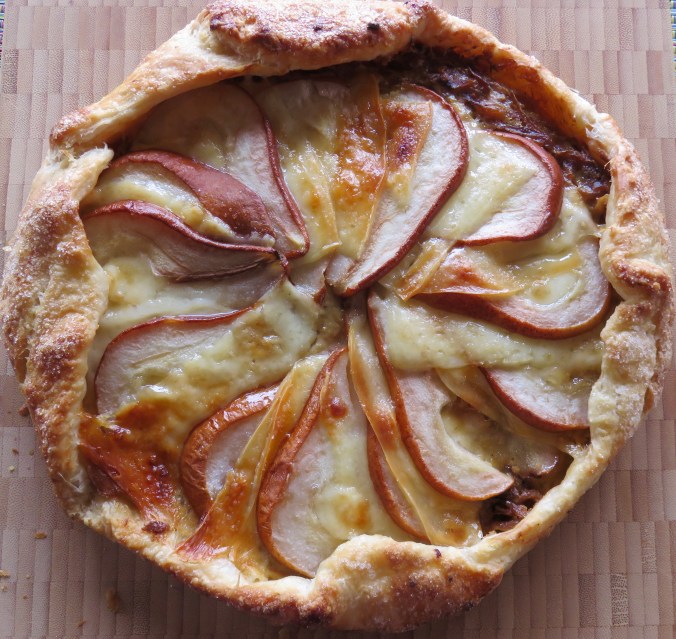
I made a rough-puff tart with caramelized onion and pear and two cheeses for lunch. We finished it off for dinner. Scrumptious.

Gary is reading statistics about political incarceration of children around the world. Our country has taken children from their parents and then so failed to care for those children that they are unable to reunite them with family. How does such an abomination of itself not bring down a government? 

Consider an ally’s behavior in similar circumstances. During the Second World War non-English speaking children fled battlegrounds from across Europe and arrived alone in England. They arrived in the care of nurses, with names pinned to their coats. Some of them would never return home again. It was still the Great Depression, Britain—famously class-conscious and ethnocentric and seriously economically depressed before, during, and for more than a decade after the war—took these children and did not always welcome the refugees. They were not treated this badly. 

We painted the floor in one of the bedrooms. Bed and bookcase and little side tables are still stacked out in the atrium and today it will be good to have things back where they belong. I want to further tidy my work space. I have two very lengthy knitting projects in progress and a warp on my loom. The only thing worse than not having a visual project to keep my eyes and hands busy might be having three. I want to move on. 

Camp NaNo day 6: DISCUSS

Camp NaNoWriMo word count: 7,532 as of 7am, mostly journaling here, but also some revision based on discussion with Ann. A thousand new words each day is, for me, a modest expectation.

Revised novel EMD word count: 74,883 This must be left alone for a few days. 

I met Ann and we shared our projects, goals, and fears. Today I need time off.

The storm this morning is impressive. Gary saw on the news that a mile of power poles came down in Seattle. This blowing rain is nothing unusual for us.

Camp NaNo day 5: SHAPE

Camp NaNoWriMo word count: 6,833 as of 5am, mostly journaling, but also progress on “The Elk Pact” that might be next week’s flash fiction. I have four others that need a look. I have updated my word count and then I will stop writing for a while. For me, this means for a few hours perhaps. I would stop working for the day, but I am meeting a friend to discuss our writing. I will bring “And Another Thing” about the man in the bar. I will whine about the novel. 

Revised novel EMD word count: 74,883 The entire novel is roughed back in. I worked from several old drafts, though I have not returned to the story that started it all. 

I started work a little after 4am yesterday. I finally put my computer away close to 8pm. My eyes are sore, but the entire novel is pasted into the new document. That’s not what I intended to do but the result of unwise impatience, I fear. I just wanted it all there. I wanted to arrive at what is to me the most powerful moment in Thena’s story, which is now the last line of the next-to-last chapter. 

I worked from several drafts written over the past three years and cut more than 15k words out of the final third—I hope this is the part that dragged—not to mention moving passages revealed earlier to later and putting a couple of flashbacks into more-or-less chronological order and, perhaps sadly, cutting back on the romance that has always felt a bit forced. A couple of times I tried to set the novel down, tried not to move ahead beyond what was carefully edited (another reason the last third dragged?), and tried to work on something else. Every time I went back to this story. 

Part 2 has a new and necessary chapter focused on the relationship between Thena and her daughter. Part 1 is mostly done and concerns regret and digging back out of it. Part 2 is triumph and obliteration and might be half complete. I returned to my initial choice of withholding specifics until later while revealing the general loss. I will save the details for Part 3, which is more or less forgiveness. I am building a new story arc.

I wanted 75-80k when I am done. There is still work to do in the middle, but further butchery toward the end, including entire unnecessary chapters already cut near the back. I need to go faster right at the end, not in the revision, which will continue for the rest of the month and go slowly indeed. My fear is repeating myself. I have already caught myself having done that. I have copied and pasted the same passage. 


We did not take our walk yesterday morning. Gary insisted he was not up for it, but then worked on the front yard where the deck is gone. The ocean rolled in mostly one breaker at a time, what I always think of as her “tame animal” behavior. This is our payment for stiff wind and rain the morning before when we did get a walk. But we went out late in the afternoon and visited with a couple on vacation from Tokyo.

After receiving six (6!) emails in the last week from Consumer Union about stopping robocalls, I unsubscribed. 

I will stop writing for the day. My eyes are tired and I need a break, and probably I will not be able to resist opening my novel and looking and writing more, but I am reading from book 9 of the Patrick O’Brian novels and feel the need to focus on the adventures of Jack Aubrey and Stephen Maturin. Maybe I will wash the glass in the front door—a manageable and measurable task sounds just the ticket. When I told Gary I thought I would take the rest of the day off, he said, “You mean I get my wife back?” Maybe, for a few hours. He has nearly finished reading Part One of Don Quixote. I am still reading Mother Is a Verb (I would love it for the cover alone).We are well caught up with our books. 

Below are photos of our missing deck. Gary does not want it returned. If you find a wild deck wandering about your neighborhood, you are free to lead it home and keep it. 

IMG_3997

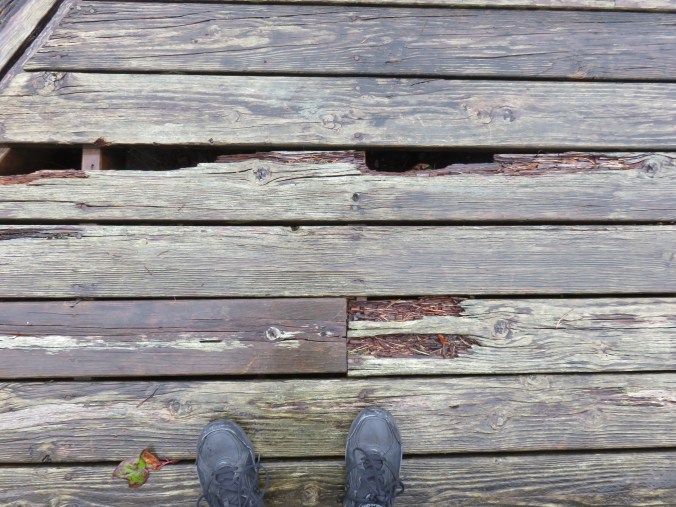
It won’t look too bad from a distance, but this photo shows why we tore off our deck.

IMG_3999

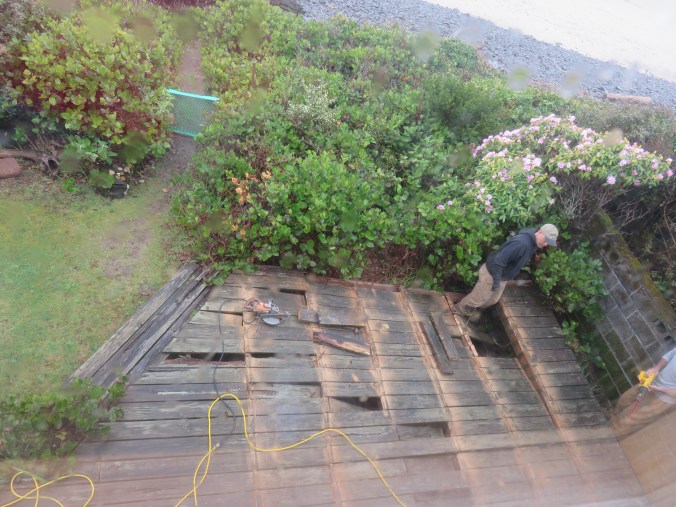
Here the deck is cut up. Jeremy has a place that will take the lumber and find a use for it.

IMG_3996

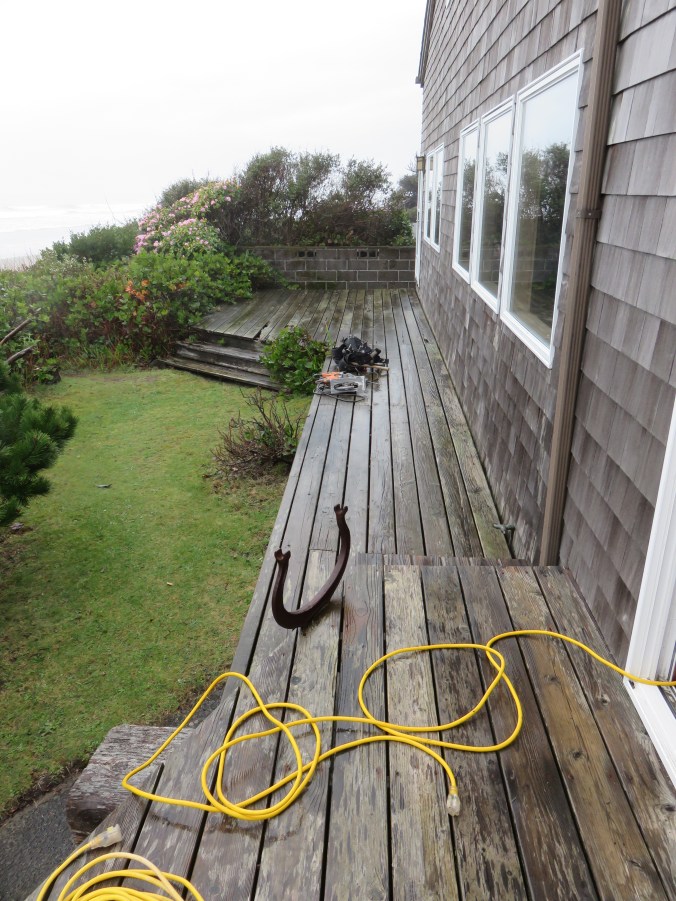
Here’s the deck from the south just before the work began. The boards in the foreground are staying.

IMG_4003

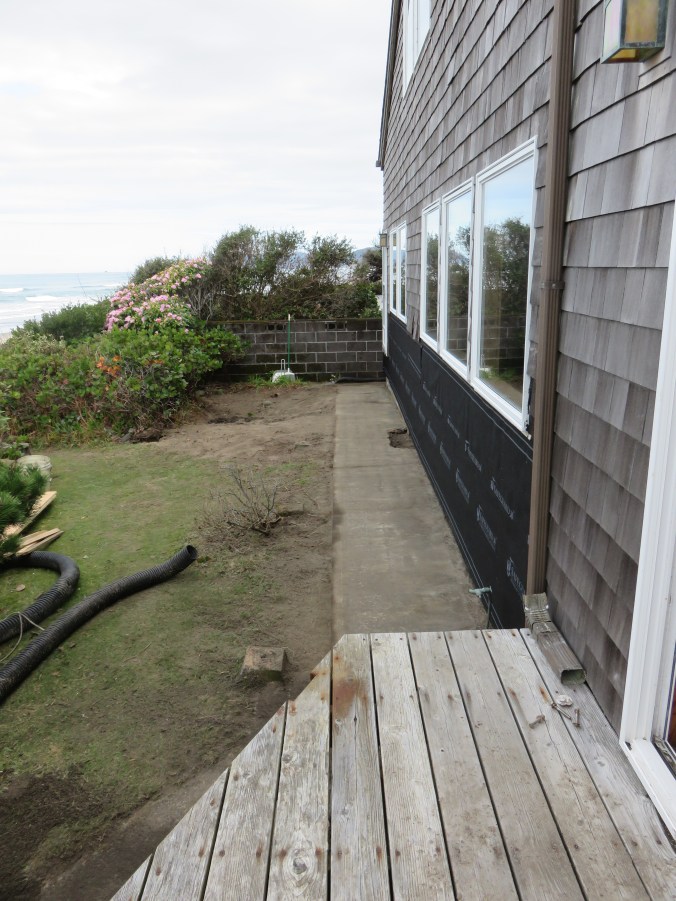
AFTER—the old concrete walkway is exposed after Gary did the tidying up yesterday morning. Jeremy is preparing to reside the sandblasted west face of our house, so he’s taken off the lower courses. The pink rhododendron is blooming.

Camp NaNo, day 4: ORDER

Camp NaNoWriMo word count: 5,576 as of 6:30am this morning, mostly journaling, but I have started a new story, a single page so far. That will be the fifth flash, I think.

Revised novel EMD word count: 20,027 Chapter 1 “Lying to My Mother” (4448 words) + Chapter 2 “Surrender” (about 5791 words) + Chapter 3 “Lying to Myself” (5476 words) + Chapter 4 “Finding the Will” (4170 words so far) is still in progress. I hope to complete the first four chapters and begin work on Chapter 5 “Painting House” this morning. That chapter will complete Part 1. It is deeply satisfying to me to restore my original structure. It might even work. I created a Table of Contents for EMD, chose titles for the fifteen chapters, and resisted—hard—the impulse to paste in additional chapters from earlier drafts. I want to work front to back on this revision. I am trying to stay on task.

We managed a walk yesterday. I emptied the linen closet. Gary worked on the front yard, clearing trash and sand off the concrete walkway and is paying for that this morning.

We were crazy-busy the rest of the day. Maybe tomorrow I will post photos of our missing deck.

Camp NaNo, day 3: DOUBT

Camp NaNoWriMo word count: 4840 as of 6am this morning, mostly journaling. One completed flash fiction (920 words) for this first week.

revised novel word count: 9817 Chapter 1 “Lying to My Mother” (4448 words) + Chapter 2 “Surrender” (about 5297 words) needs reworking. I know I am making a mess for later on, but there, at least I am writing. This afternoon I will rough-in Chapter 3 “Finding the Will” and hope to accomplish another 5k words. Not new but reworked/reframed.

As of yesterday afternoon, my plan is to write, just write anything, for NaNo and count those words each morning. For the rest of the day I will work on the novel. Fifteen chapters? The NaNo word count, therefore, is what I have accumulated as of this morning. My word count for the novel is what I did as of yesterday.

My first flash fiction looks “done” and I am journaling to gain words for CampNaNo. Separately, I am revising the novel EMD, chapter by chapter—messier than it sounds since the chapters are reordered and recombined—reintegrating old material, writing new, editing as I go along. If I “complete” a chapter every other day I might be done with this new structure by the end of the month, and if I complete an essay or flash fiction each week, I will meet my CampNaNo goal. That much looks good.

This morning I am much less confident about what I am doing with the novel. The three parts I had in mind yesterday—Denial, Regret, Afterward—feel wrong today. Today I think: Regret, Grief, Hope. But how to cram the entire recovery/denouement into a quick swipe at the end? How to sustain tension, shift the dramatic high nearer the end? I would like to push the end of “The Promised Hour” close to the end and then the last chapter kept as is? Do I want less focus on Thena’s relationship with Larry, or do I want to reframe that or do I want some fantastical what-if that is all in her head? (Well, you know I want to do that.) Can I actually delay telling the story of the murder? I told it last in the original short-story version and I was totally smacked down for that. I never learned how to build tension. I can build and sustain tension, of course, I have done it, but that doesn’t mean I know how to do it here. I suspect that is something I must learn over and over again. (Karen Joy Fowler said that she struggled with her current project and her husband was there to remind her that she’d struggled each time.) 

I fear I will spend a good deal of time whining during my meeting with Ann on Friday. But at least I have the flash story to share. I plan to bring one to each of our meetings. That will allow me to meet at least my original goal for the month.


Yesterday, Jeremy and his helper had the entire rotting deck cut apart and gone before noon. We may not rebuild most of the deck. No Scrabble this week because of work on house.

I made Pad Thai for lunch yesterday and finished the federal taxes in the evening. I made a first run at the state taxes (even more pages and also a new set-up). I know most people either use the online tax computing system or an accountant. I thought about that a lot while I was fighting with forms. But I am the person who prefers to understand how to create an APA reference rather than using an online source. I want to understand how it works.

Today, we woke early and hope to get a beach walk (we missed four days—our longest stretch in two years), clear out the linen closet, and finish the taxes. And there is more cleaning and painting in the apartment before our new tenant moves in . . . I have promised Gary we will never have to paint again as long as we live, but that also means I will have to paint the walls in the hallway pretty quick!

Will there be time for reading?


NaNo, day 2: MY WORDS TODAY

My posts for this month are likely to be entirely uninteresting. I am writing, seriously writing, and also journaling about writing. These are some of my words today:

I am reading about subtitles. The examples mostly came from nonfiction, memoirs, essay collections, but then I thought: Why not?

Everybody’s Mother Dies: A Novel About Living Past Regret

I think I might divide the novel into Denial, Regret, Afterward. I am not happy leaving work unfinished, and that novel is unfinished.

NaNo word count: 3726 as of 8am

revised novel word count: 0

I have revised a flash fiction from working hard yesterday, a funny piece called “And Another Thing.” It’s been a long time since I wrote funny. It’s about a drunk man in a local bar who manages not to get into a fight, this time. I read it aloud to Gary and he liked it, asked me where it came from—I have no idea. I will still plan on accomplishing my original goal for the month: 4 polished pieces prepared for publication, with all that alteration entirely by accident. Now I will also try to rewrite the novel.

STICKER PRICE

I did not have my camera with me so I cannot post a photo of the orange-juice orange Mustang we saw this morning at Costco. The sticker price is a tad over $44k, but I could save $4k buying it from Costco. I laugh about this because the color is one of my husband’s favorite (bright) car colors, and because somehow we managed to raise a son who likes muscle cars. Yes, it’s true. He bikes or busses or walks to work and doesn’t own a car, but if he had one it would be a Mustang GT. Or something like it.

April I have committed this year to CampNaNo again, a daily writing tracker. National Novel Writing Month (NaNoWriMo) in November involves a commitment to 50k words in 30 days. I’ve done it three times. The “Camp” in April works differently and allows writers to determine how many pages or words or hours or minutes of time they want to commit to.

I dithered and pledged something easy. I pledged to write 10,000 words. I expect to exceed that, and so far have 2900 words. But here’s the thing: What do I really want to work on? So far I have taken fragments of story ideas and worked on those. Do I work on one of the novels? fantasy and SF? flash nonfiction? poetry for National Poetry Month?

Good questions.

So far, as I said, flash fiction:

“And Another Thing” realist fiction about a drunk in his bar confronting another drunk, and it’s funny. It’s been a long time since I wrote funny.

“Final Words from the Master” is a first contact fantasy about the end of a seriously unfortunate landing on what might be Earth by kinder and more intuitive people than ourselves.

“The Way They Disappeared” about a young girl who causes an attacking hand to, well, disappear.

“Rapunzel” is realist fiction about a girl scooping ice cream in a tourist-town, and it makes her ears cold—actually no idea where this will go. Also funny.

What I think I most want to work on is a novel that no one wants. My goal was to show the hard work of recovery from overwhelming grief, but that grief-inducing scene remains the highlight and I kept pushing it earlier and earlier into the novel in order to focus more on what happens afterward. Every time I tried to reveal that event late in the narrative, I got chewed, even when I left foreshadowing hints big as pink elephants. And with that scene near the beginning, the rest of the story apparently feels like a letdown. There must be a way to fix this, but I do not seem to be a good enough writer to figure out how. Still. I might try again.

Maybe create a short story to try out a different structure? What if the grieving mother imagines other ways her life might have gone? What if grief is her best option? That’s cheery.

Or I could work on another manuscript entirely. I have a novel that won publication and prizes for the first chapter. Maybe that one?

Or flash.

Stay tuned for daily updates and maybe a shared story along the way.

post-AWP


IMG_3994

So we went, I saw, and we came home again. Fourteen thousand people. I saw Marvin Bell entering the building as we drove past. I am mostly the invisible woman, too old to matter, but there were amazing people all around.

My choices of what to bring home were determined by money ($15) and covers. I am a genuinely shallow person who chooses books for their covers. Then I read the first page. Believer is stunning. Witness (a journal I have long admired) gave me a free issue because I rolled 9 three times in a row. Ruth Gundle (bless her!) handed me Judith Barrington’s newest. I could not resist buying Karen Joy Fowler’s new collection of short stories (charged it!) and then three volumes of poetry (Dan Kaplan’s cover was not great imo, but a peak inside revealed his write is). I could have spent a couple of days trolling literary journals. I had less than an hour.

I went to only one presentation (seriously, just one) and it was a perfect choice, even though I am not teaching anymore:

S157. The Most Versatile Essay: Flash Nonfiction in Any/Every Classroom. (Brian Benson, Allison K. Williams, Sayantani Dasgupta, Anna Vodicka, Celeste Chan) Even the most reluctant-to-write students take to flash essays. Drawn to their economy, they’re won over by the urgency and potency of the form. From the academy to the incarcerated, beginners to advanced, flash nonfiction is a boon to writers of all stripes, and a vital part of teaching in the technological age. Panelists will discuss the versatility of the form, successful teaching strategies, prompts, exercises, and go-to resources from a range of educational settings and pedagogical perspectives.

Panelists represented programs from all over the U.S. and the world. Hugo House in Seattle, The Attic in Portland, as well as academic and commercial backgrounds. Pages of notes! I received a wealth of excellent advice from five people who write nonfiction, are active members of writing communities, and shared years of specific, hands-on experience working with young adults and adults. Though I have taught for 40 years, I learned from each member of this panel and left feeling energized and excited by approaches that were entirely knew to me.

I hugged Allison, shook Dinty Moore’s hand, bought Karen Joy Fowler’s new book, two poetry books from Burnside Books, plus another book written by the person working that booth—gorgeous all! I rushed through the Book Fair. Presses I have submitted to, presses holding work, some who have sent me kind rejections, and others who sent me form rejections. It was pretty overwhelming.

And then I sat and talked to Molly Gloss and Bette Husted and when Karen Joy Fowler showed up, we all talked.

I had arranged to meet Gary outside at 2:30, and as I went down the stairs I could see him through the window. There he was on the sidewalk talking to Ruth Gundle while she waited for Judith Barrington to pick her up. Brilliance everywhere I looked.

Five hours of literary illuminaries.


Gary felt I should mention the $4.25 for a Pepsi. He’d waited in line for 10 minutes and felt disheartened by the price. He left his change as a tip, and it wasn’t cold, though the young man who handed it to him was touched to receive a tip.

I had told him I would not be buying lunch. That much I know about conventions. He is still ranting about that Pepsi, “my AWP experience.” He was a grocer for much of his adult life and knew what was paid for that Pepsi.

Bette or Molly told me I’d missed Nisi Shawl. I missed Debra Magpie Earling. There were many people I would have enjoyed shaking hands with. I took no photos, though I had my camera with me. I knit a couple of rows on a baby blanket. I limped.